
What happens if everyone else quietly kept up with CME… and you didn’t do a single thing all fellowship?
Because that’s what this feels like, right? You wake up at the end of PGY6, boards are looming, credentialing forms start asking about CME, and you suddenly realize: “I basically treated CME as a joke for two years. Did I just nuke my career?”
Let me cut straight into the anxiety: it feels catastrophic, but it’s usually not career-ending. The real danger is less “you’re dead in the water forever” and more “you’ve created a painful mess that you now have to untangle under time pressure, while exhausted, with people watching.”
Let’s walk through how bad this actually is, step by step.
First reality check: what exactly did you ignore?
Most people say “I ignored CME” but mean one of three different things. They’re not equally bad.
| Situation | How Bad Is It? |
|---|---|
| Ignored hospital/departmental CME emails but did some other learning | Mild |
| Did almost no formal CME, but still did conference/board review, etc. | Moderate |
| Literally zero tracked CME, no logins, nothing recorded | Higher risk, still usually fixable |
Let’s be precise:
You didn’t log formal CME credits
You went to grand rounds, did journal clubs, read papers, maybe attended an annual conference, but you never bothered to claim or record credits. This is wildly common. Annoying to fix, not fatal.You skipped all the stuff that could count as CME
You didn’t go to national meetings, didn’t claim MOC points, didn’t log online modules, didn’t do grand rounds sign-ins, ignored everything. This is where it starts to hurt.You’re about to finish fellowship and are facing:
- Initial specialty boards
- Soon after, state license renewal
- Then hospital credentialing / privileging forms
All of those have some version of: “List your CME” / “Are you compliant with CME requirements?” on them.
The good news: initial board certification usually doesn’t care what you did during fellowship for CME. They care that you completed an ACGME-accredited program and pass the exam. But your future self (post-fellowship you) is the one who’s going to pay for what you didn’t do.
How bad is it for board certification?
Here’s the part nobody tells you clearly, so you just sit there spiraling.
For most specialties:
During residency/fellowship
There’s usually no formal CME requirement tied to your trainee status. You’re not maintaining an independent board certification yet. The “CME requirements” are more about hospital/department/ACGME expectations.At initial board certification
You take your board exam as a fresh graduate. The requirement is generally:- Completed accredited training
- Valid license (or at least not revoked/restricted)
- Pass the exam
CME during fellowship is usually not a gatekeeper for sitting for your initial boards.
Where you will feel it:
- After you become board-certified and enter MOC programs (ABIM, ABS, etc.)
They then expect:- X CME credits every cycle (often 25–50 per year equivalent)
- Some combination of “MOC points,” “Lifelong Learning,” “Practice Assessment” modules
So if your question is: “Will ignoring CME in fellowship stop me from even sitting for boards?”
For almost everyone: No.
But if your question is: “Did I just set myself up to be massively behind and scrambling as soon as I’m attending?”
That’s closer to yes.
The real damage: where it shows up in your life
Here’s where ignoring CME in fellowship usually bites:
1. State medical license renewal
Most states don’t care what you did as a fellow per se. They care what you did in the last X years when you renew.
The kicker: many people time their first license renewal to hit shortly after fellowship. So if you spent fellowship ignoring CME, by the time your first renewal rolls around:
- Clock starts at: end of med school/residency
- You have: almost no formally documented CME
- Required: 25–100 hours per renewal period depending on state, sometimes with specific subtypes (opioid prescribing, ethics, pain management, etc.)
So worst-case here:
- You get a renewal notice
- The form asks you to attest that you completed required CME
- You…did not
Most boards don’t automatically audit every applicant. But lying on an attestation if you do get audited is the fast track to real trouble.
What usually happens when people mess this up:
- They call the board, very stressed
- The board says some version of: “You need to complete X hours ASAP”
- You binge CME like it’s Anki before Step 1
Annoying and miserable? Yes. Career-ending? No.
Unless you lie and get caught. Don’t do that.
2. Hospital credentialing / privileges
Hospitals love paperwork, and committees love checkboxes.
Typical problems here:
- Application says “Submit record of CME from the last 2 years”
- You have…screenshots of UpToDate and vibes
What happens in real life:
- Credentialing office emails: “We need documentation of CME hours. Please send certificates.”
- If you have nothing, you either:
- Scramble to find anything that might count (national conference certificates, recorded grand rounds emails, online modules you half-remember doing)
- Or you admit you’re light and ask what they require for initial appointment
Most hospitals are used to new grads having thin formal CME history. If you’re honest, many will say something like: “You’ll need X CME hours by the time of your first reappointment.”
Annoying. Embarrassing. Fixable.
The worst-case isn’t “no privileges forever.” It’s:
- Delayed start date
- Extra scrutiny
- Being the awkward new attending emailing, “Hey, can you rush my CME log? My credentialing is stuck.”
3. Malpractice / employment contracts
Some contracts literally say: “Physician will maintain CME as required by state board / hospital / specialty.”
If you’re noncompliant:
- Technically, you’re in breach
- Practically, unless there’s a big incident, most groups don’t go hunting for this on day one
But if something goes wrong and lawyers start combing everything?
Then every checkbox you half-assed—including CME—becomes ammunition.
So yeah, ignoring CME is one of those quietly dangerous things. It doesn’t blow up your life right away. It just loads the gun.
How fixable is this if you’re still in fellowship?
If you’re still currently a fellow and panicking, you’re actually in the best possible version of this bad situation.
You can still do damage control before anyone’s officially asking questions.
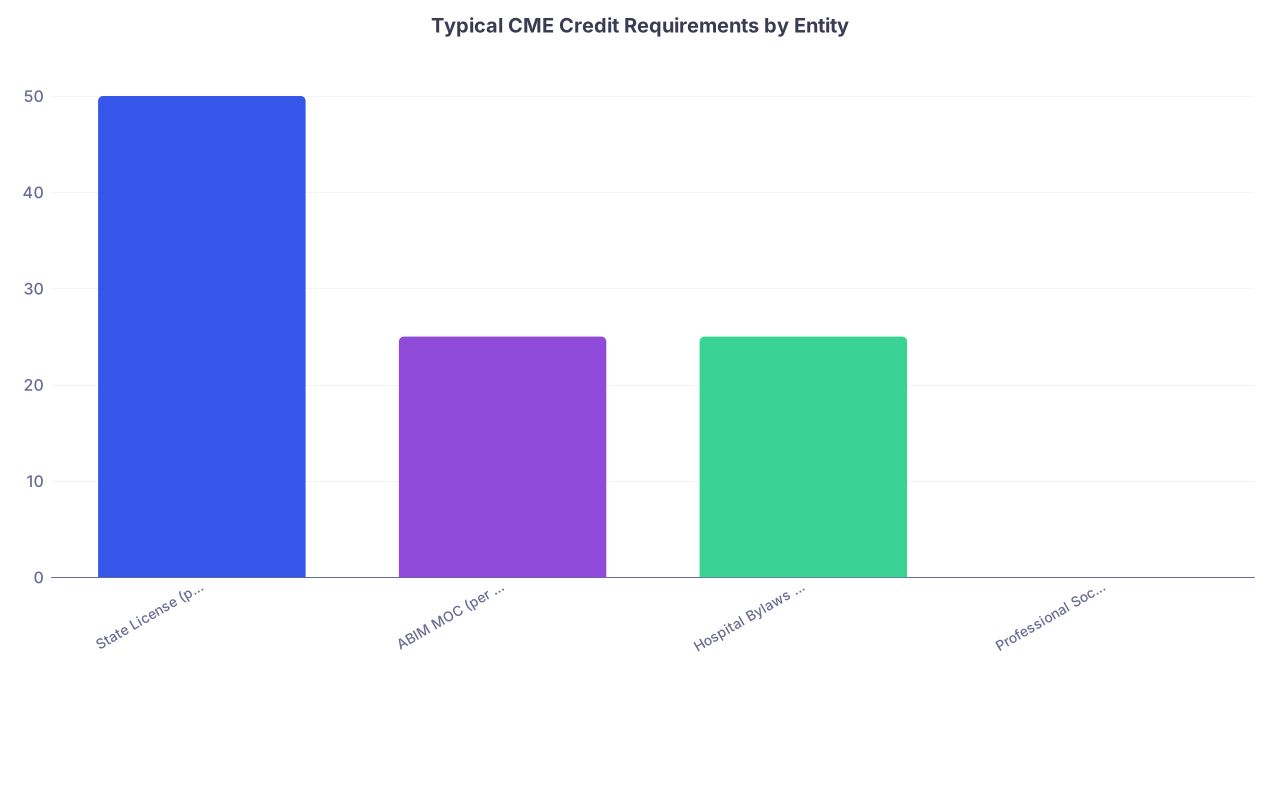
| Category | Value |
|---|---|
| State License (per cycle) | 50 |
| ABIM MOC (per year equiv.) | 25 |
| Hospital Bylaws (yearly) | 25 |
| Professional Society (optional) | 0 |
Here’s what I’d do if I were in your shoes, starting today:
Talk to GME or your program coordinator
Ask very directly:- “Do we have any required CME for fellows?”
- “Does the institution track any CME automatically?”
- “Can I get a transcript of whatever’s already been recorded?”
Sometimes they’ve tracked more than you realized: grand rounds, morbidity & mortality, required online modules. I’ve watched people discover they “had nothing”…and then find 30–60 hours hiding in institutional systems.
Start hoarding low-friction CME
Not glamorous. Just brute force.- Free online modules (state medical societies, specialty societies often have these)
- Recorded grand rounds that offer CME
- UpToDate / DynaMed CME claiming (if available through your institution)
- Board review Qbank CME add-ons
You’re not aiming for intellectual perfection here. You’re building a future paper trail.
Keep one clean record going forward
Don’t rely on random emailed certificates. Make a simple CME log:- Date
- Activity
- Provider
- Credits
- File link/screenshot location
Yes, it’s tedious. So is reapplying for privileges because your initial file was a mess.
If you do this for the remaining months of fellowship, you may not completely erase the gap, but you’ll soften it enough that it doesn’t look like total neglect.
How bad is it if fellowship already ended?
This is the nightmare version: you’re already an attending or finishing fellowship, and someone’s asking now for proof.
You basically have three problems at once:
- You need hours
- You need documentation
- You need the story to hang together
Here’s the part that sucks but works: you can accumulate a surprising amount of CME in a short time if you absolutely have to.
I’ve seen people knock out:
- 30–50 CME hours in a few brutal weeks
- Heavy use of:
- Recorded online lecture series with CME
- High-yield board review courses that offer CME
- State-mandated modules (opioids, implicit bias, ethics)
It’s not fun. You will hate your laptop. But it’s doable.
Then you have to figure out how to answer the questions on forms.
The golden rule: never lie on an attestation.
If something asks, “Did you complete X hours in the last Y years?” and you didn’t, you have two options:
- Fix it before signing (binge CME until it’s true)
- Or be honest and ask how to rectify it
Most boards/hospitals would rather you come clean and fix it than catch you lying later. Lying about CME is way worse than having been behind on CME.
Mental side: why this feels so much worse than it usually is
Part of why this spirals in your head:
- You’ve spent a decade in systems where missing one requirement can blow everything up (Step deadlines, match rules, contract dates).
- You’re used to high-stakes, no-mercy structures.
- So your brain maps “I ignored CME” → “I’m going to lose my license.”
Real world is uglier and more forgiving at the same time.
Institutions care about:
- Safety
- Liability
- Being able to say “Look, we have processes” when things go to court
You being behind on CME is a problem. You being proven dishonest about it is a disaster.
So the real “damage” is mostly:
- Extra stress
- Lost time doing catch-up CME instead of things you actually care about
- Some embarrassing conversations where you feel like a careless kid in front of administrative adults
That’s not nothing. But it’s also not “you’re unemployable forever.”
Concrete next steps (so you’re not just spiraling)
If I had to boil the damage-control plan down:
Figure out what actually exists
Ask GME, your hospital CME office, and check:- Grand rounds attendance logs
- Required online modules
- Conference attendance certificates
You might already have more CME than you think.
Map out what you actually need
- Look up your state’s CME requirement per renewal cycle
- Check your specialty board’s MOC requirements
- Ask your future or current hospital what they expect for appointment/reappointment
Create a 3–6 month catch-up plan
Focus on:- High-yield CME sources
- Topics that double-dip (board-relevant + CME credit)
- Any state-mandated content you’ll definitely be asked about
Get ahead of paperwork
Before renewal/credentialing hits:- Have a clean log
- Have certificates in one folder
- Be ready to answer, calmly, “Yes, I’m current on CME requirements.”
You can’t undo ignoring CME during fellowship. But you can stop it from snowballing into something bigger.

| Step | Description |
|---|---|
| Step 1 | Realize you ignored CME |
| Step 2 | Contact GME and CME office |
| Step 3 | Review license and job timelines |
| Step 4 | Collect existing CME records |
| Step 5 | Plan catch up before graduation |
| Step 6 | Check state and board requirements |
| Step 7 | Complete high yield CME quickly |
| Step 8 | Create ongoing CME tracking system |
| Step 9 | Still in fellowship |
FAQ: CME Panic Edition
1. Can ignoring CME during fellowship stop me from getting board certified?
Usually no. Initial board certification is based on completing an accredited program and passing the exam. Most boards don’t require documented CME from fellowship for initial certification. The problem shows up later, when you’re in MOC and doing license renewals, not at the first board exam.
2. Can I get in trouble for “backdating” CME or guessing at dates?
Yes. Don’t do it. Most CME providers time-stamp completion, and if you’re ever audited, made-up dates or obviously backdated entries can look like fraud. You can reasonably estimate older activities if you truly did them and just don’t remember the exact day, but don’t invent CME you never completed or alter documentation.
3. What if I literally have zero documented CME and renewal is coming up soon?
Then you go into emergency mode. Look up exactly how many hours your state requires for that renewal period, prioritize CME sources that give a lot of hours fast (online courses, conference recordings, board review with CME), and start now. If the deadline is truly impossible to meet, call your state board early and ask what your options are—they’d rather hear from you before the deadline than after an audit.
4. Will hospitals or employers reject me because I didn’t keep up with CME as a fellow?
For most new grads, no one expects a massive CME portfolio. What they care about is that you’re compliant going forward. If you can show that you’re currently up-to-date and can hand over a clean log and certificates, they’re not going to dig into what you did three years ago as a fellow unless something else is off.
5. Is it ever okay to just say “Yes, I met CME requirements” if I’m slightly short?
That’s where you get into dangerous territory. If you’re a tiny bit short and you immediately close the gap before you sign anything, fine. But signing an attestation that you know is false—even by a few hours—is a bad habit to start. Boards and hospitals take dishonesty more seriously than being behind and fixing it.
6. I feel like this proves I’m irresponsible. Does this reflect on me as a physician?
It proves you were drowning during training and treated a vague, bureaucratic requirement like background noise. That’s not great, but it’s also very common. What matters now is whether you ignore it and hope it goes away, or you face it directly, clean up the mess, and build better habits going forward. Fixing it is exactly what a responsible physician would do.
Key points to walk away with:
- Ignoring CME in fellowship rarely kills your career, but it absolutely creates extra stress and cleanup work later.
- The real risk is dishonesty on attestations, not being behind—catch up and be truthful.
- Start tracking and accumulating CME now, before boards, licensing, or credentialing forces you to deal with it under a deadline.