
It’s 11:42 p.m. You just opened an email from your state medical board with the subject line: “Notice of CME Audit – Response Required.”
Your heart drops. You thought you were fine on CME. You’ve done conferences, online modules, journal quizzes. But did you actually save all the certificates? That random webinar from 2 years ago. The big national conference where the certificate went to some spam email you never checked. The self-study you think counted, but you’re not sure.
And the question hits, full force:
What if they ask for proof, and I just… don’t have it?
What if I’m short? What if my logs don’t match? What if I misread the rules and half of what I thought counted actually doesn’t?
Let’s walk through how bad this can realistically get, what usually happens, and what you can do if you’re staring at an audit notice with a half-complete CME paper trail.
First: How Bad Is It Really If You Can’t Prove Everything?
Let me be blunt: the board is not excited to yank your license over 3 missing CME hours with a reasonable explanation.
They are very interested in two things:
- Are you actually meeting CME requirements overall?
- Are you being honest?
The worst-case scenarios people catastrophize about usually involve:
- License suspension
- Public discipline posted on the board website
- Report to NPDB
- Credentialing committees side-eyeing you forever
- Medicare/insurer issues
Those things absolutely can happen — but generally not because someone is missing a handful of certificates from legit activities and responds in good faith. They happen when:
- People lie on renewal (“Yes, I completed all CME”) when they clearly didn’t
- There’s a pattern of noncompliance across multiple cycles
- There’s willful misrepresentation or falsified documents
- The CME shortage is big and the physician blows off the board’s requests
Most typical “I can’t find all my CME proof” cases end up more like:
- You prove part of it
- You scramble to get whatever records you can
- The board gives you a time-limited chance to remediate the deficit and submit proof
- Maybe a warning letter, maybe a fine, maybe a non-public note on your file
Not nothing. But not career-ending-apocalypse either.
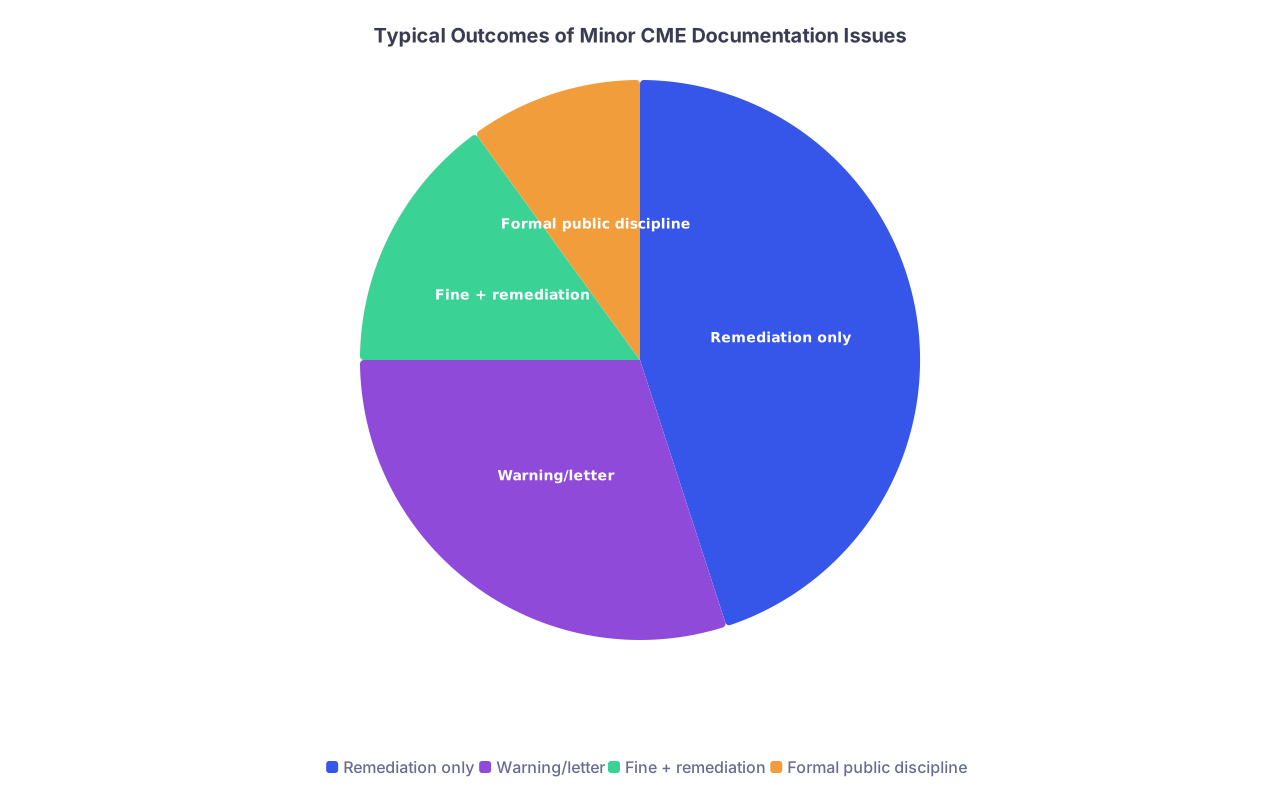
| Category | Value |
|---|---|
| Remediation only | 45 |
| Warning/letter | 30 |
| Fine + remediation | 15 |
| Formal public discipline | 10 |
Boards know documentation can be messy. What makes them nervous isn’t a missing certificate. It’s patterns that look like “I checked the box and hoped no one would ever verify it.”
What Actually Happens During a CME Audit?
Let’s pull the mystery out of this, because uncertainty is what makes the anxiety spin.
Usually, an audit looks like this:
- You get a notice (email, mail, or both)
- They specify:
- The reporting period (e.g., previous 2 or 3 years)
- How many hours you were required to complete
- How many hours in specific categories (e.g., controlled substances, ethics, opioid prescribing, risk management)
- Deadline to respond
- What documentation they’ll accept
You’re expected to send them:
- Certificates of completion
- Attendance records
- Transcripts from CME providers (like an ACCME provider)
- Conference summaries or formal statements of credit
- Sometimes, your self-reported CME log if that’s part of your system
Here’s where your stomach drops: you realize you can’t produce proof for everything you said you did.
Stop and breathe here. Then be strategic.
Step 1: Figure Out Exactly What You’re Missing (Even If It Hurts)
You can’t fix what you won’t name. Open a spreadsheet or a notebook and write it all out.
Column by column:
- What you reported (or think you did)
- Dates of activities (approximate if needed)
- Type of activity (conference, online, self-study, journal CME)
- Hours claimed
- Whether you have documentation in hand
- Whether you might be able to retrieve it (contacting provider, logging back into portal)
You’ll probably end up with three piles:
- Fully documented stuff – certificates, clear proof
- Recoverable stuff – you know the provider, can probably get a transcript
- “I did it but have nothing” or “I think I did it” gray-zone activities
That third pile is where all the panic lives.
Here’s the ugly truth: if you can’t get documentation and the board requires it, you shouldn’t keep counting those hours. Even if you’re sure you did them. Boards run on evidence, not vibes.
So you work with:
- What you can clearly prove
- What you can reasonably reconstruct
And you accept that you may end up officially short on the numbers. That’s not fatal if you handle it correctly.
Step 2: Start Hunting for Missing Documentation Like It’s a Second Job
Before you assume you’re sunk, actually search. Hard.
Places I’ve seen people recover CME documentation from, after they were sure it was gone:
- CME provider portals (you forgot your login, that’s it)
- Conference websites where they still host old transcripts
- Email archives using “CME” “certificate” “credit” “ACCME” “AMA PRA Category 1”
- Spam/junk folders from the time of the activity
- Your hospital’s CME office (they often have logs of grand rounds, local conferences, etc.)
- National societies (ACP, AAFP, ACC, AAN, etc.) that maintain your CME transcript if you gave them your number

| Step | Description |
|---|---|
| Step 1 | Get Audit Notice |
| Step 2 | Make CME List |
| Step 3 | Mark Missing Proof |
| Step 4 | Search Email and Files |
| Step 5 | Log into CME Portals |
| Step 6 | Contact CME Providers |
| Step 7 | Update Proof List |
| Step 8 | Plan Remediation |
| Step 9 | Prepare Audit Packet |
| Step 10 | Still Missing Credits |
You’re not faking doing the CME. You’re proving you did. That means aggressively chasing down records, not shrugging and giving up because you don’t see a PDF in your downloads folder.
Also: don’t forget “passive” CME sources you might have:
- Board prep courses that included CME
- MOC activities through ABIM/ABFM/ABP/etc.
- Performance improvement CME (PI-CME) tied to QI projects
- Journal CME from big-name journals, where they store a transcript under your login
You’d be amazed how much adds up once you start digging.
Step 3: When You’re Still Short – Owning It Without Destroying Yourself
Let’s say you’ve done the excavation, and you still come up short. Either:
- You really didn’t complete enough CME, or
- You did, but cannot obtain acceptable proof
This is the nightmare scenario in your head: “I lied on renewal, I’m a fraud, they’re going to yank my license.”
Reality is usually less dramatic but still uncomfortable.
What you do next matters more than the deficit itself.
You want your response to the board to show:
- You took the audit seriously
- You tried in good faith to document everything
- You’re transparent about gaps
- You’re immediately willing to remediate
This is where I’m going to say something strong: don’t get cute with the truth.
Don’t:
- Retro-create logs making it look like you always had them
- Back-date things
- Pretend an uncertified activity was accredited CME
- “Estimate up” your hours based on vague memories to hit the exact requirement
Boards are very used to seeing numbers that just so happen to perfectly match the requirement after an audit letter arrives. It doesn’t look great.
Instead, something like:
- “I’m able to document X hours for the audit period.”
- “I attempted to obtain records from [providers] and could not obtain proof for [Y] hours I believed I had completed.”
- “This leaves me [Z] hours short of the requirement for this period.”
- “I’m prepared to complete remedial CME immediately and provide documentation.”
If you’re more than a couple of hours off, I’d seriously consider calling a medical board attorney in your state for a quick consult. Not because you’re doomed, but because it’s stupid to guess how to phrase things when your license is on the line.
What Consequences Are Actually on the Table?
Every board is different, but let me group this in a way that matches the anxiety:
Mild (Annoying, But You Survive)
Most common when:
- You’re short by a small number of hours
- This is your first “event”
- You respond on time and cooperate
Possible outcomes:
- You’re required to complete make-up CME (often above the deficit)
- You may have a short window (30–90 days) to submit proof
- Maybe a warning or “letter of concern” that’s non-public in some states
Credentialing bodies rarely lose their minds over this if it doesn’t escalate.
Moderate (Now It’s on Paper Somewhere)
This happens when:
- The deficit is bigger
- Or you’ve had prior noncompliance issues
- Or you ignored initial communications
Potential consequences:
- A small civil penalty/fine
- Mandatory extra CME in a specific topic (e.g., professionalism, ethics, record keeping)
- A formal reprimand or “public order” in some states that may show on the board’s website
It’s not ideal, and yes, this can show up when hospitals or insurers credential you. But even then, a single CME-related issue that you remediated and haven’t repeated is not the same as “shady malpractice pattern.”
Severe (This Is What You’re Afraid Of)
This is where everyone’s brain jumps first. But it’s more often tied to:
- Repeated noncompliance across cycles
- Flat-out misrepresentation
- Refusal to remediate or ignoring board orders
- Coupling CME issues with other concerns (substance use, fraud, etc.)
Potential outcomes:
- Probationary license status
- Restricted license
- Suspension in extreme cases
- Report to NPDB
If you’re reading this early in the process, that’s not where you are. And if you’re closer to that cliff, you shouldn’t be crowdsourcing advice anyway — you need a lawyer who does professional licensing in your state.
How Different Entities Look at CME Problems
The anxiety spiral often jumps ahead: “If I get dinged on CME, will this haunt me forever?”
Here’s the rough hierarchy of who cares and how much:
| Entity | How Much They Care | Why |
|---|---|---|
| State Medical Board | Very High | Licensing, public safety |
| Hospital Credentials | Moderate-High | Privileges, risk profile |
| Malpractice Insurer | Moderate | Risk assessment |
| Payers (Medicare, etc.) | Moderate | Compliance culture |
| Future Employers | Variable | Pattern vs one-time issue |
One-time, fully remediated CME issue:
- Usually read as “annoying, but fixable”
Pattern of ignoring CME + untruthful renewals:
- Read as “this person doesn’t respect compliance, and might cut corners elsewhere”
So yes, it matters. But it matters most as part of your overall story, not as a single isolated sin.
Practical Moves If You Just Got the Audit Notice
Let’s translate this into a to-do list that might actually lower your heart rate:
Read the letter twice. Slowly.
Highlight:- Reporting period
- Total CME required
- Special categories (opioids, risk management, etc.)
- Documentation standards
- Exact response deadline
Stop guessing — pull your actual renewal attestation.
What did you say you completed? Are there category-specific requirements you missed?Make a clean, detailed CME list for that period.
Don’t skip the small 0.5 or 1-hour things. They add up.Start the documentation hunt. Aggressively.
Email search. Provider portals. Society accounts. Hospital CME office. Conference organizers.Mark what’s rock solid vs. what’s shaky.
If you can’t get a certificate or transcript from a recognized provider, don’t lean on it.If you’re short, think about immediate remediation.
Many states allow you to make up missing CME with current activity as part of a consent order or stipulation. Don’t wait to see if they demand it — start lining up courses you can do fast and document easily.Strongly consider a quick consult with a licensing attorney if you’re:
- Short by more than a couple of hours
- Unsure how to explain a mismatch
- Worried your previous attestation may be read as dishonest
It’s not overkill. Spending a few hundred bucks now can keep you from saying something careless in your response that creates bigger problems.
How To Talk About This If It Becomes Public
Another horrible thought: “What if my hospital or future employer asks about this?”
If there’s a public order, someone will eventually see it. You need a calm, honest soundbite.
You want something short and boring:
- “I was audited on CME for the 20XX–20YY period. During that review, it was determined that I couldn’t document all the hours I’d attested to. I worked with the board to complete additional CME and resolved it. There have been no issues since.”
Not:
- A long defensive story
- Blaming the board
- Blaming your office manager
- Minimizing (“it was just paperwork”)
Own it. Show it’s fixed. Move on.
How to Not End Up Here Again (Because Once Is Enough)
I know this is the “I swear I’ll never do this again” moment.
Some boring but life-saving habits:
Use a single, consistent email for all CME registrations
Save certificates in one cloud folder named “CME – [Years]”
Keep a simple running log (Google Sheet works) with:
- Date
- Activity name
- Provider
- Hours (and category if relevant)
- Link or filename of certificate
Use CME providers that maintain transcripts when possible (UpToDate, big societies, etc.)
Set a calendar reminder halfway through each CME cycle to check your progress instead of discovering it at renewal
Nothing fancy. Just enough that if you get that audit email again, you’re annoyed — not panicked.
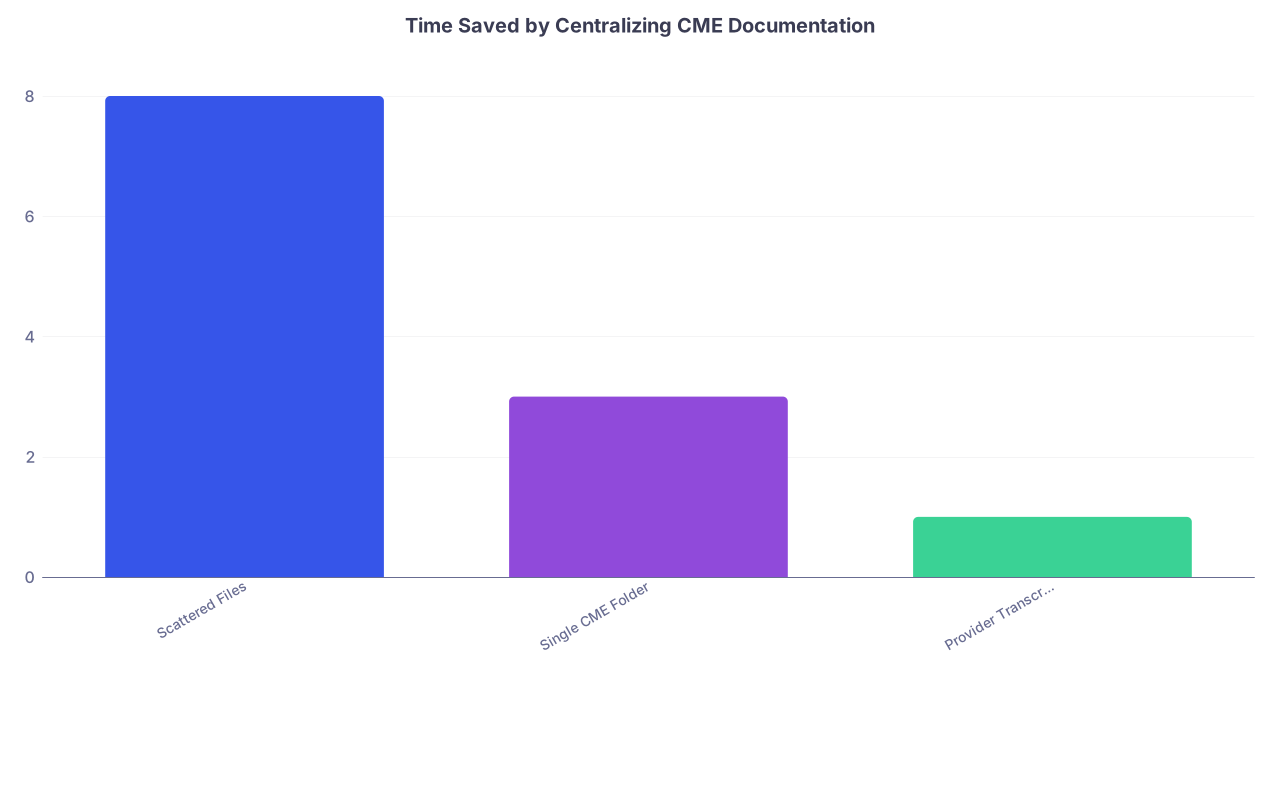
| Category | Value |
|---|---|
| Scattered Files | 8 |
| Single CME Folder | 3 |
| Provider Transcripts | 1 |
The Emotional Part Nobody Talks About
The thing that really eats at people in this situation isn’t just fear of punishment. It’s shame.
“Everybody else figured this out.” “I’m supposed to be responsible and I can’t even track my own CME.” “Are they going to think I don’t care about staying current?”
This is the part I want to push back on a bit. The CME system is:
- Inconsistent between states
- Bizarrely fragmented across providers
- Often treated as a checkbox exercise instead of real learning
You’re not the only one whose documentation is messy. You’re just the one who got audited this cycle.
You still have to fix it. You still have to own your piece of it. But you don’t have to turn it into some moral indictment of your entire career.

If You Take Nothing Else From This
Let me boil it down:
- Missing or unprovable CME credits is usually a fixable problem if you respond early, honestly, and thoroughly.
- The board cares far more about your honesty and willingness to remediate than about a small numerical shortfall.
- Stop guessing in your head, do the unglamorous work of tracking down what you can prove, and get expert help if the gap is more than minor.
You’re not the first person to stare at an audit notice with a half-complete CME trail and feel sick. What you do next is what determines whether this becomes a painful but limited hassle… or something bigger.

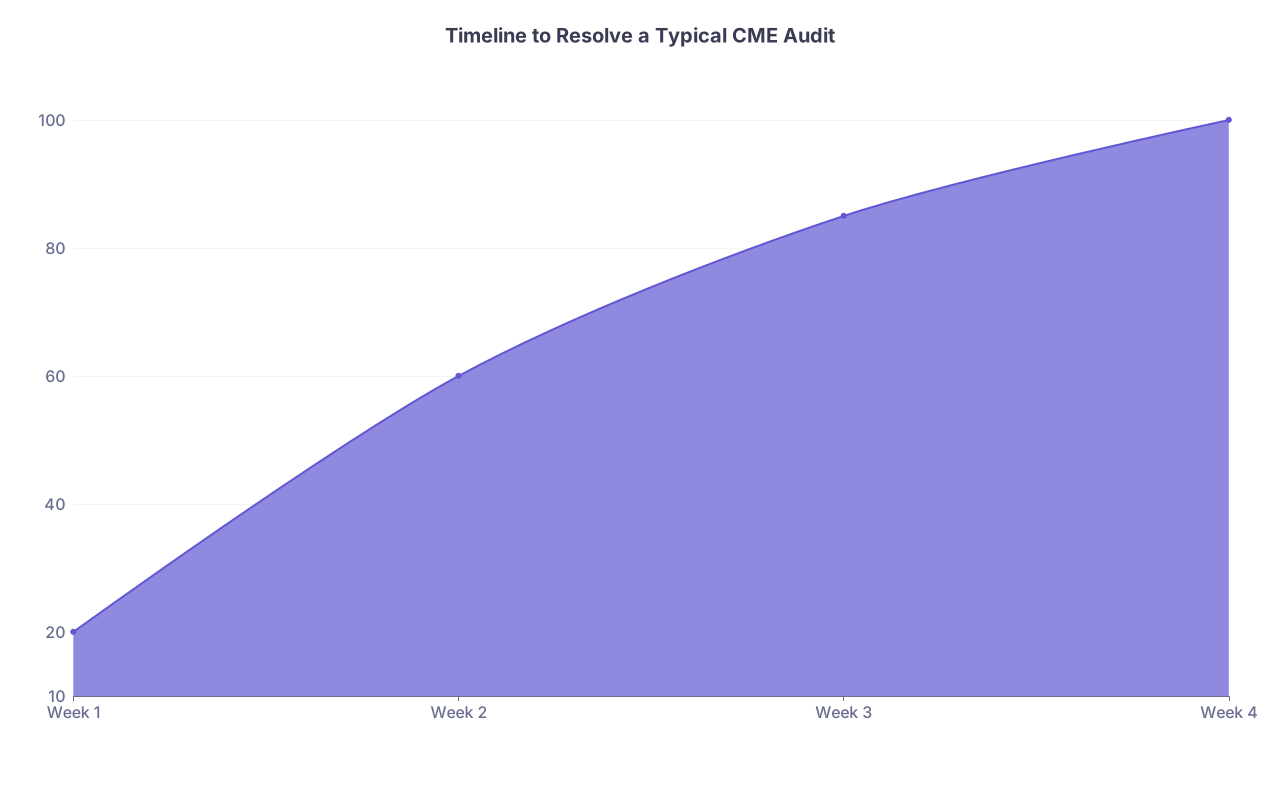
| Category | Value |
|---|---|
| Week 1 | 20 |
| Week 2 | 60 |
| Week 3 | 85 |
| Week 4 | 100 |