
The gap in your CME history is not a career death sentence. But pretending it doesn’t matter is naive.
If you’re reading this, you probably already know exactly where the gap is. The year you barely logged anything. The months where your hospital was understaffed, your kid was sick, you were burned out, depressed, or just surviving call—and CME was the last thing on your mind.
And now you’re spiraling:
“What happens when credentialing sees this? Will employers think I’m unsafe? Lazy? Checked out? Will this haunt every job application for the next decade?”
Let’s walk straight into the worst-case scenarios, because those are the ones keeping you up at 2 a.m. with your CME portal open in one tab and job postings in another.
How Employers Actually Look at CME (Not the Fantasy Version You See in Brochures)
Most people imagine some super sophisticated process where employers evaluate the quality of your CME—like a thoughtful committee reading all your transcripts and appreciating how much you’ve learned about evidence-based practice.
No. That’s not what happens.
Here’s what usually happens with CME during hiring and credentialing:
They check whether you meet:
- State licensure CME requirements
- Hospital medical staff bylaws (if applicable)
- Board certification maintenance requirements (if relevant to your specialty)
They look for anything that screams:
- “This person is completely ignoring professional requirements”
- or “This person might be risky from a liability perspective”
They document it so they can say:
- “We verified CME as part of credentialing.”
Most systems are not scrolling line-by-line through your 2019 CME log judging you for that empty quarter. They’re looking at totals and compliance. It’s more box-checking than soul-judging.
But here’s the part you’re worried about: what if your gap crosses the line from “normal human fluctuation” into “possible red flag”?
Let’s be blunt: it can—but it depends on a few key things.
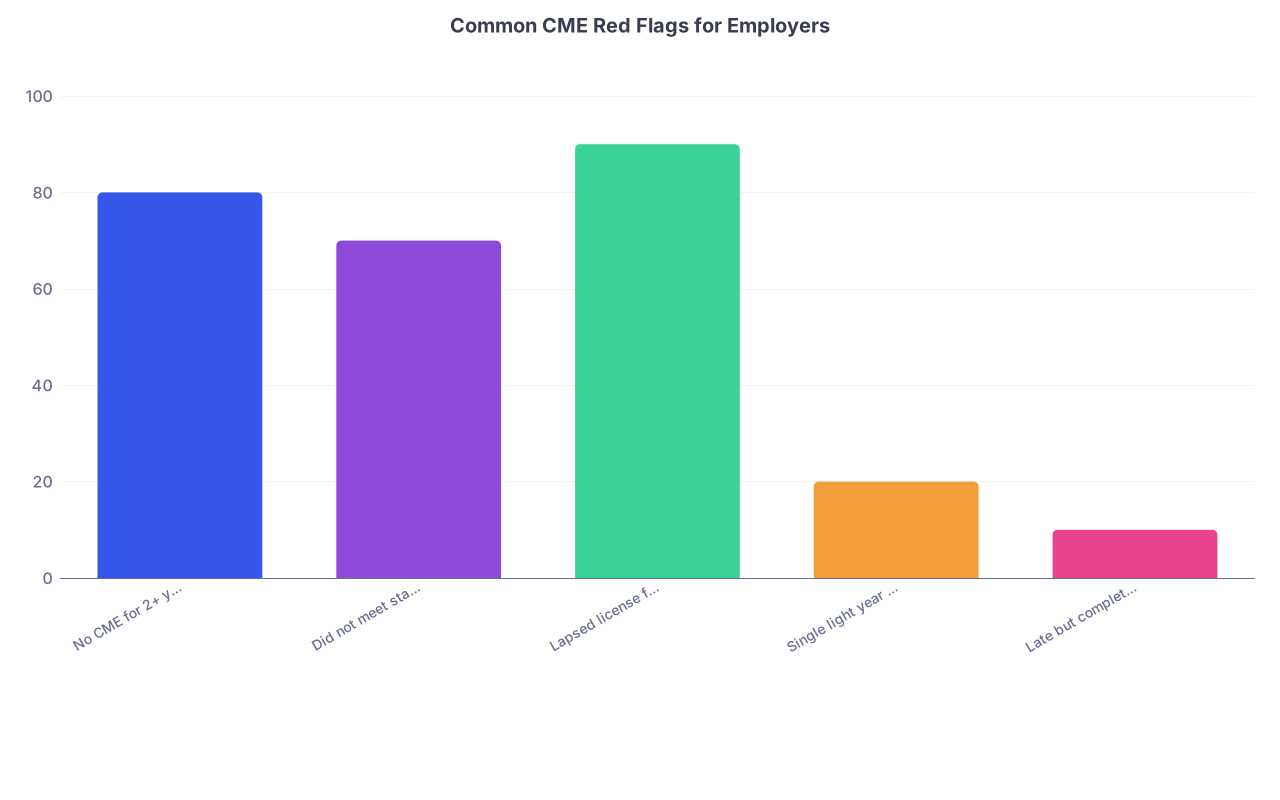
| Category | Value |
|---|---|
| No CME for 2+ years | 80 |
| Did not meet state minimum | 70 |
| Lapsed license from CME issue | 90 |
| Single light year gap | 20 |
| Late but completed CME | 10 |
(Values represent how likely each issue is to raise serious concern, roughly, not hard data—but this is the hierarchy.)
When a CME Gap Really Does Raise Red Flags
So let’s go through the nightmare scenarios you’re probably playing in your head.
1. No CME for multiple years
If your CME log basically flatlines for 2+ years, especially if those overlap with active clinical practice, that will get noticed. And people will make assumptions:
- Are you clinically disengaged?
- Are you burned out to the point of danger?
- Are you a malpractice risk because you’re not staying up to date?
This is especially true if:
- You’re in a field with rapidly changing standards (oncology, critical care, EM, ID, etc.)
- You work in a high-risk environment (ICU, OR, ED)
- You claim in your CV to be “deeply committed to evidence-based practice” while your CME record looks like a desert
But even in this scenario, it’s not automatic disqualification. It’s: “We will ask about this. We might want an explanation. We may require remediation.”
Employers don’t love risk, but they do understand context. People get sick. People have kids. People take on insane administrative roles and lose track. People burn out.
The danger isn’t the gap itself as much as:
- No explanation
- No evidence you fixed it
- No insight into what happened
2. You actually didn’t meet state board requirements
This is bigger. If your CME gap resulted in:
- A licensure issue
- A letter from the board
- Probation
- A delay in renewal
That’s no longer a “quiet” problem in your CME log. It becomes a reportable problem.
That will absolutely trigger extra scrutiny from:
- Hospitals credentialing you
- Larger health systems
- Some malpractice insurers
Does that mean your career is over? No. But it does mean you’re now playing the game on hard mode.
You’ll need:
- Documentation of how it was resolved
- Proof you’re now compliant
- A clear, calm explanation ready for interviews: what happened, what you learned, what systems you’ve put in place so it won’t repeat
3. You’re switching jobs right after a light/no-CME period
This is where timing looks suspicious.
Example:
- Last year: documented burnout, low productivity, maybe a couple of complaints
- Same year: almost no CME
- Now: you’re applying somewhere new
Will everyone connect those dots? Not always. But a careful credentialing office might. And if your file already looks “borderline” in other areas (gaps in employment, prior remediation, malpractice history), the CME gap adds weight to the “concern” pile.
If this is you, you cannot just hope no one notices. You need a narrative ready.
But let’s talk about the scenario that’s more common and way less dramatic.
What’s Almost Never a Dealbreaker (Even If Your Brain Says It Is)
You might be catastrophizing something that’s, frankly, very normal.
Here are CME “gaps” that rarely sink anyone:
One light year where you just barely met requirements, especially if:
- You “caught up” in the following year
- Your overall 2–3 year pattern is fine
A few months (or even most of a year) with minimal CME while:
- You were on maternity/paternity leave
- You had a serious health issue
- You were transitioning between roles or locations
- You were in a very heavy clinical or call year
Switching from one tracking system to another and having a documentation mess
(Happens constantly. New EMRs. New CME portals. Lost certificates.)
Most employers are not going to reject someone because 2021 was a CME drought while you were covering call for three people during COVID surges. There’s a level of realism.
What should calm you a bit: they care whether you’re compliant now, not whether your pattern has always been aesthetically pleasing.

The Part No One Says Out Loud: CME Is Mostly a Compliance Game
Here’s the annoying truth—I’ve seen this so many times it almost feels like a dark joke.
- You can be obsessively up to date clinically and still look “non-compliant” on paper if you don’t log credits properly.
- You can be clinically mediocre and still look spotless because you’re great at clicking through online modules.
Employers are not really equipped to judge the quality of your CME. They judge:
- Did you hit the required hours?
- Did you cover mandated topics (opioid prescribing, ethics, cultural competency, etc., depending on state)?
- Are you staying current enough for someone to defend it in court if needed?
So your internal fear—“They’ll think I’m a bad doctor because of this gap”—usually doesn’t match how they actually see it. They’re thinking:
- “Is this a technical compliance issue or a real risk?”
- “Is this an isolated blip or part of a bigger pattern?”
You’re personalizing something that’s mostly bureaucratic.
How Hiring Committees And Credentialing Actually Weigh a CME Gap
Let’s rank what scares employers more than a modest CME gap.
| Issue | Concern Level (Low/Med/High) |
|---|---|
| Single light CME year, now corrected | Low |
| Gap in employment with explanation | Low–Medium |
| Multiple malpractice suits recently | High |
| Board investigation or probation | High |
| Pattern of professionalism concerns | High |
A one-year CME dip that you’ve already fixed is nothing compared to:
- Lawsuits
- Professionalism problems
- Board issues
- Repeated complaints
The annoying part is that your brain locks onto the one thing you can see in black-and-white on a report (CME totals) and uses it as proof you’re doomed.
But most hiring folks are scanning patterns, not singular blips.
If they see:
- The last 2–3 years: you’re meeting or exceeding expectations
- Licenses active, board cert current
- No disciplinary actions tied to CME
Then the earlier gap becomes “background noise,” not a central story.
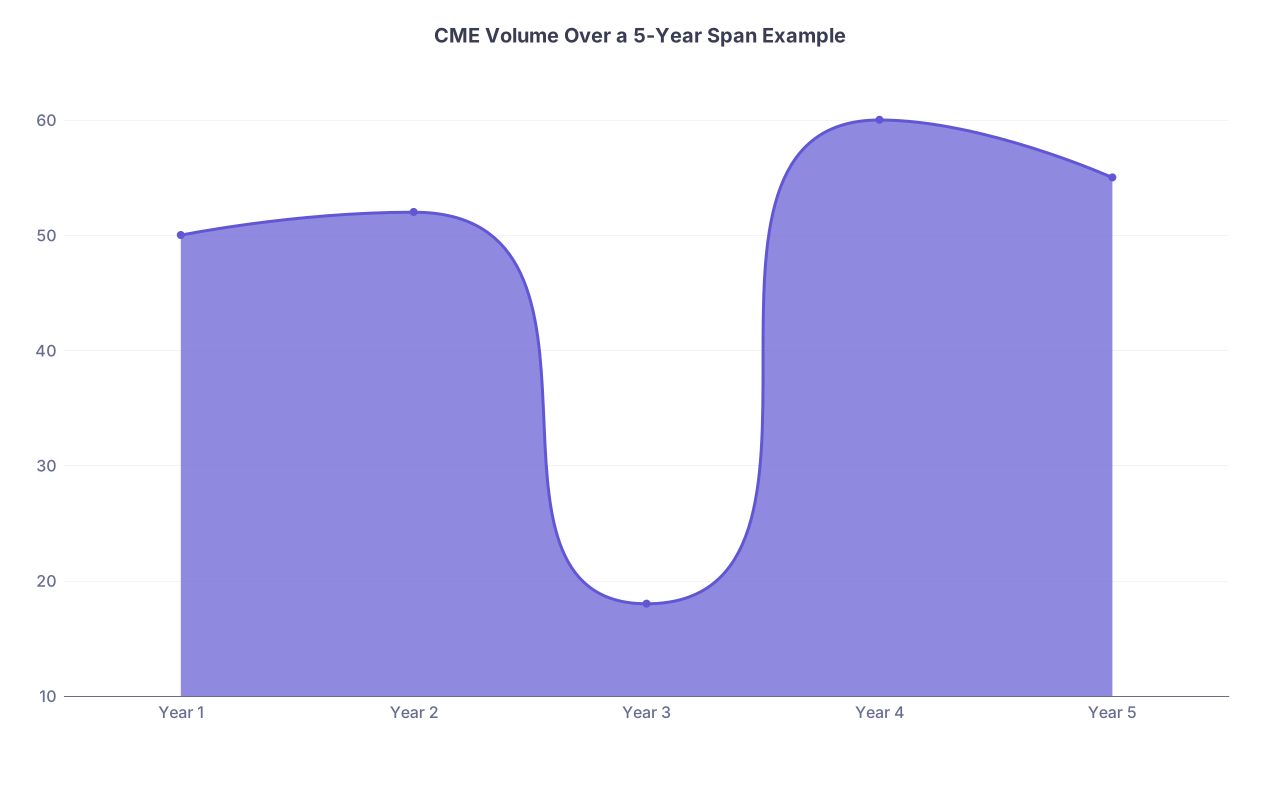
| Category | Value |
|---|---|
| Year 1 | 50 |
| Year 2 | 52 |
| Year 3 | 18 |
| Year 4 | 60 |
| Year 5 | 55 |
Year 3 looks scary when you stare at it alone. Zoomed out over 5 years? It looks like life happened and then you recovered.
What To Do If You Already Have a CME Gap
Okay, so the damage (in your mind) is already done. You’re not asking “how do I prevent this” but “how screwed am I, and can I fix this?”
You can absolutely make this survivable. Here’s how I’d triage it if I were in your shoes.
Step 1: Get brutally honest with your timeline
Pull your records from:
- State medical board
- Board certification portal
- CME logging system (hospital, specialty society, or personal)
Map out:
- Years where you didn’t meet requirements vs just had lower volume
- Whether you missed technical renewal deadlines
- Any formal letters, warnings, or probation tied to CME
You need to know if we’re talking:
- Cosmetic problem (looks messy, but you’re compliant now)
- Structural problem (you actually broke rules and it’s documented)
Step 2: Fix what you can before you apply anywhere new
If you’re currently under-required totals for this cycle:
- Load up now. Yes, binge CME. It’s not ideal, but it’s better than staying exposed.
You want to be able to say, truthfully:
- “I’m currently fully compliant with all state and board CME requirements, and I’ve continued to stay up to date, especially in the last 1–2 years.”
If you wait until after an employer calls this out, it looks reactive. If your log shows recent activity before applications, it looks like growth.

Step 3: Write your internal script before they ask
You don’t want to improvise when someone on a credentials committee asks, “We noticed you had a low CME year in 2020—can you explain that?”
You want something like:
- “During 2020, I was working increased clinical hours due to staff shortages and unfortunately I let my formal CME tracking slip. I was still engaged in guideline updates and case conferences, but I didn’t log formal hours consistently. As soon as I recognized that, I corrected it, and for the past three years I’ve exceeded the required CME and set up a structured tracking system.”
Or:
- “That low CME year coincided with a serious family/health situation. I remained clinically active, but my formal CME fell behind. I addressed the deficiency and brought myself into full compliance, and since then I’ve been very proactive with CME—especially in [key area relevant to your practice].”
You’re not groveling. You’re taking responsibility and showing it’s a solved problem, not an ongoing risk.
Step 4: Make the recent years impossible to criticize
If you’re worried about 2019 or 2020, your best defense is what 2023 and 2024 look like.
Pattern to aim for now:
- Meeting or exceeding your annual requirements
- A mix of activities (conferences, online modules, specialty-specific content)
- If you had a gap tied to burnout or chaos: extra CME in that same specialty area now
You want a future employer to think:
- “Okay, something dipped here, but they came back strong and have been engaged and consistent since.”
You’re building a narrative of recovery and responsibility.
Situations Where You Should Proactively Bring It Up
You don’t always need to volunteer, “By the way, I had a CME gap in 2018.” But in some cases, being upfront is better than waiting to be cornered.
Consider bringing it up early if:
- The gap caused official action (license delay, probation, formal letter)
- You’re moving to a very risk-sensitive environment (academic center, big system, or heavy malpractice climate)
- You know your former institution documented CME non-compliance somewhere that might be shared
Even then, the tone matters:
- Not: “I’m so sorry, I’m terrible, I messed up everything.”
- But: “There was a period where X happened, here’s how it affected my CME, and here’s how I resolved it and prevented recurrence.”
What terrifies employers is defensiveness or denial. Calm ownership is disarming.

How To Make Sure This Doesn’t Haunt Your Future Self
Your current fear is about the past gap. Your future regret will be about repeating it because you never put a system in place.
You don’t need a perfect, 17-step productivity workflow. You need something simple and boring that works under stress.
Basic guardrails:
Pick one place to track CME (specialty society portal, hospital system, or a simple spreadsheet + folder of certificates).
Set 2–3 calendar reminders per year:
- Mid-year: “Check CME totals”
- 3–6 months before license renewal
- 1 month before license renewal (panic buffer)
Keep a small buffer above the minimum. If your state requires 50 hours every 2 years, aim for 60–70. It gives you room for life to go sideways.
This is less about impressing employers and more about not triggering your own anxiety every time you start a job search and have to look at that cursed CME log again.
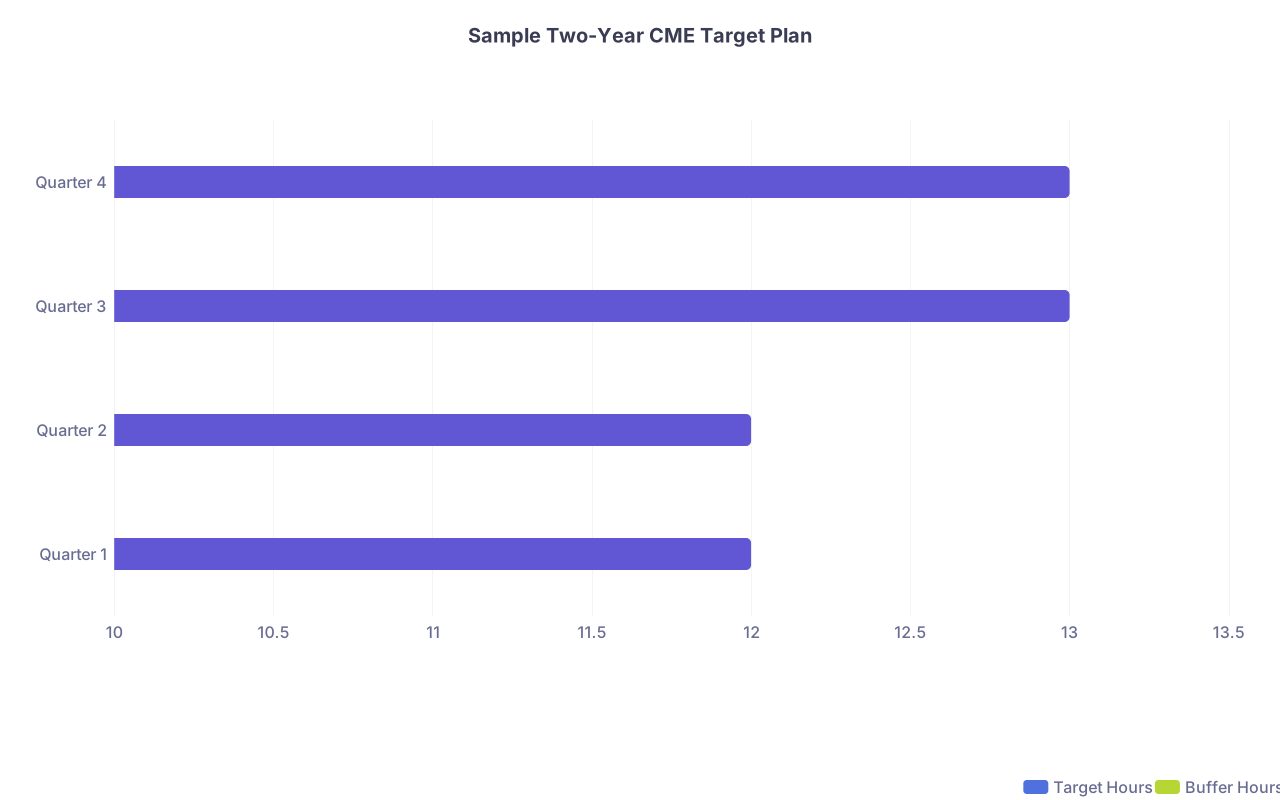
| Category | Target Hours | Buffer Hours |
|---|---|---|
| Quarter 1 | 10 | 2 |
| Quarter 2 | 10 | 2 |
| Quarter 3 | 10 | 3 |
| Quarter 4 | 10 | 3 |
Even a modest quarterly target plus a small buffer keeps you far away from “uh-oh, I need 40 hours this month” panic.
Here’s the uncomfortable-but-reassuring bottom line:
A gap in your CME history can raise red flags if it signals a pattern of non-compliance, risk, or neglect.
A gap in your CME history does not automatically ruin your career, tank every job application, or brand you forever as unsafe.
Employers care a lot more about:
- Whether you’re compliant right now
- Whether you’ve resolved any past issues
- Whether your recent pattern shows responsibility and growth
You’re not being judged on the worst year of your life in isolation. You’re being judged on the arc.
Today, don’t try to fix everything. Just do this one concrete thing:
Open your CME record, pick the last 24 months, and write down your total hours and gaps. Then add one CME activity to your calendar this week and complete it—so that the “current you” looks stronger than the “past you” you’re so afraid they’ll see.