
You’ve got moving boxes still half-unpacked, you finally found your stethoscope in a random kitchen box for some reason, and now you’re trying to update your medical license for your new state. You open the new state medical board website and realize their CME requirements look nothing like what you’ve been doing for years.
Different topics. Different cycles. Different mandatory hours. Different “gotcha” rules.
And your brain immediately goes:
“Did I just screw myself? Are they going to say I’m not compliant? Can I lose my license? Am I going to have to repeat years of CME? Am I going to be stuck in credentialing purgatory and not be able to start my job on time?”
Yeah. This is that article.
Let’s walk through the worst-case scenarios you’re already spinning out about… and then what actually happens in real life.
First harsh truth: states don’t talk to each other as much as you think
Everyone imagines this giant shared database where New York, Texas, California, and Florida all perfectly track every hour of CME you’ve ever done and instantly flag inconsistencies like some kind of CME NSA.
Reality is way dumber and more annoying.
Most state medical boards care about two main things when you apply or renew:
- Are you currently licensed and in good standing somewhere else?
- For this state, for this renewal period, do you meet their CME rules?
They don’t usually retro-audit your entire CME history across all states for the last decade. They’re not going back to PGY-2 and checking whether you counted that random online ethics course correctly.
What trips people up is the mismatch in:
- Total hours required
- Time window (1 year vs 2 vs 3)
- Specific mandatory topics (opioids, domestic violence, child abuse, implicit bias, HIV, etc.)
You’re worried about “not matching up.” The boards are mostly worried about “are you reasonably current and not obviously lying.”
Which brings me to the next anxiety bomb.
The nightmare scenario you’re imagining vs what actually happens
The nightmare in your head probably looks like this:
You move states.
You apply for a new license.
They scrutinize your CME.
They realize your last state required 100 hours every 2 years and this new one wanted 150, including 8 hours of controlled substance CME, and you don’t have it.
They deny or delay your license.
Your job start is pushed back. Your employer is mad. Payroll is delayed. Everything collapses.
Here’s what actually happens most of the time:
You apply for your new license.
They look: are you licensed anywhere else and in good standing? Yes? Good.
They look at your CME attestation and sometimes a sample of certificates.
If something’s off, they don’t usually “destroy your life,” they say some variation of:
“Hey, you’re short on X CME or mandatory topic Y. Complete this amount by [date] and send us proof.”
Is it annoying? Absolutely. Can it mess with credentialing timelines if you wait too long? Yes. But is it usually some irrevocable career-ending event? No.
The three big CME mismatch problems when you move
Let me break down the usual pain points, because they’re pretty predictable.

1. Different total hours and cycles
Example:
You were in State A, which requires 50 hours of CME every 2 years.
You move to State B, which requires 100 hours every 2 years.
You’re thinking: “I only did 50. Am I dead?”
Here’s the nuance: the new state usually cares about its cycle, not what your last state wanted.
If you’re applying for an initial license in the new state, often they:
- Ask if you’re in good standing elsewhere
- May not require full-cycle CME for initial licensure, or
- May require a certain amount within the last X years
They don’t usually say, “Well, your old state only forced you to do 50, and we prefer 100, so we retroactively judge you by our standard for the past decade.”
What can happen:
- For renewal in the new state, you’ll need to meet their full requirement for their next cycle.
- You might be asked to show a certain number of hours in the last 12–24 months. If you’re short, they’ll often let you make it up before renewal or give you a short window.
Where it gets stressful is when your move and your renewal dates are close together. That’s when you’re doing frantic weekend CME marathons to catch up.
2. Mandatory topic mismatches
This is the trap door.
Different states love their pet topics. Stuff like:
- Opioid prescribing / pain management
- Domestic violence / intimate partner violence
- Child abuse and neglect recognition
- Suicide prevention
- Cultural competency / implicit bias
- HIV / infectious disease
- Human trafficking
You might come from a state that’s chill on mandatory topics and land in a state that has a list as long as your arm.
These are the situations I’ve seen freak people out:
- New state requires 3 hours opioid CME in the last 3 years and you have… none.
- New state requires a specific course (e.g., a branded state opioid module) and your general addiction CME doesn’t count.
- New state wants child abuse recognition training for initial license, and your “pediatrics general CME” isn’t specific enough.
Usually the board doesn’t revoke anything retroactively; they just don’t consider your CME requirement fully met for their purposes until you complete those specific topics. So you may have to:
- Do a few topic-specific modules quickly
- Submit certificates showing those exact courses
- Sometimes use their state-approved platform or provider list
Annoying. Stressful if your start date is looming. But still solvable.
3. Timing windows that don’t line up
You know that awful feeling when the dates don’t match?
Your old state: 2-year cycle ending in December.
Your new state: requires some CME “within the last 12 months” or a different 2- or 3-year window tied to their renewal.
So you move mid-cycle, with CME scattered across the last few years, and your brain’s like:
“Are they going to throw out half of what I’ve done because it doesn’t fall perfectly in their date range?”
Usually, this is how it shakes out:
- The new state often has a defined look-back period (e.g., CME must be within the last 24 or 36 months).
- As long as your certificates fall inside that window, they tend to accept them, regardless of whether they were “for” another state’s cycle.
- Anything older gets ignored. Which might mean you’re short.
This is where people panic and start doing 20 hours of CME in a week. Which, by the way, is miserable but doable if you really need to.
How strict are states actually? (Spoiler: often strict on paper, flexible in practice)
Let me be realistic and not sugar-coat it.
On paper, some state CME rules look brutal.
In practice, state boards tend to behave like this:
- They care a lot if you lie or falsify CME. That’s a big deal.
- They care if you ignore mandatory public-health topics completely.
- They are usually less aggressive if you’re slightly short on general CME hours and you fix it promptly when they tell you.
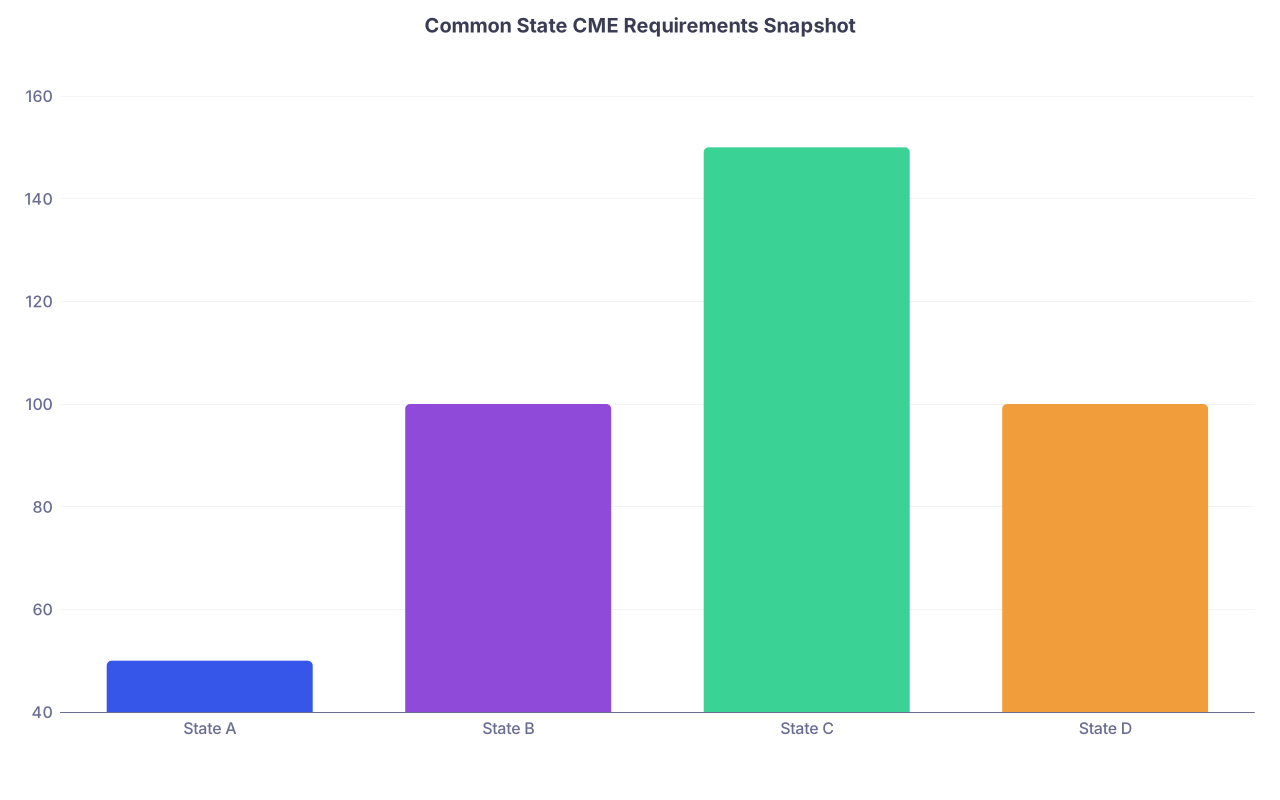
| Category | Value |
|---|---|
| State A | 50 |
| State B | 100 |
| State C | 150 |
| State D | 100 |
The people at medical boards aren’t sitting there hoping to catch you in a minor discrepancy so they can ruin your career. They actually want licensed physicians in their state. They just need to check enough boxes to protect themselves legally and politically.
Where people actually get into trouble:
- Repeatedly ignoring board letters about missing CME
- Attesting “Yes, I did it all” when they didn’t, and then being audited
- Having other red flags (disciplinary stuff, malpractice issues) and also having CME problems
A small CME mismatch by itself, fixed quickly, almost never turns into some huge scandal.
What to do if you’re about to move (or just moved) and your CME doesn’t match
Let’s get practical, because the anxiety is coming from the uncertainty.

| Step | Description |
|---|---|
| Step 1 | Moving or recently moved |
| Step 2 | Check new state CME rules |
| Step 3 | Compare with last 2-3 years CME |
| Step 4 | Document and save certificates |
| Step 5 | Plan targeted CME |
| Step 6 | Complete required topics fast |
| Step 7 | Upload and organize proof |
| Step 8 | Apply or renew with confidence |
| Step 9 | Any gaps? |
Step one: pull the exact CME rules for the new state
Not a blog. Not Reddit. The actual medical board website.
Look specifically for:
- Total hours required per cycle
- Cycle length and start/end logic (calendar vs birth month vs license date)
- Mandatory topics (and how many hours of each, and how often)
- Any special rules for initial licensure vs renewal
Step two: line up your last 2–3 years of CME against that
Open a spreadsheet or just scribble it out:
- How many total hours do you have in that look-back period?
- Do you have anything that clearly counts for opioids/pain, child abuse, DV, etc.?
- Are you missing whole categories?
Be brutally honest. Lying to yourself here just delays the pain.
Step three: close the gaps before they become urgent
If you see you’re missing:
- 2 hours of opioid prescribing? Go find a state-accepted module tonight.
- A child abuse course required before initial license? Knock it out this week.
- 10–20 general hours because your total is low? Do a few decent on-demand courses.
You don’t need to like it. You just need to finish it and save the certificates somewhere obvious.
What if I already applied and realized I don’t match?
Deep breath. This happens more than you think.
Here’s the pattern I’ve watched play out:
You submit an application. You attest you’re compliant based on what your old state needed.
Later you discover your new state has extra required topics or higher hours.
You’re now spiraling about being audited, being labeled dishonest, losing everything.
Reality:
- Some states don’t deeply audit CME unless something triggers a closer look.
- If the board contacts you and says, “We need proof of X,” your job is to react fast and get that CME done and documented.
- If you realize you were wrong and you’re still in process, you can often email the board, clarify, and say you’re completing the missing hours right away.
Is it ideal to have attested incorrectly? No.
Is it automatically the end of the world? Usually not, as long as you fix it and don’t double down.
If you’re really panicked, you can literally call or email the board staff and say:
“I recently moved from [old state] and I’m realizing your CME requirements are different. I want to be sure I’m compliant. Can you clarify what I need to have completed as of now vs what I can complete before next renewal?”
They might sound slightly bored. That’s fine. Bored is good. Bored means this is not some rare, catastrophic event for them.
Quick reality check on overlapping requirements
You’re also probably wondering: “Do I have to meet CME requirements for both states if I keep both licenses?”
Yeah. If you maintain multiple active licenses, each state expects you to meet its own requirements.
That doesn’t mean you need double the actual CME content, though.
Most CME activities can “count” for multiple states simultaneously, as long as:
- They’re AMA PRA Category 1 (or equivalent accepted type)
- They meet any topic-specific rules in each state
So one 3-hour opioid CME can help you satisfy opioid requirements in three different states, assuming all three accept that course/provider.
The hassle isn’t doing totally separate CME. The hassle is tracking which course covered which requirement for which state and in what date window. The admin side is what fries people.
If you’re juggling multiple states, this is the one time I’ll say it: make a spreadsheet. Future you will be less miserable.
The one thing that actually will hurt you
Not the mismatch itself. Not discovering late that you’re short. Not having to do 15 hours of CME in a weekend (though that is a special kind of hell).
The thing that’s actually dangerous: pretending it’s fine and ignoring it.
When boards get truly irritated, it’s usually because:
- You ignored reminders
- You provided no documentation
- You obviously lied on an attestation and then ghosted them
- You let it fester over multiple cycles
You can be behind and still be in control.
You lose control when you avoid opening emails from the board because they scare you. When you don’t log into your CME portal because you’re scared of what you’ll see. When you decide, “I’ll fix this later,” and then it’s suddenly renewal month.
Two final sanity checks
You’re probably still worried, so let me spell out the three most grounded takeaways.
- States care most about current compliance, not retroactively punishing you for different past rules in another state.
- Most CME mismatches can be fixed by doing specific catch-up CME and submitting proof; boards rarely “blow up” your career over a reasonable gap you address quickly.
- The real risk isn’t the mismatch itself; it’s denial, delay, and silence. If you face it early, email when you’re confused, and knock out the missing hours, you’re going to be fine.