
The myth that “as long as I hit the CME number, I’m fine” is dead wrong.
Let me tell you what actually happens when credentialing committees and medical staff offices pull your CME history. They are not just checking if you hit 25 or 50 hours. They are reading it as a behavioral report card: how you practice, how you handle feedback, and whether you’re a risk to the hospital.
You think it’s a box-checking exercise. They think it’s evidence.
I’ve sat in those rooms. I’ve watched chairs, CMOs, and risk management go through a physician’s CME transcript line by line when there’s a problem. And I’ve also seen careers salvaged—or quietly ended—because of what those records showed.
Let’s walk through what’s really being judged when someone pulls your CME history.
The First Pass: Are You A “Problem File” Or A “Routine Renewal”?
The dirty secret: for most of you, no one is lovingly scrutinizing every CME hour at each renewal. Medical staff offices are buried. They triage.
There are basically two piles.
Routine renewal: no red flags in the file, no major complaints, no big malpractice issues. The CME review here is quick: did you meet the minimum hours and specific requirements (e.g., risk management, opioid prescribing, specialty-specific content)? If yes, stamp, move on.
Problem file: performance issues, complaints, outlier outcomes, disruptive behavior, or big malpractice payouts. This is where your CME gets dissected.
The trick is that you do not always know when you’ve quietly moved from pile one to pile two.
What triggers a closer look at your CME:
- Sentinel event or bad outcome under review
- Multiple substantiated complaints (patients, nurses, colleagues)
- Pattern of borderline behavior (charting, timeliness, follow-up)
- System-level issue tied to your specialty (e.g., sepsis bundle failures, procedural complications)
When that happens, someone on the committee asks the inevitable question:
“Has this doctor done any CME that actually addresses these issues?”
That’s the turning point. And that’s where most physicians’ CME histories look embarrassingly generic.
The Truth: Committees Care More About Alignment Than Hour Totals
Once you’re under closer scrutiny, they do not care that you have 80 hours instead of 50.
They care about what those hours say about you as a clinician.
Here’s what gets noticed—positively and negatively.
1. Specialty-Relevance vs. Random Filler
A CME transcript that looks like this:
- 2.0 hours – “Advances in heart failure management”
- 1.5 hours – “Perioperative anticoagulation”
- 2.0 hours – “Interpretation of cardiac CT”
- 1.0 hour – “Managing chest pain in the ED”
vs. this:
- 1.0 hour – “Physician wellness and burnout”
- 1.0 hour – “Financial planning for physicians”
- 1.0 hour – “General infection control overview”
- 1.0 hour – “Mindfulness for clinicians”
Both are “CME.” Only one looks like a cardiologist who is staying sharp in cardiology.
Committees are not anti–wellness or anti–financial planning. But when your transcript is dominated by generic content and almost no real specialty education, the unspoken conclusion is: this doctor is mailing it in.
I’ve heard variations of: “Why is this interventionalist doing 12 hours of leadership webinars and almost nothing on procedural complications or imaging?”
They expect a clear spine of specialty-related CME that reflects current practice.
2. Pattern Recognition: Does Your CME Track Your Weaknesses Or Ignore Them?
If there’s a clinical issue on the table—say, post-op infections, opioid prescribing, sepsis management—someone on the committee will literally search your CME titles for those themes.
If there’s a complaint about communication or professionalism, they’ll look for anything that suggests you’ve tried to improve there too.
A strong file, in a problem review, looks like this:
- Two years ago: concern about opioid prescribing
- Following year’s CME: “Safe opioid prescribing in chronic pain,” “Alternatives to opioids in perioperative care,” “State opioid regulations update”
- Documented improvement in practice from pharmacy or quality data
That tells a story: feedback → education → change.
A weak file looks like:
- Complaints about poor communication and delays
- CME that is 90% random specialty updates with not a single hour on communication, teamwork, handoffs, or patient safety
That tells a different story: denial or indifference.
No one says it out loud, but the mindset in the room becomes: “We’ve flagged this issue multiple times and there is zero evidence this physician has engaged with the problem.”
3. Recency: Did You Panic-Load Hours Before Renewal?
Everyone knows you’re busy. Everyone also knows what a “panic month” looks like on a transcript.
Thirty-five hours in the same week on random online modules, all completed at 11:45 p.m.? They notice.
Do they care if you technically hit the requirement this way? For routine files, not much. The credentialing office mostly shrugs.
But again, in problem cases, it becomes part of the pattern:
- Sloppy charts
- Late dictations
- Complaints about being unavailable
- Then a CME record that screams: “I ignored this for 23 months and crammed at the end.”
The narrative writes itself: This physician does the bare minimum, late, only when forced.
If instead they see consistent CME—few hours every quarter, conferences, targeted topics—it feeds a different narrative: engaged, professional, takes ongoing learning seriously.
4. The Type of CME: Passive vs. Intentional
Not all CME is created equal in the eyes of a committee.
Sliding into whatever free online module you can find at 11 p.m. is technically okay. But when someone is under review, the type of activity becomes more relevant.
Intentional CME that gets respect:
- National or high-level specialty conferences (ACC, ASCO, ATS, etc.)
- Procedural workshops and simulation-based training
- MOC activities with performance improvement components
- Hospital-based QI projects that generate CME credit
Low-signal CME that looks like filler:
- Endless 0.25–0.5 hour increments from random industry webinars
- Recycled/identical modules year after year with no progression
- Topics completely unrelated to your actual practice pattern
I’ve watched a committee chair say: “This surgeon had three major complications and in the last two years, the only CME close to those issues is one 1-hour online event, and 20 hours of generic surgery updates. That doesn’t frame well.”
They are not rating the quality of every course. They are reading intent.
What Hospitals Track Quietly: Risk, Regulation, And Optics
Another thing people underestimate: credentialing decisions don’t happen in a vacuum. Legal, risk, and regulatory realities shape how your CME is interpreted.
Mandatory Buckets: Miss These And You’re In Trouble
Most hospitals and health systems now have specific CME buckets they must see:
- Opioid prescribing / controlled substance training (often state-mandated)
- Patient safety, quality improvement, or risk management hours
- Cultural competency or implicit bias (in some states/systems)
- Specialty board MOC requirements (if you’re claiming “board-certified”)
If you’re missing these, you don’t just look sloppy—you create a regulatory and legal vulnerability for the hospital.
That’s when the tone in the room changes. It stops being, “Can we overlook this?” and becomes, “We cannot defend this if something bad happens.”
| CME Area | Typical Expectation |
|---|---|
| Total CME Hours | Meet state/board minimum |
| Specialty-Specific | Majority of hours |
| Opioid/Controlled | Per state/regulatory rules |
| Patient Safety/QI | A few hours each cycle |
| Ethics/Professional | At least periodic exposure |
This is why some medical staff offices now send those annoying reminders about specific modules. They’re not nagging. They’re closing legal loops.
Optics: How Your CME Looks If Something Goes Public
Here’s the part no one talks about: what your file looks like in discovery.
Imagine a bad outcome. It goes to lawsuit. Plaintiffs get your personnel and credentialing file. They see:
- Multiple prior complaints
- Internal memos about concerns with your practice
- And then a CME history that’s all “Financial wellness for physicians” and “Strategies for time-share investing” while your clinical outcomes were deteriorating.
Do you understand how toxic that looks in a courtroom?
Hospitals have lived this nightmare. So now committees think downstream: If we renew this person with this record and something happens, will we be embarrassed by what’s in the file?
An aligned, serious CME history protects not just you, but the institution.
The Red Flag Patterns CME Can Reveal
Most of the time, no one says, “This doctor’s CME is a problem.” But they do notice patterns that reinforce other concerns.
1. The “Stale” Physician
Ten years of transcripts that look identical:
- Same conference every year
- Same generic updates
- No new areas, no skill-building, no QI work
When this is coupled with stagnant or declining performance, it becomes an argument that you’re coasting on old training. I’ve seen senior physicians lose influence, privileges quietly narrowed, or get nudged toward retirement because their whole file—CME included—screamed “stale.”
2. The “All Industry, All The Time” CME Consumer
CME heavily dominated by industry-sponsored dinners and product-focused talks raises eyebrows in 2026, especially if your ordering/prescribing patterns match those sponsors a little too perfectly.
No one will deny your privileges solely on this, but it absolutely colors perception when combined with outlier cost or utilization data.
3. The “No Pattern At All” Transcript
Some physicians jump randomly between:
- Pediatrics vaccines
- Dermatology updates
- Hospice billing
- New diabetes drugs
- Emergency airway management
None of it corresponding to their actual field or their problem areas.
This reads like someone clicking anything free that pops up, with zero intentionality. Again, paired with other issues, it makes you look unserious about actual growth.
How Committees Think When There’s A Problem On The Table
Let’s walk through what really gets said in those closed-door conversations.
Scenario: Orthopedic Surgeon With Infection Concerns
Performance data shows higher-than-expected post-op infections. There are a couple of anonymous OR nurse complaints about “cutting corners” on pre-op prep. Risk management is nervous.
Someone pulls the surgeon’s CME:
- Strong annual attendance at a large ortho conference
- No infection control or perioperative management sessions listed
- No hospital-based QI infection initiatives
- No targeted CME after the first flagged case
In the meeting, you’ll hear things like:
“He stays current in ortho, but there’s nothing here showing he took the infection concerns seriously.”
If instead they see:
- Ortho conference with sessions attended on infection prevention
- Dedicated CME modules on surgical infections and antibiotic stewardship
- Participation in a hospital QI project (with CME credit) on OR infection bundles
The conversation changes to:
“He engaged with the issue; we need to see if the processes are the problem, not just him.”
That difference is massive. Same number of hours. Completely different story.
How To Build A CME Record That Actually Protects You
This isn’t about gaming the system. It’s about not looking clueless when someone eventually opens your file on a bad day.
You should think of your CME as a curated narrative, not just a ledger.
1. Anchor Your CME In Your Actual Practice
If you’re a hospitalist but half your CME is outpatient primary care webinars because they were free, that looks off.
If you’re a proceduralist, there should be a clear thread of procedure-related safety, complication management, new techniques, and peri-procedural care.
Ask yourself once a year: If someone looked only at these titles, would they know what I actually do?
2. Match Your CME To Known Risk Areas
Every specialty has landmines: sepsis, anticoagulation, sedation, opioids, handoffs, documentation, informed consent.
Your transcript should periodically touch those landmines. Not once, five years ago. Recurringly.
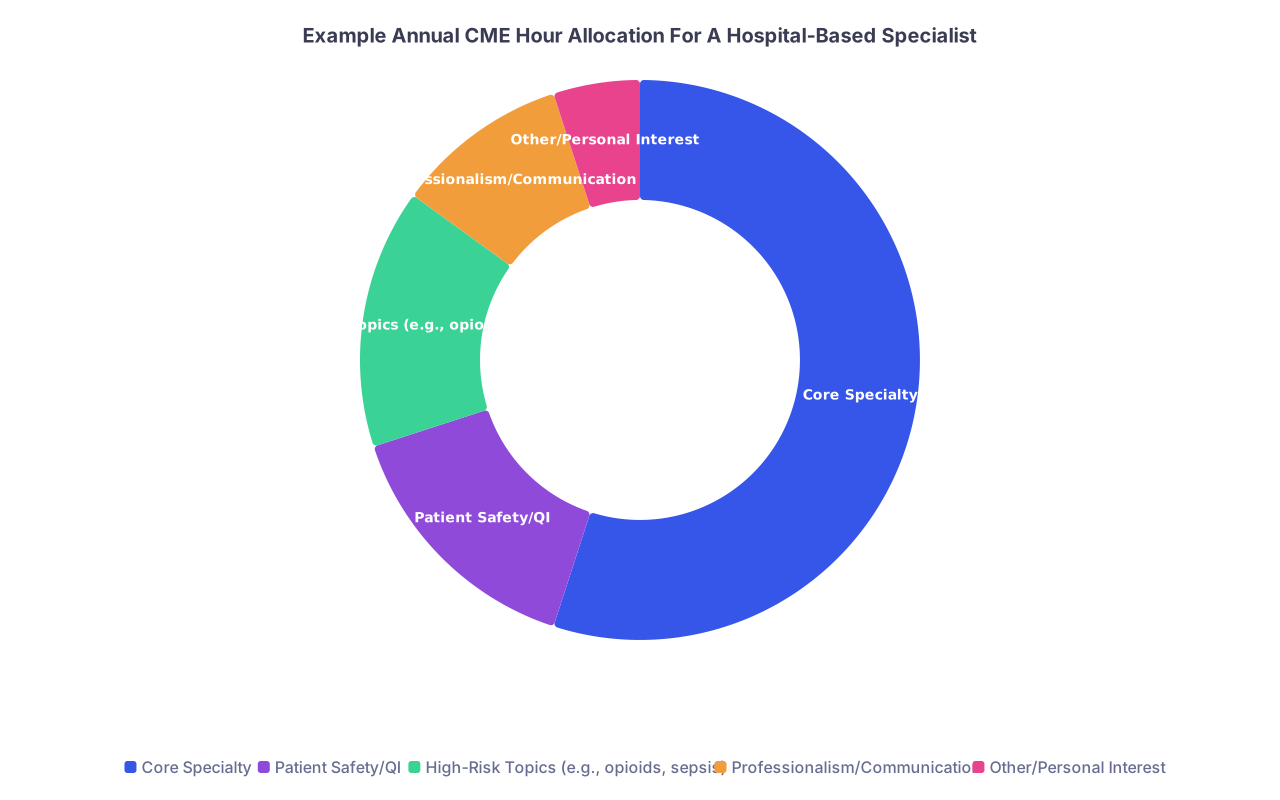
| Category | Value |
|---|---|
| Core Specialty | 55 |
| Patient Safety/QI | 15 |
| High-Risk Topics (e.g., opioids, sepsis) | 15 |
| Professionalism/Communication | 10 |
| Other/Personal Interest | 5 |
That kind of distribution looks intentional, responsible, and defensible.
3. When You Get Feedback, Put It In Your CME
This is the part no one teaches you, but every smart attending figures out.
You get a feedback letter, peer review comment, or quality note that says:
- Documentation incomplete
- Delays in responding to critical results
- Nurse communication concerns
- Perioperative risk stratification gaps
Within the next 6–12 months, you should have CME that directly addresses that theme. Better yet, engage in a QI project tied to it and get CME through that.
Then, if your file is ever re-opened, there’s a clean arc: identified issue → targeted education → improvement attempt.
That’s what saves people.
4. Don’t Do All Your CME In One Frantic Burst
Even if your hospital allows you to, do not routinely wait until month 23 of a 24-month cycle to do 100% of your CME.
A healthy-looking pattern:
- Same total hours
- Spread across the cycle
- With a mix of activities (conferences, online modules, QI)
A panicked pattern:
- Fifty hours in two weeks
- Nothing for almost two years before
You might get away with it for a while. Until someone’s already questioning your time management, follow-up, and reliability. Then this becomes another brick in that wall.
What Early-Career Physicians And Trainees Should Take From This
If you’re still in residency, fellowship, or early attending years, you’re forming habits and reputations that will follow you.
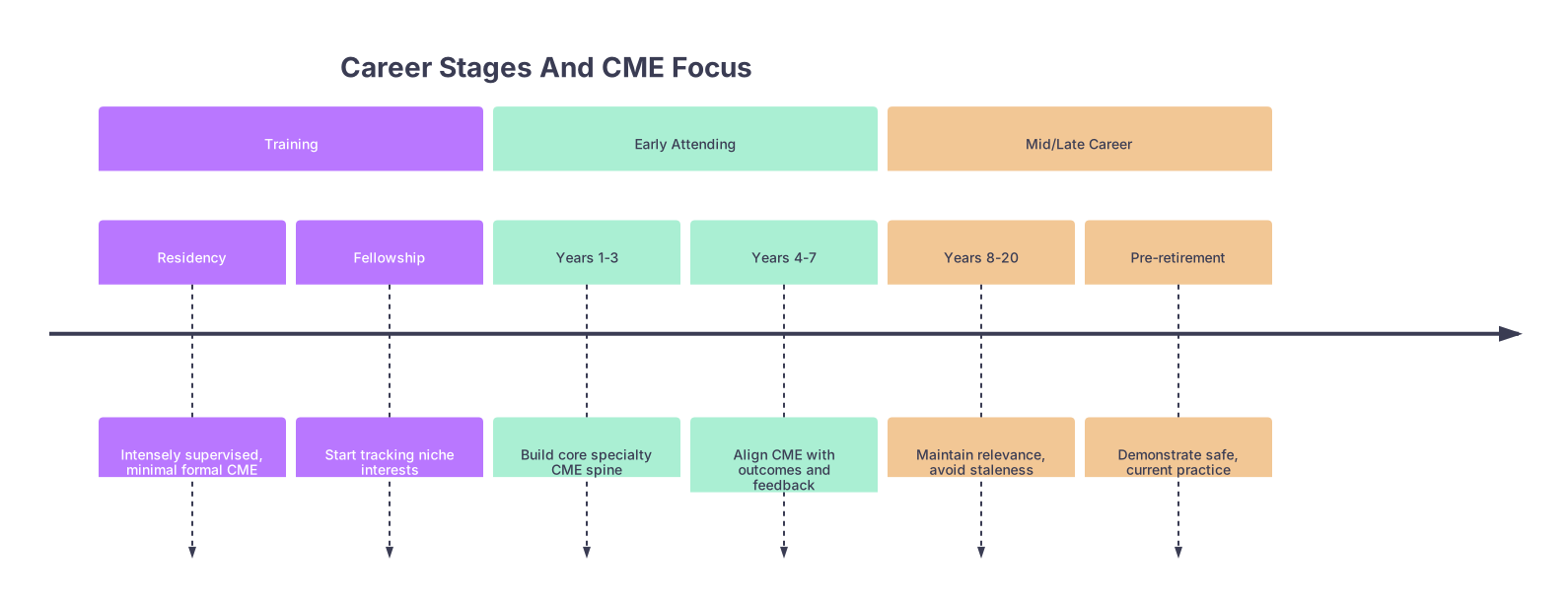
| Period | Event |
|---|---|
| Training - Residency | Intensely supervised, minimal formal CME |
| Training - Fellowship | Start tracking niche interests |
| Early Attending - Years 1-3 | Build core specialty CME spine |
| Early Attending - Years 4-7 | Align CME with outcomes and feedback |
| Mid/Late Career - Years 8-20 | Maintain relevance, avoid staleness |
| Mid/Late Career - Pre-retirement | Demonstrate safe, current practice |
Start now:
- Keep a personal log of topics you struggle with or see repeatedly in M&M, safety reports, or near-misses. Translate those into CME targets.
- Don’t treat CME as “something I’ll care about once I’m established.” Credentialing committees look harder at newer attendings after early mistakes, not less.
When you’re the new attending with a couple of early complications and a CME record that’s a wasteland of generic junk, you look like someone who hasn’t grown out of “student mode.”
When your CME history shows you’re already thinking like a responsible, self-directed physician, people notice.
The Bottom Line: CME Is Evidence, Not Decoration
Here’s the blunt summary no one gives you in orientation:
- For routine renewals, CME is a compliance checklist.
- For problem files, CME becomes character evidence.
It shows whether you’re the kind of physician who:
- Treats feedback as noise, or as a signal to improve
- Coasts on old training, or continually sharpens relevant skills
- Does the bare minimum at the last minute, or behaves like a professional adult responsible for thousands of lives
Credentialing committees are not impressed by big hour totals. They are reassured by coherence, alignment, and responsiveness.
You do not control whether you’ll ever have a bad case, a complaint, or a complication review. You absolutely control whether, on that day, your CME history makes you look like a risk—or like someone any reasonable hospital would want to keep.
Build that record now. Quietly, consistently, intentionally.
Because when the spotlight comes—on your worst clinical day—you want your CME history to be one of your strongest allies, not another liability.
With that mindset in place, you’re ready to stop treating CME as a chore and start using it as leverage for your credibility. The next step is learning how to choose specific courses, conferences, and QI projects that actually move your practice—and your reputation—forward. But that is a conversation for another night.