
The plaintiff’s attorney will see your CME documentation before your own hospital CMO does—and they’ll read it far more carefully than you ever have.
Let me walk you through what actually happens when your chart, your deposition, and your CME history land on a malpractice lawyer’s desk. Because the things they notice first in your CME file are not what you think. And yes, your “I did my 25 hours this year” printout is nowhere near enough.
How Your CME Becomes a Weapon in Litigation
Here’s the part no one tells you in grand rounds: once a serious case is filed, your CME record is treated like any other piece of evidence.
Plaintiff attorneys subpoena:
- Your hospital credentialing file
- Your CME transcripts (often 5–10 years back)
- Specialty certifications and recertifications
- Risk management and mandatory trainings
They’re not doing this out of curiosity. They’re hunting for leverage.
The quiet conversation in defense prep rooms sounds like this:
“Please tell me Dr. X has something in their CME about sepsis after 2018… anything?”
When they don’t find it, everyone’s blood pressure goes up.
Your CME record gets used in three main ways:
- To argue you didn’t keep up with evolving standards of care
- To undermine your credibility in front of a jury
- To pressure you into settling because your file will look terrible on cross-examination
And all of that starts with what malpractice attorneys notice first when that transcript lands in their hands.
1. The Date Pattern: Before vs After the Bad Outcome
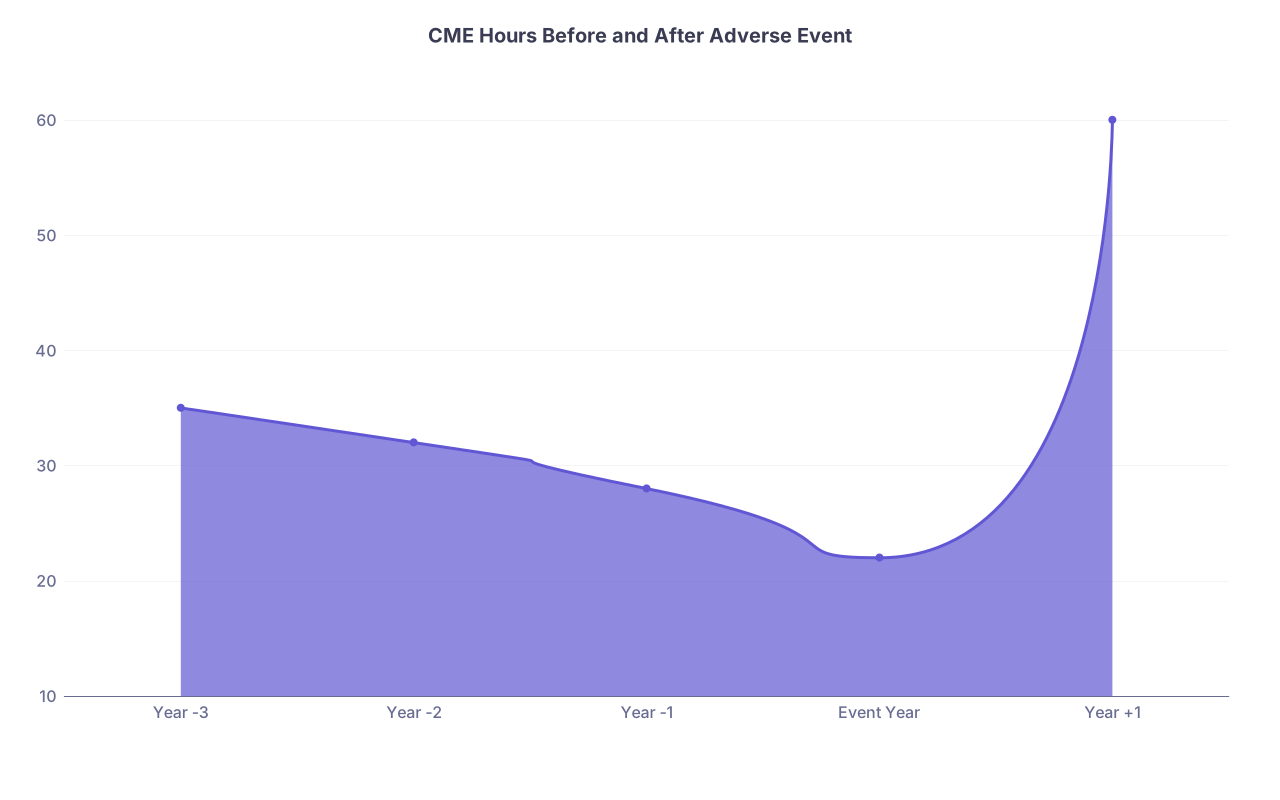
The first thing a malpractice attorney looks at is the timeline—what you did before the event, and what suddenly spikes after.
| Category | Value |
|---|---|
| Year -3 | 35 |
| Year -2 | 32 |
| Year -1 | 28 |
| Event Year | 22 |
| Year +1 | 60 |
Here’s the play they love:
- The adverse event: say, a stroke after missed AFib anticoagulation
- They pull your CME history for the prior 3–5 years
- They circle that the year of the event you barely met minimum requirements, and none of your CME relates to anticoagulation, stroke prevention, or updated guidelines
- Then they circle that after the suit was filed, your stroke-related CME hours exploded
In deposition, it comes out like this:
“Doctor, I see that after this patient’s stroke in 2021, you completed several courses on stroke risk stratification and anticoagulation. Can you explain why you hadn’t taken any such courses in the five years prior, despite treating hundreds of similar patients?”
You feel where that’s going.
What helps you:
- A steady pattern of meeting or modestly exceeding required hours
- Relevant CME before the incident that maps to the clinical issue in the case
- No huge “oh-shit spike” that obviously looks like you’re trying to fix things after the fact
What hurts you:
- Large gaps where you barely scraped your state/hospital minimums
- A cluster of hyper-relevant CME only after the adverse event
- Long periods with no meaningful education in core risk areas of your specialty
Plaintiff attorneys weaponize that pattern to argue negligence wasn’t random—it was predictable. Because you weren’t staying current.
2. Alignment With the Clinical Issue in the Case
The second thing they lock onto: topic alignment.
They’re asking one question: “Could this doctor reasonably claim to be up to date on this specific area when this event happened?”
Let’s make it concrete.
You’re an internist. A sepsis case. Patient came in hypotensive, borderline labs, sent out, returns in florid septic shock and dies.
When your CME file gets pulled, the attorney scans for:
- Sepsis
- Early recognition
- SIRS/qSOFA
- Surviving Sepsis Campaign
- ED or inpatient management of infection
If you’ve got nothing along those lines in the last 3–5 years, that’s devastating. Because now the argument is:
“Not only did Dr. X miss the signs of sepsis, but they hadn’t engaged in any continuing education on sepsis recognition or management in years, despite it being a common and life-threatening condition in their daily practice.”
Here’s the ugly truth: you don’t need every topic under the sun covered. You do need visible, defensible CME in:
- High-risk, high-frequency conditions in your specialty
- Areas where guidelines have changed in the last 5–10 years
- Core safety domains (diagnostic error, communication, handoffs, etc.)

The private conversations program directors and risk managers have sound like:
“If this ends up in front of a jury, can we convincingly say this person kept up with modern practice in that exact area?”
If the answer is no, you are very exposed.
3. The “Checkbox CME” Problem: Low-Value, Irrelevant Hours
The third thing malpractice attorneys sniff out immediately is fluff.
They can smell checkbox CME from a mile away:
- Endless “ethics” or “professionalism” modules with no relevance to the case
- Non-clinical topics dominating your transcript (financial planning, wellness)
- Repeated completion of the same low-rigor online quiz modules
On paper, you hit your 25 or 50 hours. In reality, you look like someone gaming the system.
Here’s the inner monologue of a cynical plaintiff lawyer reading that list:
“This doc had plenty of time to attend ‘Physician Wellness in the Digital Era’ three years in a row, but not a single update on the new anticoagulation guidelines? Thank you very much.”
Is that fair? Maybe not. But it works.
They don’t care that your state board accepts those hours. They care about what a jury will hear when they say:
“Doctor, between 2018 and 2022, you completed 143 hours of CME. Can you tell the jury how many of those hours related to diagnostic accuracy or high-risk conditions you treat every week?”
If the honest answer is “almost none,” your defense attorney just clenched their jaw.
4. The Risk Manager’s “Top 5” and Whether You Touch Any of Them
Behind closed doors, hospital risk managers and malpractice carriers have their own quiet list of high-liability topics for each specialty. They expect to see some engagement in those areas over any 3–5 year period.
For primary care or hospital medicine, that list usually includes things like:
- Sepsis and early deterioration
- Chest pain and ACS
- Stroke/TIA
- Anticoagulation and bleeding
- Transitions of care and follow-up
For surgery:
- Informed consent and documentation
- Perioperative anticoagulation
- Surgical site infection prevention
- Recognition of post-op complications
- Time-outs and safety checklists
| Specialty | High-Risk CME Topics |
|---|---|
| Internal Med | Sepsis, chest pain, stroke, AFib |
| Emergency Med | Sepsis, MI, trauma, stroke, psych holds |
| General Surgery | Consent, infection, post-op complications |
| OB/GYN | Shoulder dystocia, hemorrhage, VBAC |
| Anesthesia | Airway, hemodynamics, sedation safety |
Malpractice attorneys, especially the experienced ones, know these patterns too. So they scan for them:
- “Show me everything this doc has done on X in the last five years.”
- “Nothing on postpartum hemorrhage and they delivered 300 babies a year? Perfect.”
You do not need to rebuild your entire CME plan around fear. But you absolutely should make sure your transcript, viewed from 10,000 feet, shows recognizable engagement with those high-liability domains in your world.
5. Sloppy, Incomplete, or Inconsistent Documentation
The fourth thing they notice—fast—is messy documentation.
This is where people get burned for no good reason.
Common red flags:
- Holes in the transcript: missing certificates, unverified activities
- Self-reported CME with vague titles: “Case review,” “reading,” “conference”
- Inconsistent providers, no clear pattern, a lot of “Other – 1.0 hr” entries
- Failure to distinguish between Category 1 vs Category 2 (or equivalent)
Plaintiff attorneys love attacking credibility. If they can suggest you’re sloppy with your own records, it bleeds over into how a jury sees your clinical practice.
It sounds like this:
“Doctor, you’re asking this jury to trust your memory of complex clinical decisions from three years ago. Yet your own continuing education records are incomplete, with multiple hours you’ve documented as ‘reading’ or ‘self-study’ without dates, topics, or accrediting bodies. Is that right?”
You don’t want to answer that on the record.

| Step | Description |
|---|---|
| Step 1 | Adverse Event |
| Step 2 | Claim Filed |
| Step 3 | Discovery Phase |
| Step 4 | Subpoena Credentialing File |
| Step 5 | Obtain CME Records |
| Step 6 | Attorney Review |
| Step 7 | Use in Deposition |
| Step 8 | Trial or Settlement |
Here’s the fix: you don’t need perfection. You need something that looks intentional and traceable.
- Use one or two main CME providers whose transcripts can be reprinted easily
- Store PDFs of certificates in a single, labeled cloud folder by year
- Actually put descriptive titles on self-claimed CME (e.g., “Journal reading – NEJM stroke trials 2020–2022”)
Your goal: make your file boring. Clean. Hard to attack.
6. Whether Your CME Matches the Standards They’ll Cite Against You
This part’s subtle but crucial.
In a serious case, both sides bring in experts. Those experts will cite:
- Society guidelines
- Position statements
- Consensus pathways
- Recent landmark trials
Plaintiff attorneys comb your CME record and look for one of two storylines:
- You ignored the very guidelines their expert is citing
- You didn’t even know about those guidelines because your education never touched them
Let’s say it’s an ACS case. Plaintiff expert cites ACC/AHA guidelines from 2014, updated 2021. They look at your CME:
- Any ACC, AHA, or major cardiology-focused content?
- Any ED chest pain risk stratification courses?
- Any hospital medicine updates on troponin, risk scores, disposition?
If they find nothing, the cross-examination script practically writes itself.
On the flip side, if you do have CME that aligns with those guidelines, your defense attorney can do this:
“Doctor, can you tell the court about the cardiac risk assessment course you completed in 2020? What guidelines did that course emphasize? Did your practice at the time reflect those recommendations?”
Does that automatically get you off the hook? No. But it gives you something very powerful in front of a jury: a coherent narrative that you actually try to stay current.
That matters more than you think.
7. The Gap Between Your Stated Practice and Your Education
Another trick they use: comparing what you say you do to what your CME shows you care about.
Example: You testify that you “specialize” in high-risk obstetrics, manage complex VBACs, and routinely handle shoulder dystocia.
Plaintiff counsel will quietly slide your CME transcript in front of the jury and point out:
- Zero courses on shoulder dystocia
- Nothing on fetal heart rate interpretation
- No CME on postpartum hemorrhage in years
That disconnect is gold for them. It lets them paint you as overconfident, underprepared, and cavalier.
I’ve seen defense attorneys in pretrial conferences literally groan when they realize:
“Their whole brand is high-risk X, and in five years of CME there’s virtually nothing on X.”
You don’t need 50 hours on the same niche topic. But if you market or describe yourself as having special expertise in anything—procedures, high-risk populations, advanced therapies—your CME should at least nod in that direction.
One or two serious, recognizable courses can shut down an entire angle of attack.
8. The “Last-Minute Scramble” Signature
Here’s a pattern malpractice attorneys and hospital credentialers both notice, and for different reasons:
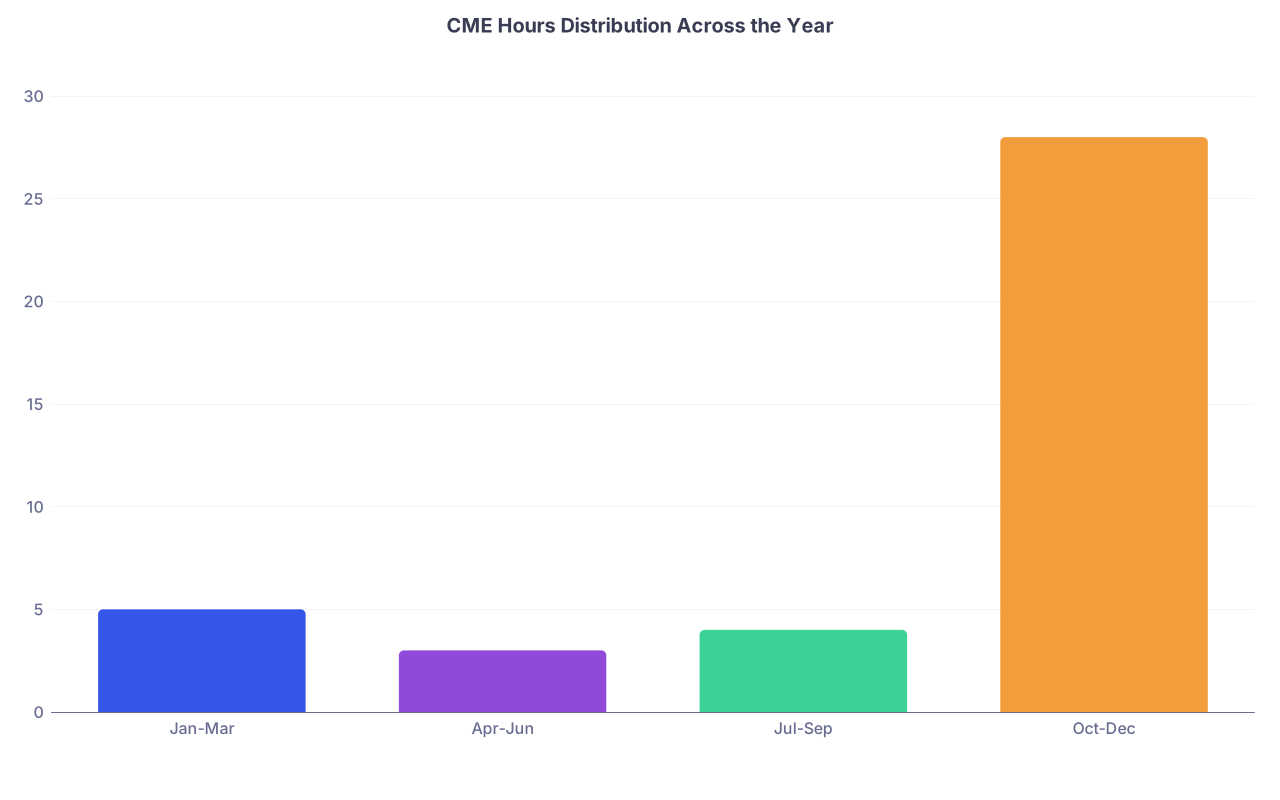
- You do almost no CME from January through October
- In November and December you suddenly log 80% of your year’s required hours
On the credentialing side, it tells them you’re disengaged with real learning and just plugging quotas. On the legal side, it sets up a narrative of procrastination and minimal compliance.
Combine that with a bad outcome late in the year, and they get to say:
“Doctor, the year this patient died under your care, you waited until the final six weeks of the year to complete nearly all of your continuing education. Does that pattern reflect your general approach to staying current in your field?”
You do not need to be Type A about this. But spacing out your CME—even modestly—automatically looks more like ongoing professional development and less like end-of-year damage control.
| Category | Value |
|---|---|
| Jan-Mar | 5 |
| Apr-Jun | 3 |
| Jul-Sep | 4 |
| Oct-Dec | 28 |
Attorneys see that kind of bar chart in your file and immediately smell a pattern they can exploit.
9. The Hidden Problem: No Risk-Management CME
There’s one more thing they look for, and this one is more psychological than legal: risk management and patient safety CME.
Why? Because it signals mindset.
If over multiple years you have:
- Zero time spent on communication skills
- Nothing on diagnostic error or cognitive bias
- Nothing on handoffs, teamwork, or safety culture
You look, frankly, like someone who doesn’t think about error prevention. Even if that’s not true.
Defense attorneys love when they can say:
“Doctor, can you describe the risk management and patient safety training you’ve sought out over the last several years, specifically around communication and preventing diagnostic errors?”
If you’ve actually done that work, it humanizes you in front of a jury. You look like someone trying to get it right, not someone cruising through requirements.
And plaintiff attorneys know that too. So they check whether that story exists in your CME record or not.
How to Quietly “Litigation-Proof” Your CME Pattern
You cannot litigation-proof your practice. That’s fantasy. But you can remove easy targets from your CME record.
You’re not doing this to impress your state board. You’re doing it so that if a terrible case hits, your defense attorney doesn’t have to win the game shorthanded.
Here’s what a sane, defensible pattern looks like over 3–5 years:
- Hours: You meet or slightly exceed required hours every year, without absurd spikes
- Topic spread: Each year includes some mix of:
- Core clinical updates in your bread-and-butter conditions
- 1–2 things that map directly to known high-risk areas
- An occasional risk management / communication / safety course
- Timing: CME is reasonably distributed through the year, not all in December
- Documentation: Certificates and transcripts are clean, retrievable, and specific
- Alignment: If you’re “known for” something clinically, your CME reflects that
Not heroic. Just intentional.
FAQ (Exactly 3 Questions)
1. Can my CME record actually be used against me in court, or is that exaggerated?
Yes, it can, and it routinely is in significant cases. Your CME history is discoverable, and plaintiff attorneys absolutely request it in serious litigation. It gets used to challenge whether you were truly up to date in the area at issue, to attack your credibility, and to imply a pattern of minimal compliance rather than genuine ongoing learning. I’ve seen cases where weak CME patterns didn’t cause the verdict, but they made the doctor far less sympathetic and believable on the stand.
2. Is it better to load up on risk-management CME or focus mostly on clinical topics?
If you overdo risk-management modules and ignore core clinical content, you look like someone trying to lawyer-proof their practice instead of staying sharp. The sweet spot is balance: most of your hours should be serious clinical updates in areas you actually treat, with a modest but visible thread of risk management, communication, and safety topics. That’s what plays best in front of both credentialing committees and juries.
3. If I’ve been doing “checkbox CME” for years, is it too late to fix my pattern?
No, but stop kidding yourself about it. You can’t rewrite your past transcripts, but you can change the next 2–3 years so that, if a claim arises, the more recent pattern looks deliberate and defensible. Start incorporating high-liability topics in your specialty, add a couple of real risk-management or diagnostic-error courses, and spread your hours more evenly through the year. Defense counsel only needs a coherent story to work with; give them one.
Key Takeaways
- Malpractice attorneys read your CME like a roadmap of your priorities—and they weaponize gaps and fluff.
- A defensible record shows steady, relevant, well-documented learning in high-risk areas you actually practice.
- You’re not doing CME just for your license; you’re building the file that will be read aloud when everything goes wrong.