
What if the CME courses you’re proudly completing are the exact reason you’re not getting promoted, not growing, and not getting the roles you actually want?
Most physicians assume CME is a box to check. Hit the credit number, upload the certificates, forget it. I’ve watched that mindset quietly freeze careers for 5–10 years at a time.
Not from lack of work.
From bad CME choices.
Let me walk you through how this goes wrong, what red flags to watch for, and how to stop sabotaging your own growth every time you click “Register” on another random webinar.
The Silent CME Trap: Hitting Credits, Missing Direction
The biggest mistake? Treating CME like a compliance chore instead of a strategic tool.
Here’s the pattern I see over and over:
- You get an email: “Earn 1.5 AMA PRA Category 1 Credits.”
- It’s free. It’s tonight. You’re tired. You sign up.
- Topic? Marginally related to your practice. Not aligned with your goals. But hey, credits.
Fast-forward three years:
- You’ve done 80–120 hours of CME.
- You’re still in the same role.
- Your skills haven’t meaningfully shifted.
- Your CV doesn’t look any more “promotable” than it did.
The problem isn’t that you skipped CME.
It’s that you chose low-impact, misaligned CME for years.
Let me be blunt:
If your CME history doesn’t tell a coherent story about where you’re going, it’s probably holding you back.
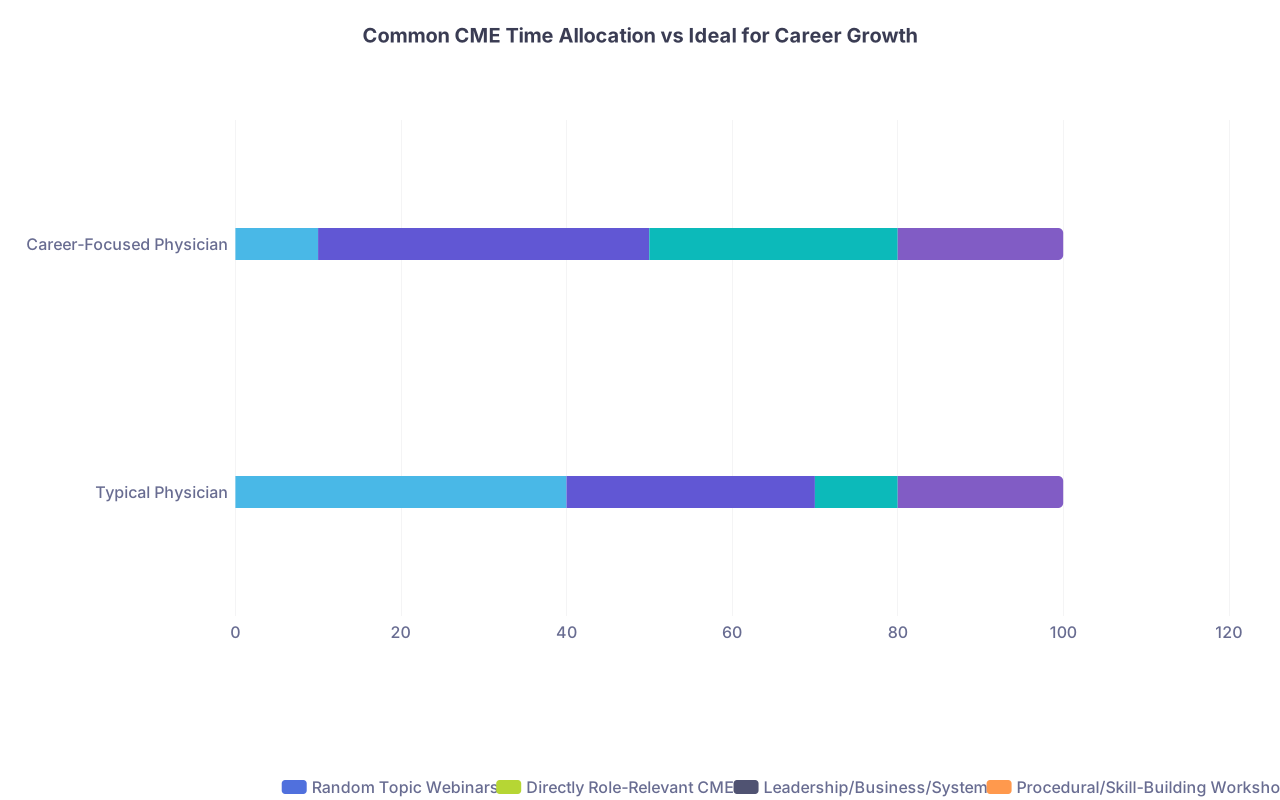
| Category | Random Topic Webinars | Directly Role-Relevant CME | Leadership/Business/Systems | Procedural/Skill-Building Workshops |
|---|---|---|---|---|
| Typical Physician | 40 | 30 | 10 | 20 |
| Career-Focused Physician | 10 | 40 | 30 | 20 |
The left bar? That’s how most people choose CME.
The right bar? That’s how people who actually move up tend to choose it.
Mistake #1: Choosing CME That Matches Your Past, Not Your Future
This is the most common and most damaging pattern.
You say you want:
- Department leadership
- More procedural work
- Transition into quality, informatics, or administration
- Academic advancement
But your CME log is a museum of your current job, not your next one.
How this quietly blocks you
Promotion committees and hiring leaders look at patterns, not just totals.
I’ve sat in meetings where people said:
- “He says he wants to lead quality projects, but all his CME is niche clinical minutiae.”
- “She wants to move into medical education, but I don’t see a single education-focused course or workshop.”
- “For someone aiming for section chief, there’s zero evidence of leadership development here.”
They won’t say it to your face.
They’ll just rank someone else higher.
Red flags you’re stuck in “past-self CME”
Watch for these:
- 90% of your CME is hyper-technical clinical updates you already mostly know.
- Nothing in the last 2–3 years on:
- Leadership
- Communication
- Health systems science
- Quality improvement
- Informatics
- Education/teaching
- You “intend” to pivot specialties/interests but your CME log doesn’t show it at all.
How to fix it
Before you sign up for anything, ask one ruthless question:
“Does this align with the job I want in 3–5 years?”
If not, skip it—even if it’s free, easy, and convenient.
Mistake #2: Chasing Easy Credits and Ignoring Skill Depth
You know those free 0.5–1 hour online modules that practically complete themselves?
They’re the CME equivalent of junk food. Fine in moderation. Harmful as a diet.
If your CME pattern is mostly:
- Short pharma-sponsored talks
- Quick Q&A webinars with no assessment or application
- “Click-through” online modules you play in the background
…then don’t be surprised when your skills plateau.
Why this is a career-growth problem
Easy-credit CME almost always:
- Adds breadth, not depth.
- Doesn’t change your practice patterns.
- Doesn’t give you anything impressive to list or talk about in:
- Promotions dossiers
- Annual reviews
- Interviews
- Letters of intent
You know what actually stands out?
- Intensive hands-on workshops
- Multi-day courses with projects or assessments
- Longitudinal programs (e.g., leadership academies, educator certificates)
- QI or research-related CME tied to a real deliverable

Quick self-check
Look at your last 12–24 months of CME and categorize:
- How many hours were:
- 0.5–1 hour webinars?
- 1–2 day workshops?
- Longitudinal courses (over weeks or months)?
- How many resulted in:
- A new procedure you now perform?
- A QI project you led?
- A concrete change in your daily workflow?
If <10–20% of your CME led to a real, visible practice change or tangible output, you’re under-using it badly.
Mistake #3: Ignoring Institutional and Specialty Signals
Another subtle but costly mistake: choosing CME in a vacuum, disconnected from:
- Your institution’s strategic priorities
- Your department’s direction
- Your specialty’s evolving expectations
How this hurts advancement
You might actually be working hard and learning real things…
But if it’s not aligned with what your system values, it doesn’t move you forward there.
I’ve seen:
- A hospital pivot to value-based care while physicians are still filling their CME with obscure rare-disease talks.
- Departments pushing telehealth, but physicians have zero CME in virtual care, billing, or remote patient monitoring.
- Institutions focusing on patient safety and QI, yet promotion candidates with no relevant CME or projects in those areas.
When promotion committees ask, “How is this person advancing our mission?” your answer can’t be, “I know a lot about rare vasculitis now.”
What alignment actually looks like
Here’s a simple structure to use:
| Source | What to Look For | Example High-Impact CME Choice |
|---|---|---|
| Hospital/health system | Strategic plan, major initiatives | Course on population health or value-based care |
| Department/division | New services, focus areas | Workshop on new procedure your group is adopting |
| Specialty board/society | Updated guidelines, new exam areas | MOC module on health equity or QI |
| Regulatory changes | Coding, telehealth, compliance | CME on new E/M coding or telehealth laws |
If your CME doesn’t map to at least one of those, you’re probably leaving influence and advancement on the table.
Mistake #4: Failing to Build a Recognizable “Brand” Through CME
Like it or not, you have a professional brand.
The question is whether you shape it on purpose or let it scatter.
Your CME choices either:
- Reinforce a clear identity: “She’s our go-to person for X.”
- Or blur it: “He’s done a bit of everything, not sure what his niche is.”
The hidden power of a focused CME pattern
I’ve seen careers accelerate because someone’s CME history made their trajectory obvious:
- The hospitalist whose CME over 3 years clearly showed:
- QI, patient safety, and systems-based practice
- Leadership and communication
- Project management
- Result: chosen to lead a sepsis QI initiative, then moved into an associate medical director role.
- The general internist whose CME concentrated on:
- Medical education
- Feedback skills
- Curriculum design
- Assessment
- Result: pulled into clerkship leadership, then APD.
This didn’t happen by accident.
Their CME log read like a roadmap to where they ended up.
What a scattered CME log looks like
Red flags:
- A little cardiology. A little GI. A bit of coding. One telehealth talk. One leadership webinar. Nothing deep.
- You can’t summarize your last 3 years of CME in a single sentence.
- When someone asks, “What’s your niche?” you fumble the answer.
If your CME history looks like a random grab-bag, you’re making it harder for anyone to picture you in a bigger, more defined role.
Mistake #5: Ignoring Non-Clinical CME That Actually Gets You Promoted
Clinical CME feels safe. It feels legitimate. It also feels directly tied to patient care, which is comforting.
But here’s the uncomfortable truth:
Many of the roles you say you want are unlocked by non-clinical expertise:
- Leadership
- Communication
- Quality improvement
- Health equity
- Systems-based practice
- Data and informatics
- Financial literacy and operations
And yes, these all exist as accredited CME. Most people ignore them.
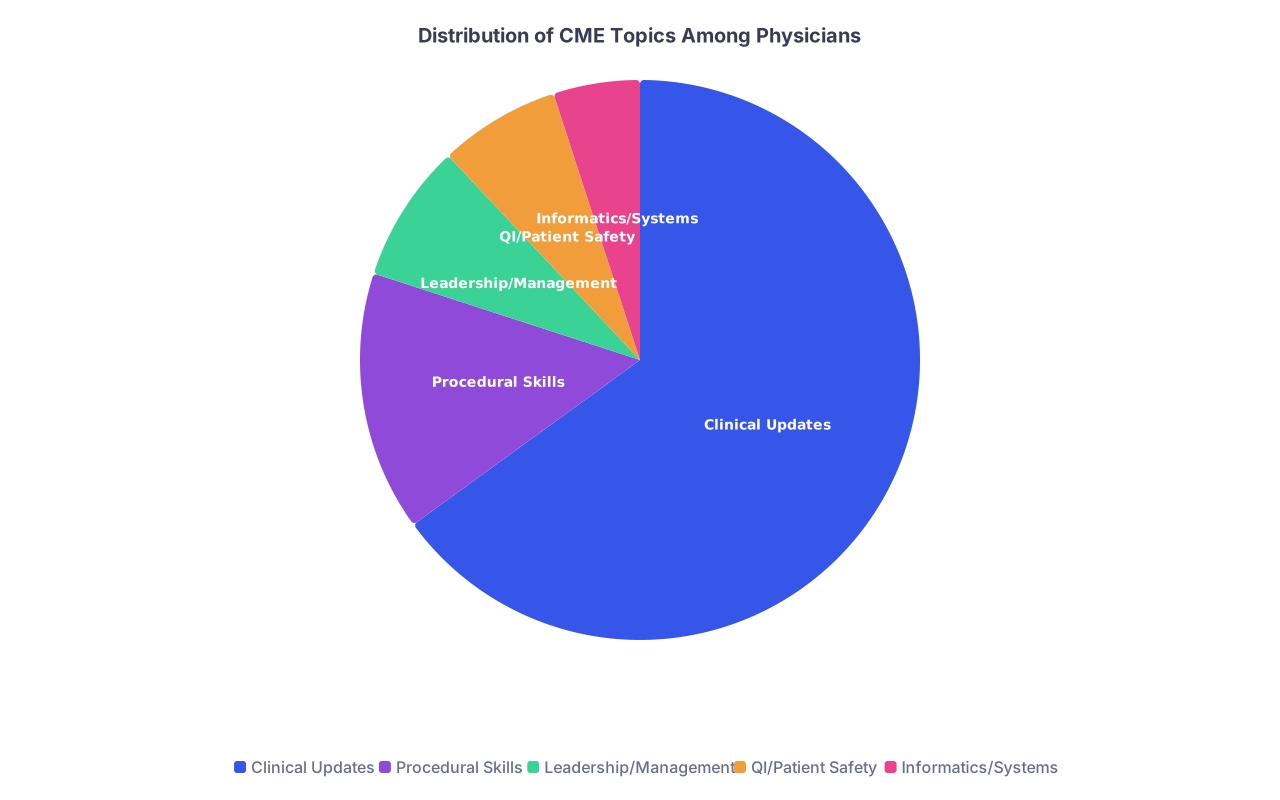
| Category | Value |
|---|---|
| Clinical Updates | 65 |
| Procedural Skills | 15 |
| Leadership/Management | 8 |
| QI/Patient Safety | 7 |
| Informatics/Systems | 5 |
That tiny slice for leadership and systems? That’s why you see so many clinicians stuck at the “good worker bee” level, never trusted to run anything.
Where this bites you
You get feedback like:
- “We’re looking for someone with leadership experience.”
- “We need people who understand systems improvement.”
- “We’d like someone with experience in education/administration.”
And you have…
More lectures on anticoagulation, COPD, or endoscopy techniques.
Those are necessary. They won’t differentiate you.
What you should deliberately add
At least 15–25% of your CME hours should be in non-clinical areas that support higher-level roles. Examples:
- Leadership academies for physicians
- Courses on conflict management and crucial conversations
- QI methodology courses tied to actual project work
- Intro to healthcare finance, operations, and strategy
- Medical education certificate programs
- Population health and health equity modules
These are the CME activities that:
- Show up in promotion dossiers as real “value-add.”
- Give you talking points in interviews and annual reviews.
- Equip you with language and frameworks leaders recognize.
Mistake #6: Never Converting CME Into Visible Output
Another quiet career killer: treating CME as consumption only.
If your CME never turns into:
- A project
- A protocol change
- A committee role
- A teaching session
- A publication or poster
…then you’re getting only about half the possible career benefit.
How this plays out
Two physicians attend the same QI-focused CME course.
- Physician A:
- Files the certificate.
- Slightly tweaks their personal practice.
- Moves on.
- Physician B:
- Uses it to lead a small QI project on readmissions.
- Presents results at M&M and then at a regional conference.
- Lists it in annual review and promotion materials.
Exact same CME. Completely different career impact.
If your CME hour totals are fine but your accomplishments page is thin, this is probably why.
How to Choose CME That Actually Moves Your Career Forward
Let’s turn this into a concrete, mistake-proof approach.
Step 1: Define a 3–5 Year Direction
Not a fantasy title. A direction.
Examples:
- “Become the go-to person for hospital-based QI and patient safety.”
- “Transition into medical education leadership.”
- “Develop expertise in outpatient procedures in my specialty.”
- “Move toward informatics and clinical decision support.”
Step 2: Set Rough CME “Buckets”
Over a 2–3 year period, aim for something like:
- 40–50%: Directly clinical, but clearly aligned with your focused niche.
- 20–30%: Non-clinical but tightly connected to your future role (leadership, QI, education, systems).
- 20–30%: High-yield procedural or skill-building workshops, or longitudinal courses.
Write this down. Literally. Then hold yourself to it.
Step 3: Apply a Harsh Filter to Every Course
Before registering, ask:
- Does this directly support the role or niche I want in 3–5 years?
- Will this give me:
- A new skill?
- A new credential?
- A project idea?
- Something substantial to talk about at my next review?
- Could I see this course being mentioned favorably in:
- A promotion letter,
- A reference,
- Or an interview?
If the answer is no to all three, that’s a red flag. You’re probably falling back into credit-chasing.
Step 4: Tie Each Major CME to One Action
For anything longer than a 1-hour webinar, write down:
“From this CME, I will implement/do/share X within 3 months.”
Examples:
- After a QI CME: propose or join a small improvement project.
- After a teaching/education CME: redesign part of how you teach students or residents, or give a workshop.
- After a leadership CME: volunteer to lead a small committee or initiative, or change how you run your team huddles.
You’re trying to convert CME from “hours logged” into “evidence of growth.”
Quick Warning Signs You’re Sabotaging Yourself With CME
If you recognize more than a few of these, you need to re-think your choices:
- You pick CME mostly based on:
- Time of day
- Cost
- Email subject line
- You can’t articulate a coherent theme across your last 3 years of CME.
- Your CV shows dozens of hours but almost no:
- Roles
- Projects
- Initiatives
- Measurable outcomes
- You tell people you want leadership/education/QI roles, but your CME log is 95% clinical minutiae.
- You feel “busy” with CME but your job title and responsibilities haven’t materially changed in 5+ years.
If that stings, good. Better annoyed now than stuck in the same role five years from today.
FAQs
1. Isn’t CME just about maintaining competence and licensure? Why overthink it?
That’s the minimum bar. If you treat CME only as “keep my license alive,” you’ll stay exactly where you are. The physicians who move into leadership, niche roles, or specialized tracks are the ones who treat CME as targeted professional development, not just regulatory maintenance.
2. How do I balance meeting board/state requirements with more strategic CME?
You do both at once by being intentional. Most strategic CME—leadership, QI, education, systems—still offers AMA PRA Category 1 Credits. You’re not choosing between “compliance” and “growth”; you’re choosing which compliant activities give you the highest return. Start by mapping your requirements, then filling them with courses that align with your future goals.
3. What if my institution only offers generic or low-quality CME?
Then do not let your entire CME portfolio be defined by convenience. Use external sources:
- Specialty society annual and regional meetings
- Online CME platforms with curated advanced or longitudinal content
- Certificate programs in education, QI, or leadership
Yes, it may cost more and take more effort. That’s exactly why it differentiates you.
4. How many hours should I devote to non-clinical CME without hurting my clinical expertise?
If you’re meeting your clinical CME needs and staying guideline-current, shifting 20–30% of your CME hours to non-clinical but role-relevant content is not going to erode your clinical skills. It will, however, dramatically increase your odds of being seen as leadership or specialized material. The risk isn’t doing too much non-clinical CME; the real risk is doing none.
5. How can I “prove” the value of strategic CME in a promotion or job application?
Connect the dots explicitly:
- List key CME activities under “Professional Development” with brief descriptions.
- Under “Accomplishments,” show how those CME activities led to:
- QI projects
- New teaching roles
- Committee leadership
- Clinical innovations or new services When your portfolio reads like “CME → new skill → new role/responsibility → outcome,” committees stop seeing your CME as fluff and start seeing it as evidence of deliberate growth.
Key points to remember:
- Random, easy-credit CME keeps you licensed but keeps your career stagnant.
- Your CME history should read like a roadmap to the role you want, not a scrapbook of whatever emails hit your inbox.
- If your CME doesn’t regularly produce visible skills, projects, or roles, you’re wasting effort that could be quietly building the career you actually want.