
The way most physicians choose CME is financially irrational.
The real unit of CME is dollars per credit
The data shows a simple truth: if you are not tracking cost per CME credit, you are almost certainly overpaying.
Most physicians think about CME in vague buckets:
- “Big annual conference.”
- “Some online modules.”
- “Maybe a board review course.”
But decision quality improves dramatically when you convert everything to a single metric: $/credit. Once you do, the spread between conferences and online platforms is not subtle. It is an order-of-magnitude issue in many cases.
Let us quantify it.
Typical cost structures: conferences vs online CME
To compare fairly, you have to break costs into:
- Direct activity fees (registration / subscription).
- Travel and lodging (for in‑person CME).
- Opportunity cost (time away from clinic – optional to monetize, but very real).
For now, focus on direct financial costs, because they are easy to benchmark.
Baseline assumptions
These are representative mid‑range values from major U.S. conferences and common online CME offerings in 2023–2024. Numbers will vary by specialty and geography, but the ratios are remarkably stable.
- Major national specialty conference:
- Registration: $900–$1,400
- Credits available: 20–30 AMA PRA Category 1 Credits™
- Regional/state conference:
- Registration: $350–$700
- Credits: 8–15 credits
- Online CME subscription (annual):
- Cost: $300–$1,200
- Credits realistically obtained: 25–60 credits
- One‑off online courses/webinars:
- Cost: $25–$200
- Credits: 1–10 credits
Let us turn this into actual $/credit benchmarks.
| CME Format | Direct Cost Range | Credits Typically Earned | Cost per Credit (Direct Only) |
|---|---|---|---|
| National in‑person conference | $900–$1,400 | 20–30 | $30–$70 |
| Regional/state conference | $350–$700 | 8–15 | $30–$80 |
| Board review in‑person course | $1,200–$2,000 | 30–45 | $27–$67 |
| Online CME annual subscription | $300–$1,200 | 25–60 | $5–$30 |
| One‑off online webinar/course | $25–$200 | 1–10 | $10–$50 |
Even without travel, the median online option tends to land around $10–$20 per credit, while conferences cluster around $40–$60 per credit.
And that is before we account for airfare and hotels.
The hidden multiplier: travel and lodging
In‑person conferences are not just registration fees. The hotel and plane ticket usually cost more than the CME itself.
Let’s work through a conservative, real-world example for a 3‑day national meeting.
- Registration fee: $1,100
- Airfare: $450
- Hotel: $275/night × 3 = $825
- Local transport & meals (after per diem/conference food): ~$275
Total out‑of‑pocket: $1,100 + $450 + $825 + $275 = $2,650
Assume you actually attend enough sessions to claim 24 credits. That yields:
$2,650 / 24 ≈ $110 per credit
Now compare that to a decent online subscription:
- Online CME subscription: $600
- Credits completed over the year: 40
$600 / 40 = $15 per credit
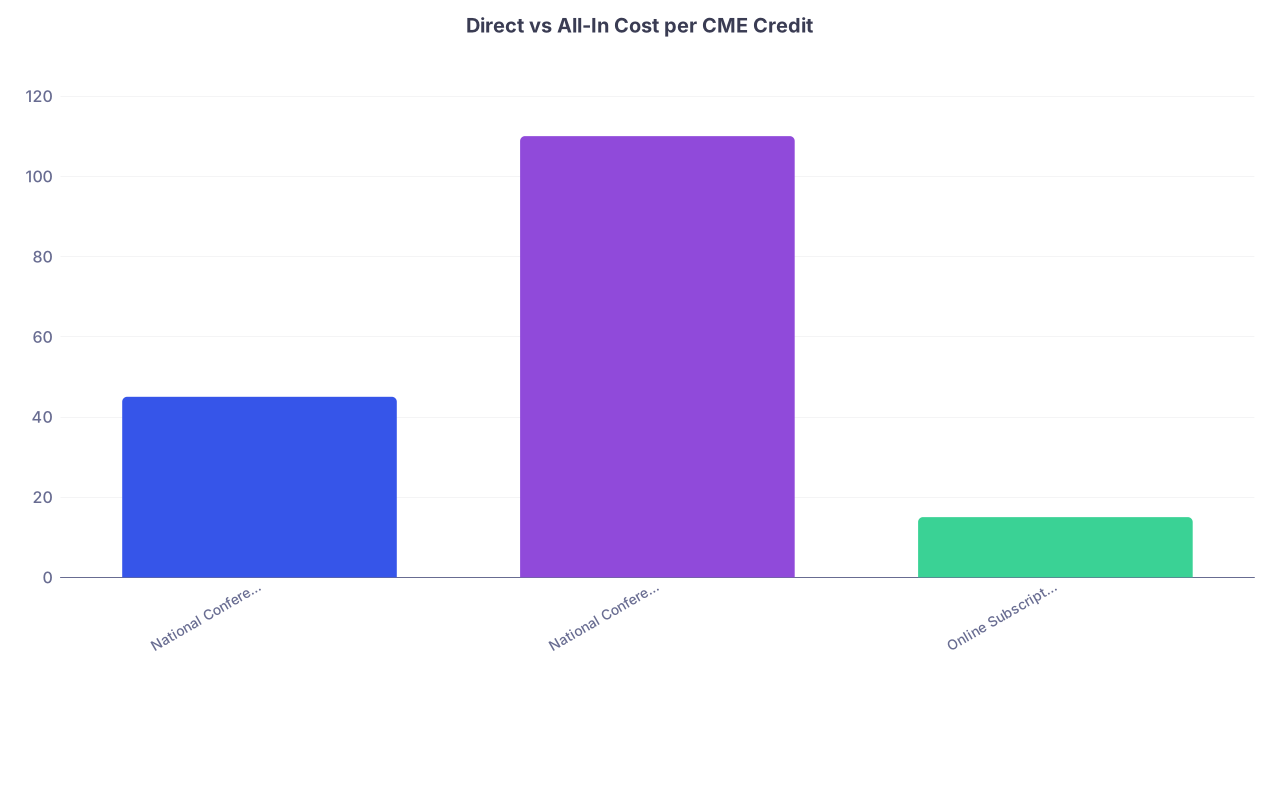
You are paying roughly 7× more per credit for the conference once all travel costs are included.
Let’s visualize that spread.
| Category | Value |
|---|---|
| National Conference (direct only) | 45 |
| National Conference (with travel) | 110 |
| Online Subscription | 15 |
Those are not rounding errors. That is a structural difference.
If your goal is “fulfill CME requirements at a reasonable cost,” conferences are a very inefficient vehicle. They are great for networking, committee meetings, and changing scenery. They are poor as a raw CME credit machine.
Specialty context: how many credits do you actually need?
Before choosing any CME strategy, quantify the requirement.
Many U.S. state medical boards and specialty boards converge around these figures:
- 25–50 CME credits per year (often 50 credits over a 2‑year period).
- Some states require specific subtypes (opioid prescribing, ethics, risk management, etc.).
- MOC (maintenance of certification) programs may layer on additional “points” or practice assessments.
For a typical attending needing 30–50 credits per year, we can map realistic strategies:
- Conference‑heavy strategy (1 major conference + scattered small items).
- Online‑dominant strategy (subscription + targeted one‑offs).
- Hybrid strategy (1 conference every 1–2 years + steady online CME).
Let’s quantify total annual cost under each.
Scenario comparison: annual CME fulfillment
Assume target = 40 credits/year.
Strategy A: Conference‑heavy
- One national conference:
- All‑in cost: $2,650
- Credits obtained: 24
- Remaining 16 credits via mix of regional/live/online at ~ $30/credit direct cost = $480
Total annual CME cost: $3,130
Cost per credit: $3,130 / 40 = $78.25
Strategy B: Online‑dominant
- High‑quality online subscription:
- Cost: $700
- Credits earned: 35
- 5 credits from special mandated topics (opioids, ethics, etc.) at $30/credit = $150
Total annual CME cost: $850
Cost per credit: $850 / 40 = $21.25
Strategy C: Hybrid (conference every 2 years)
Year with conference:
- National conference all‑in: $2,650 for 24 credits
- Subscription: $600 for 30 credits (you do not need all, but you will probably earn them; allocate 16 more toward your requirement that year)
You now have 40+ credits. If we pro‑rate the conference cost over two years (since many physicians justify it that way):
- Annualized conference cost: $2,650 / 2 = $1,325
- Annual subscription cost: $600
Annual CME spend: $1,925
Typical credits available/year: ~40–50
So effective cost per credit is closer to: $1,925 / 45 ≈ $43
Still more expensive than the online‑dominant strategy, but cheaper than being conference‑dependent.
Let me put the three side by side.
| Strategy | Annual Cost | Credits Counted Toward Requirement | Effective Cost per Credit |
|---|---|---|---|
| Conference‑heavy | $3,130 | 40 | $78.25 |
| Online‑dominant | $850 | 40 | $21.25 |
| Hybrid (conf q2y) | $1,925 | ~45 | ~$43 |
If you only care about hitting the requirement with reasonable educational value, the data is unforgiving: online‑dominant CME wins on cost efficiency by a wide margin.
Where conferences actually make sense
I am not saying “never attend conferences.” That would be naïve. Conferences do three things online CME cannot replicate well:
Networking and career leverage
- Meeting collaborators, vendors, future employers.
- Presenting research or leading sessions. That is career capital, not just CME.
Exposure to frontier topics and technologies
- You can walk a poster hall in an hour and scan an entire field’s direction.
- You can compare vendors and tools side‑by‑side, which is practically impossible online.
Psychological benefit
- Getting out of your usual environment.
- Compressed learning with fewer clinical distractions.
But those are business development and professional growth functions, not efficient CME acquisition. If you attend a conference, treat it as a strategic investment: networking, brand building, staying visible in your specialty. The CME credits should be viewed as a side benefit, not the primary justification.
When physicians rationalize a $3,000 trip primarily as a way to “get CME done,” they are ignoring the cost data.
Breaking down online CME cost per credit properly
Not all online CME is cheap. And some very “cheap” options are garbage from a learning standpoint.
You want to look at effective rather than theoretical credits.
A few variables matter:
- Catalog size vs usable content for your practice area.
- Time per credit (some platforms are more efficient than others).
- Whether the content also satisfies MOC, state requirements, or DEA/controlled substance mandates.
- How much of the subscription you actually use.
Here is the pattern I see repeatedly in real usage data from groups:
- A platform might advertise “200+ CME credits available.”
- The average clinician on that platform completes 20–40 credits.
- That is your denominator. Not 200.
So if you pay $800 for an annual subscription and realistically complete 25 credits, your true cost is $32 per credit, not $4 per credit.
You correct that by:
- Choosing platforms whose content you will actually use.
- Budgeting time for CME throughout the year rather than panic‑cramming.
- Avoiding overlapping subscriptions that cover the same ground.
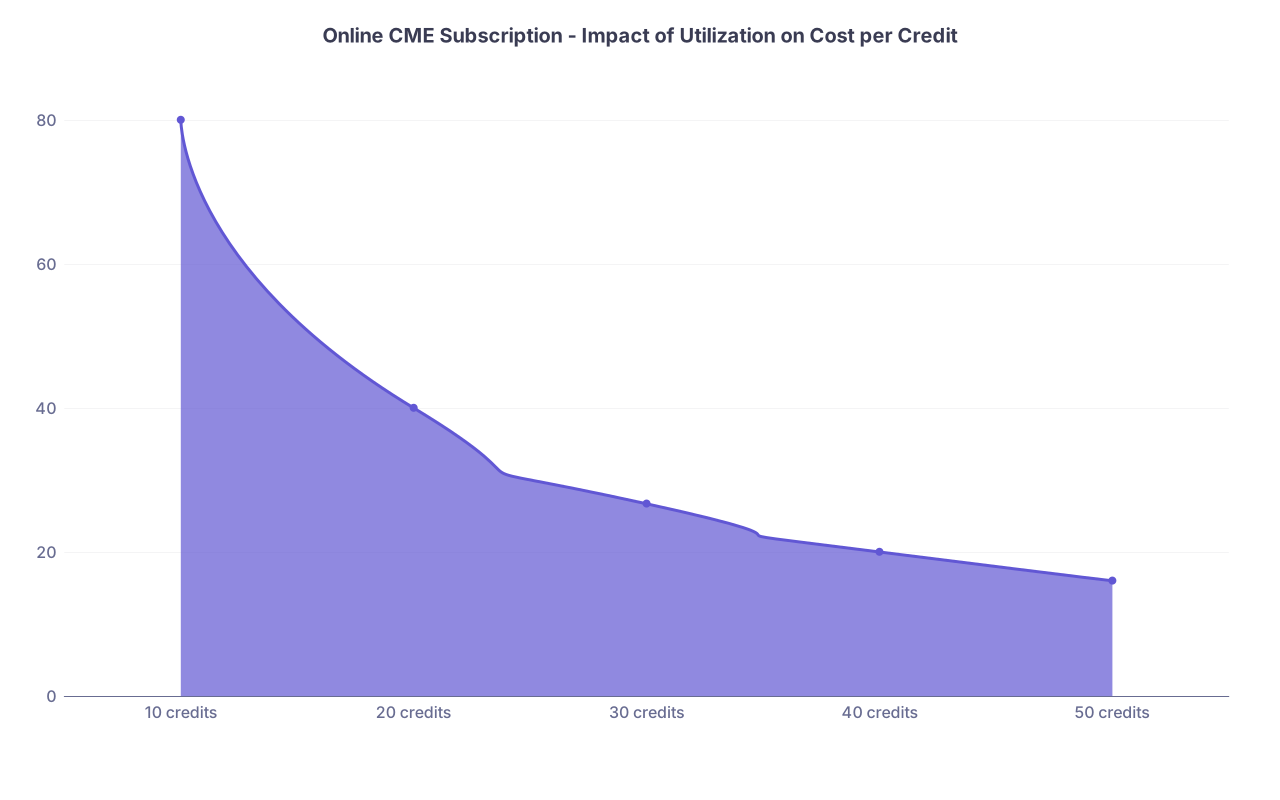
Let’s visualize how utilization changes effective cost.
| Category | Value |
|---|---|
| 10 credits | 80 |
| 20 credits | 40 |
| 30 credits | 26.7 |
| 40 credits | 20 |
| 50 credits | 16 |
Assuming a $800 subscription:
- At 10 credits: $80/credit – worse than many conferences.
- At 30 credits: ~$27/credit – competitive with low‑end conferences.
- At 50 credits: $16/credit – vastly better than in‑person.
Under‑utilized subscriptions are silent budget killers. You fix that with basic tracking.
How to benchmark your current CME cost per credit
If you have never run this calculation on your own history, do it once. The numbers are often unpleasant.
Basic method for the last 12 months:
List all CME‑related expenses
- Conference registrations.
- Travel (airfare, hotel, ground transport) clearly tied to CME.
- Online subscriptions.
- One‑off course fees.
Sum total credits claimed (not just attended)
- Pull certificates from your CME tracker, hospital system, or board portal.
- Exclude things with zero cost (hospital‑provided grand rounds) if you want a “paid CME only” metric.
Compute:
- Total CME spend / total credits = global $/credit.
Then segment it:
- In‑person events: spend and credits.
- Online CME: spend and credits.
- Free CME: credits only (for completeness).
You will probably find:
- Global $/credit: $40–$90
- In‑person $/credit: often $80–$150
- Online $/credit: often $10–$30
Once you see that spread, it becomes easier to make data‑driven changes.
Organizational vs individual economics
If you are employed or in a large group, the calculus changes slightly, because:
- There may be an annual CME stipend ($2,000–$4,000 is common).
- Some organizations cover travel for 1 conference/year.
- They may have enterprise licenses for certain online CME platforms.
Even then, I argue you should still care about cost per credit.
Why? Because hidden overheads exist:
- Every day you are away from clinic reduces RVU production or patient access.
- Groups care about coverage. Your absence pushes work onto colleagues.
- Your stipend is still money that could have been used for other professional needs (certifications, equipment, etc.).
You do not have to optimize to the last dollar, but you should know when you are buying a $20 credit vs a $120 credit. Standards matter.
Here’s a useful quick‑screen framework for groups:

| Step | Description |
|---|---|
| Step 1 | Need CME Credits |
| Step 2 | Consider 1 Conference |
| Step 3 | Use Online CME |
| Step 4 | Attend and Maximize Credits |
| Step 5 | Reevaluate ROI |
| Step 6 | Choose Targeted Modules |
| Step 7 | Use Broad Subscription |
| Step 8 | Primary Goal |
| Step 9 | Covered by Stipend? |
| Step 10 | Need Required Topics? |
The logic is simple: do not pretend networking trips are cost‑effective CME. Call them what they are, and then decide if they are worth it.
Time cost: the number physicians ignore
Money is only half the metric. The other half is hours.
A typical 3‑day conference:
- Travel: ~8–12 hours door to door, round trip.
- On‑site: 24–30 hours of sessions, plus “dead time.”
- Total time: realistically 35–45 hours for ~24 credits.
So you are spending roughly 1.5–2 hours per credit, not counting pre‑reading.
A reasonably efficient online course:
- 1 credit ≈ 1 hour of content (plus a short assessment).
- No travel overhead.
- Total time: ~1–1.2 hours per credit.
If you monetize your time at even $200/hour of clinical value, the picture becomes more extreme:
- Conference: 40 hours × $200 = $8,000 implicit time cost for 24 credits → $333/time-adjusted per credit, plus direct dollars.
- Online: 40 credits × 1.1 hours = 44 hours × $200 = $8,800 for 40 credits → $220/time-adjusted per credit.
These numbers are crude, but the direction is consistent: online CME returns more credits per hour of your life.
I am not arguing you should never leave the hospital. Just do not lie to yourself that conferences are an efficient way to “get CME done.”
Practical benchmarks and guardrails
If you want to impose some discipline, here are numbers I consider “reasonable ranges” in the current market for a U.S. physician:
Target global cost per CME credit (all-in, including conferences):
- Aggressive cost‑conscious: $15–$25
- Reasonable: $25–$40
- Wasteful: consistently above $60
For purely online CME:
- Good: $10–$20 per credit (based on actual usage).
- Acceptable: up to $30 if content is highly relevant or includes MOC.
- Overpriced: above $40/credit unless it hits very narrow mandatory topics.
For in‑person conferences (all-in):
- Under $60 per credit: relatively efficient, especially if local/driveable.
- $60–$100 per credit: only justified with strong networking or academic reasons.
- Above $100 per credit: this is a professional development trip, not a CME strategy.
Let’s lay out one more quick comparison to keep in your back pocket.
| Category | Excellent | Acceptable | Poor / Wasteful |
|---|---|---|---|
| Overall annual mix | $15–$25 | $25–$40 | > $60 |
| Online CME only | $10–$20 | $20–$30 | > $40 |
| In‑person (all-in) | < $60 | $60–$100 | > $100 |
If your own numbers are sitting in the “poor” column, you do not need another conference. You need a spreadsheet.
How to redesign your CME plan using the data
Here is a simple, rational approach you can execute in an hour:
Define a 2‑year target.
- Say: 80 credits total, including 10 credits of mandated topics.
Assign formats by function.
- Mandated topics: targeted online modules (these are often $25–$40/credit; accept that).
- Routine CME and clinical updates: online subscription that you will actually use.
- Networking / visibility: one conference every 1–2 years, treated as business development.
Constrain by cost per credit.
- Aim for global cost per credit under $30.
- If a conference pushes you above $50/credit even after averaging with online CME, reconsider.
Back‑test annually.
- At year end, redo the math: total $ spent / credits claimed.
- Adjust next year’s mix if your numbers drift upward.
To make this real, plug in numbers:
- Subscription A: $700/year, you will realistically use 30–40 credits. Call it $23/credit.
- Mandatory DEA + opioid bundle: 8 credits for $250 → $31/credit.
- One national conference in 2 years: $2,500 all‑in, yields 24 credits → $52/credit, but spread over 2 years → 12 credits/year of that cost.
Two‑year totals:
- Online CME: $700 × 2 = $1,400 → 70 credits.
- Mandatory bundle: $250 → 8 credits.
- Conference: $2,500 → 24 credits.
Total: $4,150 for 102 credits over 2 years → ~$40.7 per credit.
Still high. You could lower that by:
- Swapping the conference for a smaller regional meeting ($1,200 all‑in for 18 credits); or
- Maximizing online utilization to 50 credits/year (then online cost/credit drops significantly).
Run the numbers. Decide consciously.
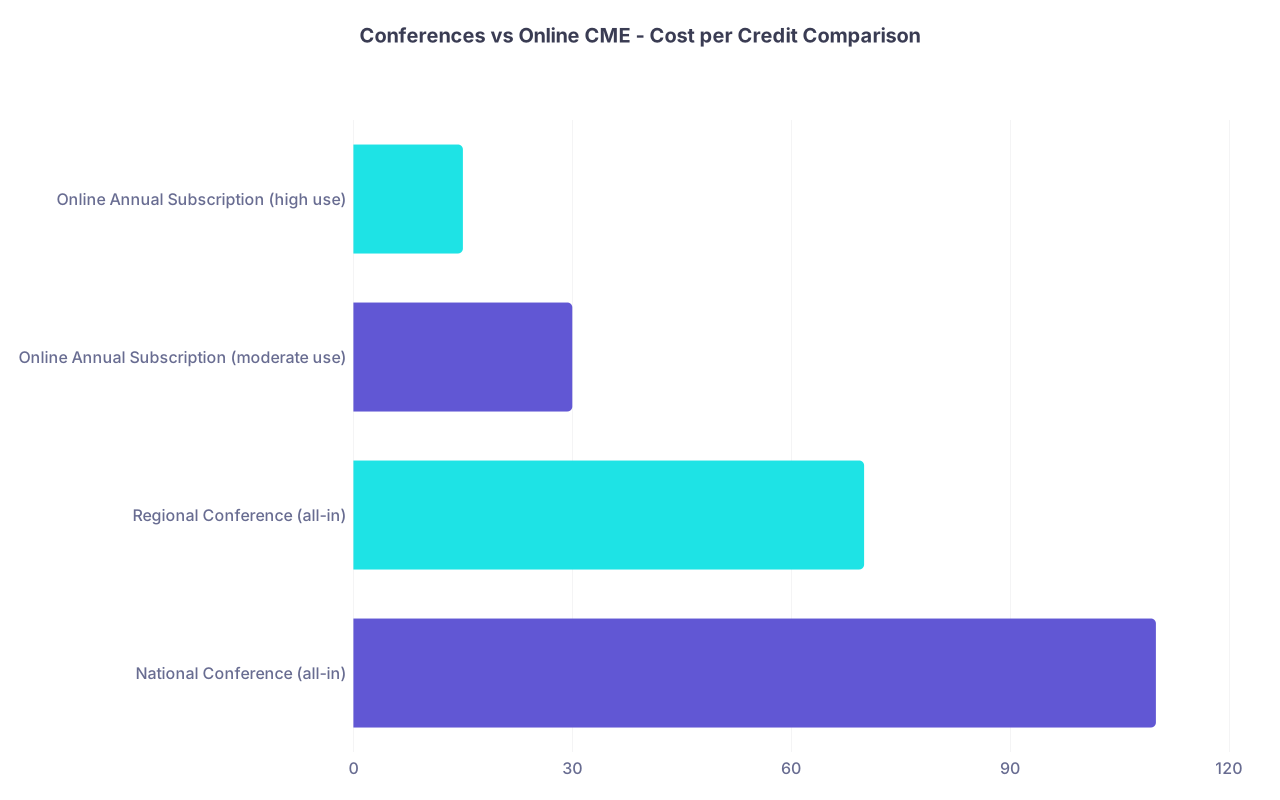
Visual snapshot: conferences vs online
To close the loop, here is a simple side‑by‑side of typical real-world scenarios.
| Category | Value |
|---|---|
| National Conference (all-in) | 110 |
| Regional Conference (all-in) | 70 |
| Online Annual Subscription (moderate use) | 30 |
| Online Annual Subscription (high use) | 15 |
The pattern is consistent:
- Conferences: expensive credits, even when direct fees look “reasonable.”
- Online CME: cost‑efficient, but only if you actually use the subscription.
Everything else is commentary.
Key takeaways
- Cost per CME credit is the only honest comparison metric. Once you factor in travel, conferences routinely run 3–7× more expensive per credit than online CME.
- Use conferences for networking and visibility, not as your primary CME engine. If your main goal is efficient credit accumulation, a well‑used online subscription wins every time.
- Track your own numbers yearly. Total CME spend divided by total credits should generally land under $30–$40 per credit; if you are consistently above that, your CME mix is financially inefficient.