
The real story about CME funding is this: protected time has very little to do with “education” and everything to do with power, billing, and who your leadership is afraid to lose.
Everyone gets the mandatory “you must complete X CME hours” emails. But only a very specific subset of people get their schedules cleared, clinics blocked, conferences paid for, and travel quietly approved. You’ve seen it and maybe blamed yourself for not “advocating better.” Let me be blunt: that’s not the main reason.
Let me walk you through how this really works behind closed doors—what actually drives CME support, who gets protected time, and why some people will always be “too busy” to leave clinic while others are flying to national meetings on departmental funds.
How CME Really Sits in the Power Structure
Here’s the dirty little secret: from an institutional standpoint, CME is a compliance checkbox and a recruitment/retention perk, not an educational mission.
The hospital CMO and legal team care that:
- Licenses stay valid
- Board certifications stay current
- Joint Commission and state boards stay off their backs
That’s it. They do not wake up wondering, “Did Dr. Smith really have an enriching educational experience this year?”
So the system is built like this:
- Minimum CME requirement: your problem.
- “Enhanced” CME (courses, conferences, protected time): leadership’s retention and branding tool.
And once something is framed as a retention tool, the politics kick in. Because now someone decides who is “strategic” enough to invest in.
Protected time for CME is rarely standardized, even in places that pretend it is. On paper, you’ll see policies that say things like:
- “Faculty are encouraged to attend one regional or national meeting per year”
- “CME is an essential component of lifelong learning”
- “Clinical duties should be arranged to allow professional development.”
In faculty meetings, attendings roll their eyes when they read those lines. Because what actually happens?
The answer depends on where you sit.
The Hierarchy of Who Gets Protected CME Time
Protected CME time is allocated in tiers, even if nobody writes it down that way. I’ve seen this pattern at large academic centers, big private systems, and community hospitals alike.
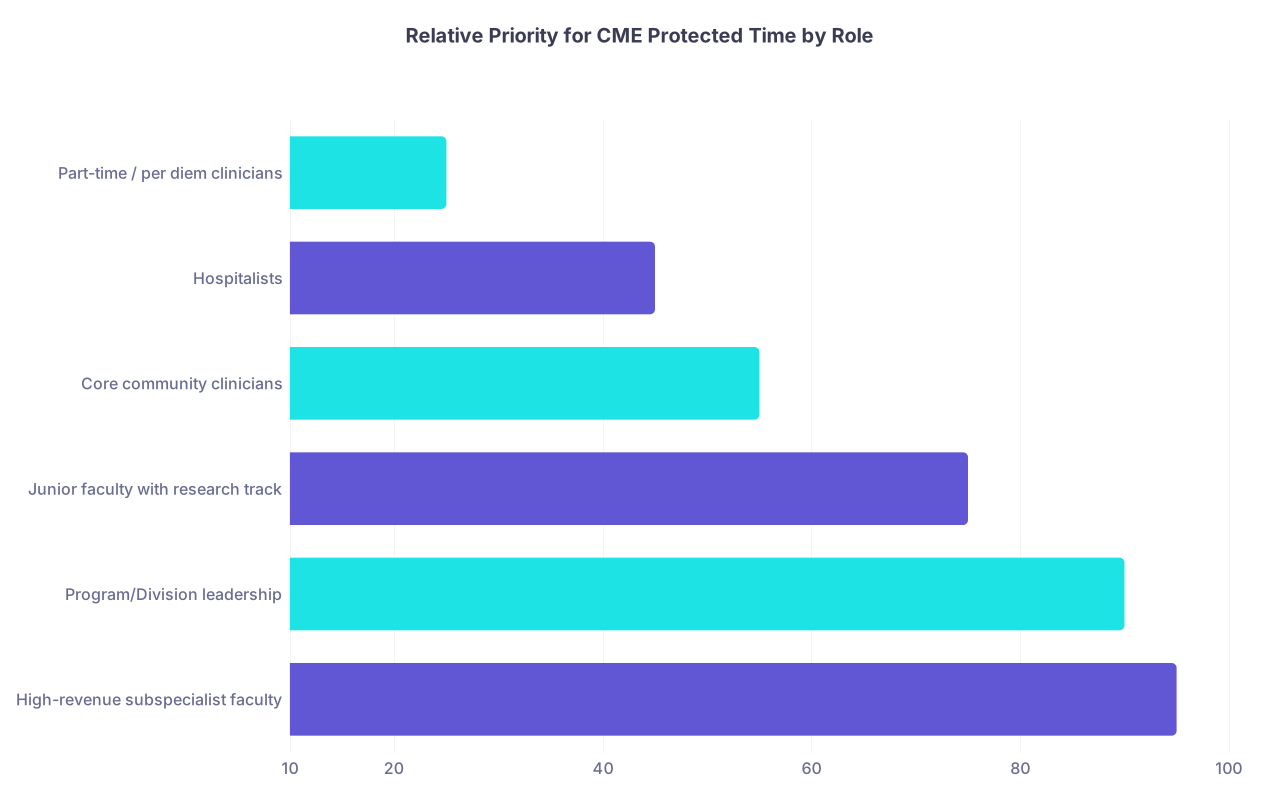
| Category | Value |
|---|---|
| High-revenue subspecialist faculty | 95 |
| Program/Division leadership | 90 |
| Junior faculty with research track | 75 |
| Core community clinicians | 55 |
| Hospitalists | 45 |
| Part-time / per diem clinicians | 25 |
Let’s translate that chart into real life:
1. High-revenue subspecialists
The interventional cardiologist bringing in seven figures? The orthopedic surgeon with a 4–6 month waitlist? They get protected CME time, almost no questions asked.
Why? Because leadership is terrified of losing them. I’ve heard the conversations in closed-door budget meetings:
“If he walks, we lose two cath rooms’ worth of volume.”
“Just block his clinic for ACC. We’ll eat the cost.”
These folks get:
- Clinics blocked for major national society meetings
- Courses explicitly tied to new procedures the hospital wants to market
- Travel and registration covered out of “strategic growth” or departmental funds
Nobody pulls up their RVU report to argue.
2. People with titles: chiefs, program directors, section heads
They are the face of the department. If they’re not “up to date,” that looks bad. So they’re funded.
But here’s the trick: their CME is often disguised as something else—leadership retreats, “strategic planning” meetings, specialty society councils. The time is baked into their administrative percent effort.
A program director, for example, might have:
- A written expectation to attend ACGME or specialty education meetings
- Protected administrative time that absorbs conference days
- Quiet coverage from associate/assistant directors during travel
So when they go to meetings, it’s not framed as “we’re blocking clinic for CME.” It’s part of their job description.
3. Junior faculty on the “track”
This group is interesting. Not all junior faculty. Just the ones someone in leadership has informally tagged as “promotable” or “retention priority.”
They’re the ones whose division chief says:
“Let’s make sure she gets to that course. We’re grooming her for X role.”
They get:
- Encouraged to attend specific meetings that align with future leadership or research goals
- Help rearranging clinics to make travel possible
- Sometimes partial reimbursement if they’re presenting
If you’re junior and you don’t get nudged toward anything, that’s data. It means you’re not on anyone’s “strategic” radar. Yet.
4. Everyone else: the workhorses
This is most of you. The people who make the clinic schedule function and the inpatient census move.
You’ll recognize the script:
- “Sure, you can go—if you find your own coverage.”
- “We can’t cancel clinic; patients have been booked for months.”
- “You have CME money in your contract, but we can’t afford to lose access this quarter.”
Translation: they’re fine if you educate yourself, as long as it does not cost them RVUs or staffing complexity.
So your CME happens:
- On vacation days
- On random days off
- After hours via online modules, podcasts, recorded webinars
And then leadership turns around and sends an annual “we support lifelong learning” email. The cognitive dissonance is… impressive.
5. Hospitalists and shift-based clinicians
Hospitalists, ED, nocturnists—this group is a bit different. Your coverage model is shift-based, so there’s at least a theoretical mechanism to free you.
Reality:
- You can get time off, but often by swapping shifts or using PTO
- Protected, paid time for CME during the year is rare unless written into your contract
- Group-funded conferences usually go to leaders or “representatives”
The politics here are more about internal group dynamics than the department chair. Who’s favored. Who’s considered a “team player.” Who the medical director wants to showcase outside.
Why Administration Quietly Fights True Protected CME Time
From an operations standpoint, true protected time is a nightmare.
You’re asking them to pay twice:
- For your salary while you’re gone
- For lost revenue (clinic, OR, consults) or coverage costs
So they do what bureaucracies always do: they talk a big education game, then design systems that make it just hard enough that only the most favored or the most determined get meaningful time.
Some of the favorite administrative moves:
- “Self-study emphasis”: Pushing online CME so they never have to touch the schedule
- “Conference cap”: Limiting funded meetings to “one per year,” then never defining what protected time means
- “Coverage responsibility”: Requiring you to secure your own coverage (which practically kills access for many, especially in understaffed services)
Behind the scenes, I’ve watched VPs say things like:
“If we standardize protected CME time for everyone, we blow our access metrics.”
“We should keep it case-by-case. Gives us flexibility.”
“Flexibility” here means “discretion,” and discretion is where bias and politics thrive.
The Criteria Nobody Admits They Use
Officially, CME support is driven by “educational value” and “alignment with departmental goals.” You’ve seen those words.
Unofficially, these are the actual filters that get applied:
| Factor | How It Really Affects You |
|---|---|
| RVU/Revenue generation | High earners get automatic yes |
| Retention risk | Flight risk gets extra investment |
| Leadership potential | Future leaders get groomed with conferences |
| Relationship with chief | Favorites get flexible coverage and approvals |
| Visibility to executives | “Showcase” people get sent to big meetings |
If you doubt this, watch what happens when two people request time for CME in the same week.
One is a high-volume proceduralist whose RVUs keep the department’s numbers pretty. The other is a low-RVU but rock-solid clinician educator.
Who gets their clinic blocked?
Every time I’ve seen that scenario in real life, the answer wasn’t even debated. They just find “creative solutions” for the high producer and tell the educator, “Maybe consider an online course this year.”
Academic vs Community: Same Game, Different Wrapping
The politics change flavor depending on where you work, but the core logic doesn’t.
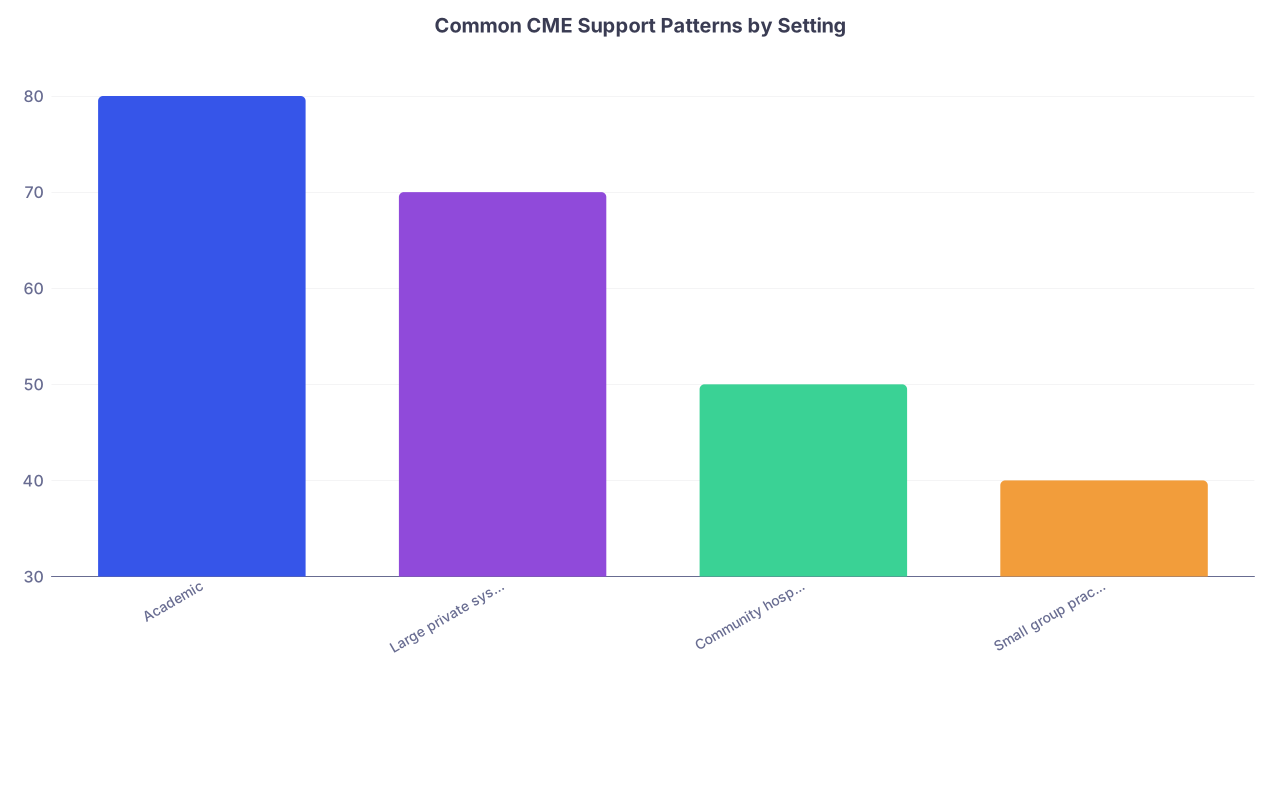
| Category | Value |
|---|---|
| Academic | 80 |
| Large private system | 70 |
| Community hospital | 50 |
| Small group practice | 40 |
Think of those values as “degree of politics involved,” not “amount of support.” Because politics scale with size and money.
Academic centers
Here the buzzwords are “promotion,” “national presence,” and “scholarly activity.”
Patterns I’ve seen:
- CME tightly tied to academic output—present a poster, get funded
- Education/teaching CME gets lip service but little protected time
- Big-name conferences treated as status markers—who goes to ASCO, ACC, RSNA is watched
Junior faculty from marginalized backgrounds often get stuck: expected to overperform on service and DEI work, then quietly blocked from conferences with the line, “We really need you on the wards that week.” I’ve heard this verbatim.
Large private systems
They love standardization. On paper you get:
- X dollars per year for CME
- Y days “allowed” for professional development
But here’s the catch: those “CME days” are not truly protected. Your use of them is subject to “operational needs.” Which, in practice, means:
- It’s easy to say yes for low-volume clinics
- It’s “impossible” to reschedule high-volume ones, unless you’re too important to say no to
So the currency is influence. How much trouble are you willing to make? And how much trouble is leadership willing to take from you?
Community hospitals and small groups
Less bureaucracy, more raw power.
If the CMO or managing partner likes you and sees you as “core,” you can get what you need. If they see you as replaceable, you’re doing CME on your own.
I’ve seen practices where:
- One senior partner attends three conferences a year, fully funded
- Everyone else uses their own money and vacation time and is told, “We’re just too lean to support that for everyone.”
Nobody says, “Because he’s a founding partner.” But everyone knows.
What People Actually Do to Get Real CME Support
You cannot rewrite your institution’s politics. But you can play the game with your eyes open.
The physicians who consistently get protected time without burning bridges tend to do a few things differently.
They frame CME as departmental value, not personal enrichment
The worst way to ask:
“I’d like to go to this conference; it would be great for my learning.”
The language that works better in real life:
- “This course will let me bring back [procedure/approach] that could expand our service line.”
- “Our outcomes in [X] lag the benchmark; this meeting is where the latest protocols are being set.”
- “We don’t currently have anyone deeply trained in [niche area]; I’d like to fill that gap.”
I’ve watched mediocre requests get approved purely because they were phrased as, “This helps the program,” not, “This helps me.”
They pre-solve the coverage problem
If you show up with:
- Proposed dates
- A written coverage plan
- Proof you’ve looked at the clinic grid and minimized impact
You transform the ask from “extra work for admin” to “rubber stamp.”
The attendings who get shut down are the ones who toss the idea out casually in a hallway: “I was thinking about going to this thing in October.” That just sounds like more work for whoever has to fix the schedule.
They get formally aligned with a niche or role
Once your identity shifts from “generic clinician” to:
- Stroke lead
- Sepsis champion
- Simulation director
- Clerkship leader
Your CME is suddenly “program development” or “education leadership,” not a random ask. That’s where many institutions quietly loosen the purse strings.
You do not need to be a full division chief. Being the “X person” in your group is enough.
They keep receipts of value
The behind-the-scenes move smart people make:
- Give a brief departmental presentation after a big meeting
- Start a small QI project based on a conference takeaway
- Share guidelines or protocols from a course in a visible way
Now leadership sees a feedback loop: send you out, you bring something back. The next time you ask, no one wants to look like the person who blocked “innovation.”
The Dark Side: Who Gets Systematically Left Out
Let’s not sugarcoat this. There are consistent patterns in who gets quietly sidelined in CME access.
- Women and physicians from underrepresented backgrounds, disproportionately loaded with service and DEI work that conveniently “makes it hard to free you up”
- Part-time clinicians, who are assumed to be “less committed” and therefore a lower investment priority
- Clinicians in low-glamour, high-need areas (SNF coverage, clinic heavy specialties, safety-net work) whose absence “hits access too hard”
I’ve heard variations of this said in leadership meetings:
“She’s already 0.8 FTE; I don’t think we can justify pulling her out more.”
“He’s so good with the complex patients—if he’s gone, our throughput tanks.”
Meanwhile, someone else with a leaner schedule and better political capital is boarding a plane to a resort city for “educational purposes.”
You are not imagining the pattern. It’s real.
What You Can Actually Do Next Year
If you want more than checkbox CME, you need a deliberate approach. Not magical. Just specific.
- Get very clear on what kind of CME you want and why. Vague “I should go to more conferences” doesn’t move anything.
- Tie your goal to something your department cares about: recruitment, outcomes, new services, resident education, marketing.
- Pick one major meeting or course and start planning 9–12 months in advance. Late requests are easy to deny.
- When you bring it up with your director, lead with value, bring a proposed coverage plan, and be explicit that this aligns with your role and growth in the department.
- After you go—even if you pay your own way—make the value visible. Short talk, protocol suggestion, a small change people notice.
You’re training your local system to associate your CME with forward movement, not inconvenience. That’s how you gradually move yourself from “optional” to “must support.”
FAQ: The Quiet Politics of CME Funding
1. Is it normal to have to use vacation time for CME?
Sadly, yes. Many institutions treat CME as something you’re “allowed” to do but not something they’ll proactively protect. You’re not uniquely disadvantaged if this is your current setup. It does, however, mean your contract and local culture aren’t prioritizing you beyond regulation minimums.
2. How much CME should I reasonably expect my employer to fund?
For most employed physicians, a modest annual stipend (e.g., $2,000–$4,000) and a few days per year “available” for CME is the norm on paper. The important question is not the money, it’s whether those days are truly protected or always “subject to operational needs.” The latter is a loophole big enough to drive a bus through.
3. As a resident or fellow, do I have any real leverage for CME?
More than you think, but it’s indirect. You can often get support to attend specialty society meetings if you’re presenting. Program directors like showcasing trainees; it helps with accreditation narratives and recruitment. Framing your ask as “this highlights our program” is much more effective than “I’d really like to go.”
4. I’m in a low-RVU specialty. Am I doomed to second-tier CME access?
Not necessarily, but you won’t win by arguing RVUs. Instead, tie your CME to things your department can brag about: patient satisfaction, safety initiatives, resident teaching, or new quality metrics. Low-RVU but high-visibility or high-impact roles can get surprisingly good support when positioned correctly.
5. My colleagues seem to get approved for conferences I’m denied. How do I confront that?
Do not open with accusation. Ask for criteria. “I’d like to understand what factors you consider when approving CME time and funding so I can plan better.” Then listen carefully. You’ll often hear the real priorities between the lines—service coverage, seniority, leadership roles, alignment with departmental initiatives. Once you know the hidden rules, you can decide if you want to play within them, push against them, or start planning your exit.
With this lens, you’ll never look at a “CME opportunity” email the same way again. Protected time is not a random privilege; it’s a mirror of your institution’s real priorities and your place in that hierarchy.
The next move is yours: decide what kind of CME you actually want and how you’ll position yourself so that when the calendars get made and the budgets get cut, you’re one of the people they quietly make room for. The politics of promotion, leadership roles, and who gets invited to the decision table are built on the same foundations—but that’s a story for another day.