
The fastest way to quietly destroy a career you spent decades building is to ignore your specialty‑specific CME rules. Not burnout. Not one bad patient outcome. Neglecting your board and state CME requirements will do it faster and with far less sympathy from anyone.
Let me be blunt: “I did not know” has never once saved a physician from board lapse or a licensure problem. The systems are set up so that if you are not actively on top of this, you are assumed to be non‑compliant. Period.
You think you are safe because you are going to conferences and clicking through random online modules? That is exactly how smart, competent physicians end up with a shocking email from their board: “Your certification has lapsed.”
This is avoidable. But only if you stop treating CME like background noise.
1. The Complacency Trap: “CME Is CME” (No, It Is Not)
The most common and most dangerous mistake is assuming all CME is interchangeable. “I hit 50 hours, so I’m good.” That mindset is how people lose board status.
Your specialty board does not just care about the quantity of CME. They care about:
- Type (AMA PRA Category 1 vs 2, self‑assessment, performance improvement, etc.)
- Topic (specialty‑relevant vs generic)
- Format (live vs enduring, accredited vs non‑accredited)
- Time window (cycle‑based: 3, 5, 10 years; or annual)
And they are increasingly inflexible about it.
Some very real examples I have seen:
- A cardiologist with 120+ CME hours… but only a handful were cardiology‑specific. The rest were generic leadership, wellness, and medico‑legal lectures. Strong content. Completely useless for his American Board of Internal Medicine (ABIM) Maintenance of Certification (MOC) requirements.
- An anesthesiologist who did 50 hours of CME over two years, all AMA PRA Category 1… but her board (ABA) required MOCA‑specific activities including simulation and QI. She had hours, but not the right hours.
- A pediatrician who did tons of CME in practice but never logged it properly into the ABP portal. On paper, to the board, it looked like she did almost nothing. She found out the hard way.
Here is the pattern:
Physician thinks: “I’m learning. I’m going to conferences. I’m fine.”
Board thinks: “You did not meet our exact specifications. You are not fine.”
The minimum you must know (and document) for your specialty
You need a written summary for your own use that answers:
- Total CME hours per cycle
- How many must be specialty‑specific
- How many must be certain formats
- Self‑assessment (SA‑CME, SA‑MOC, etc.)
- Performance improvement (PI‑CME)
- Simulation, case review, etc.
- Any exam requirements (secure exam, longitudinal assessment, question‑bank type programs)
- Deadlines (annual vs end‑of‑cycle)
If you cannot answer those for your board right now, you are already at risk.
2. The False Security of “I’m Meeting State CME Requirements”
Another huge trap: confusing state license CME rules with specialty board CME rules and assuming they are interchangeable.
They are not.
Your state board might say something like: “50 hours of CME every 2 years, 2 hours in opioid prescribing, 1 hour in ethics.” Fine. That keeps your license alive.
Your specialty board might be saying: “Participate in longitudinal assessment every year, complete 1–2 performance improvement modules, and log X hours of specialty‑specific CME over a 5‑year cycle.”
Different systems. Different requirements. Different consequences.
| Requirement Type | State Medical Board | Specialty Board |
|---|---|---|
| Primary purpose | Licensure | Certification |
| Cycle length | 1–3 years | 3–10 years |
| Focus | General practice | Specialty‑specific |
| Content type | Broad CME allowed | Prescribed formats |
| Consequence | Licensure risk | Board status risk |
Here is the mistake: Physicians hit their state CME number and assume they have covered themselves. They ignore the specialty‑specific rules until they are one email away from disaster.
You must treat these as two separate checklists:
- Checklist A: State license CME (opioid hours, ethics, risk management, etc.)
- Checklist B: Board certification CME / MOC / MOCA / CC
If your calendar has reminders for license renewal but not for your specialty CME cycle milestones, you are under‑protected.
3. Hidden Specialty Landmines That Cost People Their Boards
Every specialty has its own little twists that catch people off guard. You cannot afford to be ignorant of yours.
Here are some real problem areas I keep seeing.
3.1 Radiology and the SA‑CME trap
Radiologists will often pile up general CME from meetings, tumor boards, or industry‑sponsored dinners and feel safe. Then they discover that:
- The American Board of Radiology (ABR) requires SA‑CME (self‑assessment CME) with specific credit types.
- Random grand rounds do not always count as SA‑CME.
- Certain subspecialty requirements are buried in fine print.
Result: radiologists with hundreds of hours of “CME” but not enough of the board‑approved CME categories required to maintain certification.
3.2 Surgeons and QI/PI requirements
Many surgical boards, like the American Board of Surgery (ABS), want:
- Participation in practice improvement projects
- Engagement in registry‑based assessment
- Sometimes procedure volume documentation tied to CME pathways
Surgeons who assume “operative volume plus conferences will be enough” get burned when they skip the formal PI modules or registry‑linked CME that the board actually tracks and audits.
3.3 Psychiatrists and MOCA‑style programs
Psychiatry (ABPN), neurology, and similar boards increasingly use:
- Continuing certification programs built around regular question‑based assessments
- Activity requirements tied to specific board portals
Ignoring email invites to start these longitudinal assessments is not harmless procrastination. It creates gaps that board systems interpret as non‑engagement, which is a direct route to “not meeting certification requirements.”
4. The Documentation Disaster: “I Did The CME, I Just Cannot Prove It”
Another classic way to jeopardize board status is much more boring but just as deadly: documentation failure.
Boards do not care what you remember doing. They care what you can prove. If you cannot produce documentation when they audit, you are in trouble.
I have watched senior attendings scramble through old email archives, dig through conference tote bags, and call CME offices begging for attendance records from years prior. Sometimes they succeed. Often, they do not.
Common documentation mistakes:
- Relying solely on the activity provider’s website without downloading certificates.
- Never backing up CME certificates to a centralized location.
- Assuming “it is in the system somewhere” (systems change, vendors close, portals get redesigned).
Here is your red flag test: If tomorrow your board asked for the last 6 years of CME documentation, could you produce it within 24 hours?
If the answer is no, you are unnecessarily exposed.
A simple, non‑negotiable system (that people still skip)
You need one master CME folder system:
- A main directory:
CME_[YourName] - Subfolders by year (or by board cycle)
- In each folder:
- CME certificates (PDF)
- Screenshots of completion pages if certificates are not available
- Summary spreadsheet with:
- Date
- Provider
- Title
- Number of credits
- Category (Category 1, SA‑CME, PI‑CME, etc.)
- Notes on how it applies to board or state requirement
Yes, this is tedious. So is explaining to a credentialing committee why your board status is “lapsed – administrative noncompliance.”
5. Online CME Portals: Helpful, Until They Mislead You
Another subtle mistake: blindly trusting institutional or third‑party CME dashboards.
Hospital CME portals, specialty societies, and large CME vendors often show you:
- Total hours completed
- Categories of CME
- Some breakdowns by topic
The problem is: their categories do not always match your board’s categories.
I have seen this scenario:
- Portal says: “You have 80 CME hours this cycle.”
- Physician relaxes.
- Board says: “You are short 10 hours of board‑approved self‑assessment CME and have not met the longitudinal assessment part.”
Why? Because:
- The portal counts every recorded activity.
- The board only counts activities from accredited, recognized providers and specific activity types that they approve.
You must treat any automated “you are on track” message with suspicion unless it comes directly from your specialty board’s own portal.
If your board offers a dashboard (ABIM, ABR, ABEM, etc.), that is your source of truth. Everything else is a rough guide at best.
6. The Deadline Illusion: “I’ll Fix It Before Renewal”
A lot of smart, busy doctors decide they will “catch up” on CME right before the renewal deadline. This is survivable for simple hour‑based systems. It is a terrible idea for modern specialty certification.
Why this strategy fails now:
Longitudinal assessments are time‑gated.
You cannot do three years’ worth of annual question modules in one weekend.Performance improvement projects take real time.
QI projects, chart reviews, and registry‑linked CME are not night‑before activities.Providers close, content expires.
Some CME activities have availability windows. You may find options have disappeared.Board portals are not instantaneous.
Uploads, verifications, and data transfers from CME providers can take days to weeks. Waiting until day 0 is a gamble.
](https://cdn.residencyadvisor.com/images/articles_svg/chart-cme-completion-timing-among-physicians-1824.svg "CME Completion Timing Among Physicians")
| Category | Value |
|---|---|
| Early planners | 15 |
| Steady pace | 35 |
| Last 6 months | 30 |
| [Last 30 days](https://residencyadvisor.com/resources/continuing-medical-education/behind-on-cme-credits-a-30-day-recovery-plan-for-busy-physicians) | 20 |
That last 20%—the “last 30 days” group—is where you see frantic emails, expedited CME purchases, and unfortunately, people who still fall short.
You want to be in the steady pace group, not the “I am trying to buy everything on some random CME site at 2 a.m.” group.
7. Employment, Credentialing, and Malpractice Fallout
Losing board status because of CME non‑compliance is not just an academic issue. It has concrete, career‑altering consequences.
Hospital privileges
Most hospitals require:
- Active, unrestricted state license
- Current board certification (or eligibility within a defined time frame)
- Ongoing participation in MOC/CC/MOCA etc.
If your board certification status changes to “lapsed,” “not participating,” or “expired,” your credentials committee will notice. Often:
- You get placed on probationary status
- You may have to submit a remediation plan
- In serious cases, privileges can be suspended or not renewed
Once that happens, every future credentialing packet asks about it.
Employer contracts
Many physician employment contracts contain language like:
- “Physician will maintain board certification in [specialty]”
- “Failure to maintain certification is grounds for termination”
I have seen physicians scramble to fix a certification lapse before HR or administration formally acts. Some succeed. Some are let go quietly.
Malpractice and payer issues
Certain malpractice carriers and payers see board status as a proxy for quality. A sudden lapse can trigger:
- Higher premiums
- Extra underwriting questions
- Payers challenging network participation or requiring explanations
This is how what started as “I forgot to complete some CME modules” turns into a cascade of professional damage.
8. Red Flags That You Are Headed For Trouble
You do not need a psychic. There are clear warning signs you are on the wrong track with specialty‑specific CME:
- You cannot clearly state your board’s current CME/MOC requirements.
- You are unsure when your current cycle ends.
- You have not logged into your specialty board portal in over 12 months.
- You rely entirely on email reminders from your board (and your spam filter is aggressive).
- You assume your institution is tracking CME for you.
- You think “I have always done conferences; I will be fine.”
If any of those describe you, stop assuming “it will work out.” This is not the kind of system that works itself out in your favor.
9. How to Stop Jeopardizing Your Board Status (Without Making CME Your Full‑Time Job)
You do not need a 40‑page manual. You need a short, strict system.
Step 1: Get the rules from the actual source
Not from colleagues. Not from a random blog. From your specialty board’s website and/or portal.
Print or save:
- Current CME / MOC / CC requirements
- Cycle dates
- Specific activity types required
Highlight anything that is not just “hours.”
Step 2: Build a one‑page personal requirement summary
One page. For your eyes only. Include:
- Your board
- Your cycle start and end dates
- Required:
- Total CME hours
- Specialty‑specific hours (if defined)
- Self‑assessment activities
- PI/QI modules
- Longitudinal assessment participation
- Any key deadlines (annual, mid‑cycle milestones)
Keep this in the front of your CME folder and on your desk / desktop.
Step 3: Map current CME to those rules
Look at the last 1–2 years of CME you actually did. For each, ask:
- Does this meet board‑recognized CME criteria?
- Does it fulfill a specific requirement (e.g., SA‑CME, PI‑CME)?
- Have I logged it in my board portal if required?
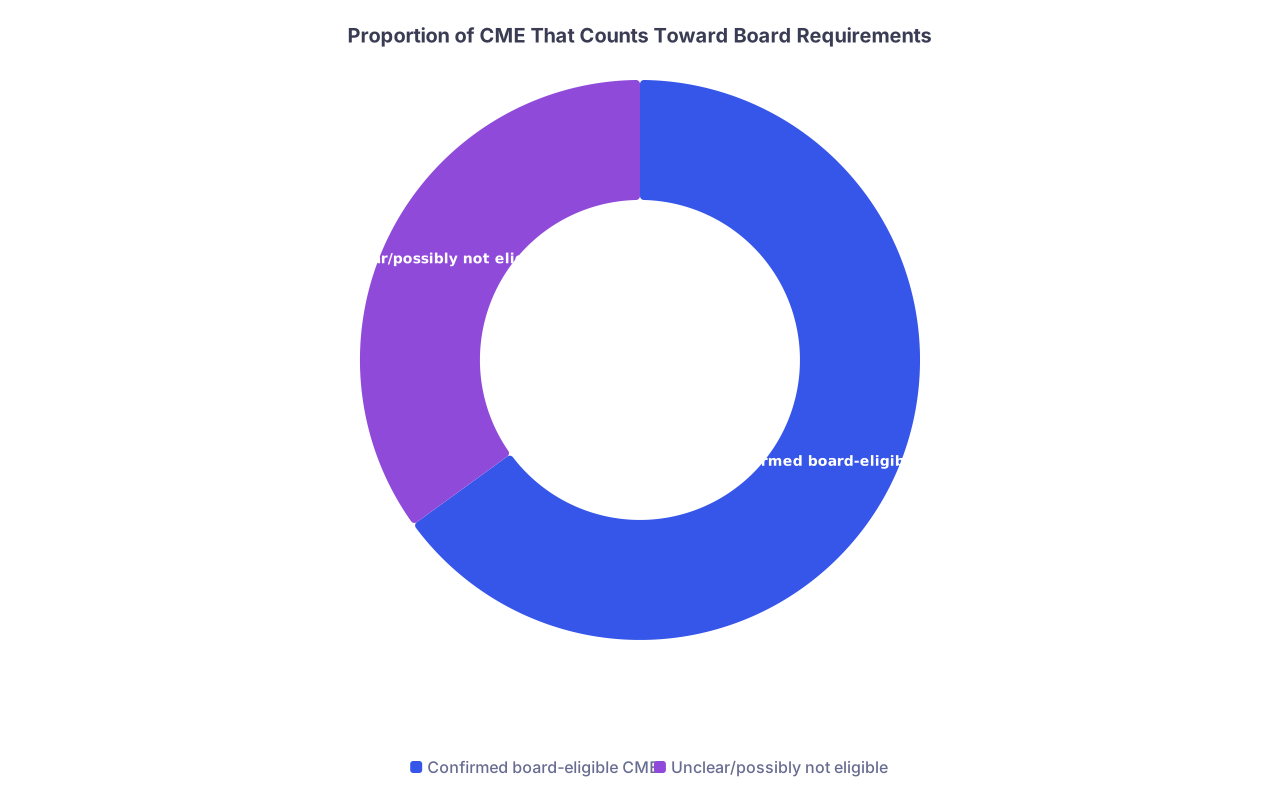
| Category | Value |
|---|---|
| Confirmed board-eligible CME | 65 |
| Unclear/possibly not eligible | 35 |
If that “unclear” portion is big, you are one cycle away from a crisis.
Step 4: Set quarterly check‑ins with your board portal
Not yearly. Quarterly.
Every 3 months:
- Log into your specialty board portal.
- Confirm your progress bar (if they use one).
- Check for new or changed requirements.
- Make sure recently completed CME is actually credited.
Ten minutes quarterly beats ten frantic days at the end of the cycle.
Step 5: Stop doing random CME, start doing targeted CME
You do not have unlimited time. So stop wasting it on CME that does not advance your board or license status.
Before you sign up, ask:
- Is this accredited for AMA PRA Category 1 (or equivalent)?
- Does it meet a specific board requirement (e.g., self‑assessment) or at least count as specialty‑relevant CME?
- Will I get a downloadable certificate and/or automatic transmission to my board?
No certificate, no clear accreditation, no obvious mapping to your requirements? Skip it or treat it as “bonus learning,” not requirement fulfillment.
10. The Bottom Line: This Is Not Optional Admin Work
Ignoring specialty‑specific CME rules is not like ignoring hospital flyers or the latest wellness initiative. This one hits the core of your professional identity: your ability to call yourself board‑certified and to keep practicing the way you want.
If you want the short version:
- Stop assuming all CME counts. Your board has very specific categories and requirements. Learn them.
- Separate “keep my license” from “keep my board certification.” They are two different sets of rules. You must satisfy both.
- Do not rely on memory, portals, or last‑minute panic. Build a simple tracking system, verify everything in your board portal, and chip away at requirements steadily.
The mistake most physicians make is not laziness. It is misplaced confidence. “I am doing plenty of CME; I will be fine.” That sentence has cost people their board status, their privileges, and in some cases their jobs.
Do not be one of them.