
Prescribers get into trouble not for lack of knowledge, but for sloppy compliance with a patchwork of state CME rules that almost no one explains clearly.
Let me fix that.
You want to prescribe controlled substances across multiple states without waking up one day to a surprise audit, a board letter, or a DEA visit. That means your “prescribing and controlled substance CME” strategy has to be smarter than just grabbing a random opioid webinar every two years.
Here is how you actually meet multi-state controlled substance CME requirements without losing your mind—or your license.
1. The Reality: Multi-State Prescribing Is a Regulatory Trap
If you practice telemedicine, cover locums, work for a national virtual group, or hold licenses in a few bordering states, you are already in the highest‑risk group for getting this wrong.
The core problems:
Each state issues its own CME mandates for:
- License renewal
- Controlled substance prescribing
- Opioid/pain management
- “Drug diversion” or “safe prescribing”
- Implicit bias / SUD stigma (in some states under the same umbrella)
These rules change. Often. Mid-cycle. Sometimes without fanfare.
Many physicians assume:
- “If I meet my home state requirement, I’m covered.” Wrong.
- “If I have DEA X-waiver training, I’m fine.” Also wrong, and X-waiver is now gone anyway.
- “Our corporate compliance team will tell me.” Often wrong, especially for 1099 or contract telehealth work.
You need to think state-by-state and cycle-by-cycle. Like a checklist, not a vibe.
2. Core Concepts: What Actually Counts as “Controlled Substance CME”
Before you start listing state rules, understand the categories. Boards do not all use the same language, but they cluster around similar themes.
Common buckets:
- Opioid prescribing
- Pain management (acute and/or chronic)
- Controlled substances (broad, including benzodiazepines, stimulants, sedatives)
- Risk mitigation and addiction / substance use disorder (SUD)
- PDMP use and documentation
- Federal and state regulations around prescribing
The key thing I have seen trip people up: states may demand specific content elements. For example:
- “Must cover non-opioid alternatives to pain treatment.”
- “Must address signs of substance use disorder and referral.”
- “Must include risk evaluation and mitigation strategies.”
- “Must include state-specific controlled substance rules or PDMP requirements.”
If your activity does not hit those, the board can say “nice lecture, but it does not satisfy our requirement.”
3. How State Requirements Differ (And Why Multi-State Is Hard)
Let me make this concrete.
You hold licenses in:
- California
- Florida
- Texas
- Virginia
You prescribe controlled substances via telemedicine and in-person.
Those four states represent four different patterns of controlled substance CME requirements, renewal cycles, and content expectations. Multiply that by 2–6 licenses and you understand why people quietly panic during renewal season.
| State | Hours Required | Frequency | Focus Area |
|---|---|---|---|
| California | 2+ hrs | Per 2-year cycle | Pain management / SUD |
| Florida | 2 hrs | Every renewal | Prescribing controlled substances |
| Texas | 2+ hrs | Per 2-year cycle | Opioids abuse / pain |
| Virginia | 2 hrs | Per 2-year cycle | Pain management / opioids |
That table is illustrative, not a live legal reference. The exact numbers move. The pattern does not:
- Some states require controlled substance CME every cycle.
- Others require it once at first renewal, then general CME later.
- Some specify exact hours in opioids, others say controlled substances broadly.
- Some demand state-specific content (e.g., PDMP in their state).
If you assume “2 hours on opioids from any ACCME provider covers everything,” you will eventually be wrong somewhere.
4. The Regulatory Stack: Who You Actually Answer To
You are not dealing with just “the state.” You are balancing overlapping authorities:
- State medical board(s) – license renewal CME and conduct standards
- DEA – registration to prescribe federal scheduled drugs
- State pharmacy / controlled substance authority – sometimes separate boards
- Payers (Medicare, Medicaid, commercial) – documentation and utilization scrutiny
- Employers / health systems – internal prescribing and CME policies
Most controlled substance CME rules for licensure are set by state medical boards and legislatures, not by DEA. DEA doesn’t say “you need 2 hours per year,” but it absolutely cares about your patterns and documentation.
So you should structure your CME plan to satisfy:
- The strictest relevant state requirements you face
- Your risk exposure (how heavily you prescribe and to what populations)
- What is realistically achievable without chasing 30 different niche courses
5. Step One: Build a Clean State-Specific Requirements Map
You cannot “wing” multi-state compliance. You need a state map.
Here is the disciplined way to do it.
A. List all jurisdictions
Not just where you live. Everywhere you hold an active license and/or active DEA registration.
Create a simple spreadsheet with:
- State
- License number
- Renewal date
- Renewal cycle length (1, 2, or 3 years)
- Any special designations (osteopathic, telemedicine-only, etc.)
B. Pull the official CME rules for each state
You should not rely on blog posts, CME vendors, or generic summaries. These are always lagging behind.
Go directly to:
- State medical board website “CME Requirements” or “License Renewal”
- Statutory references (some boards link to the specific law)
- Any “FAQ for opioid prescribing / controlled substances”
Document exactly:
- Total CME hours per cycle
- Required hours in prescribing / pain / controlled substances
- Whether the requirement is:
- One-time only
- First renewal only
- Every renewal
- Any mandatory subtopics:
- PDMP use
- State-specific opioid rules
- Non-opioid pain treatment
- SUD identification and treatment
If the board uses vague language like “may include,” you treat that as optional. If it says “must include,” you obey that literally.
C. Where physicians misread the rules
The two most common mistakes I see:
Confusing “one-time” vs “every renewal.”
Example: A state required 3 hours in opioid prescribing at the first renewal after a certain year. Years later, physicians are still repeating it every cycle when it was never required again—or worse, they skipped the one-time requirement entirely.Confusing “must be state-specific” vs “general opioid CME is fine.”
A generic national opioid course might not address the state’s PDMP laws or specific regulations. If the board demands that, you need a course clearly designed for that state.
Do not guess. If unclear, email the board, screenshot their response, and file it with your CME records.
6. Step Two: Design a Multi-State CME Strategy That Actually Scales
Once you know what each state wants, you can stop grabbing random courses and start thinking globally.
A. Identify the “highest bar” states
Some states are trivial (no specific controlled substance CME). Some are demanding and specific.
You structure your CME around the strictest overlapping requirement you have, then layer in state-specific items where absolutely necessary.
For example:
- State A: 2 hours opioid prescribing every cycle
- State B: 3 hours pain management including non-opioid alternatives every cycle
- State C: One-time 3 hours on state PDMP and opioid rules
Your smart plan:
- Take a 3-hour pain management + opioid course that includes non-opioid alternatives each cycle (covers A and B).
- In the first renewal for State C, complete a state-specific 3-hour PDMP / opioid law course once and keep that certificate forever.
You do not need nine different 1-hour modules, all repeating the same content in slightly different flavors.
B. Prioritize CME types that are broadly accepted
Most boards recognize CME if it is:
- Accredited by ACCME (physicians) or AOA (osteopathic)
- Jointly provided by a hospital, medical school, or recognized national medical society
- Clearly labeled as “opioid prescribing,” “pain management,” or “controlled substance prescribing”
Look for activities that specifically state:
- “Meets X state requirement” or
- “This activity is designed to meet regulatory CME requirements on opioid prescribing and pain management”
This is not legally binding, but it is a strong signal that the content is structured to satisfy common board standards.
7. Step Three: Choose CME That Covers What Boards Actually Look For
Most boards do not sit down and watch your CME videos. They look at documentation and content descriptors.
You want your controlled substance CME to check these boxes:
Clinical fundamentals of prescribing
- Indications and contraindications for opioids and other controlled drugs
- Risk factors for misuse, overdose, diversion
- Opioid equivalence, tapering, rotation
Non-opioid and non-pharmacologic pain management
- NSAIDs, acetaminophen, adjuvants
- Neuropathic pain agents
- Physical therapy, CBT, interventional pain options
Regulatory and legal framework
- Federal controlled substance schedules
- State-specific prescribing limits (e.g., days’ supply for acute pain)
- Requirements for written vs electronic prescriptions
- EPCS (electronic prescribing of controlled substances) rules where applicable
Risk mitigation and documentation
- PDMP query requirements and practical workflow
- Opioid treatment agreements
- Urine drug testing strategies and pitfalls
- Documentation wording that actually holds up in a chart review
Addiction, overdose, and SUD
- Recognizing opioid use disorder
- Screening tools
- Brief intervention strategies
- Referral pathways and medication-assisted treatment basics
When you read a course description and it covers at least 3–4 of these themes, it tends to satisfy most state “prescribing and controlled substance CME” language.
8. Common Multi-State Pitfalls and How to Avoid Them
Let me be blunt. These are the ways people get burned.
Pitfall 1: Assuming one mega-course covers every state forever
Example:
A physician does a 6-hour national opioid course in 2021. By 2025:
- Two of their states have switched from “one-time” to “every-cycle” CME requirements
- One state now mandates state-specific PDMP instruction
- The physician has not done any additional opioid CME
On audit, that 2021 course may not cover the current rules. Boards care about timing within the renewal cycle and alignment with current regulations. You cannot coast indefinitely on one old certificate.
Pitfall 2: Counting non-accredited education
Journal clubs, internal hospital in‑services, and informal compliance meetings are not automatically CME. If it does not carry CME credit from an accredited body, many boards will not count it.
You can sometimes get “special credit” with documentation and extended explanation, but it is not worth betting your license on that.
Pitfall 3: Poor documentation and record-keeping
The board does not want your entire educational life story. They want three clean things:
- CME certificate with your name, date, and accredited provider
- Description/title clearly reflecting controlled substance/pain content
- Number of credit hours and type (Category 1, AOA, etc.)
If you cannot pull those up quickly, you look disorganized at best, suspicious at worst.
I recommend a simple structure:
/Year/State/CME-Opioids/
with PDFs named:2024-06-15_Opioid-Prescribing-Update_3-CMEhrs.pdf
Boring, yes. But it saves people when they are blindsided by a random audit years later.
9. Matching CME Strategy to Practice Risk Profile
Not everyone needs the same depth.
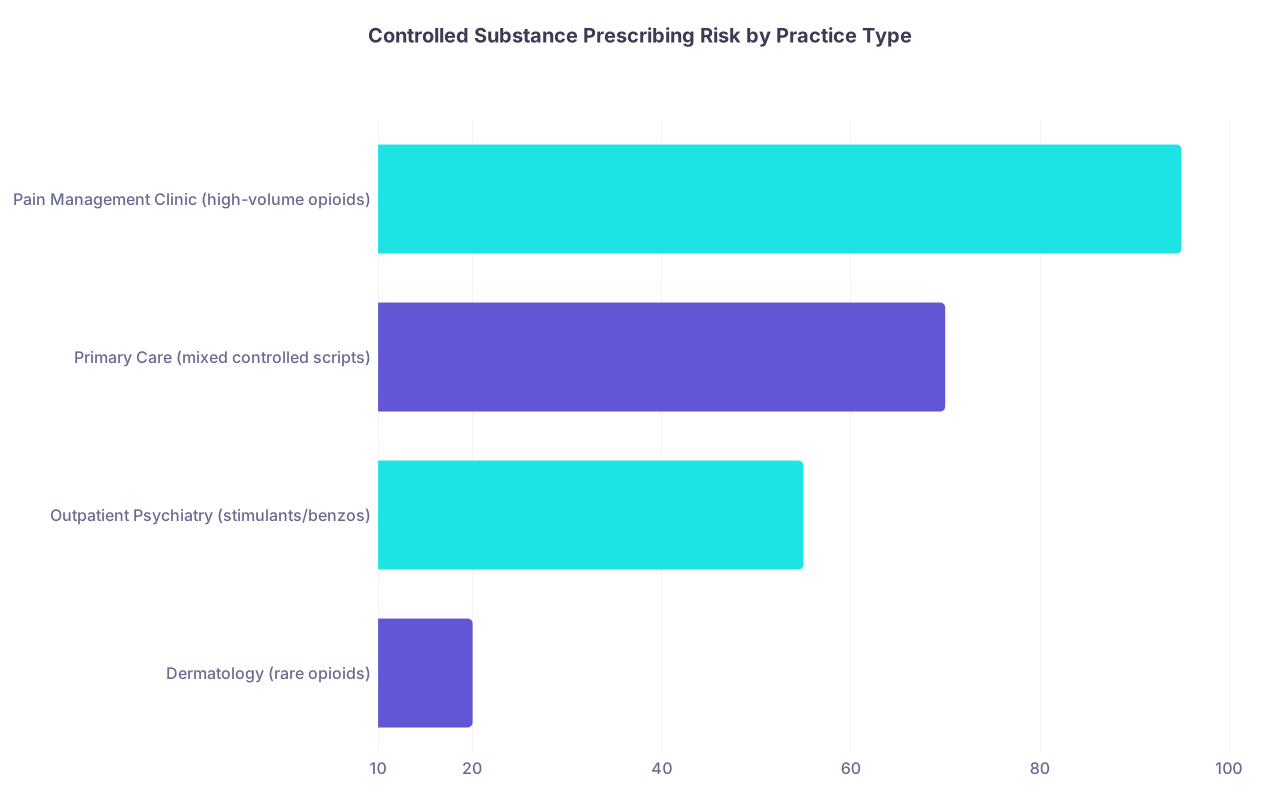
| Category | Value |
|---|---|
| Dermatology (rare opioids) | 20 |
| Outpatient Psychiatry (stimulants/benzos) | 55 |
| Primary Care (mixed controlled scripts) | 70 |
| Pain Management Clinic (high-volume opioids) | 95 |
If you are:
- High-volume prescriber (pain, addiction, some primary care, oncology, palliative)
- Writing long-term opioids, benzodiazepines, or stimulants
- Practicing telemedicine at scale
You should treat controlled substance CME as risk armor, not just box-checking.
That means:
- Doing more than the minimum hours
- Favoring courses with real-world case discussions and documentation examples
- Focusing heavily on:
- Risk mitigation
- PDMP workflow integration
- Responding to aberrant behaviors
- Handling dismissals and transitions of care
If you almost never prescribe controlled substances (say, pure dermatology, radiology, pathology), your strategy is simpler: hit the state minimums with high-yield courses that keep you out of trouble when you do occasionally prescribe.
10. Building a 3-Year Multi-State Controlled Substance CME Plan
Let me walk you through what a sensible 3-year plan actually looks like for a multi-state physician. This is where most people never get beyond vague intentions.
Assumptions:
- You hold 4 state licenses.
- All 4 states require some controlled substance / opioid / pain CME every 2-year renewal cycle.
- One state requires a one-time state-specific PDMP course.
Here is a reasonable approach:
Year 1:
- Do a 3–4 hour comprehensive opioid prescribing and pain management course (ACCME-accredited, national).
- Do your one-time 2–3 hour PDMP/state law course for the specific state that requires it.
Year 2:
- Optional but smart: 1–2 hours focused on a pain/safe-prescribing niche that is directly relevant to your practice (e.g., chronic low back pain, managing long-term benzodiazepines, stimulant prescribing in adults).
Year 3:
- Do another 2–3 hour updated controlled substance prescribing course, ideally incorporating recent law or guideline updates.
- Drop in any required state-specific short modules if one of your states updates its rules.
This pattern keeps you:
- Well within hour minimums
- Current with guideline and law changes
- Documented clearly across all boards
If one of your states moves to an every-cycle PDMP requirement, you plug in an annual 1-hour PDMP update in Years 1 and 3.
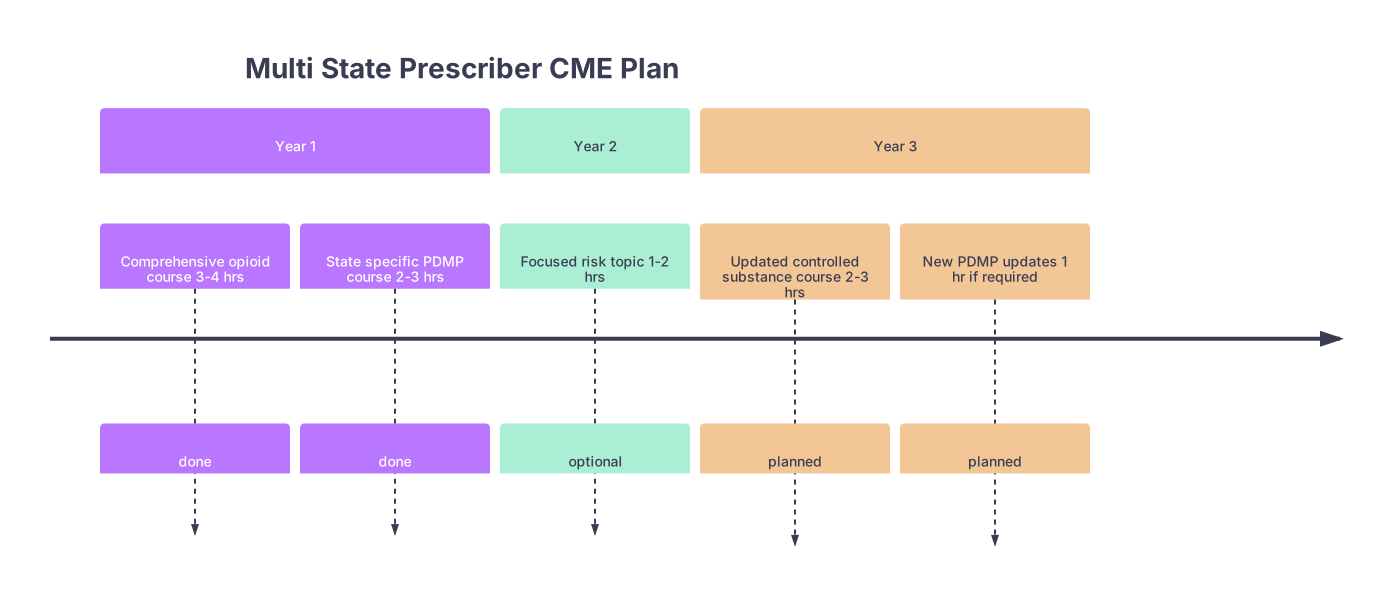
| Period | Event |
|---|---|
| Year 1 - Comprehensive opioid course 3-4 hrs | done |
| Year 1 - State specific PDMP course 2-3 hrs | done |
| Year 2 - Focused risk topic 1-2 hrs | optional |
| Year 3 - Updated controlled substance course 2-3 hrs | planned |
| Year 3 - New PDMP updates 1 hr if required | planned |
11. Special Case: Telemedicine and Prescribing Across State Lines
Telemedicine breaks people’s mental model in a predictable way.
Core rule:
You practice medicine where the patient sits, not where you sit.
So if you are sitting in Colorado and treating a patient located in Florida:
- You must have a Florida license (with very rare emergency exceptions).
- You are subject to Florida’s controlled substance rules, PDMP requirements, and CME mandates.
People cut this corner every day, often under the assumption that “our platform handles that.” Sometimes they are wrong.
If you:
- Work for a large telemedicine company
- Cover several states in a regional tele-urgent care role
- Hold an IMLC (Interstate Medical Licensure Compact) cluster of licenses
You should specifically clarify:
- Which states require telemedicine-specific opioid rules (some limit prescribing of Schedule II via telehealth).
- Whether any state requires you to register with their PDMP even if you are out-of-state.
- Whether your employer requires additional internal CME beyond the state minimum.
Some states explicitly state that controlled substance CME requirements apply to all prescribers, regardless of whether they practice in-person or via telemedicine.
12. How to Vet a CME Course Before You Commit
You do not need to overthink every course. But you should scan a few key markers.
Look at:
- Accreditation statement: “This activity has been planned and implemented in accordance with the accreditation requirements and policies of the Accreditation Council for Continuing Medical Education (ACCME) …”
- Target audience: Physicians, prescribers, controlled substance prescribers
- Learning objectives: Do they mention:
- Opioid prescribing
- Pain management
- PDMP use
- Risk mitigation
- State/federal regulation
- State endorsements: Some activities are specifically built to “meet X State medical board requirement.” Prioritize these for your stricter states.
If a course is essentially a pharmacology lecture on “all analgesics ever invented” with no mention of regulation, misuse, or PDMP, it may not satisfy certain boards that explicitly want prescribing practices and risk mitigation.
13. Handling Audits, Board Questions, and “Can I Count This?” Moments
Audits are not rare anymore. People are often caught off guard because the letter arrives during a busy month and is written in formal, mildly threatening language.
When faced with a CME audit, you want:
- An organized file of certificates for the entire audit period.
- A simple crosswalk document:
- State
- Renewal years
- Required controlled substance hours
- Which specific courses satisfied those hours
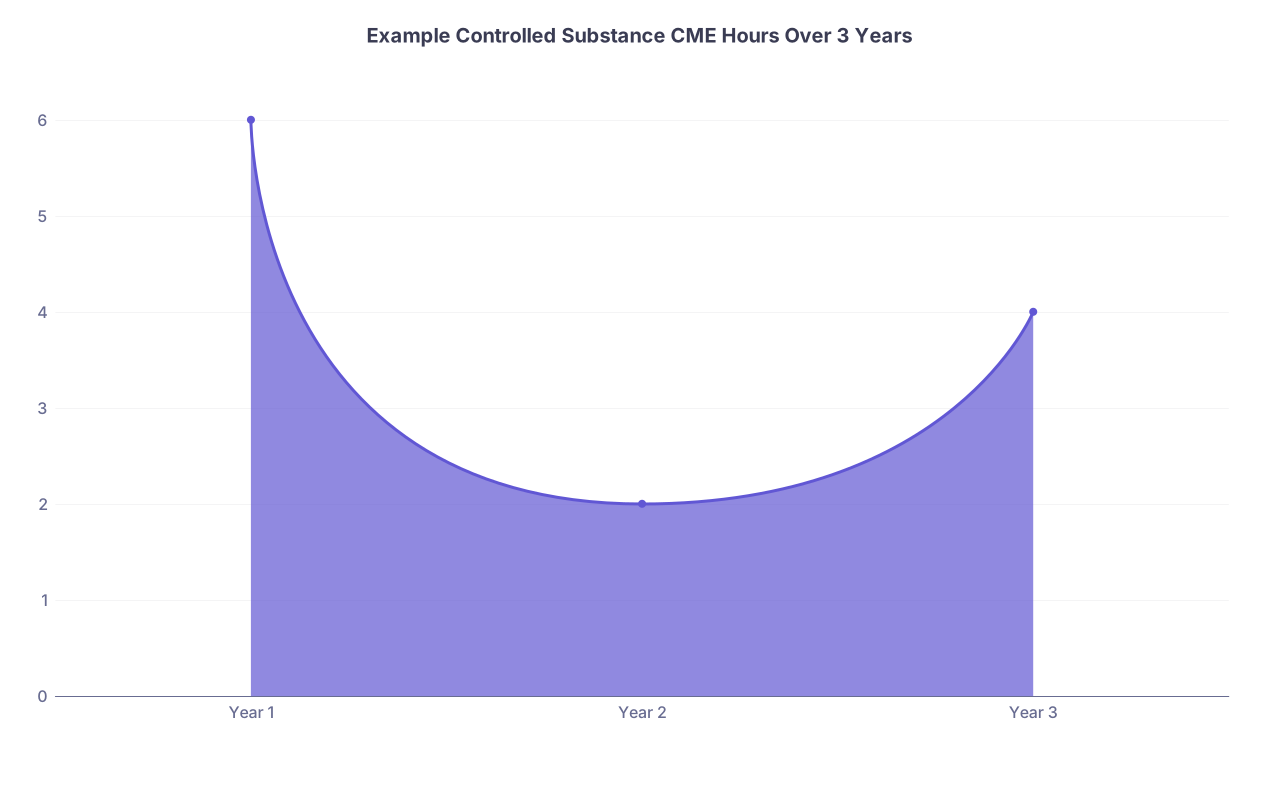
| Category | Value |
|---|---|
| Year 1 | 6 |
| Year 2 | 2 |
| Year 3 | 4 |
If the board questions whether a specific course qualifies, you respond with:
- The course certificate
- The learning objectives or an abstract showing relevance
- A concise statement: “This course addressed opioid prescribing, pain management, and risk mitigation strategies consistent with the board’s requirement for controlled substance prescribing CME.”
Most boards are pragmatic. If the content clearly matches the intent of their rule, they accept it. The physicians who struggle are the ones who cannot produce anything organized or took clearly off-topic courses.
14. Tools and Systems That Actually Help (Not Just Pretty Dashboards)
There is a cottage industry of CME vendors that promise “50 states compliant opioid CME.” Some are good. Some are marketing.
What actually helps:
- A simple spreadsheet or note app tracking:
- States, renewal dates, and controlled substance CME hours per cycle
- A cloud folder structure for CME certificates by year and category
- A recurring calendar reminder 6–12 months before each state renewal to:
- Review state website
- Confirm no new specific requirements were added
- Plug any gaps in required content

If you work within a large health system:
- Ask if your compliance or education department maintains a matrix of state prescribing CME requirements. Some do.
- If they do not, do not assume they will protect you. Their obligations are to the institution; your license is still your responsibility.
15. Where Things Are Headed: More Scrutiny, Not Less
Let me be candid. The era of casual, undocumented opioid prescribing is over, and it is not coming back.
Trends I expect to continue:
- More states standardizing specific controlled substance CME hours.
- Increasing expectation that courses address:
- Non-opioid and non-pharmacologic pain treatments
- SUD recognition and treatment pathways
- Social determinants and bias in pain/SUD care
- Closer alignment between board enforcement, PDMP usage data, and prescription monitoring.

Frankly, physicians who do the absolute bare minimum CME and treat it as a chore, not a protective tool, will remain on the edge of trouble. Those who treat controlled substance CME as part of their risk management culture will sleep better and practice more confidently.
16. Putting It All Together
If you strip all the noise away, meeting multi-state prescribing and controlled substance CME rules comes down to a few disciplined habits:
- Know exactly which states you answer to and what each one demands.
- Build a 3-year CME plan that hits the strictest requirements first and layers in state-specific obligations.
- Choose CME that is clearly labeled, accredited, and aligned with real-world prescribing, not just pharmacology trivia.
- Document ruthlessly and organize your proof as if you will be audited. Because at some point, you probably will be.
Once you have that foundation, controlled substance CME stops being a scramble at renewal time and becomes something more useful: a structured way to keep your prescribing sharp, defensible, and safe for the patients who actually need these medications.
With that solved, the next logical step is tightening up your day-to-day prescribing workflows—PDMP usage, documentation templates, treatment agreements—so your practice patterns match the education on your CME certificates. But that is a deeper operational conversation, and it deserves its own dedicated playbook.