
The way most physicians talk about CME categories is wrong.
Your state license, your specialty board, and your hospital credentialing committee are not counting “hours” the same way—and they definitely do not mean the same thing when they say “live,” “enduring,” or “performance” CME.
Let me break this down specifically, the way your board and auditors actually think about it.
1. Three Different Axes: Format, Credit Type, and Use-Case
First distinction that people miss: “live,” “enduring,” and “performance” describe format and activity type, not worth or prestige. Boards then layer credit type (AMA PRA Category 1 vs 2; AOA 1-A vs 1-B, etc.) and use-case (state license vs MOC vs hospital privileging) on top.
You are dealing with three overlapping systems:
Activity format
- Live CME
- Enduring material CME
- Performance / PI (practice improvement) CME
- (Plus a few others like test-item writing, teaching, etc., but we will keep our scope tight.)
Credit type / designation
- AMA PRA Category 1 Credit™
- AMA PRA Category 2 Credit
- Performance Improvement / PI CME (often tied to MOC Part 4)
- AAFP Prescribed / Elective, AOA 1-A / 1-B, etc.
Regulator
- State medical boards (license renewal)
- ABMS specialty boards (MOC / continuing certification)
- Hospital / health system (privileges, credentialing)
- Sometimes DEA / DOJ (for controlled substance training, opioids, etc.)
If you do not separate these in your head, you will keep asking the wrong question: “Does this course count?”
The better question: “For what purpose, and under which rule set, is this going to be counted?”
2. What “Live CME” Really Means (and How Boards Count It)
Live CME is not just “in-person.” That myth keeps tripping people up.
Definition in practical board language
In AMA / ACCME terms, live CME is usually:
- A scheduled, real-time educational activity
- With the ability for two-way interaction with faculty (Q&A, chat, polling where you can ask questions)
- Delivered:
- In-person (conference, grand rounds, tumor board, workshop)
- Or virtually/synchronously (Zoom/Teams webinar, live virtual conference)
- Accredited as live activity by an ACCME-accredited provider and designated for AMA PRA Category 1 Credit
Boards care that:
- You participated in real time
- The provider tracked/verified your attendance
- The certificate or transcript clearly labels it as a live or “course / live activity” credit
How ABMS boards usually count live CME
Let us talk about patterns across major boards. They differ in detail but the logic is similar:
American Board of Internal Medicine (ABIM)
Historically emphasized MOC points more than “live vs enduring.” For many years, internal medicine diplomates would get:- 1 MOC point per 1 CME credit when the activity is MOC-eligible
- No strong requirement that it be live, with a few exceptions for certain pathways The counting is driven by:
- “Is it MOC eligible?”
- “Is the provider sending completion data to ABIM?”
American Board of Family Medicine (ABFM)
ABFM distinguishes between:- CME credit hours (50 / year equivalent, often framed in 3-year cycles)
- Certification activities (KSA, PI activities, etc.) ABFM generally does not require a minimum number of “live” hours; they focus on:
- Is it ACCME/AAFP approved CME?
- Are your PI and KSA activities done?
American Board of Anesthesiology (ABA)
Counts CME credits plus MOCA activity types:- Some MOCA modules can be live or enduring; again, the format is less important than the designation and content
Surgical boards (e.g., ABS)
For years, surgery boards have been more old-school. Historically they liked:- A chunk of Category 1 CME, with some boards previously preferring live activities from major meetings. Many have loosened strict “live meeting” requirements, especially after COVID, but some linger in policy language.
So what actually happens in practice?
For most ABMS boards today, “live vs enduring” is not the main axis. The main axis is:
- Is it Category 1?
- Is it MOC-eligible and reported to my board?
- For some boards, is there a performance / QI component separate from didactic CME?
But there is one place where “live” still bites people: state medical boards and hospital bylaws.
How state medical boards count live CME
States vary wildly. A few examples:
Texas
- Requires 48 hours CME per 24-month period
- At least 24 must be Category 1
- Opioid-based CME must meet specific requirements
“Live” vs “enduring” is not the main dividing line, but if the state ever does specify “live,” they mean synchronous participation, not just face-to-face.
California
- 50 hours CME every 2 years
- Must be AMA PRA Category 1 or equivalent
Rarely fixates on live vs enduring, except if mandated for special topics.
Some states historically have language like “a portion must be live, interactive education.” When this appears:
- Webinars with live Q&A usually qualify as live
- On-demand recordings do not
The theme: state boards increasingly care about topic requirements (opioids, suicide prevention, implicit bias) rather than insisting on live vs enduring. But a minority still specify that a subset must be “live” or “interactive,” and they usually define that in alignment with ACCME “live activity.”
| State | Total Hours / Cycle | Category 1 Required | Live/Interactive Requirement? |
|---|---|---|---|
| California | 50 / 2 years | Yes | No |
| Texas | 48 / 2 years | 24+ Category 1 | No specific live requirement |
| Florida | 40 / 2 years | Yes | Certain topics specified |
| Pennsylvania | 100 / 2 years | Yes | 12 opioid-related hours |
| Ohio | 50 / 2 years | Yes | No |
(Always check the current state board rules; they change more often than you think.)
How hospitals and credentialing count live CME
Here is where “live” still matters more:
Some hospital bylaws, especially older ones, state:
“Physicians must complete X hours of Category 1, live CME related to their privileges per 2-year credentialing cycle.”They often define “live” loosely:
- In-person conferences, grand rounds, morbidity & mortality conferences
- Live virtual meetings with sign-in
- Sometimes they grudgingly accept interactive webinars as “live” if attendance is verifiable
If your credentialing office is old-school, they may frown on getting 100% of your CME from on-demand modules. I have seen offices push back when someone submits only online self-study from a single vendor.
So for live CME, your mental checklist should be:
- Does my state explicitly require live hours?
- Do my hospital bylaws ask for live or “in-person” CME?
- For my board, is there any explicit policy giving extra weight to live CME? (Increasingly rare, but worth checking in surgery and some subspecialties.)
3. Enduring Material CME: How On‑Demand Is Counted
Enduring material is where most physicians now stack the bulk of their credits. Boards know this. They are mostly fine with it—as long as the provider is legit and the credit type is correct.
What counts as “enduring” material CME
Enduring = not real-time. Examples:
- Pre-recorded video modules you can watch anytime
- Online question banks that give CME credit
- Printed or online journal CME with post-tests
- Recorded conference sessions available on-demand > 24 hours after live presentation
- Podcasts with embedded CME credit and post-tests
The key characteristics:
- You can complete them at your own pace
- The content exists independently of a specific time and place
- The provider typically:
- Posts learning objectives
- Has a start/end date for CME availability
- Requires some assessment (quiz, evaluation) to claim credit
- Issues a certificate specifying the credit type
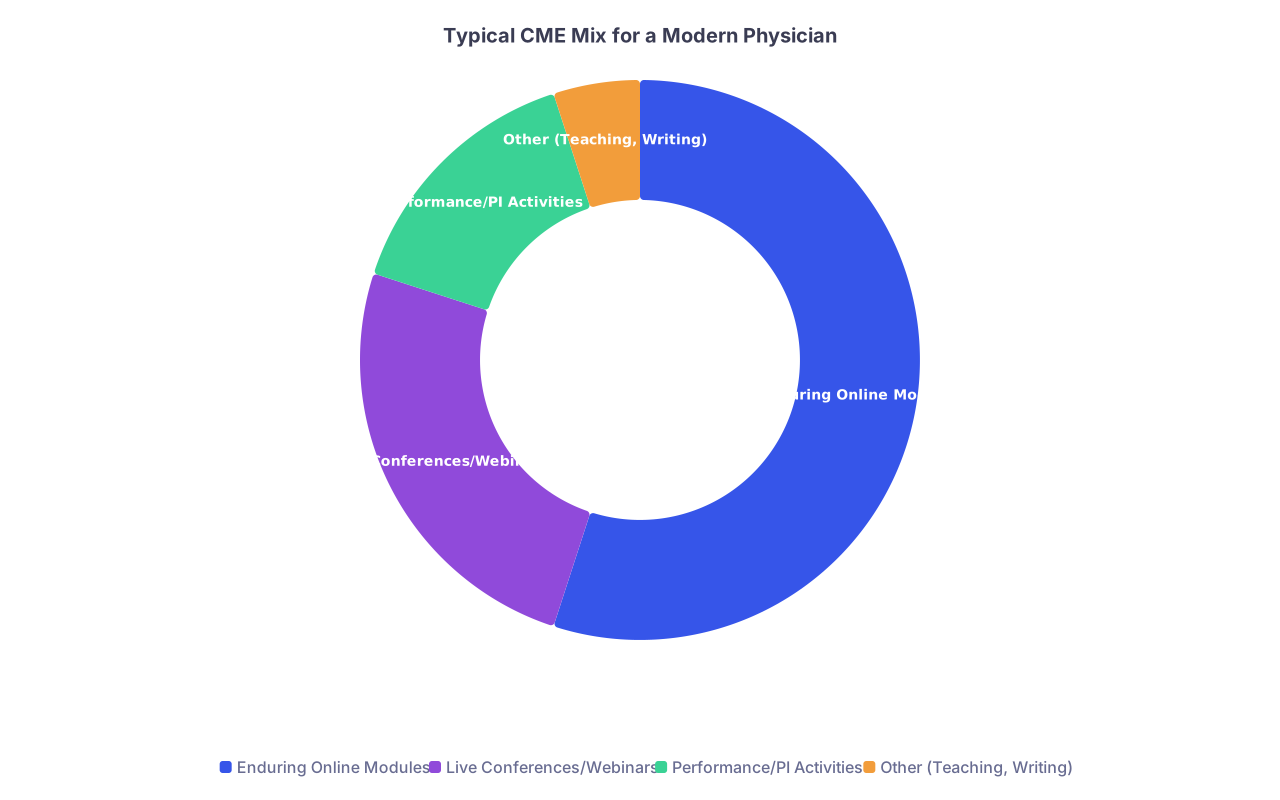
| Category | Value |
|---|---|
| Enduring Online Modules | 55 |
| Live Conferences/Webinars | 25 |
| Performance/PI Activities | 15 |
| Other (Teaching, Writing) | 5 |
How boards count enduring CME
For most ABMS boards and state licensing boards:
- Enduring AMA PRA Category 1 Credit is counted exactly the same as live Category 1, unless a rule explicitly says otherwise.
- If a requirement just says “50 hours of Category 1 CME,” your on-demand, ACCME-accredited modules absolutely count.
- For many boards, your enduring CME is now the primary way you complete MOC and topic-specific mandates (opioid prescribing, patient safety, etc.).
Where you can get burned:
- Using non-accredited content and assuming it will “count”
- Confusing Category 2 with Category 1
- Assuming every enduring CME is automatically MOC-eligible (it is not; the activity must be registered with your board, and the provider must report completions)
So the enduring CME checklist is simple:
- Does the certificate clearly say AMA PRA Category 1 Credit™ (or AAFP Prescribed / AOA 1-A / relevant equivalent for your board)?
- If you need MOC credit:
- Does the course explicitly say it is approved for your specialty board’s MOC?
- Does the provider list supported boards and promise direct reporting?
If those boxes are checked, boards usually do not care that you did it at 1:30 a.m. in sweatpants.
4. Performance / PI CME: The Most Misunderstood Category
Performance CME (often labeled PI CME – Performance Improvement CME) is where people really start guessing. And guessing wrong.
This is not just “learning about quality improvement.” It is not “reading about sepsis bundles.” Boards use performance/PI CME for MOC Part 4–style requirements: showing you actually changed practice in your own environment.

What qualifies as performance / PI CME
ACGME/ABMS and ACCME language is tedious, but the core pattern is always:
- Identify a clinical measure or gap
- Example: Only 60% of your diabetic patients have A1c documented in past 6 months.
- Collect baseline data
- Pull charts, run an EMR report, track a sample.
- Plan an intervention
- Implement a reminder in the EMR, standardize a nurse pre-visit checklist, etc.
- Implement the change over a defined period.
- Re-measure after the intervention
- Compare your performance to baseline: did A1c documentation rise from 60% to 85%?
- Reflect and document
- What worked, what did not, next steps.
PI/Performance CME programs wrap this into a structured module with:
- Pre-defined measures or templates
- Tools to help you pull data
- Worksheets or online forms to document the QI cycle
- Credit granted based on completion of all stages, not just “watching content”
Boards see this as evidence that you did more than passively consume facts—you changed practice behavior.
How ABMS boards count performance CME
Let me give you a concrete pattern.
ABFM (Family Medicine)
- Requires specific Performance Improvement (PI) activities each certification cycle.
- Completing a board-approved QI/PI activity satisfies a PI requirement and may also award CME hours.
- They do not just want didactic CME; they want chart review, intervention, and re-measurement.
ABIM (Internal Medicine)
- “Practice Assessment / Quality Improvement” used to be a distinct requirement; they have softened and blended some requirements, but:
- Many PI/QI activities, often integrated in health systems, are still recognized for MOC points (often more points than a standard didactic CME course).
Surgical and subspecialty boards
- Often require some version of practice improvement or “improvement in medical practice” credits or attestations.
- They may accept:
- Formal PI-CME modules through societies
- Participation in registry-based QI programs
- Institutional QI projects that meet their criteria
The important thing: for your board, PI CME is not interchangeable with standard CME. For many, 1 PI project can be worth 20–50 “points” or hours, but they are a separate bucket you must fill.
How boards count performance CME in numbers
A typical pattern for a PI activity:
The board or accreditor will say something like:
- “Completion of this PI activity is designated for 20 AMA PRA Category 1 Credits and 20 MOC Part 4 points.”
That means:
- For state licensure or hospital privileges, this one project can be logged as 20 hours of CME.
- For your board, it also satisfies all or part of your practice assessment / quality improvement requirement.
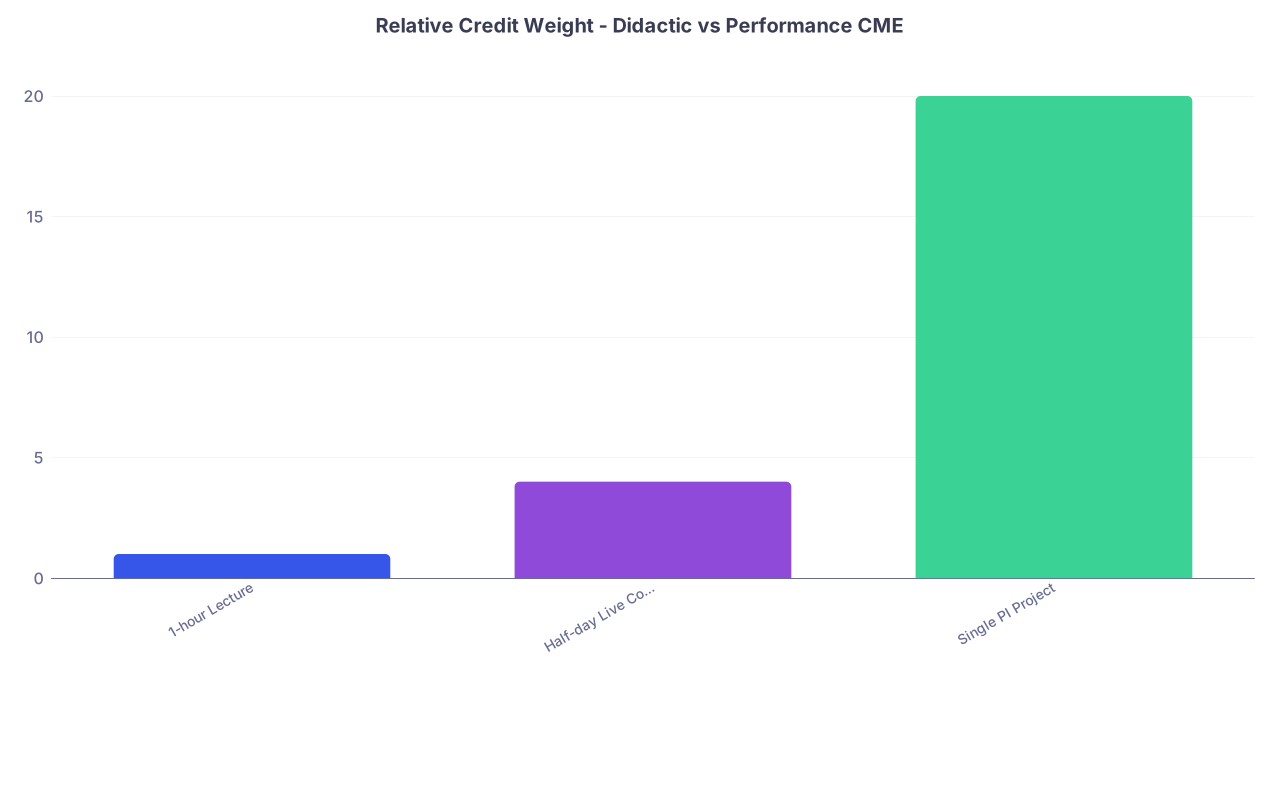
| Category | Value |
|---|---|
| 1-hour Lecture | 1 |
| Half-day Live Course | 4 |
| Single PI Project | 20 |
So boards count it in two dimensions:
- Plain CME credit hours (for total hour requirements)
- PI / MOC Part 4 credit (for specific improvement requirements)
You need both perspectives when you decide how much PI CME to do.
5. Mixed Activities: Live + Enduring + Performance in One Package
Modern CME offerings are not cleanly separated. You will see:
A live conference that:
- Offers standard live CME credit for attendance
- Includes optional enduring access to recorded sessions for additional credit
- Includes a PI/QI add-on module that can earn extra credit and fulfill MOC Part 4
An online platform that:
- Provides enduring video lectures (Category 1)
- Integrates case-based learning (still Category 1)
- Offers separate, structured QI projects (Performance/PI CME)
How do boards count these hybrid deals?
Boards do not care about the marketing bundle. They care about the accreditation:
- Each component is separately designated:
- The live sessions: “This live activity is designated for up to 10 AMA PRA Category 1 Credits.”
- The enduring recordings: “This enduring material is designated for up to 15 AMA PRA Category 1 Credits.”
- The PI project: “This PI CME activity is designated for 20 AMA PRA Category 1 Credits and qualifies for ABIM MOC Part 4.”
You claim and document:
- How many live credits you actually attended
- How many on-demand credits you actually completed
- Whether you fully completed the PI project
The boards then:
- Add all the Category 1 credits into your total CME number.
- Separately track whether you fulfilled:
- Didactic CME requirement
- PI/QI requirement
- Any topic-specific conditions (opioids, patient safety, etc.)
6. How to Document CME So Boards Do Not Hassle You
The actual counting by boards is mechanical. The pain happens when your documentation is vague or sloppy.
You want your CME records to answer these questions cleanly:
What type of credit is this?
- AMA PRA Category 1 Credit™?
- PI CME / MOC Part 4?
- AAFP Prescribed? AOA 1-A?
What was the format?
- Live course, live webinar, enduring online module, PI project.
How many credits?
- Clear numeric value, dates of completion.
Was it MOC-eligible and reported to my board?
- Ideally, you see it on your board’s portal, not just on a certificate.
Good habits:
Keep certificates or transcripts grouped by:
- Board reporting (ABIM, ABFM, ABS, etc.)
- State license cycles
- Hospital credentialing cycles
Download annual transcripts from major CME vendors and professional societies. They usually show:
- Live vs enduring
- PI activities
- Board MOC mapping
Do not rely on memory for PI/QI: document project titles, dates, roles, and outcomes, even if your institution submits them.
If you get audited by a state board or hospital credentialing committee, “Here is my ACCME transcript sorted by date and category” ends the conversation very quickly.
7. Practical Strategy: Balancing Live, Enduring, and Performance CME
You do not need some elaborate dashboard. You need a simple tactical plan for each 2–3 year cycle.
I usually advise physicians to think in terms of four buckets:
Core total CME hours – mostly enduring
- Stack inexpensive, reputable online Category 1 content
- Satisfy state license totals and general board hour requirements
Live / interactive CME – 1–2 targeted events
- Pick 1–2 meetings or virtual live courses that:
- Actually improve your practice
- Satisfy any lingering “live CME” culture or requirements at your hospital
- Use grand rounds or department conferences to top this up
- Pick 1–2 meetings or virtual live courses that:
Performance / PI CME – at least one solid project per board cycle
- Use a board-approved PI module or institutional QI project that:
- Earns substantial CME hours
- Fulfills your MOC Part 4 / PI requirement
- Use a board-approved PI module or institutional QI project that:
Topic-mandated CME
- Track mandatory subjects: opioids, pain management, human trafficking, implicit bias, etc.
- Use targeted enduring modules that issue certificates with explicit topic wording.
If you cover these four buckets, you are rarely surprised by a credentialing committee or board portal message.
8. Quick Comparison: How Each Is Typically Counted
| Dimension | Live CME | Enduring CME | Performance / PI CME |
|---|---|---|---|
| Format | Real-time, interactive | On-demand, self-paced | Multi-step QI project with data cycles |
| Common Credit Type | AMA PRA Cat 1 (live activity) | AMA PRA Cat 1 (enduring material) | AMA PRA Cat 1 + MOC Part 4 / PI credit |
| Counts for State CME? | Yes, if Cat 1 and accredited | Yes, if Cat 1 and accredited | Yes, usually with large hour value |
| Counts for MOC? | Yes, if designated MOC-eligible | Yes, if designated MOC-eligible | Yes, and often mandatory for improvement reqs |
| Extra Requirements | Attendance tracked | Post-test / attestation | Baseline data, intervention, re-measurement |
FAQ (4 questions, no more, no less)
1. Do state medical boards actually require a certain number of “live” CME hours, or is Category 1 enough?
Most states do not explicitly require “live” CME; they require a certain number of Category 1 hours and sometimes specific topics (opioids, ethics, etc.). A minority of states or legacy policies still mention “live” or “interactive” hours, but they often accept live webinars as meeting that requirement. You must check your specific state’s rules, because the language and enforcement vary, and the state board’s FAQ often clarifies whether synchronous virtual activities count as “live.”
2. If I complete a performance/PI CME activity, can I double-count those credits for both MOC and state licensure?
Yes. Performance/PI CME usually carries a CME hour designation (e.g., 20 AMA PRA Category 1 Credits) and MOC Part 4/PI designation. For state licensure and hospital credentialing, you log the hours like any other CME. For your specialty board, the same activity also fulfills a performance/QI requirement and awards MOC points. You are not “double-dipping”; you are using one accredited activity for two different regulatory purposes, which is exactly how these activities are designed.
3. Are recorded conference videos counted as live CME or enduring CME?
Recorded conference content accessed after the event is almost always accredited as enduring material, not live. The fact that the session was originally given live does not matter. If you watch it on-demand later and take a post-test, you are earning enduring CME. Some meetings provide both: live credit for those who attended in real time, and enduring credit for those who watch recordings later. The certificate or transcript will specify which format applies to your participation.
4. How do I know if an online CME course is MOC-eligible for my specialty board, not just CME?
You must see explicit language from the provider stating that the activity is approved for your specific board’s MOC and that they will submit completion data to that board. Look for phrases like “This activity has been approved for ABIM MOC points” or “ABFM-approved PI activity,” and check the list of supported boards. If the course only mentions “AMA PRA Category 1 Credit” with no MOC language, it will count for CME hours but not for your board’s MOC requirements unless you see confirmation on the board’s portal after completion.
With the distinctions between live, enduring, and performance CME clear—and how each is actually counted by boards—you are no longer guessing or overpaying for the wrong format. The next step in your trajectory is tighter: building a deliberate 2–3 year CME plan that hits every state, board, and hospital requirement with minimal wasted effort and maximum value to your practice. That strategic planning is its own discipline, and we will tackle that another day.