
Most physicians are wasting CME on MOC Part II—and the boards are perfectly fine with that.
Let me be blunt: ABMS Maintenance of Certification Part II (Lifelong Learning and Self-Assessment) is where otherwise smart physicians get trapped in confusion, overpay for credits they do not need, and miss easy pathways they could have used to fulfill multiple requirements simultaneously.
You are not failing MOC because you are lazy. You are failing it because the system is deliberately fragmented and opaque.
Let’s dissect the traps and the legitimate loopholes—specialty by specialty—so you can stop “collecting certificates” and start working the system strategically.
1. The Core Problem: MOC Part II Is Not “Just CME”
This is the first big misunderstanding: CME ≠ MOC Part II.
Every ABMS member board plays its own little game here, but there are three moving parts you have to separate in your head:
- State medical licensure CME
- AMA or AOA credit categories (Category 1 / 1-A, 2 / 2-A, etc.)
- ABMS MOC Part II–specific “Lifelong Learning and Self-Assessment” (LLSA, SA, SAP, etc.)
You can be flush with CME certificates and still be non‑compliant with MOC Part II.
Typical structure (varies by board, but this is the mental model you need):
- You must earn a certain number of CME hours over a 3–5 year cycle.
- A subset of those hours must be “MOC-approved” or include self‑assessment (SA, Part II, LLSA, or board‑labeled equivalents).
- Some boards require board‑specific modules (e.g., ABIM Medical Knowledge modules, ABP MOC points, ABA MOCA Minute questions).
The trap: You grab random CME (state requirements satisfied), your license is clean, and then one morning you open your board portal and see this:
“You have met your CME requirement but have not completed sufficient Part II Self-Assessment activities.”
That sentence has cost people their board certification.
2. How Part II Is Structured (Board by Board Reality Check)
I am going to generalize here, but this is roughly how several major boards treat Part II.
| Board | Typical Cycle Length | General CME Requirement | Specific Part II Requirement |
|---|---|---|---|
| ABIM | 5 years | ≥ 100 MOC points | At least 20 Medical Knowledge (MK) points |
| ABFM | 3 years | ≥ 150 CME hours | ≥ 50 ABFM-approved credits including KSA/PI |
| ABP | 5 years | ≥ 100 MOC points | Mix of Part II (Lifelong Learning) and Part IV |
| ABA | Annual rolling | ≥ 250 CME/10 years | MOCA Minute + Part II-approved CME |
| ABEM | 10 years (shifting) | CME hours variable | LLSA/SA modules + online assessments |
The point is not the exact numbers. The point is the pattern:
- Volume requirement (total CME/points)
- Type requirement (a subset must carry a Self‑Assessment or MOC designation)
If you ignore the type requirement, you fall into the Part II trap.
3. The CME Traps That Burn Physicians Constantly
Let me walk through the worst offenders. These show up in every specialty.
Trap 1: “Any CME counts toward MOC, right?”
No. That assumption is how you end up with 200 CME hours and zero usable Part II credit.
Boards typically require that Part II activities meet both:
- Accredited CME (usually AMA PRA Category 1 Credit)
- Board‑approved as MOC Part II or Self‑Assessment (SA) activity
If the course vendor does not explicitly say something like:
“This activity offers 10 AMA PRA Category 1 Credits™ and 10 ABIM MOC Medical Knowledge points”
…then it is almost certainly not giving you MOC Part II credit, even if it is excellent education.
Trap 2: Assuming “live conferences” cover everything
You fly to a major specialty conference. Four days. Twelve sessions a day. You walk away with 25 or 30 CME hours.
Then you discover:
- Only the plenary or select sessions were MOC‑certified
- You needed to complete online post‑test questions you never touched
- Or the conference provided CME only, and MOC approval was “pending” (translation: may never show up)
Live meetings are notorious for being CME‑heavy and MOC Part II‑light.
Trap 3: Not completing the required post‑test or evaluation
A lot of MOC Part II credit is locked behind attestation + quiz + evaluation.
Common scenario:
- You complete the online course (or attend the session)
- You forget to open the separate MOC section
- You never click “I am claiming MOC points”
- You never do the 10–20 question Self‑Assessment quiz
- Result: You earned CME but zero MOC Part II
On ABIM and others, those points often only post after:
- You pass the quiz, and
- The provider transmits completion data to the board
Miss one step, and your dashboard stays red.
Trap 4: Vendor language games
Commercial CME vendors love phrases like:
- “MOC‑compatible”
- “Meets the educational needs for MOC”
- “Designed to support your lifelong learning and self‑assessment”
None of that means they actually applied for, or got, formal MOC Part II approval from an ABMS board.
The only wording you should respect:
- “[X] credits of ABIM MOC Medical Knowledge points”
- “Approved by ABP for MOC Part 2 points”
- “This activity is approved for up to X ABA MOCA Part 2 credits”
If you do not see a direct board name + Part II/MOC language, treat it as CME only.
Trap 5: Over‑earning CME in the wrong category
Some boards distinguish:
- Category 1 vs Category 2
- Live vs enduring material
- Ethics, opioid prescribing, risk management, etc.
You can overshoot in one bucket and still be short in another, especially:
- Opioid/controlled substance CME (state‑mandated)
- Ethics/professionalism CME
- Board‑specific “Self‑Assessment” hours
The “loophole” here is to double‑dip intelligently. I will get to that.
4. The Loopholes: How to Make One Activity Count 3–4 Times
Part of being smart with MOC Part II is choosing activities that satisfy several obligations at once.
Here is the core strategy: stack requirements.
Loophole 1: Board‑Approved Online CME with MOC + State Credit
Look specifically for activities that say something like:
“This course provides 4 AMA PRA Category 1 Credits™, 4 ABIM MOC points, and meets the opioid/controlled substance CME requirement for [your state].”
That is one activity doing triple duty:
- State license requirement
- Total CME hours
- MOC Part II (self‑assessment) points
Good sources:
- Specialty society CME (e.g., ACC, ACR, AAP, ACEP)
- Hospital or health system education departments
- Some large online platforms that integrate with ABMS boards
You want board‑approved + state‑relevant + self‑assessment all in one.
Loophole 2: Use board‑sponsored products first
ABMS boards increasingly have their own online question banks/portals that count for Part II.
Examples (conceptually):
- ABIM: Medical Knowledge modules within the MOC portal
- ABA: MOCA Minute questions
- ABEM: Online LLSA assessments
- ABFM: Knowledge Self-Assessment (KSA) modules
These are:
- Always MOC‑eligible
- Designed to post points directly
- Often cheaper per unit of MOC credit than commercial CME
I tell people: Fill your Part II requirement as much as possible from your own board’s website first, then add external CME only for content you genuinely want or license quotas you still need.
Loophole 3: Grand rounds / hospital CME that carry MOC credit
Many health systems now embed ABMS MOC in their regular grand rounds and case conferences.
Typical pattern:
- You attend weekly grand rounds (1 hour each).
- The CME office has designated certain sessions as MOC‑eligible.
- You sign the sheet, complete a short online quiz or evaluation.
- ABMS MOC points auto‑flow to your board (if you gave them your NPI and board ID).
Physicians miss this because:
- They never completed the one‑time registration with their hospital CME office.
- They never checked the box to transmit data to ABIM/ABP/ABA/etc.
- They skip the online quiz assuming attendance alone is enough.
If your hospital is a large academic or regional center, ask explicitly:
“Which of our regular CME activities are approved for ABIM (or your board) MOC Part II, and how do I get those points sent?”
It is often low‑friction credit you are already earning—if you do the paperwork.
Loophole 4: Longitudinal assessment as CME bank
Several boards now treat their longitudinal assessment program as Part II CME and self‑assessment credit at the same time.
Examples:
- ABIM Longitudinal Knowledge Assessment (LKA): Answering questions every quarter can generate both MOC points and some boards translate that to CME hours.
- ABA MOCA Minute: Each question contributes to MOCA Part 2.
- Some pediatrics and family medicine programs have similar longitudinal platforms.
That means:
- As you stay active on the longitudinal assessment, you accumulate Part II steadily.
- You then only need to fill in gaps with external CME, not reinvent the wheel.
For time‑pressed clinicians, longitudinal programs are usually the highest yield source of Part II credit—because they are tied to your ongoing practice anyway.
5. Specialty‑Flavored Gotchas
The traps are similar, but each specialty dresses them up differently. A few patterns I see over and over.
Internal Medicine (ABIM)
Common pitfall: Physicians assume “100 points over 5 years” means any points from any role (Part II, Part IV, etc.). Then they get this bomb:
“You have not met your Medical Knowledge (MK) requirement.”
ABIM requires:
- 100 total MOC points every 5 years
- Of those, at least 20 points must be Medical Knowledge (which are Part II)
- And you must pay annual fees and be current with the assessment pathway
Traps:
- Doing mostly QI/Part IV stuff or patient safety modules and ignoring MK.
- Doing CME with “MOC available” but never claiming/activating the MK points.
- Not linking your ABIM ID with the external CME provider.
Loophole:
- Every time you buy course access, ask: “Does this grant ABIM Medical Knowledge points, and will you report them directly?”
- Use ABIM’s own MOC modules and the Longitudinal Knowledge Assessment as your backbone.
Pediatrics (ABP)
ABP splits MOC across parts (II and IV) with overlapping point systems. Many pediatricians over‑spend on boutique CME when:
- Their hospital QI projects can cover a big chunk of both Part II and Part IV.
- Free or low‑cost AAP modules are explicitly ABP‑approved.
Peds trap: Missing the “lifelong learning and self‑assessment” specific modules and assuming any AAP CME automatically feeds MOC. It does not. You must pick the MOC‑tagged offerings.
Emergency Medicine (ABEM)
ABEM historically loved structured LLSA modules; now it is shifting to continuous certification models and oral exams.
Traps:
- Waiting until the last year of the 10‑year cycle to complete multiple LLSA modules. Those modules can disappear or change format.
- Not realizing that many ED conference vendors offer ABEM‑approved activities that count specifically as Part II, not just generic CME.
Loophole:
- Finish required ABEM‑branded online assessments early and spread them over years.
- Use ED‑specific online platforms that explicitly state “ABEM MOC Part II credit available.”
Anesthesiology (ABA)
ABA’s MOCA system is fairly structured, but you can still screw it up:
- People assume MOCA Minute alone covers all Part II credit. It often covers a lot, but not necessarily your entire CME volume requirement.
- Certain required content areas (e.g., patient safety, QI) must be hit; random ASA meeting CME does not always do that.
The smart anesthesiologists:
- Max out MOCA Minute participation.
- Use ABA‑listed CME that aligns with MOCA Part 2 categories.
- Then fill residual state/licensure CME with cheap online Category 1 credits.
6. Workflow: How to Stop Guessing and Start Systematically Hacking Part II
Here is how I would tell a busy hospitalist or proceduralist to approach this.
Step 1: Pull your board’s snapshot
Log into your board portal and identify exactly:
- Your current cycle dates
- Your total CME/point requirement (for the cycle)
- The Part II / Medical Knowledge / Lifelong Learning subset requirement
- Any content‑specific requirements (ethics, QI, patient safety)
Write it down. Not in your head. On an actual piece of paper or a note file.
| Category | Value |
|---|---|
| Year 1 | 10 |
| Year 2 | 15 |
| Year 3 | 20 |
| Year 4 | 25 |
| Year 5 | 30 |
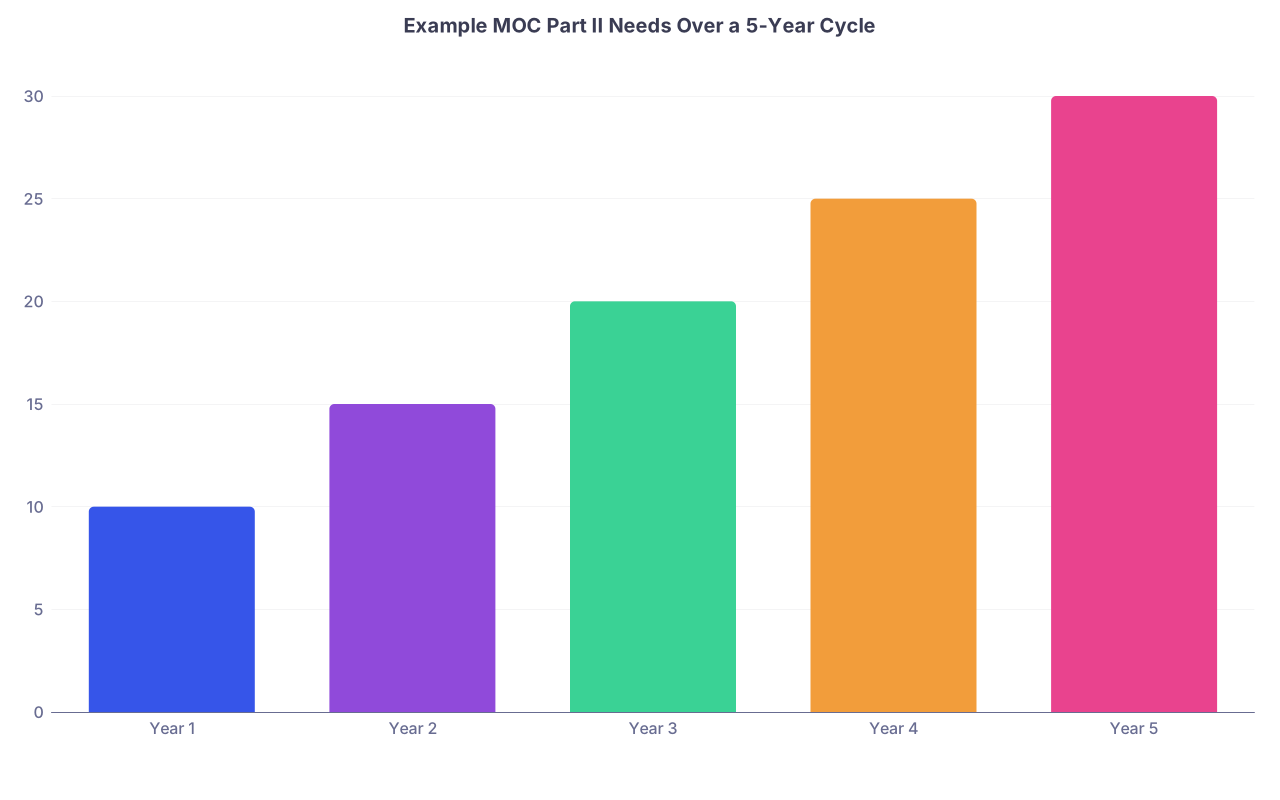
The chart above is what too many careers look like: barely doing anything in years 1–2, then a panic spike in years 4–5.
You want a flat line, not that.
Step 2: Identify what you already do that could count
List your regular educational activities:
- Grand rounds
- Tumor board / M&M / case conferences
- Journal clubs
- Department CME days
- Specialty society membership with bundled CME
Ask explicitly for each:
“Is this activity accredited for [your board] MOC Part II / self‑assessment credit, and how do I get that reported?”
If the answer is “we’re not sure,” push. CME offices are often slow to file the extra MOC paperwork, but they will if enough physicians ask.
Step 3: Prioritize board‑approved / longitudinal offerings
These are non‑negotiable because they are:
- Cheap or included in your MOC fees
- Guaranteed to count as Part II
- Tightly integrated with your board dashboard
Mark them as your primary Part II supply line. Everything else is strategic supplementation.
Step 4: Use external CME to stack benefits, not randomly plug holes
When you look at commercial CME, apply this filter:
- Does it give AMA PRA Category 1 or equivalent?
- Is it formally approved for my ABMS board’s MOC Part II?
- Does it satisfy any state‑mandated topics (opioids, ethics, risk management)?
- Does it support real practice needs (e.g., new guidelines you actually need)?
If the answer is only “CME” but not “MOC,” let it drop to the bottom of your list unless you truly care about the content.
7. Documentation, Reporting, and the Timing Trap
There is another set of traps that have nothing to do with the education itself, and everything to do with paperwork and timing.
Reporting Lag
Many MOC credits do not post instantly. I have seen:
- 4–6 week delays from major conferences
- 1–2 month lag from smaller CME providers
- Longer if there was an error in your board ID or date of birth
If your deadline is December 31 and you complete a course in mid‑December, you are gambling:
- Provider delay
- Data transmission error
- Your own oversight in claiming the MOC portion
Smart strategy: Front‑load Part II earlier in the cycle. Use the last year only for cleanup, not to do 100% of what you need.
Mis‑entered board IDs
Single most annoying thing I see:
- Physician enters ABIM number with a typo on a CME vendor site.
- Vendor reports completion to a non‑existent record.
- Points never show up.
- The physician assumes the board is “behind” and waits until after the deadline to complain.
Take 10 minutes once:
- Log into every major CME platform you use.
- Verify your board ID, NPI, name spelling, and date of birth exactly match the board’s record.
Yes, it is tedious. But this is the plumbing. If the pipes are misaligned, nothing flows.
The Certificate Hoarder Delusion
You know the binder. Or the desktop folder called “CME 2019–2024 FINAL.”
Here is the harsh reality: many boards no longer care about your paper certificates unless you are audited. What matters is:
- Activities reported electronically to the board
- Proper classification as MOC Part II
You can have a binder full of gorgeous certificates and still be listed as “Inactive” on your board’s public verification because the vendor never transmitted the data.
8. Real‑World Optimization Scenarios
Let me walk through how a sane strategy looks for three archetypes.
Scenario 1: Busy hospitalist (ABIM)
- Cycle: 5 years, needs 100 points, at least 20 MK, plus assessment pathway (LKA or 10‑year exam).
- Strategy:
- Enroll in ABIM LKA. Answer questions regularly. That alone yields a baseline of MK points over time.
- Coordinate with hospital CME office so that grand rounds report ABIM Part II where possible.
- Once a year, do one ABIM‑approved online CME course that grants 10–20 MK points and covers new guidelines you actually care about.
- Double‑dip with state‑required CME that also carries ABIM MOC credit (opioid, safety, etc.).
End of cycle, you log in and you are not scrambling. Your MK requirement is already met by routine work.
Scenario 2: Outpatient pediatrician (ABP)
- Cycle: 5 years, 100 points total, mixture of Part II and IV.
- Strategy:
- Do 1–2 AAP MOC modules each year that bundle Part II and Part IV credit.
- Turn one of your practice’s QI projects (vaccination rates, asthma care) into an ABP‑qualifying project that yields MOC.
- Use state pediatric society meetings only when they explicitly state ABP MOC Part II credit is included.
The loophole: Your everyday QI work is often eligible for Part II and Part IV. You just have to package it correctly.
Scenario 3: Academic anesthesiologist (ABA)
- Cycle: Continuous MOCA with Part 2, 3, 4 blended.
- Strategy:
- Stay current with MOCA Minute. Do not fall behind.
- Identify departmental meetings (M&M, QI conferences) that are already MOCA Part 2 approved and register for electronic reporting.
- Use ASA annual meeting only for high‑value content, not as your primary MOC source.
Result: You meet your Part II obligation mostly by answering MOCA Minute and doing what you were already going to do academically.
9. Quick Visual: Where Most People Fail
| Category | Value |
|---|---|
| Assumed CME = MOC | 40 |
| Skipped SA Quiz | 25 |
| Late Completion | 15 |
| Wrong Board ID | 10 |
| Used Non-Approved CME | 10 |
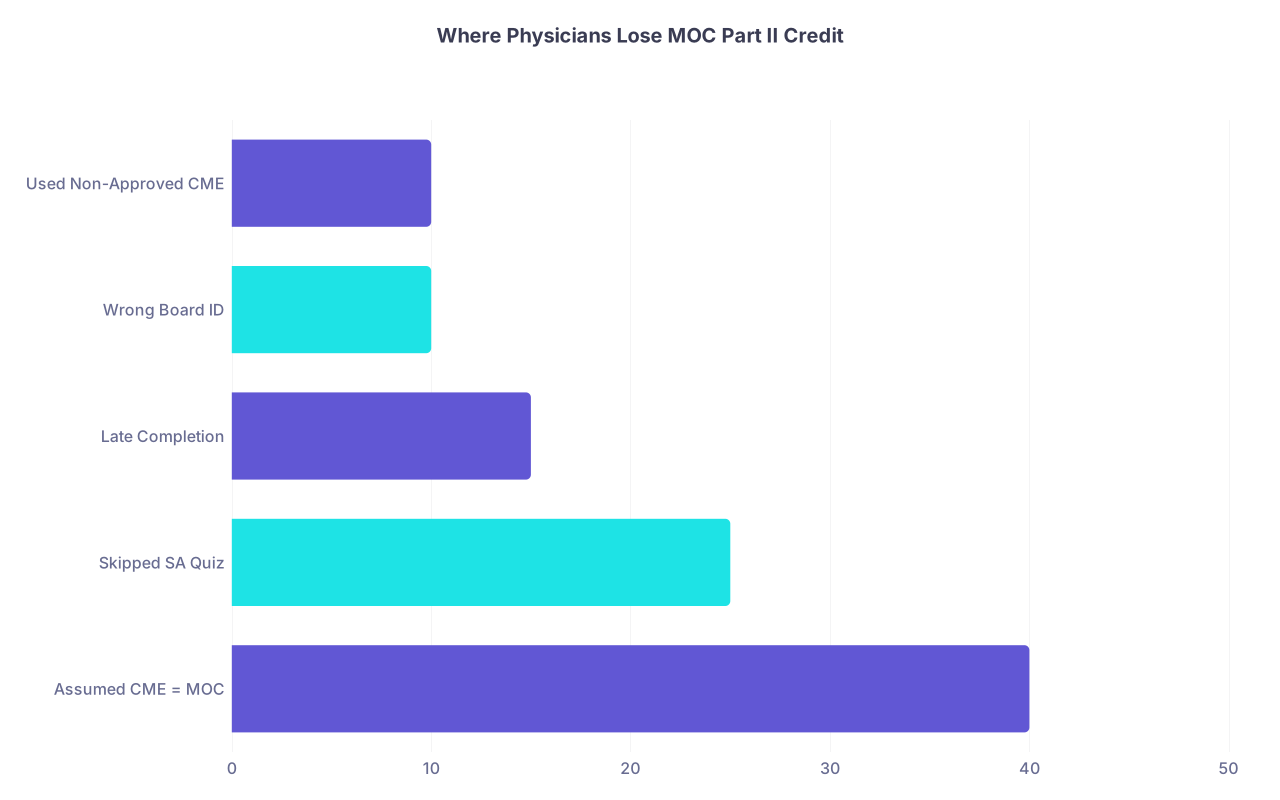
If you look at the chart and see yourself in the top two bars, that is fixable. You do not need to work harder. You need to be more targeted.
10. Your Short Checklist Before You Buy or Attend Anything
When you are about to spend time or money on a CME activity, run through this—fast:
- Does it clearly state: AMA Category 1 (or equivalent)?
- Does it explicitly say: “Approved for [your board] MOC Part II / self‑assessment / medical knowledge points”?
- Is there a post‑test or self‑assessment component you are willing to complete?
- Will the provider electronically report to your board? If not, what is the manual process?
- Can this also satisfy a state or hospital requirement (opioid, risk management, ethics, etc.)?
If you cannot answer those in 60 seconds from the activity’s landing page, move on or contact the provider before you commit.

| Step | Description |
|---|---|
| Step 1 | Check Board Portal |
| Step 2 | Identify Part II Gap |
| Step 3 | Do Board Online Modules |
| Step 4 | Use Hospital or Society CME |
| Step 5 | Verify Electronic Reporting |
| Step 6 | Use Different Activity |
| Step 7 | Recheck Dashboard Quarterly |
| Step 8 | Can Board Modules Cover It? |
| Step 9 | MOC Approved? |
That is the actual mental algorithm you should be running, not “which conference sounds nice this year?”
FAQ (exactly 5 questions)
1. Do I really need “MOC‑specific” CME if I already exceeded my state CME requirement?
Yes. State CME requirements and ABMS MOC Part II rules are separate. You can completely satisfy your state medical board and still be listed as “Not Certified” by your specialty board because you did not complete enough self‑assessment / MOC‑designated activities. Treat them as two different currencies that sometimes overlap, not as one unified system.
2. Can I convert regular CME into MOC Part II credit after the fact?
In almost all cases, no. If the activity was not approved as MOC Part II at the time you took it, you cannot retroactively label it. What you can sometimes do is use structured QI work or case reviews as the basis for board‑approved MOC projects, but that requires going through a board or accredited provider’s formal process. Random noon conference CME from three years ago is not getting converted.
3. Is it safer to just buy big, expensive board review courses that advertise huge MOC credit totals?
Not automatically. Some of those are excellent, some are bloated and inefficient. Before you drop a couple thousand dollars, verify exactly: which board(s) they are approved for, how many hours count as Part II/self‑assessment, how reporting works, and whether the content aligns with your actual practice. There is nothing magical about a “big” course if a cheaper, targeted, board‑approved online module gives you the same Part II credit.
4. How often should I check my board MOC dashboard?
At least twice a year. Quarterly is even better. You want to catch missing or mis‑reported activities early, while you still remember where you took them and who to contact. Waiting until the last year (or worse, last quarter) of your cycle is how small glitches turn into certification crises.
5. What if I realize near the end of my cycle that I am short on Part II credits?
You still have options, but you need to move fast and only choose immediately reportable activities. Look for: your board’s own online self‑assessment modules, hospital CME that reports in real time, and large, reputable online CME platforms that clearly state they transmit data to your board weekly or faster. Avoid activities with unclear reporting timelines. And do not assume that attending a live conference in November will post to your board by December 31.
Key points, no fluff:
- MOC Part II is not generic CME; you need board‑approved self‑assessment credit, not just any hours.
- The smartest move is to stack requirements—board longitudinal programs + hospital/society CME that carry explicit MOC + state credit.
- Most failures are paperwork and timing, not effort. Check your board dashboard regularly, verify reporting, and stop buying CME that does not move your MOC numbers.