
It is 10:30 p.m. You finally sat down to claim CME from a conference you attended three months ago. You open your specialty board’s site to see what else you need for Maintenance of Certification. Within 5 minutes you are staring at phrases like “Part II self‑assessment,” “practice assessment/PI,” “CME credit vs MOC credit,” and “attestation cycles.” And your first thought is: Am I actually keeping up, or am I about to get an unpleasant email about losing certification?
Let me be direct: most physicians conflate CME and MOC, or they ignore the differences until their renewal date is staring them in the face. That is how people get burned. The fine print is what matters—especially because the fine print is different for ABIM, ABFM, ABS, ABEM, ABP, and the rest of the alphabet soup.
I will walk you through the actual structure: what CME is, what MOC is, how they do and do not overlap, and how the largest boards play by slightly different rules that can quietly wreck your weekend if you do not understand them.
1. First Principles: What CME Is vs What MOC Is
Before we go board by board, you need clean definitions.
CME (Continuing Medical Education):
- Education activities that keep you clinically up to date.
- Credited by ACCME or equivalent.
- Comes in flavors: AMA PRA Category 1 Credit, Category 2, AAFP Prescribed credit, AOA credit, etc.
- Used for:
- State licensure renewal.
- Hospital credentialing.
- Sometimes employer requirements or payer panels.
MOC (Maintenance of Certification):
- Board-specific certification maintenance program.
- Run by an ABMS member board (e.g., ABIM, ABFM, ABS, ABEM, ABP, etc.) or other boards like AOA.
- Includes multiple “parts”: knowledge assessment, CME / self‑assessment, practice improvement, professionalism / licensure tracking.
- Used for:
- Maintaining “board certified” status.
- Often required for hospital privileges, some payers, some employers.
Core truth:
All MOC activities are educational, but not all CME counts as MOC.
Boards now partner with CME providers so a single activity can give you both:
- Regular CME credit (e.g., 5 AMA PRA Category 1 Credits)
- MOC credit (e.g., 5 MOC points for ABIM Part II)
But the reverse is not guaranteed. That local hospital grand rounds may give you CME only, zero MOC.
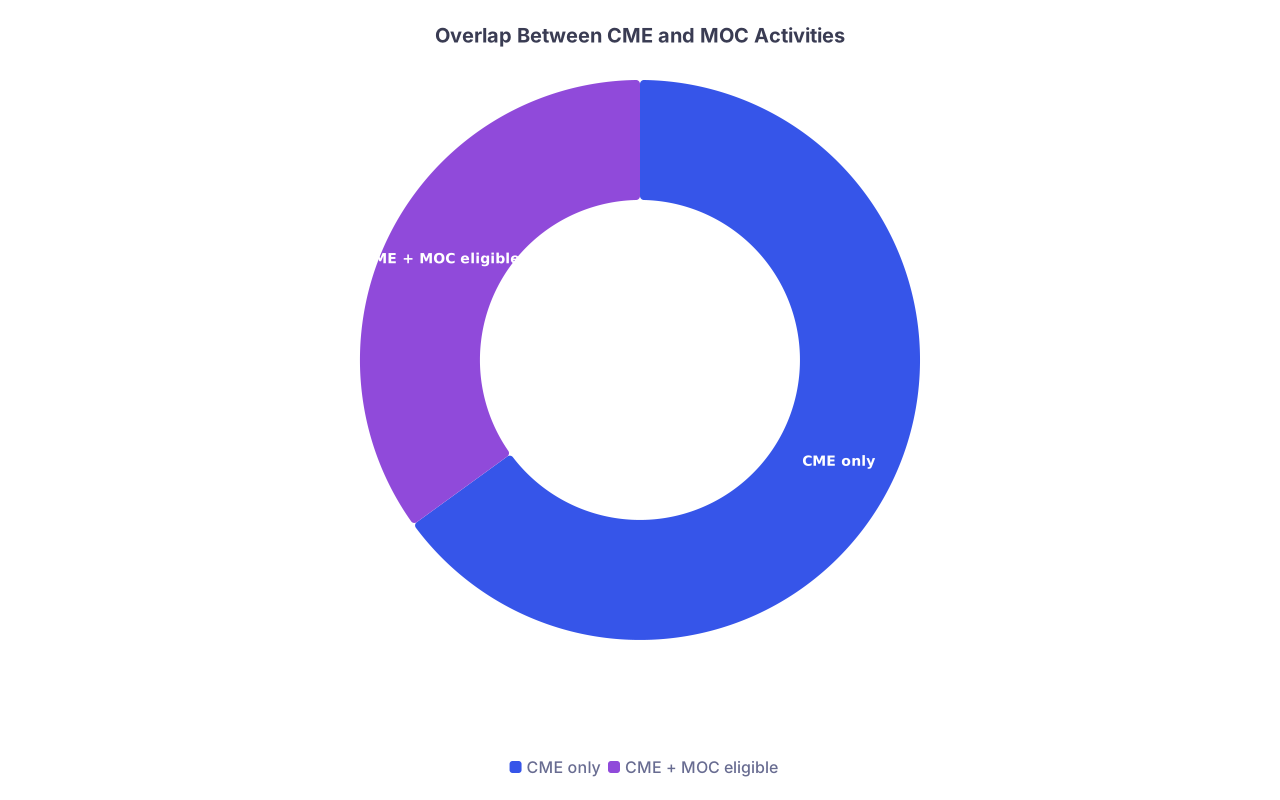
| Category | Value |
|---|---|
| CME only | 65 |
| CME + MOC eligible | 35 |
Think of it this way:
- CME = General currency you spend for licensure.
- MOC = Specialty board-specific currency. Sometimes redeemable via the same activities, sometimes not.
2. The Architecture of MOC: The Four-Part Model
ABMS boards follow a four-part model. The names vary slightly, but the skeleton is the same:
Part I – Professionalism and Professional Standing
- Maintain an active, unrestricted medical license.
- Usually verified automatically via state licensure databases.
Part II – Lifelong Learning and Self‑Assessment
- CME with a “self‑assessment” component.
- Question-based modules, board-endorsed products, or accredited CME with post‑tests.
Part III – Assessment of Knowledge, Judgment, and Skills
- Traditional high-stakes recertification exam, or
- Longitudinal assessment (quarterly questions, “take it as you go”) in many boards now.
Part IV – Improvement in Medical Practice (aka PI/QI)
- Quality improvement, practice assessment, or performance improvement projects.
- May use registry data, chart audits, or structured PI modules.
Now, where does CME actually plug into this?
- Part II is where CME/MOC overlap most.
- Some boards also allow CME activities to “double-dip” as Part IV if they are structured as performance improvement CME (PI-CME / QI-CME).
- Part III is mostly independent—though some boards give CME for participation in longitudinal assessment.
The confusion usually comes from this: people assume “I did 50 hours of CME this year, I’m fine.” That is incomplete. Correct question is: Do those hours meet your board’s MOC Part II rules and totals within the defined cycle?
3. ABIM, ABFM, ABP, ABEM, ABS: How the Major Boards Differ
Let me break down some of the big boards. Not exhaustively, but enough that you see how the fine print shifts under your feet.
3.1 ABIM – Internal Medicine and Subspecialties
ABIM has one of the more complicated ecosystems, but also one of the better-integrated CME/MOC pipelines.
Key features:
- 10-year certification “expiration,” but continuous MOC requirements.
- MOC points system: you earn “points” for approved activities (CME, QI, etc.).
- Default expectation: 100 MOC points every 5 years; at least some from medical knowledge (Part II) and some from practice assessment (Part IV). They also expect you to be “meeting MOC requirements” every 2 years.
Where CME fits:
Many CME activities (live conferences, online modules) are labeled “ABIM MOC Part II.”
You can earn:
- AMA PRA Category 1 Credits (for your license), and
- ABIM MOC points (for your certification)
from the same event, if accredited correctly.
ABIM Longitudinal Knowledge Assessment (LKA) gives both MOC points and, in many cases, CME credit.
Common pitfall I have seen:
People attend conferences, claim only CME through the conference portal, never click the ABIM MOC attestation step. Result: license CME looks great, ABIM MOC points remain abysmal.
3.2 ABFM – Family Medicine
ABFM is more structured and explicit, less point-based and more module‑based.
Key features:
Three main MOC components:
- Knowledge self‑assessment (KSA)
- Performance improvement (PI)
- CME hours
Recertification exam or continuous knowledge self‑assessment alternatives (e.g., Continuous Knowledge Self-Assessment (CKSA)).
Where CME fits:
- Most KSA and PI activities carry CME credit.
- ABFM also requires a baseline amount of CME (often 150 hours per 3-year cycle, including certain numbers of ABFM-endorsed activities; details shift slightly over time, so you always confirm the current cycle language).
Subtle issue: doing “random CME” through your hospital or UpToDate gives you licensure CME, but does not necessarily fulfill ABFM’s specific KSA/PI expectations. You must still complete ABFM-branded or ABFM-approved activities.
3.3 ABP – Pediatrics
ABP uses a “points and cycles” model but with a constant background hum of specific activity types.
Key points:
- MOC points in:
- Part II (Knowledge and self‑assessment)
- Part IV (Improvement activities)
- Time-limited certificates with continuous requirements.
Where CME fits:
- Many ABP MOC Part II activities provide both CME and MOC.
- ABP also recognizes some external QI projects (e.g., from hospitals) as Part IV with or without additional CME.
Major issue for pediatricians: they often accumulate tons of unstructured CME (regional pediatrics meetings, hospital grand rounds) that do not carry ABP MOC credit. License looks fine; MOC dashboard does not.
3.4 ABEM – Emergency Medicine
ABEM’s “MyEMCert” and LLSA era changed the nature of MOC.
Historically:
- LLSA (Lifelong Learning and Self-Assessment) tests, based on selected articles.
- High-stakes recertification exam every 10 years.
Now:
- MyEMCert modules: topic-specific, more frequent, smaller chunks.
- Less reliance on a single huge exam.
Where CME fits:
- Many MyEMCert and LLSA activities can be paired with CME credit (depending on how your institution counts them).
- Emergency physicians also do significant trauma, stroke, and PALS/ACLS-type CME; some of these are linked to ABEM MOC if structured and submitted properly.
Main trap: EM physicians assume ACLS/PALS/ATLS-type renewals automatically count toward ABEM MOC. They may not, unless they are tagged appropriately and reported through an accredited provider or directly accepted by ABEM.
3.5 ABS – General Surgery and Subspecialties
Surgeons live in a different universe of logbooks and case requirements.
ABS MOC components:
- Professionalism and Professional Standing (license, privileges)
- Lifelong Learning and Self-Assessment (CME, SESAP, question banks)
- Cognitive expertise (exam or longitudinal assessment)
- Practice improvement and patient safety
Where CME fits:
- ABS requires a fixed number of CME credits in a cycle (e.g., 150 Category 1 over 5 years, with some minimum of self‑assessment credits).
- SESAP modules and ABS-approved activities count as both CME and MOC.
Common misread: They hit 150 CME hours from random sources, but too few of them are “self‑assessment” CME (i.e., involve questions and feedback). ABS then flags them as not meeting the Lifelong Learning/Self-Assessment requirements, despite plenty of raw CME hours.
4. Side-by-Side: How Boards Treat CME vs MOC
Here is a clean snapshot for some major boards. Details change by year and subspecialty, but the structural differences hold.
| Board | CME Use for Licensure | MOC Structure | CME–MOC Overlap |
|---|---|---|---|
| ABIM (Internal Med) | Standard CME for state license | Points system (Parts I–IV, 10-year certificate, continuous MOC) | High – many CME activities grant ABIM MOC points |
| ABFM (Family Med) | Standard CME for state license | KSA, PI modules, exam/CKSA | Moderate – ABFM activities usually include CME; generic CME alone is not enough |
| ABP (Pediatrics) | Standard CME for state license | Points for Part II/IV, recert exam/longitudinal assessment | Moderate – many ABP MOC activities include CME, but routine CME often does not carry MOC |
| ABEM (Emergency Med) | Standard CME for state license | MyEMCert modules, professionalism, licensure | Variable – some EM-specific CME can be MOC eligible; not automatic |
| ABS (Surgery) | Standard CME for state license | CME credits (with self-assessment), exam or longitudinal, PI | Moderate – SESAP and ABS-endorsed CME count for both; generic CME may not meet self-assessment requirements |
The key column is the last one. That is where your time either compounds or gets wasted.
5. Where Physicians Get Burned: 7 Recurrent Failure Modes
I have seen the same mistakes over and over. Let me outline the main ways people get in trouble with MOC vs CME.
5.1 Assuming All CME Automatically Counts for MOC
Classic error.
You attend:
- 3-day national conference
- Weekly grand rounds
- A couple of online modules on your own time
You rack up 60–80 hours of AMA PRA Category 1 Credit. You log into your board portal. It shows:
- CME section: fine or not even tracked by the board.
- MOC Part II/Part IV: anemic.
Reason: Those activities were never configured or reported as MOC-credit activities. Boards do not crawl the ACCME universe on your behalf. The activity has to be explicitly set up and reported as MOC-eligible.
5.2 Ignoring “Self‑Assessment” Requirements
Many boards (ABS, ABIM historically, others) distinguish between:
- Plain CME: you read/listen; minimal or no evaluation.
- Self‑assessment CME: you answer questions, get feedback, show engagement.
If a board requires “X hours of CME, Y of which must be self‑assessment,” you cannot backfill that with slide‑viewing certificates. You need question-based, performance‑tracked modules like:
- SESAP (surgery)
- KSA (family medicine)
- ABIM MOC-approved question-based CME products
- Article-based CME with scored post-tests
5.3 Not Linking CME Provider Accounts to Board Portals
Many large CME providers now offer automated reporting to ABIM, ABP, etc. If you do not enter your board ID and NPI correctly, and do not consent to have your completion data sent, nothing moves.
So you end up in this ridiculous situation:
- You actually completed enough MOC-eligible CME.
- The board shows zero, because nothing was transmitted.
I have seen this with ACCME “CME for MOC” systems, UpToDate MOC, NEJM Knowledge+, and multiple society conferences. One unchecked box and your weekend disappears into manual attestation hell.
5.4 Misunderstanding Cycles vs Certificate Expiration
Boards run on two clocks:
- Certificate expiration date (e.g., 12/31/2030)
- Ongoing cycle requirements (e.g., 100 points every 5 years, or at least X activities every 3 years)
People fixate on the big exam / expiration date and forget that they can be flagged as “Not Certified” or “Not Meeting MOC Requirements” years earlier if they fail the interim cycle targets.
Translation: You cannot just “catch up” in year 9. Some boards expect consistent progress.
5.5 Assuming State CME == Board Requirements
Licensure CME is simple:
- State X: 50 hours CME every 2 years.
- Some states: sub‑requirements (opioid prescribing, ethics, domestic violence, etc.)
Boards could not care less about those specifics. They want:
- MOC-branded activities.
- Their own veneer of “self‑assessment” and “improvement” baked in.
If your mental model is “as long as I meet my state CME hours, I am fine,” you are already behind.
5.6 Overlooking Practice Improvement (Part IV) Completely
Many physicians drag their feet on Part IV because it feels bureaucratic. They think practice improvement means reinventing quality improvement from scratch. Reality is more generous:
- Many hospitals have QI projects pre‑approved for MOC Part IV across multiple boards.
- Specialty societies often host PI‑CME modules that check the box for several boards.
The error: physicians complete QI work (e.g., sepsis bundle improvement, asthma readmission project) but never get it documented as a Part IV-approved MOC activity. So they do the work anyway, and the board acts like none of it happened.
5.7 Leaving Provider Choice to Chance
If you randomly pick CME based entirely on convenience (“what email spammed me this week?”), you get a random mix of:
- CME-only
- CME + MOC
- CME + MOC + PI
The efficient way is the opposite: you deliberately choose providers and activities that maximize overlap:
- One activity gives you licensure CME, board MOC Part II, sometimes Part IV.
- Some activities also cover state-specific CME mandates (opioids, pain, ethics) simultaneously.
Random CME is how you end up with 200 hours of credit and a red MOC dashboard.
6. Strategy: Turning MOC and CME Into a Single Integrated Workflow
Let me walk through a practical, board-agnostic approach that works for most physicians.
Step 1: Map Your Obligations on One Page
You should be able to answer clearly, right now:
- State license: How many CME hours per cycle? Any topic mandates?
- Board:
- How many MOC points or hours?
- Any specific breakdowns (e.g., self‑assessment, PI/QI, knowledge assessment)?
- Any interim deadlines (every 3 or 5 years) in addition to the big exam?
If you can not write that on half a page, you are flying blind.

| Step | Description |
|---|---|
| Step 1 | Identify State CME Rules |
| Step 2 | Identify Board MOC Requirements |
| Step 3 | List Gaps in CME and MOC |
| Step 4 | Choose CME Providers with MOC |
| Step 5 | Complete Activities Quarterly |
| Step 6 | Verify Credits Posted to Board Portal |
| Step 7 | Adjust Plan Each Year |
Step 2: Choose CME Providers That Are Explicitly MOC-Linked
Look for language such as:
- “This activity is approved for ABIM MOC Part II”
- “ABP MOC Part 2 points available”
- “PI-CME that meets Part IV requirements for ABFM, ABIM, etc.”
Large integrated players:
- Specialty societies (e.g., ACC, AHA, AAP, ACP, ACS, ACEP, AAFP)
- Some Q‑bank style products (e.g., MOC-focused question banks)
- Hospital systems with NCQA/ABMS QI-accredited projects
The metric you care about: how many of your annual CME hours directly pull double duty as MOC credit.
Step 3: Front-Load Self‑Assessment and Practice Improvement
Procrastination on Part II/IV is how people get trapped later.
Better pattern:
- Every year: do at least one major self‑assessment activity (e.g., SESAP section, KSA, ABIM MOC CME module) that yields a chunk of MOC points and CME.
- Every 1–2 years: participate in one QI/PI project that is recognized by your board.
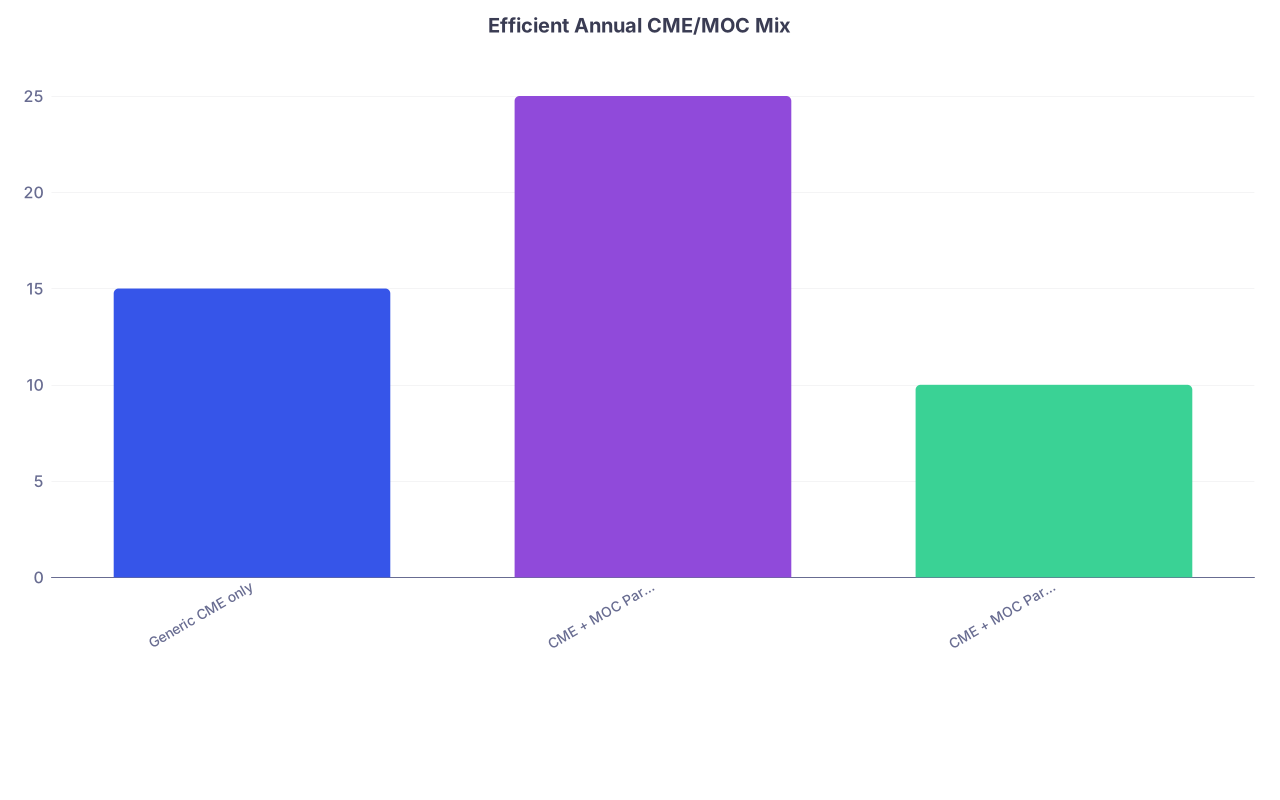
| Category | Value |
|---|---|
| Generic CME only | 15 |
| CME + MOC Part II | 25 |
| CME + MOC Part II+IV | 10 |
That pattern easily exceeds most boards’ rolling targets without a year‑10 scramble.
Step 4: Link and Verify Accounts Religiously
Whenever you engage with a major CME provider:
- Enter your ABIM/ABFM/ABP etc. ID.
- Verify NPI.
- Authorize automatic reporting to your board.
Then, 1–2 months later:
- Log into the board portal.
- Confirm the activity appears with proper points/credits.
- If not, contact the CME provider while it is still fresh.
Step 5: Use Longitudinal Assessments to Your Advantage
Boards moving to longitudinal formats (ABIM LKA, some ABS and ABP structures, ABEM MyEMCert) are actually making your life easier if you integrate them:
- They drip questions over time; you answer in small bursts.
- Many are CME-eligible as well as MOC.
- They keep you from facing high-stakes exam prep marathons.
Do not ignore these until the last minute. The whole model is “little and often.”
7. Subspecialists and Multi-Board Diplomacy
If you are dual-certified—say, IM + Cardiology, or Pediatrics + Neonatology—you are playing this game on “hard mode.” But there are ways to make it tolerable.
Common patterns:
- Primary board (IM, Peds, Surgery) plus one or more subspecialty boards.
- Some boards share or cross-recognize certain MOC activities; others treat them separately.
Examples:
- ABIM: many subspecialty MOC activities count toward general IM MOC as well. An advanced heart failure CME that is ABIM MOC-eligible may apply to both cardiology and IM, depending on how it is coded.
- Surgery subspecialties: Vascular/colorectal sometimes incorporate ABS requirements; but you still need to check each certificate’s rules.
Practical approach:
- Use specialty-society CME that explicitly lists multiple board MOC approvals.
- When available, prioritize activities clearly tagged for both your primary and subspecialty certifications.
- Check each board portal annually to ensure cross-credit is actually being applied, not just promised.
You cannot assume that because one board shows 40 MOC points, the other one silently imported them. Sometimes they do. Sometimes they do not.
8. Quick Reality Check: Where You Stand Right Now
If I sat next to you at this very moment and asked you to open your board portal, here is what I would look for:
- Status: “Certified and Participating in MOC” vs some yellow/red warning banner.
- Total MOC points (or activities) earned in current cycle and what is required by the end of that cycle.
- Breakdown:
- Medical knowledge / Part II
- Practice improvement / Part IV
- Exam/assessment status
- Any upcoming deadlines (e.g., “Complete a KSA by 12/31 this year” or “At least 1 QI project this cycle”).
Then I would open your CME tracker (institution, self-kept, or state board) and compare:
- How many of your recent CME certificates explicitly mention MOC?
- Are you getting credit in real time or planning to clean this up at the end of the year? (Hint: clean-up mode is how you lose things.)
If your MOC components and CME activities do not look tightly linked, you are wasting effort.
FAQ (Exactly 6 Questions)
1. If I complete enough CME to renew my license, can my board still revoke or suspend my certification?
Yes. Licensure CME and board MOC are separate systems. You can be fully compliant with your state’s CME requirements and still be marked as “Not Certified” or “Not Meeting MOC Requirements” by your specialty board if you do not complete the specific MOC activities (self‑assessment, practice improvement, longitudinal assessments, or exams) they mandate.
2. How do I know if a CME activity will count toward my board’s MOC requirements?
Look for explicit statements in the activity description. You want language like “ABIM MOC Part II,” “ABP MOC Part 2,” “PI-CME meeting ABFM Part IV,” or similar. If you see only “AMA PRA Category 1 Credit,” assume it is standard CME only unless the provider confirms MOC eligibility and automatic (or manual) reporting to your board.
3. Can one CME activity count for multiple boards’ MOC programs?
Sometimes. Many major society activities and PI projects are accredited for multiple boards. For example, a quality improvement CME from a large hospital or society might be approved for ABIM, ABFM, and ABP MOC simultaneously. However, this is not automatic. You must check the activity’s accreditation statement and ensure the provider collects and reports your data appropriately for each board.
4. What happens if I fall behind on MOC requirements mid-cycle but still before my certificate expiration date?
Several boards can change your status to “Not Certified” or “Not Meeting MOC Requirements” even if your official certificate expiration date is years away. Hospitals and payers may see that status and react. Some boards allow you to “catch up” with make‑up activities, but not all will treat the lapse as if it never occurred. You do not want to test this in real time.
5. Are the new longitudinal assessments easier than the traditional 10‑year exams, and do they give CME?
They are usually more manageable, not necessarily “easier.” You answer smaller sets of questions periodically rather than cramming for a single high‑stakes exam. Many boards grant both MOC points and CME credit for participation, which is a major advantage. The trade‑off is that you must engage consistently over time; you cannot ignore them for years and then binge at the end.
6. How should I prioritize my CME choices if I am overwhelmed by options?
First, choose activities that explicitly provide both CME and MOC for your board. Second, front‑load anything that satisfies self‑assessment (Part II) and practice improvement (Part IV). Third, align some CME with your exam or longitudinal assessment content areas so your studying and credit acquisition occur together. If a planned activity offers only basic CME with no MOC or PI value and your dashboard shows gaps, it goes to the bottom of the list.
With the fine print decoded and the structural differences clear, you can stop treating CME and MOC as two competing demands and start treating them as one integrated workflow. Once you have that system in place, the next battle is choosing higher‑value content that actually sharpens your clinical practice, not just checks boxes—but that is another conversation for another night.