
The biggest CME mistake physicians make isn’t missing credits. It’s double‑counting them—and boards are far less forgiving about that than about being a little short.
You can recover from being a few CME hours behind. You do not easily recover from a board thinking you falsified your education record. And yes, double‑counting is interpreted as falsification more often than you think.
Let’s walk through where people screw this up, how boards actually check, and what happens when they catch it.
The illusion that “if the portal accepts it, I’m fine”
A dangerous assumption I hear constantly: “If the system lets me enter it, it must be OK.”
No. The system is a spreadsheet with a login. It doesn’t approve your ethics.
The most common version of this illusion:
- You attend a major conference (say, ACC, ASCO, or AAOS).
- You claim the full 20 CME hours on:
- The certifying board’s portal (e.g., ABIM/ABFM/ABEM, etc.), and
- Your state medical board renewal, and
- A hospital or employer CME attestation system.
Used correctly, that’s fine—as long as you’re not claiming them as new or additional hours each time when they’re supposed to be distinct. The trouble starts when you misunderstand what “double‑counting” actually means.
Here’s the key distinction most people miss:
- Legitimate reuse: One educational activity counted once, but reported to multiple entities, with each entity understanding it’s the same activity and within their rules.
- Double‑counting (the bad kind): One educational activity being represented as different or separate credits, so your total hours are inflated.
Where physicians get burned:
- Entering the same activity twice in the same board portal under slightly different names.
- Counting a single 1‑hour enduring material (online course) as 1 hour of CME and 1 hour of “self‑assessment,” even when the activity isn’t accredited as SA or MOC Part II.
- Using a bundled activity (e.g., a 4‑hour workshop that includes opioid prescribing content) and separately counting those opioid hours again under a “special topic” requirement, in addition to the 4 hours you already logged.
If your number of CME hours is mathematically impossible without reuse, a board will assume one thing: inflation. And they treat that as an integrity problem, not a filing error.
Where double‑counting silently sneaks in
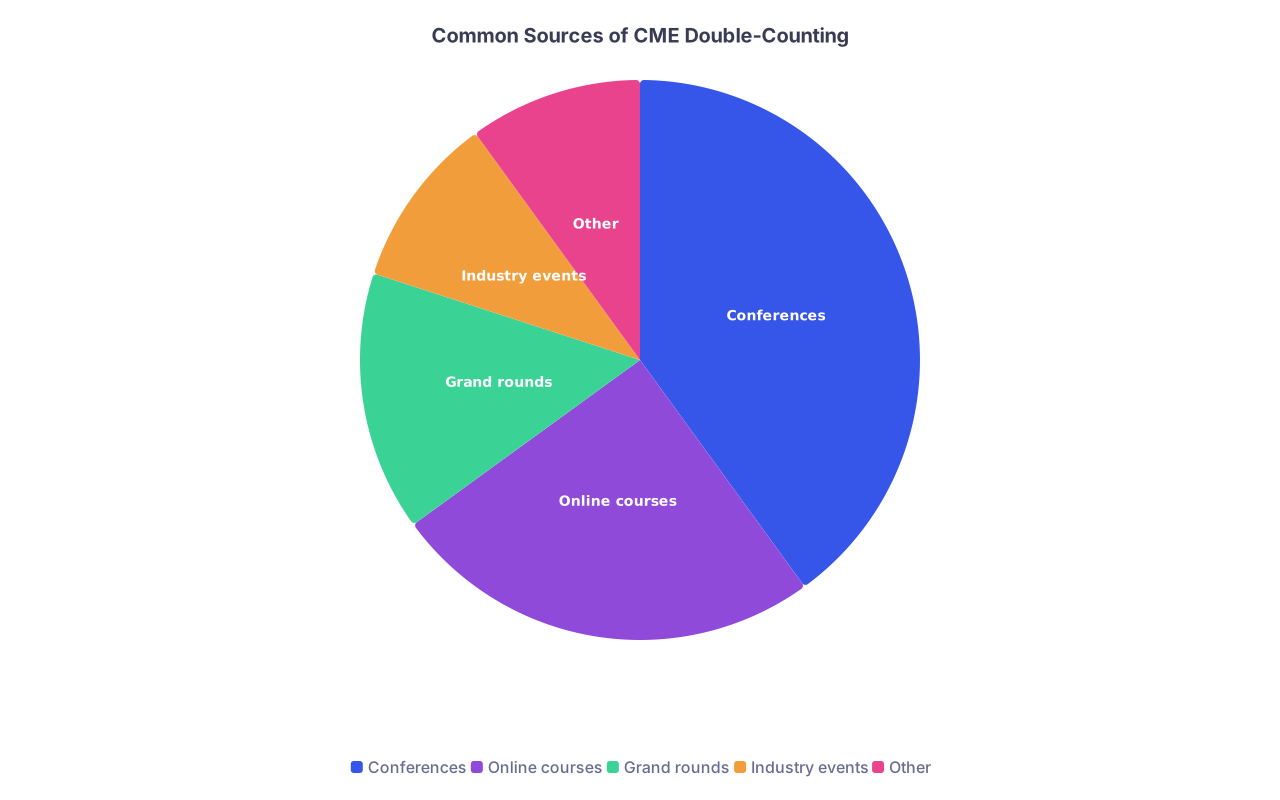
| Category | Value |
|---|---|
| Conferences | 40 |
| Online courses | 25 |
| Grand rounds | 15 |
| Industry events | 10 |
| Other | 10 |
Nobody wakes up and decides, “I’ll cheat on my CME today.” Double‑counting usually starts as sloppiness. Then sloppiness looks suspicious under audit.
Here are the traps I see over and over.
1. The same conference, split into “multiple” events
You go to a 3‑day meeting that issues a single certificate: “Total: 18 AMA PRA Category 1 Credits.”
Then you:
- Log “Day 1 sessions – 8 credits”
- Log “Day 2 sessions – 6 credits”
- Log “Day 3 sessions – 4 credits”
All in the same portal, even though your certificate already summarizes them as 18.
If the activity is accredited and recorded as one activity by the provider, but you carve it into three separate entries and also submit the full 18‑hour umbrella certificate somewhere else, you’ve just made it very hard for an auditor to understand what you did. It often looks like 18 + 8 + 6 + 4, not 18 broken up.
If you want to list individual sessions, you must:
- Either enter the actual sessions and hours only (no extra “total” entry), or
- Enter the total activity once and keep the internal breakdown in your own notes—not as extra entries.
Do not do both.
2. Using a single activity to satisfy overlapping requirements—twice
Plenty of CME providers wisely design a single course to meet multiple requirements at once. For example:
A 3‑hour online course that’s:
- AMA PRA Category 1
- Counts for opioid prescribing credit for state X
- Counts for pain management credit for hospital Y
What’s legitimate?
- Reporting that same 3‑hour course to:
- Your state board as “3 hours opioid CME (Course XYZ)”
- Your hospital credentialing as “3 hours pain management CME (Course XYZ)”
- Your specialty board as “3 AMA Category 1 (Course XYZ)”
You are using 3 real hours one time each across different entities.
What crosses the line:
- Logging “3 hours opioid CME” and “3 hours pain management CME” in the same board or state system as if they are two separate activities, for a claimed total of 6.
- Taking that same 3‑hour course and listing it twice in your hospital credentialing form under slightly different titles.
The rule of thumb: if you didn’t sit for 6 hours, you don’t have 6 hours. No matter how many labels that single course carries.
3. Self‑reported CME without backing documentation
This is where people get lazy and think, “I read an article, that’s CME, right?” Maybe. Depends on your board and whether it’s structured learning.
But the deadly combination is:
- Vaguely defined “self‑study” hours,
- No named provider or activity ID,
- Reused copy‑paste descriptions from prior cycles (e.g., “Cardiology journal reading – 50 hours” every cycle).
When that appears side‑by‑side with multiple listings of the same “Cardiology Board Review 2024” course, it looks like you’re padding.
Self‑reported CME is the first thing an auditor pokes at. If you’re going to claim it, keep it clean, specific, and not recycled year after year.
4. Reusing MOC activities in ways the board explicitly forbids
Some boards have clear rules like:
- You cannot claim credit for the same self‑assessment module multiple times in different maintenance cycles.
- You cannot reuse the same PI (practice improvement) project for multiple reporting periods unless there’s a documented new phase of improvement.
And yet, people try:
- Logging the same QI project from 2019 again in 2024 with the same title and description.
- Reclaiming the exact same online MOC module that’s specifically flagged as “credit can only be claimed once.”
If your board says “credit may be claimed once,” do not test their patience by creatively rephrasing the title and submitting it again.
How boards and regulators actually catch double‑counting

| Step | Description |
|---|---|
| Step 1 | Physician submits CME attestation |
| Step 2 | Request documentation |
| Step 3 | Compare against provider records |
| Step 4 | Close audit |
| Step 5 | Request explanation |
| Step 6 | Discipline or remediation |
| Step 7 | Random or triggered audit |
| Step 8 | Discrepancy found |
| Step 9 | Satisfactory response |
Most physicians assume, “They’ll never check; there are too many of us.” That’s naive.
Here’s how they actually do it.
1. Random audits
Many state boards and specialty boards conduct random CME audits every renewal cycle. Typical pattern:
- A small percentage (5–10%) of physicians are selected.
- They must submit certificates, transcripts, or provider verification for a sample or all activities.
You don’t need to be under suspicion. You just need to be unlucky.
Under random audit, double‑counting shows up as:
- Same certificate supporting multiple, larger claimed totals.
- Discrepancies between your log (e.g., 50 credits from Conference X) and the certificate (which clearly states 25 max).
2. Cross‑matching with CME providers
Larger CME providers (big conferences, major online platforms) keep robust attendance and credit claim records. Some boards:
- Directly accept credit feeds from approved providers.
- Or cross‑check when a pattern looks odd.
If you claim 30 credits from an activity where the provider’s records show:
- You only completed 10 hours, or
- The maximum possible credit was 12,
your board knows there’s a problem. And they know it’s on your side, not the provider’s.
3. Pattern recognition
Boards don’t need advanced AI to see red flags. Human reviewers notice:
- Repeated similar titles that look like the same course entered many times.
- Unrealistic totals (e.g., 200 hours all claimed from a single 3‑day conference).
- Multiple different names but identical dates, providers, and locations.
Once a pattern looks suspicious, they:
- Ask for supporting documentation,
- Ask direct questions like, “Explain how these activities differ,”
- Pull prior cycle records to see if the same thing has happened before.
Multiple cycles of “creative accounting” turns a questionable mistake into a likely integrity issue.
How boards interpret double‑counting: error vs dishonesty

Boards are not stupid. They know physicians make honest mistakes. They also know some physicians deliberately stretch their numbers. Their job is to sort one from the other.
Here’s how they differentiate.
Looks like an error when:
- The total overcount is small and localized (e.g., you claimed a 6‑hour course as 8 because you misread the certificate).
- Your documentation is otherwise clean and consistent.
- You respond quickly and transparently when asked.
- You immediately correct the record and accept any remediation.
In these cases, you usually get:
- A requirement to:
- Correct your reported CME, and/or
- Make up missing hours in the next cycle.
- Possibly a warning letter, often non‑public.
Still stressful, but survivable.
Looks like dishonesty when:
- There’s a clear pattern of inflation—multiple activities, multiple cycles.
- The overstatement is large (e.g., you’ve claimed 50+ hours more than your documentation can support).
- You’ve used the same certificate to back up multiple different entries that obviously exceed the credit limit.
- You’re evasive, slow, or contradictory in your responses.
- You ignore explicit rules (e.g., “do not claim this activity twice in different MOC cycles”) and do it anyway.
Now you’re in misconduct territory. That’s where you start seeing:
- Formal reprimands
- Probation
- Fines in some states
- Public disciplinary entries on your license or board profile
- Required ethics or professionalism coursework
And that’s before your employer, malpractice carrier, or hospital see it and decide what it means for them.
Real-world consequences: what actually happens to physicians
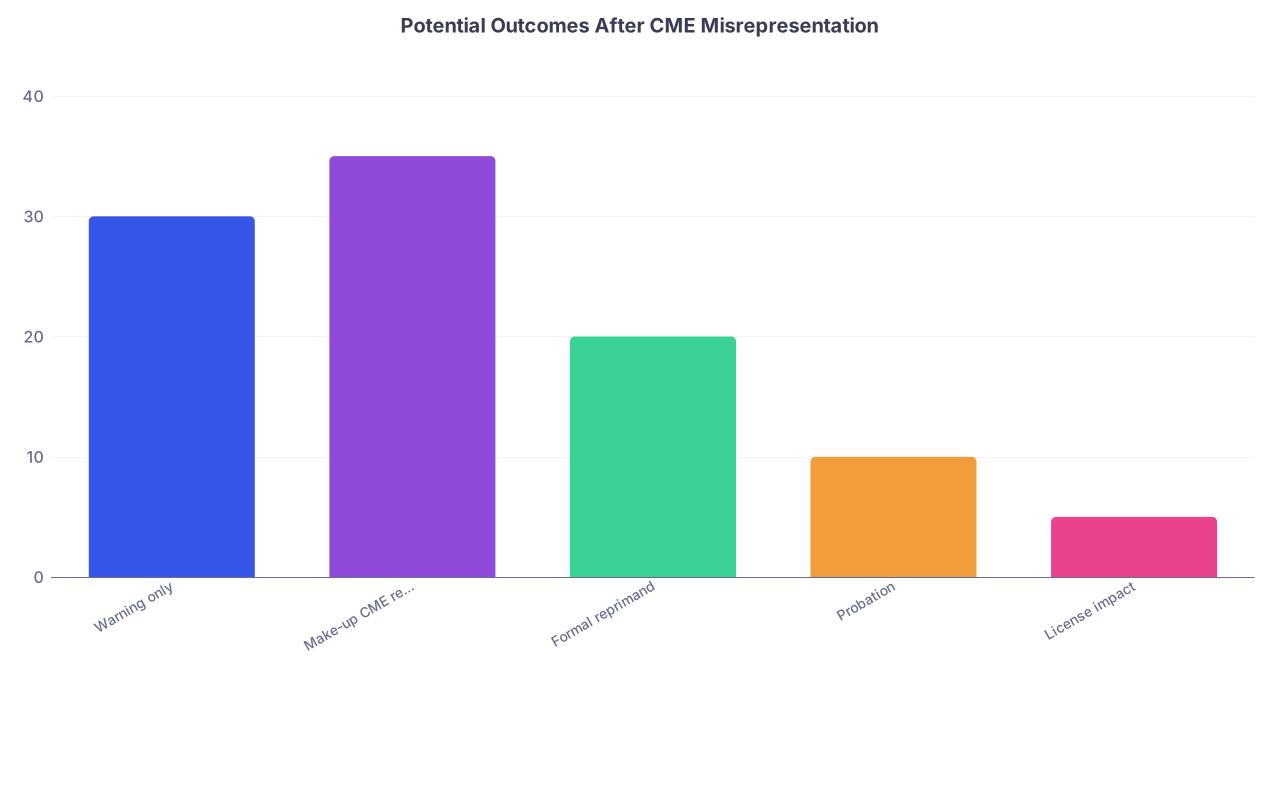
| Category | Value |
|---|---|
| Warning only | 30 |
| Make-up CME required | 35 |
| Formal reprimand | 20 |
| Probation | 10 |
| License impact | 5 |
You need a realistic sense of the downside. This isn’t “they’ll ask you nicely to fix it and move on” in every case.
I’ve seen variations of the following:
“Quiet fix + extra CME”
A physician overcounts hours from a big conference. Audit catches it. The board:- Requires a corrected submission
- Orders an extra 10–20 hours of CME in the next cycle
- Places a letter in the file but doesn’t make it public
This is the best outcome you can hope for after a mistake.
Public reprimand for “false attestation”
A board finds repeated double‑counting and inconsistent documentation. They interpret it as false attestation. Result:- Public order listing “failure to maintain proper CME documentation” or “false reporting of CME”
- Mandated CME in ethics/professionalism
- Sometimes reporting to NPDB (in more severe cases or when tied to licensure action)
License renewal delay or conditional renewal
If your documentation is a mess and your explanations are bad, your renewal can be:- Delayed while the investigation continues
- Granted with terms (e.g., monitoring, extra CME, periodic reporting)
Meanwhile, employers get nervous because “pending board action” is its own risk.
Employer fallout
A board sanction for misrepresented CME often triggers:- HR investigations
- Credentialing committee reviews
- Potential contract non‑renewal
And don’t forget: any future job application that asks, “Have you ever been disciplined by a licensing board?” now has a yes box you have to check.
Practical ways to avoid double‑counting (without going insane)
You don’t need a six‑tab spreadsheet and a PhD in compliance. You just need to stop doing the three dumbest things that lead to overcounting.

1. Maintain one master log, not five
The mistake: trying to separately track CME for:
- Your state license
- Your hospital
- Your board
- Your employer system
And then retyping the same course four times across four different lists. That’s where inconsistencies and inflation creep in.
Better approach:
Keep a single master log (spreadsheet or secure note) with:
- Date
- Provider / course name
- Number of credits
- Type (Category 1, opioid, risk management, MOC Part II, etc.)
- Where you’ve reported it (state, board, employer)
When you report to a new entity, you pull from that master, not your memory.
That way, you’re always reporting from the same source, not reconstructing your CME story each time.
2. Don’t guess. Use the number on the certificate—exactly.
If the certificate says:
- “Maximum of 7.5 AMA PRA Category 1 Credits”
Don’t:
- Round up to 8
- Assume you “probably attended all of it” if you left early
- Turn a “maximum of 7.5” into “I’ll just call it 10 across multiple systems”
You claim what you actually earned:
- If you left halfway, many providers let you claim proportional hours in their system. Use that.
- If you’re not sure, err slightly down, not up.
If pressed by a board, “I undercounted a bit because I wasn’t sure” is a very different conversation than “I added a few hours because it looked better.”
3. Treat multi‑purpose activities as a single time block
If one 3‑hour course satisfies three separate topical requirements, remember:
- You invested 3 hours of your time, not 9.
So in your master log, record it as:
- “3 hours – Course X – meets: Category 1, opioid, risk management”
Then, when each entity asks:
- State license opioid requirement → “Course X – 3 hours opioid”
- Hospital risk management requirement → “Course X – 3 hours risk management”
- Specialty board general CME → “Course X – 3 AMA Cat 1”
You’re distributing the same 3 hours across different buckets, not duplicating the hours.
What to do if you realize you’ve already double‑counted
This is where most physicians freeze and hope it “ages out.” Bad idea.

| Step | Description |
|---|---|
| Step 1 | Notice possible double counting |
| Step 2 | Review master records |
| Step 3 | Document review and move on |
| Step 4 | Quantify discrepancy |
| Step 5 | Contact board or CME office |
| Step 6 | Submit corrected totals |
| Step 7 | Complete make up CME if required |
| Step 8 | Confirm overcount? |
If you suspect you’ve overclaimed credits:
Audit yourself
Go through the last cycle systematically:- Highlight duplicated titles, providers, conference names, and dates.
- Match them against your certificates.
- Compute the real total vs the reported total.
Document your findings clearly
Create a brief summary:- “In reviewing my records, I noted that Activity X was mistakenly entered twice in [system]. Actual credit earned: 6 hours; credit claimed: 12 hours.”
Proactively correct it
Then, yes, you actually reach out:- To your board CME department or state board contact and say (in plain language) what you found and that you want to correct your record.
Boards look very differently at:
- A doctor caught in an audit who denies, minimizes, or blames the portal, vs
- A doctor who self‑identifies an issue, corrects it, and is willing to make up the deficit.
The latter is usually treated as a genuine error. The former as dishonesty.
A simple reference to keep yourself out of trouble
| Scenario | Likely Safe or Risky? |
|---|---|
| Reporting the same 10-hour conference to state board, specialty board, and employer, once each | Safe (normal, as long as hours are not inflated) |
| Entering the same 10-hour conference twice in the same board portal with slightly different titles | Risky (very likely double-counting) |
| Using a 3-hour opioid course to satisfy both opioid and risk management requirements in different systems | Safe if hours are not multiplied |
| Claiming the same MOC module for credit in two different certification cycles when the board forbids reuse | Risky and often prohibited |
| Rounding 7.5 hours to 8 hours in multiple systems | Risky pattern, especially if repeated |
How to move forward—without paranoia, but with discipline
You don’t need to be terrified of every CME entry. You do need to treat your CME like what it is: a professional attestation that boards, hospitals, and patients assume is honest.
Think of it this way:
Your clinical notes can be audited. Your billing can be audited. Your CME is no different. Sloppiness here is read as sloppiness elsewhere.
So here’s your next step today:
Open your most recent CME certificate and your last reporting portal entry side by side. Does the number of credits match exactly, or did you “estimate”? If they don’t match, fix that one entry right now—and then decide if it’s time to clean up the rest.