
Most physicians doing “risk management CME” have no idea that their malpractice carrier is quietly policing the content behind the scenes.
Let me break down how that actually works, what “acceptable” means in carrier-speak, and where content crosses the line from covered education into underwriting panic.
1. Why Malpractice Carriers Care About Your CME at All
Malpractice carriers are not in the education business. They are in the loss-avoidance business. If they fund or accredit “risk management CME,” they want one thing: lower frequency and severity of claims in their insured pool.
They watch three things closely:
- Does this education plausibly reduce risk?
- Does anything in the content increase legal exposure?
- Does it contradict our underwriting, defense, or claims strategies?
You feel this pressure in three ways:
- What topics they are eager to fund (documentation, communication, informed consent, scope of practice).
- What topics they consistently avoid or heavily edit (whistleblowing, how to sue your hospital, “how to win at deposition” from the plaintiff side).
- The fine print in their CME sponsorship agreements and content review policies.
Many physicians assume, “If my carrier offers it as risk management CME, it must be good, neutral, safe.” That assumption is naïve. The carrier has a stake in which messages you internalize.
2. The Two Hidden Filters: Educational vs. Insurability
Carriers define “acceptable” content with two overlapping filters: educational plausibility and insurability impact. If what you teach makes claims harder to defend or more likely to occur, it dies in committee.
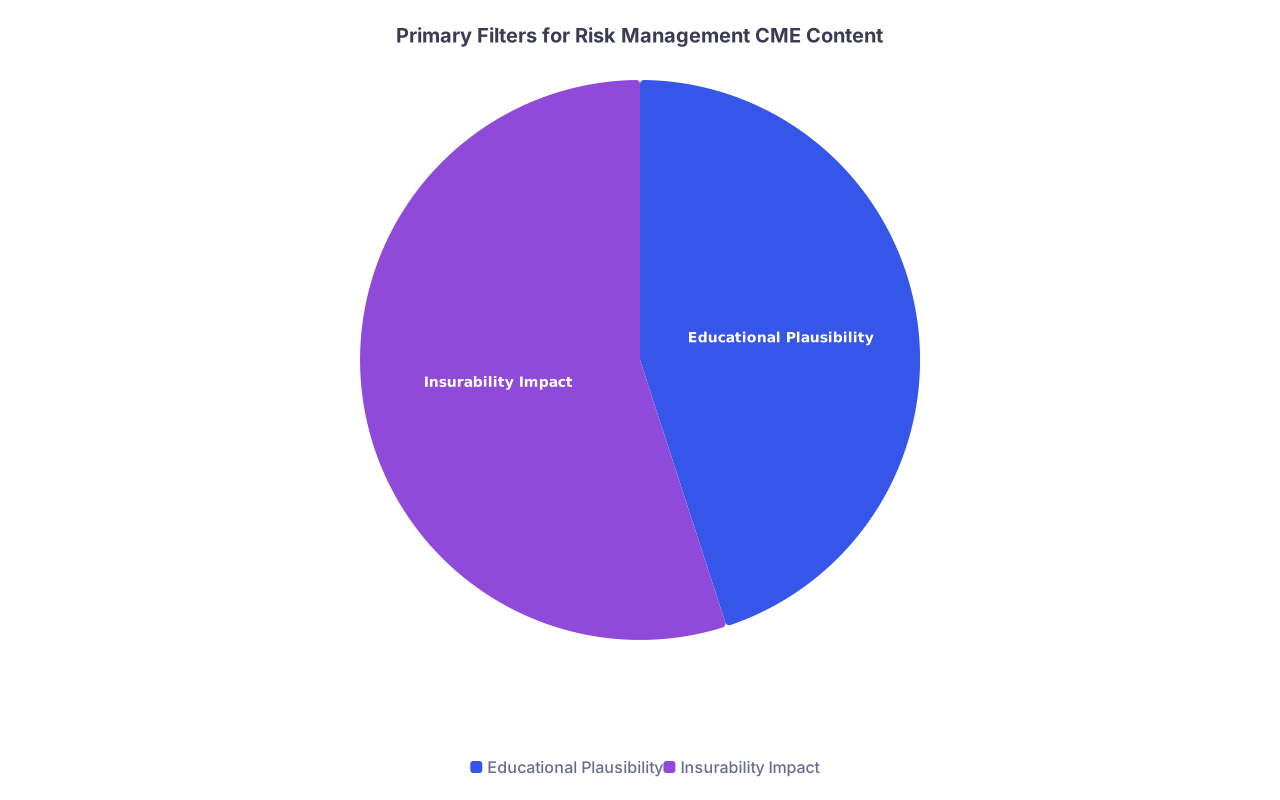
| Category | Value |
|---|---|
| Educational Plausibility | 45 |
| Insurability Impact | 55 |
2.1 Educational Plausibility: Does This Actually Reduce Claims?
From the carrier’s perspective, educationally acceptable risk management CME should:
- Anchor to real claims data or closed-case analysis
- Align with recognized standards (The Joint Commission, specialty societies, state boards)
- Target changeable clinician behavior, not purely system-level fantasy fixes
- Be measurable in some way (post-tests, audits, chart reviews, workflow metrics)
Typical “high value” themes:
- Documentation that closes common plaintiff arguments
- Communication patterns that reduce misdiagnosis or delays
- Consent processes that strengthen the defense posture
- Handoff structures that reduce cross-coverage disaster cases
- Diagnostic reasoning safeguards (for high-risk complaints like chest pain, headache, abdominal pain)
2.2 Insurability Impact: Does This Help or Hurt Our Defense Posture?
This is the part no one says out loud in the glossy brochure.
Content becomes unacceptable to a malpractice carrier if it:
- Creates discoverable statements that look like admissions of systemic negligence
- Encourages documentation practices that harm defense (e.g., “document all your doubts and every possible differential you forgot to work up”)
- Contradicts current carrier-approved “best practices” that they routinely rely on in court
- Teaches clinicians to fight or undermine institutional processes that the carrier needs in place
- Invites antitrust, employment, or regulatory landmines (e.g., compensation schemes, kickbacks)
So the formal criteria you see in a CME policy (evidence-based, peer-reviewed, balanced) sit on top of an informal but very real question:
“Will this module, slide, or sentence make it harder to defend our doctors and institutions in the next five years?”
3. How Carriers Actually Review and Gatekeep CME Content
Let’s be concrete. When a risk management CME course is proposed, three groups typically get involved:
- Clinical risk management / patient safety staff
- Claims / legal or outside defense counsel
- Underwriting / leadership for alignment with corporate risk appetite
The process usually looks something like this:

| Step | Description |
|---|---|
| Step 1 | Content Idea |
| Step 2 | Draft by Clinician or Educator |
| Step 3 | Internal Risk Management Review |
| Step 4 | Accreditation/CME Office |
| Step 5 | Legal/Claims Review |
| Step 6 | Content Not Approved |
| Step 7 | Approved Risk Management CME |
| Step 8 | Carries Legal/Policy Risk? |
| Step 9 | Revise or Reject |
Here is what they actually look for in each phase.
3.1 Risk Management / Patient Safety Review
This group checks:
- Are recommendations consistent with internal policies and guidelines?
- Are we promising more than we can operationalize?
- Does this implicate known vulnerabilities we are not ready to publicly acknowledge?
- Is there consistency with prior teachings (so we are not contradicting our own defense talking points)?
Problematic phrases that get flagged here:
- “Our hospital’s systems are unsafe because…” (especially without a vetted improvement plan)
- “Most physicians here do not follow the standard of care when…”
- Any blanket statement that could be introduced as an admission of negligence in litigation
3.2 Legal / Claims Review
Legal and claims are blunt. They ask:
- If this slide deck is subpoenaed, how does it play in front of a jury?
- Are we creating a “gold standard” that plaintiff attorneys can use to argue our doctors consistently failed to meet it?
- Are we introducing language that undermines core defense strategies (e.g., variability in practice, judgment calls, evolving evidence)?
- Are we giving away internal evaluation criteria or settlement strategies?
Content that often gets heavily edited or blocked:
- Slides listing “Top 10 ways our doctors screw up X” in colorful language
- Internal benchmarking data that reveals outlier status in mortality or complication rates
- Explicit identification of known but unresolved system dangers (“We know the ICU code pager fails intermittently”)
- Statements that minimize the defense (“There is no reasonable justification for missing a PE in 2024”—risk management loves this line, defense counsel hates it)
3.3 Underwriting / Executive Lens
This group looks at the macro impact:
- Does this content align with our broader risk reduction initiatives (e.g., sepsis, opioid prescribing, telemedicine)?
- Are we inadvertently inviting regulatory scrutiny if this material goes public?
- Are we telling clinicians to behave in ways that would increase cost without clear benefit (e.g., over-testing as a defensive reflex)?
- Does it create a paper trail that regulators or auditors could weaponize?
You will rarely see these comments written. You will experience them as: “We think this needs to be re-scoped” or “Let’s focus more on communication and less on systems criticism.”
4. What “Acceptable” Risk Management CME Content Actually Looks Like
Strip the jargon. Acceptable to a malpractice carrier means:
- It teaches behaviors they can defend in court.
- It does not generate new, discoverable admissions of unsafe practice.
- It supports, rather than destabilizes, current institutional risk strategies.
Let’s break that into some concrete topic patterns.

4.1 “Safe” Content Buckets Carriers Love
These are the areas you see over and over in approved risk CME catalogs.
Documentation and Medical Records
- How to construct a clear, contemporaneous note
- Avoiding “chart wars” and unprofessional language
- Correcting the record safely (late entries, addenda)
- Objective documentation of patient nonadherence
Carriers like this because good documentation is Exhibit A in 80% of defenses.
Communication and Disclosure
- Managing difficult conversations without escalating conflict
- Explaining diagnostic uncertainty honestly but carefully
- Structured approaches to delivering bad news
- Early, non-admitting communication after adverse events
They want clinicians who can talk like calm, thoughtful, caring professionals on the stand. CME can train that style.
Informed Consent and Shared Decision-Making
- Documenting risks, benefits, and alternatives in a defensible way
- Avoiding boilerplate-only consent; adding situation-specific risks
- Dealing with language barriers and health literacy
Consent is your first line of defense in any procedure claim. They will fund this forever.
High-Risk Clinical Scenarios
- Managing chest pain, abdominal pain, headache with defensible differentials
- Recognizing sepsis early and documenting the thinking
- Safe opioid prescribing, psychiatric risk (SI/HI), child abuse evaluation
Notice the pattern: clinically meaningful, but with direct claims footprints.
4.2 Edge Cases: Where Good Education Makes Carriers Nervous
There are educational topics that clinicians legitimately need but carriers approach with a long stick.
Real Root Cause Analyses (RCA) from Ongoing Problems
If you show an internal RCA in CME, you must scrub it:
- No patient identifiers (obvious)
- No explicit “we were negligent” language
- No unresolved safety hazards left hanging
- No language that creates a “super-standard” unattainable in daily practice
I have seen slides changed from:
“The ED’s failure to follow policy led directly to the patient’s death.”
to:
“Gaps in consistent adherence to ED policy contributed to the outcome.”
That is not accidental. That is defense positioning.
Discussions About Systemic Failure and Culture
Malpractice carriers are not thrilled with content that:
- Encourages broad “call everything unsafe” language
- Trains physicians to publicly attack the institution in real time
- Documents internal conflict in ways that are discoverable
Do you need frank talk about moral injury and unsafe staffing? Absolutely. But if a carrier is paying, the language will be “careful.”
Burnout, Well-being, and Cognitive Bias
Interesting area. Clinically critical, but legally touchy.
- Admitting cognitive fatigue and error risk is human and real
- But documenting “I was so burnt out I could not think clearly” in the chart? Defense nightmare
Good CME in this space threads the needle: acknowledges human limits, teaches risk-reducing behaviors, but does not coach self-incriminating documentation.
5. Documentation, Discoverability, and the “Don’t Write This” Problem
One of the most concrete ways carriers shape CME content is around what you put in the medical record. They care deeply about which phrases and details appear in the chart and which stay in protected quality improvement space.
| Scenario | Preferred Documentation | Risky Documentation |
|---|---|---|
| Busy ED | "ED volume high, multiple patients evaluated concurrently, care prioritized by acuity." | "I was overwhelmed and could not provide safe care." |
| Missed diagnosis follow-up | "New information prompted re-evaluation and updated diagnosis; patient informed and plan revised." | "I misdiagnosed the patient yesterday because I rushed the exam." |
| Nonadherent patient | "Patient declined recommended tests after discussion of risks and benefits; return precautions given." | "Patient is noncompliant and refuses to listen to medical advice." |
| System delay | "CT scanner unavailable, alternative imaging arranged, risks discussed with patient." | "Our hospital’s imaging system is unsafe and unreliable." |
Carriers push CME faculty to emphasize:
- Objective description of facts and processes
- Clear mention of informed discussions and shared decisions
- Documentation of alternatives offered and return precautions
- Avoidance of self-flagellating or inflammatory language
Not because they want you to lie. Because loose language in the chart becomes a script for the plaintiff attorney.
6. The CME Accreditation Layer: ACCME vs Carrier Priorities
You will see noble-sounding language in CME policies:
- Independence from commercial influence
- Fair balance and evidence-based content
- Disclosure of conflicts of interest
That is ACCME (or equivalent) territory. Malpractice carriers operate on top of that.
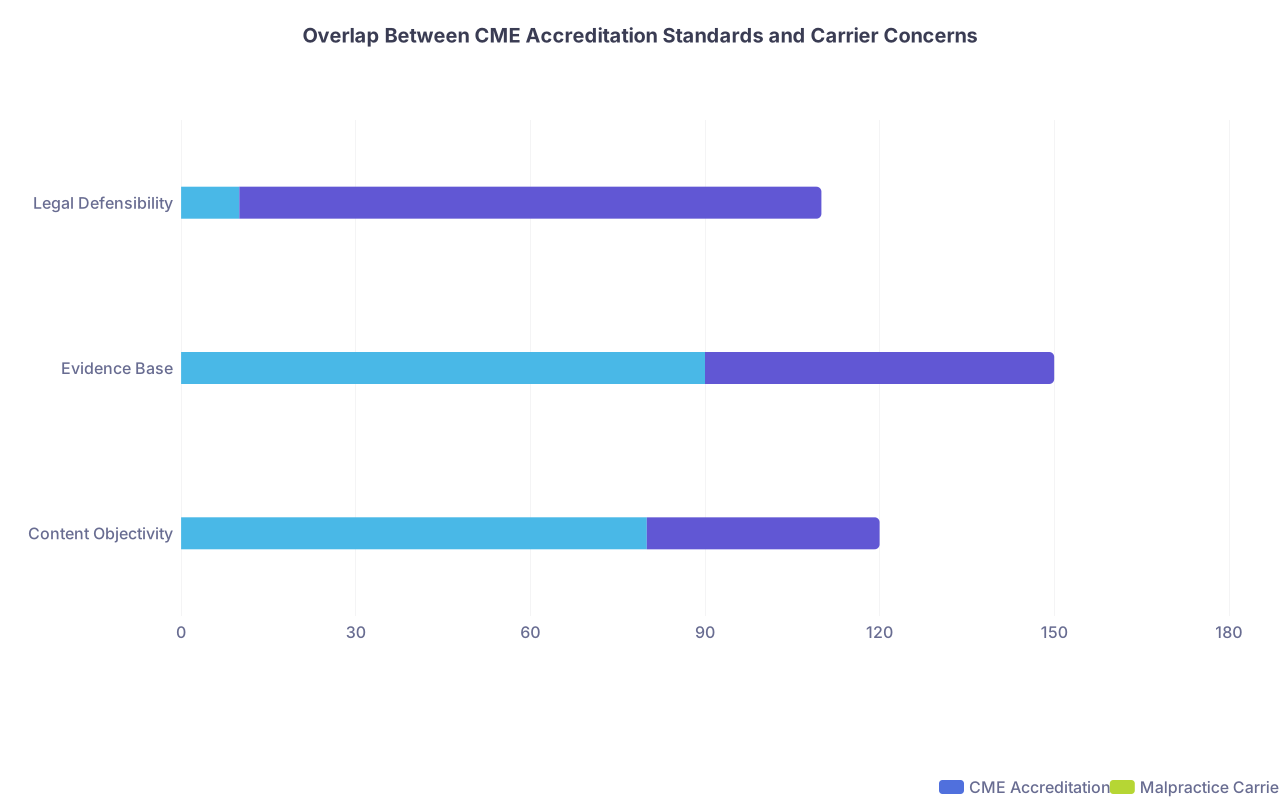
| Category | CME Accreditation | Malpractice Carrier |
|---|---|---|
| Content Objectivity | 80 | 40 |
| Evidence Base | 90 | 60 |
| Legal Defensibility | 10 | 100 |
Some tension points:
Independence vs. Sponsored Risk Messaging
CME rules say: content should be independent of commercial bias.
Carrier reality: “independent” still needs to be aligned with our legal strategy. That is bias, just not in the usual pharma sense.Evidence-based vs Legally Defensible
Sometimes best evidence suggests system-level changes or blunt admissions about cognitive error prevalence.
Defense posture may favor more nuanced, discretionary language. Good CME faculty walk this line constantly.Quality Improvement vs Discoverability
Quality improvement science encourages transparent learning from mistakes.
Legal defense wants privileged, protected, and non-discoverable discussions. Same goal (fewer errors), but very different documentation comfort level.
7. For Educators: How to Design Carrier-Acceptable Risk CME Without Gutting the Integrity
If you are developing risk management CME and you do not want your work shredded in legal review, you need to be deliberate.

Here is the pragmatic approach.
7.1 Anchor Everything in Cases, but De-Identify and De-Legalize
Use real cases, but:
- Strip dates, locations, and any unique features
- Avoid “we were negligent” narratives
- Focus discussion on decision points and process gaps, not blame language
- Use phrases like “contributing factors” and “opportunities for safer practice” rather than “this was clearly malpractice”
7.2 Teach Better Behavior, Not Self-Incrimination
For documentation and communication modules:
- Show “better vs worse” phrasing side-by-side
- Emphasize honesty and accuracy, but caution against speculative self-critique in the chart
- Distinguish between what belongs in the clinical record vs. internal QI channels
You can absolutely say: “If you realize you made a mistake, here is how to handle it clinically, interpersonally, and administratively.”
You just do not script charts that read like confessions.
7.3 Align with Published Guidelines, Not Secret Institutional Rules
If you tie your entire module to internal policies that may change, get ignored, or be inconsistent, you create a mess in court. Better:
- Start with national or specialty society guidelines
- Then explain how your institution has adapted them
- Present local pathways as “one reasonable implementation,” not the only standard of care
This keeps room for clinical judgment and reduces the chance that any deviation from Policy 7.3.5 becomes Exhibit A.
7.4 Involve Legal Early, Not as an Afterthought
The worst mistake educators make is finishing a blunt, honest, effective course and then dropping it in legal’s lap two days before launch. Of course they gut it.
Better:
- Share an outline and sample slides with risk management and legal early
- Ask explicitly: “Where are you most concerned about discoverability or admissions issues?”
- Incorporate their language preferences into your first real draft
You will keep more substance if you invite their constraints up front.
8. For Clinicians: Getting Real Value Out of “Risk Management CME”
Let’s be honest. A lot of carrier-provided risk management CME is dull, repetitive, and delivered in that “voice” that makes you reach for a second coffee.
You still need to squeeze value out of it.
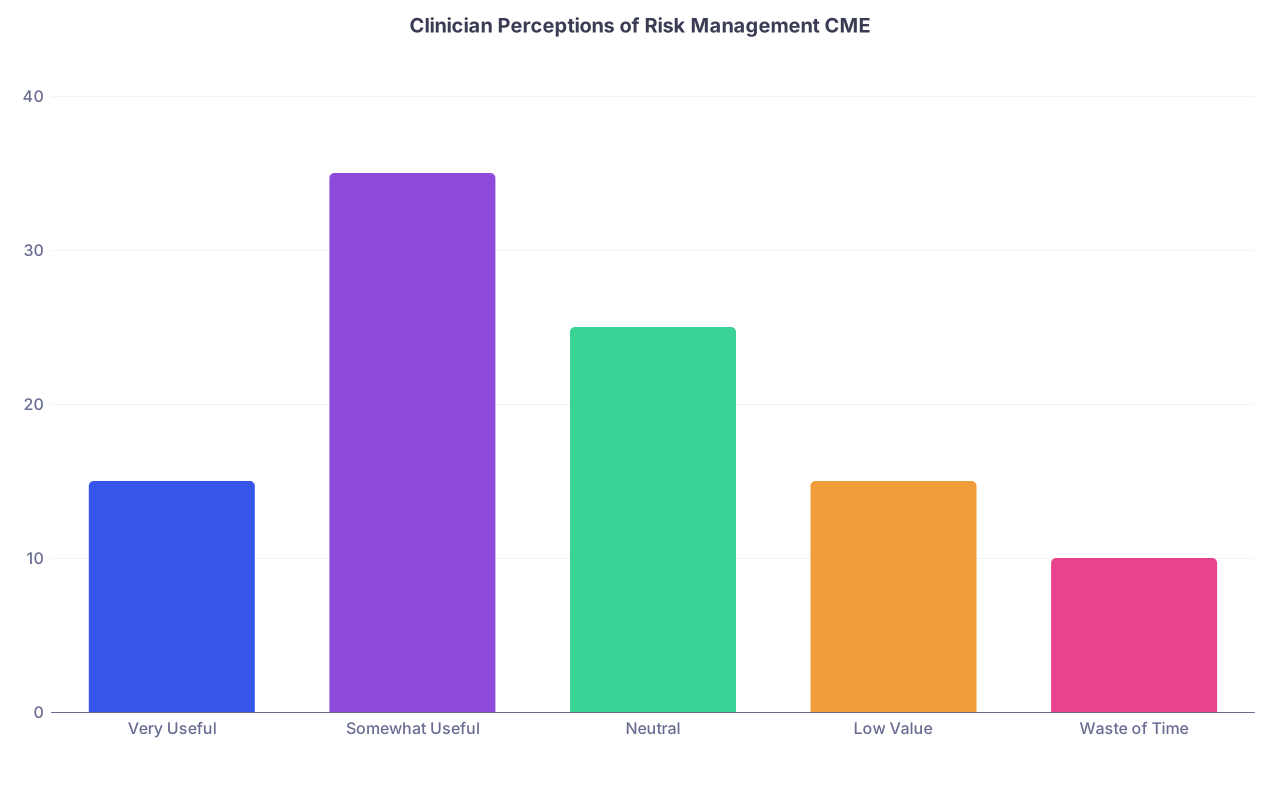
| Category | Value |
|---|---|
| Very Useful | 15 |
| Somewhat Useful | 35 |
| Neutral | 25 |
| Low Value | 15 |
| Waste of Time | 10 |
Here is how to use it strategically:
Listen for how they want you to document.
That is the closest thing you will get to a de facto “defense playbook” for your jurisdiction.Note the cases they highlight repeatedly.
Those are the landmines their actuaries care about: specific missed diagnoses, consent failures, communication breakdowns.Translate their defensive lessons into practical workflows.
If the carrier is obsessed with missed sepsis, you build a three-step bedside check for any borderline septic patient at 3 a.m. That is where the risk lives.Separate “legal paranoia” from true clinical improvements.
Sometimes the defensive instinct overshoots. Use your judgment. Do not start ordering six CTs a night “just in case” because of one horror story.Use the content to negotiate for system support.
If their CME says, “Adequate staffing, reliable handoff tools, and EHR support are essential,” that sentence is your ammunition when you ask your department chair for actual resources.
9. The Quiet Reality: Risk CME as Behavior Shaping
One uncomfortable truth: malpractice carriers use CME to shape professional norms, not just teach facts. Over time, repeated messages influence:
- How willing you are to apologize
- How specifically you document differential diagnoses
- What you say to patients after an event
- How you see your own vulnerability in a claim
That is not entirely bad. Many of those behavior changes reduce real harm. But do not pretend this is neutral academic learning. It is tightly aligned with a defense and underwriting strategy.

Recognize that when your malpractice carrier defines “acceptable” content, they are:
- Encouraging you to practice and document in ways they can defend
- Steering you away from creating discoverable, damaging statements
- Sometimes toning down system-level criticism in favor of individual behavior framing
You can work within that framework and still be clinically honest and patient-centered. You just need to understand the game being played.
FAQ (5 Questions)
1. Why do some excellent patient safety talks never qualify for “risk management CME credit” with carriers?
Because they focus heavily on system failures, culture problems, or institutional negligence without a clear behavioral defense angle. If the talk produces slides that look like admissions of widespread unsafe practice, carriers see more legal downside than claims prevention upside and will not badge it as their branded risk CME.
2. Can my personal CME notes or downloaded slides be discoverable in litigation?
Yes. Anything not clearly protected by peer-review or quality-improvement privilege can potentially be discoverable. If you write detailed notes about how unsafe your unit is or how often policy is ignored, those could be requested. That is one reason carriers push for carefully worded, non-inflammatory slide decks.
3. Are carriers pushing us toward “defensive medicine” through risk management CME?
Sometimes. Good risk CME aims for clinically appropriate vigilance and documentation. Poorly designed programs can drift into “order more tests to avoid being sued” territory. You have to filter their advice through solid clinical judgment and guideline-based care, not fear.
4. How can I tell if a risk management CME activity is carrier-friendly but clinically useless?
Red flags: generic platitudes, no concrete cases or workflows, heavy focus on legal phrasing without connecting to actual bedside decisions, and zero link to current specialty guidelines. If you leave with no specific behavior change except “be more careful,” it is mostly box-checking for the carrier.
5. As a faculty member, can I push back if legal or the carrier censors my content too heavily?
You can, and sometimes you should. The smart move is to negotiate language, not intent. Keep the clinical truths, but adjust phrasing that reads like an admission of negligence. If core safety content is being stripped out completely, escalate through your CME office or patient safety leadership and document your concerns separately in internal, privileged QI channels.
Key takeaways:
Malpractice carriers define “acceptable” risk management CME as content that reduces claims and preserves legal defensibility. They actively shape documentation, communication, and consent messaging to support their defense strategies. If you understand that lens, you can design, teach, and use risk CME that helps patients, protects you, and still passes the carrier’s quiet gatekeeping.