
You’re staring at your license renewal emails, and your stomach drops.
Rhode Island wants 4 hours of opioid prescribing CME. Florida wants 2 hours of domestic violence and 2 hours of human trafficking. California still wants pain management tied to your DEA. You hold four active licenses. Your board certification wants something else entirely.
And every site you log into—hospital credentialing, state board portal, specialty society—shows a different CME number. Different deadlines. Different “must include X topic” rules.
You’re not confused because you’re disorganized. You’re confused because none of this was built for someone who actually practices in more than one state.
Here’s how to fix it.
Step 1: Stop Thinking in “States” and Start Thinking in Buckets
The trap most multi-state physicians fall into: they try to satisfy State A, then State B, then State C. That’s how you end up doing three nearly identical opioid CMEs that all say the same thing but have slightly different titles.
You cannot think one state at a time. You need buckets.
There are basically four buckets you care about:
- Total CME hours
- Category/type (Category 1 vs 2, live vs enduring, performance improvement, MOC, etc.)
- Topic-specific mandates (opioids, human trafficking, implicit bias, HIV, ethics, etc.)
- Cycle dates (different renewal years, different birthday-based vs fixed date cycles)
Your entire strategy is:
Build one unified CME plan that covers the maximum requirement in each bucket and re-use it across states.
You are not trying to “uniquely” satisfy each state. You’re building one overbuilt structure that happens to contain each state’s minimums.
Step 2: Build a “Master Requirement Profile” Once
You do this once, then you update it when something changes. But you stop hunting the internet every year from scratch.
Open a spreadsheet or a note app you’ll actually use. Put each state you hold a license in as a column. Add your board certification and hospital system if they have CME rules that matter.
Layout something like this:
| Requirement Type | State A | State B | State C | Board Cert |
|---|---|---|---|---|
| Total hours / cycle | 50/2y | 100/2y | 40/2y | 250/10y |
| Category 1 minimum | 20 | 40 | 25 | 200 |
| Opioid/pain hours | 4 | 3 | 2 | 0 |
| Special topics (ethics, etc.) | 2 ethics | 1 HIV | 2 implicit bias | 0 |
| Cycle dates | DOB even | Odd years | 3y cycle | Rolling |
Then ask three questions:
- What’s the highest total hour requirement across any of these?
- What’s the highest Category 1 requirement?
- What are all of the specific topic requirements, by topic, with the highest hour count for each?
That gives you your personal baseline.
Example:
You’re licensed in:
- Florida: 40 hours/2 years, with specific hours in domestic violence, human trafficking, and controlled substances
- Massachusetts: 50 hours/2 years, with 3 hours in opioid prescribing and some risk management
- California: 50 hours/2 years, pain management and end-of-life issues
- Board (ABIM): 100 MOC points/5 years (largely CME-equivalent activities)
Your unified baseline might be:
- Total CME target: 50 hours every 2 years (because that’s the max)
- Category 1: 50 hours (because that’s all that counts with some boards/hospitals)
- Topic minimums:
- Opioid/pain: 4 hours (max across states)
- Domestic violence: whatever Florida wants
- Human trafficking: whatever Florida wants
- Risk management/ethics/end-of-life: match the highest number any state wants in that cluster
You don’t aim for “40 in FL and 50 in MA.” You aim for 50 total hours, and then make sure a subset of those hours checks each state’s topic boxes.
Step 3: Figure Out Where Conflicts Actually Exist (Most Are Fake Problems)
Lots of things look like conflicts but are not.
- One state says “2 hours opioid prescribing”
- Another says “3 hours pain management/addiction”
You don’t need 5 hours. If you choose properly, a 3-hour accredited course on opioid prescribing in chronic pain will satisfy both, as long as it’s AMA PRA Category 1 and the content clearly addresses what each board wants.
Real conflicts only show up when:
- Cycle dates don’t line up (one state renews every odd year, another every even year, or one is your birthday, another is June 30)
- Format restrictions differ (one state insists on “live” or “interactive” CME; another accepts everything online)
- Topic hours exceed what other states recognize as CME (rare, but happens with weird “practice improvement” mandates tied to state-only programs)
You handle fake conflicts by choosing smarter CME that can legitimately be used for more than one box. You handle real conflicts by deliberately planning your cycle.
Step 4: Align Your Cycles So You’re Not Chasing Moving Targets
Cycle mismatch is where people get burned.
Scenario:
- State A: 50 hours, 2-year cycle, renews January 31 of odd years
- State B: 40 hours, 2-year cycle, ties to your birthday in April
- State C: 30 hours, 3-year cycle, renews in June
Trying to “finish” CME for each state before each deadline separately is chaos.
Use a mental model: You are on your own CME clock. States just “check in” on that clock at different times.
Create your own internal CME cycle, for example:
- You decide: “I will complete at least 25 Category 1 hours every calendar year, plus all required topic courses on a 2-year rolling basis.”
Now when a state renewal hits, you don’t scramble. You just pull your last 2–3 years of CME, match to what they require, and you’re done.
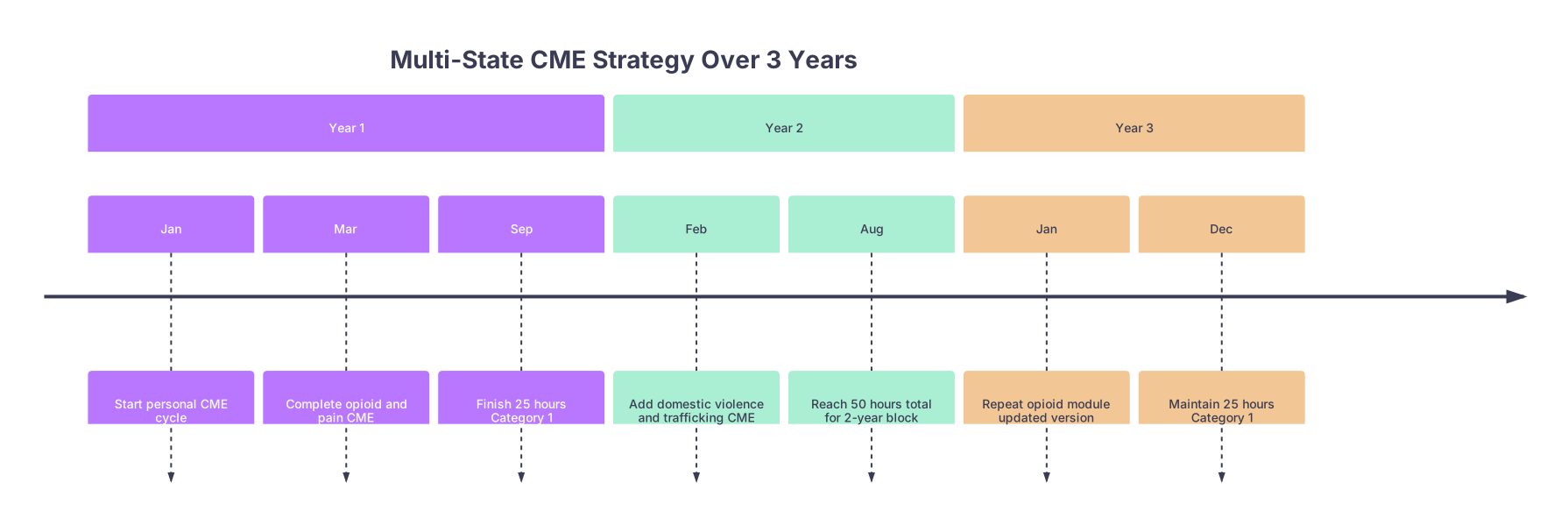
To see how this plays out over time, imagine a 3-year window:
| Period | Event |
|---|---|
| Year 1 - Jan | Start personal CME cycle |
| Year 1 - Mar | Complete opioid and pain CME |
| Year 1 - Sep | Finish 25 hours Category 1 |
| Year 2 - Feb | Add domestic violence and trafficking CME |
| Year 2 - Aug | Reach 50 hours total for 2-year block |
| Year 3 - Jan | Repeat opioid module updated version |
| Year 3 - Dec | Maintain 25 hours Category 1 |
The point: if you consistently overshoot your annual baseline, renewals become paperwork, not crises.
Step 5: Choose CME That Multiplies Across States and Boards
Not all CME is equal when you’re juggling multiple jurisdictions. Some activities count once. Others count three times.
You want CME that:
- Is AMA PRA Category 1 (or equivalent)
- Is clearly labeled with topic (opioid, ethics, human trafficking, etc.)
- Is online and exportable as a PDF certificate
- Counts toward board MOC if you care about that
You should be leaning heavily on:
- State medical society platforms that explicitly mention multi-state compliance
- Specialty societies that are savvy about opioid, risk management, implicit bias rules
- Hospital or system CME that’s well-documented and downloadable
Do not waste time on random, free, non-ACCME “webinar attendance certificates” that may or may not satisfy anyone.
Here’s how it looks if you’re being strategic:
You need 4 hours opioid for State X and 2 hours controlled substances for State Y
→ You pick a single reputable 4-hour controlled substances prescribing module addressing chronic pain, monitoring, and state/federal regs.
→ You keep the syllabus or description PDF in case any state asks you to demonstrate the content matches their language.You need 2 hours domestic violence for Florida, 1 hour child abuse for another state
→ You pick a 3-hour “family violence and child abuse” CME that explicitly covers both domains and is Category 1.
→ You record this under both topic tags in your personal log.
Step 6: Create a Personal CME Ledger That Mirrors State Categories
Relying on vendor dashboards alone is how you lose track. Vendor platforms don't care that New York wants specific HIV hours or that Michigan wants implicit bias.
You need a simple ledger. Doesn’t have to be pretty; it has to be searchable and filterable.
At minimum:
- Date completed
- Activity title
- Provider (ACCME, state medical society, hospital)
- Hours (Category 1 vs other)
- Topic tags (opioid, pain, ethics, DV, human trafficking, HIV, cultural competency, etc.)
- Which state/requirement it could cover
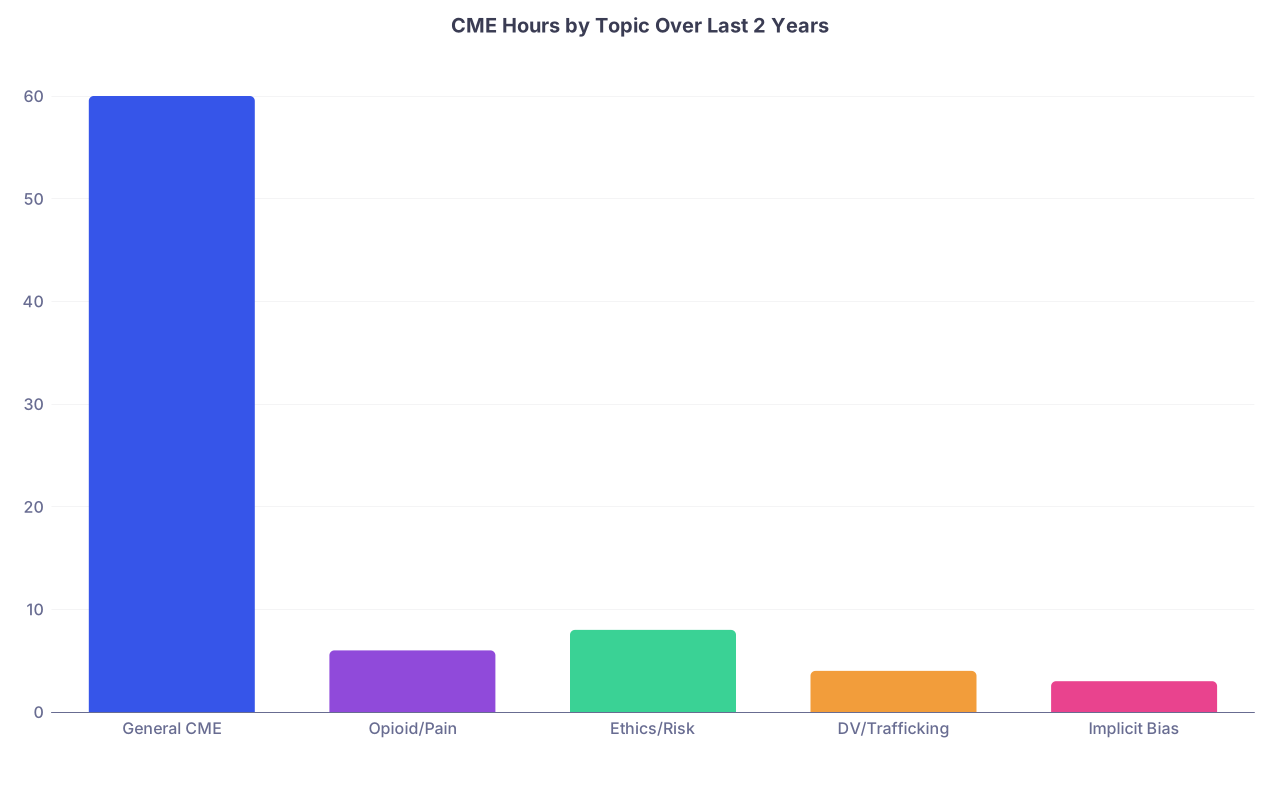
Then, once or twice a year, you roll up totals by topic.
| Category | Value |
|---|---|
| General CME | 60 |
| Opioid/Pain | 6 |
| Ethics/Risk | 8 |
| DV/Trafficking | 4 |
| Implicit Bias | 3 |
Now when State A asks for 3 hours opioid and State B asks for 2 hours ethics, you do not guess. You know exactly what you have.
If you get audited—and people do—you can produce a neat, dated log with attached certificates in under 10 minutes. I’ve watched colleagues scramble for days because they treated CME like scattered email receipts.
Step 7: Handling Genuine Conflicts and Edge Cases
Occasionally you hit a real wall. A few common ugly ones:
1. State-only courses that do not translate
Example: a state requires a course provided exclusively via their portal, focused on state-specific opioid regulations, and it may not be ACCME-accredited.
You do it. You treat it as a cost of doing business in that state. But you do not assume it counts toward your total CME unless they explicitly say so.
If it is not AMA PRA Category 1, most other states and your specialty board will not care.
So you:
- Complete it
- File it under “state compliance – not CME” in your log
- Still hit your personal 50 Category 1 hour target separately
2. Live vs enduring format conflicts
Some states require a certain number of “live” hours (in-person or live webinar). Others do not.
If even one of your states cares, you build live hours into your baseline.
For example: State C wants 10 live hours per cycle. Fine. Your personal baseline becomes:
- 50 total Category 1 hours / 2 years
- Of those, minimum 10 hours must be live activities (conferences, live webinars, hospital grand rounds with credit)
That satisfies State C and overshoots the others, which do not care.
3. Misaligned topic cycles
Let’s say:
- State A: Opioid CME required every 2 years
- State B: Opioid CME required once every 3 years
- State C: Opioid CME required every renewal, 4-year cycle
You do not do three opioid courses. You:
- Schedule one substantial, updated opioid/pain CME every 2 years
- Use that one activity to meet everyone’s clock, because any state that wants it less frequently is automatically satisfied
If one state has ridiculously detailed content demands (e.g., must include state PDMP specifics), choose a course that already tracks those requirements, or two short targeted modules that together add up to your target hours. Then mark them clearly in your ledger under all applicable states.
Step 8: Sync This With Your DEA, Hospital Privileges, and Board
The quiet landmines sit outside the state boards:
- Hospitals that want X hours of risk management or quality improvement
- Credentialing committees that want proof of opioid education tied to your prescribing privileges
- Board MOC cycles that don’t care about state content but do care about total points or specific “SA” (Self-Assessment) activities
You do not build a separate universe for each of these. They get layered onto your existing buckets.
The logic:
- Start with the largest requirement (often your specialty board or the state with the highest hours).
- Make sure the way you reach that number uses activities that:
- Are AMA PRA Category 1
- Are approved for MOC credit when possible (ABIM/ABFM/ABP, etc.)
- Make sure your content mix also hits hospital and DEA-related mandates (opioid, safety, risk, diversity if required)
So your 4-hour opioid CME:
- Satisfies State A
- Satisfies State B
- Satisfies your hospital’s “safe prescribing” checkbox
- Counts as 4 Category 1 hours toward your board total, often with MOC points
That’s leverage. That’s how you stop drowning.
Step 9: Automate the Annoying Parts
You can't automate judgment, but you can automate reminders and record-keeping.
- Put every license expiration date and board cycle end date into one calendar.
- Set reminders 6, 3, and 1 month ahead.
- Once a year, block 30–60 minutes for a quick “CME compliance check”:
- Total Category 1 hours in last 1–2 years
- Topic-specific totals (opioid, DV, etc.)
- Any weird state changes you’re aware of (opioid rules are notorious for changing)
Use one or two main CME vendors/platforms rather than sixteen scattered sites. Your certificates will be easier to pull, and you’ll have fewer passwords to remember.
If your employer offers a CME tracking tool—use it, but do not rely on it as your only source of truth. Always maintain your own exportable log.
Step 10: What To Do If You Realize You’re Short Before a Renewal
You will occasionally miss something. Or a state will quietly change rules and you notice 4 weeks before renewal.
Response plan:
- Do not panic-renew. Check what the board actually asks you to attest to. Many only require that you’ve completed the CME by the time of renewal, not by some earlier internal deadline.
- Targeted catch-up.
- If you’re short on total hours, pick high-yield Category 1 online modules with instant certificates.
- If you’re missing a topic requirement, search specifically by state + topic (e.g., “Florida domestic violence CME for physicians ACCME”). Use a reputable provider.
- Update your ledger immediately. Attach certificates.
- If you truly cannot complete the hours in time, read the board language about extensions, probationary renewals, or corrective plans. Some boards allow you to attest with a plan to complete hours within a defined window, others do not. Don’t guess—look it up or call.
I’ve seen people dig deeper holes by lying on attestation. That’s how you turn an annoying CME gap into a professionalism investigation. Not worth it.
Quick Example: Putting It All Together
Let me sketch a realistic setup.
You:
- Are board-certified in Internal Medicine
- Hold licenses in Texas, New York, and Florida
- Work for a large hospital system that requires 25 hours CME/year, including 2 hours on patient safety or quality
From your master profile:
- Texas: 48 hours/2 years, 2 hours ethics, 2 hours opioid
- New York: 50 hours/2 years, some specific topics (infection control, maybe pain)
- Florida: 40 hours/2 years, domestic violence, human trafficking, controlled substances
- ABIM: 100 MOC points/5 years
You choose your personal baseline:
- 50 hours Category 1 every 2 years (25/year)
- Topics every 2-year block:
- 4 hours opioid/pain that satisfy TX + FL + NY
- 3–4 hours ethics/risk (cover TX ethics + hospital “safety” content)
- 2–3 hours DV/trafficking (to cover Florida)
- 1–2 hours infection control for NY
You schedule:
- One weekend conference: 15 live hours (multi-topic)
- Quarterly online modules: 2 hours each on ethics, safety, or clinical updates
- One dedicated afternoon: opioid/pain 4-hour module from a national platform that has a “meets requirements for multiple states” page
- One 2–3 hour bundle from a Florida-approved provider for DV + trafficking + FL prescribing
All logged, tagged, and saved.
When Texas renewal hits, you filter your log:
- Last 2 years total hours: >48
- Ethics: check
- Opioid: check
Done.
When Florida renewal hits:
- Total hours: check
- Courses from FL-approved vendor: check
- Domestic violence and trafficking: check
Done.
You are not rebuilding your life each renewal cycle. You’re just showing your work.
Final Takeaways
- Stop thinking “one state at a time.” Build a single, slightly overbuilt CME plan based on the highest total and topic requirements across your licenses.
- Track your CME in a way that mirrors what states actually ask for: totals, formats, and topics. Vendor dashboards are not enough.
- Use CME that works double or triple duty—Category 1, topic-specific, MOC-compatible—so every hour you do counts across states, boards, and your hospital.