
You just finished residency, signed your first attending contract, and HR just emailed you your “annual education requirements.” Your board also keeps sending reminders about MOC and CME. Your inbox is a mess of “Earn 1.5 AMA PRA Category 1 Credits™!” offers.
You’re asking the right question: How many CME credits should an early‑career attending actually aim for? Not the theoretical minimum. The realistic target that keeps you compliant, sane, and competitive.
Let’s answer that directly, then walk through how to hit that target without scrambling every December.
The Short Answer: Your Target Number
Here’s the clean, no-handwaving answer.
Most early‑career attendings should aim for:
- 35–50 CME credits per year total,
including: - At least 25–30 AMA PRA Category 1 Credits™
- Enough live/ethics/risk‑management credits to satisfy your state and hospital
Why that range?
Because you’re juggling 4 overlapping buckets:
- State medical license requirements
- Specialty board (MOC/continuous certification)
- Employer/hospital bylaws
- Your own career goals (skills, niche, promotion)
The legal minimum in many states is around 25–50 hours every 2–3 years, which averages to ~10–25 per year. But if you only chase the bare minimum:
- You risk coming up short if your state, board, and employer don’t line up
- You’ll get stuck in high‑stress December panic mode every cycle
- You’ll miss chances to build a real expertise niche
So I’ll be blunt: 20/year is survival mode. 35–50/year is smart mode.
Step 1: Know Your Actual Floor (State + Board + Employer)
Before you pick a “goal,” know your non‑negotiable floor.
| Source | Period | Typical Total | Category 1 Needed? |
|---|---|---|---|
| State license | 2–3 years | 25–50 credits | Often yes |
| ABIM (IM) | 5 years | 100 points | Yes (CME-like) |
| ABEM (EM) | 5 years | 100–125 CME | Yes |
| Employer | 1 year | 10–25 credits | Usually Category 1 |
Numbers vary by state and specialty, but here’s the process you should follow.
1. State Medical Board
Go to your state medical board website and look for “CME Requirements.” Don’t trust third‑party blogs for this.
Common patterns:
- Total: 25–50 CME credits every 2–3 years
- Often specify Category 1 vs “any CME”
- Almost always require certain topics, like:
- Opioid prescribing / pain management
- Ethics or professionalism
- Cultural competency / implicit bias
- Human trafficking / abuse reporting
If your state says “50 hours every 2 years, including 3 in opioid prescribing,” your absolute floor is 25/year with some topic constraints.
2. Your Specialty Board (MOC / Continuous Certification)
Next stop: your board (ABIM, ABEM, ABS, ABP, ABOG, etc.).
They won’t always say “CME” explicitly. They’ll say “MOC points,” “continuous certification,” or “lifelong learning.”
Examples:
- Some boards: 100 MOC points every 5 years, many of which are CME-equivalent
- Many allow CME activities to double count as MOC credit if properly registered
- Some require annual assessments plus a certain number of CME‑linked activities
Bottom line: if your board wants 100 points over 5 years, you’re effectively looking at ~20/year just to stay on track.
3. Employer / Hospital Bylaws
Employer expectations are usually:
- Minimum 10–25 Category 1 credits per year
- In some systems, mandatory risk, compliance, or quality modules that count as CME
- Specific topics (e.g., infection control, patient safety, documentation)
Check:
- Your medical staff bylaws
- Your credentialing packet
- Any “professional development” section in your contract
Add those numbers together across state + board + employer, convert them to per year, and that’s your hard floor.
For most new attendings, this lands around 20–30 credits/year as a minimum to not get burned later.
Step 2: Why 35–50/Year Is the Sweet Spot
Let me walk you through why I like 35–50 as a realistic, protective target.
Reason 1: Life Happens (and So Does Burnout)
You’re going to have years where:
- You’re starting a family
- You change jobs
- You’re chief, program director, or taking on new admin roles
- You’re just exhausted and can’t stomach another “Pain Management” module
If you only ever hit the bare minimum, you have zero buffer. One bad year and you’re begging your board or state for an extension.
By sitting around 35–50/year in your early years, you build a cushion:
- If your state is 50/2 years = 25/year, and you’re doing 40/year, you’re always ahead
- If your board uses 5‑year cycles, you won’t be cramming 60 points into your final year
Reason 2: Double Counting is Your Friend
A lot of activities now do triple duty:
- They count for AMA PRA Category 1 Credits™
- They count as board MOC points
- Some count toward quality/improvement components
If you pick smart activities—board‑endorsed courses, registry QI projects, conferences that report directly to your board—you can easily stay in the 35–50 band while smashing your board requirements.
Reason 3: Early Career = Steepest Learning Curve
You’re still solidifying:
- Your clinical patterns (how you actually practice without supervision)
- Your sub‑interests (hospitalist vs. subspecializing, community vs. academic)
- Your comfort with new therapies, procedures, tech
If there’s ever a time when high‑quality CME moves the needle on your competence and confidence, it’s right now.
Doing 40–50 credits/year of focused, relevant CME for the first 3–5 years out sets your clinical foundation for the next decade.
Step 3: What Types of CME Should You Prioritize?
Not all CME is equal. Some is box‑checking trash. Some actually changes how you practice.
For early‑career attendings, I’d prioritize in this order:
- High-yield clinical content in your main practice area
- Example: A hospitalist in a community setting: sepsis, HF, COPD, anticoagulation reversal, periop medicine.
- Procedural or skills‑based CME
- Ultrasound courses, airway labs, surgical technique refreshers, ECG mastery, dermoscopy.
- Required topics that will 100% come up in audits
- Opioid prescribing, risk management, documentation, ethics, implicit bias.
- Career‑building content
- Teaching skills (if you’re with residents), quality improvement, leadership, financial literacy for physicians, coding and billing.
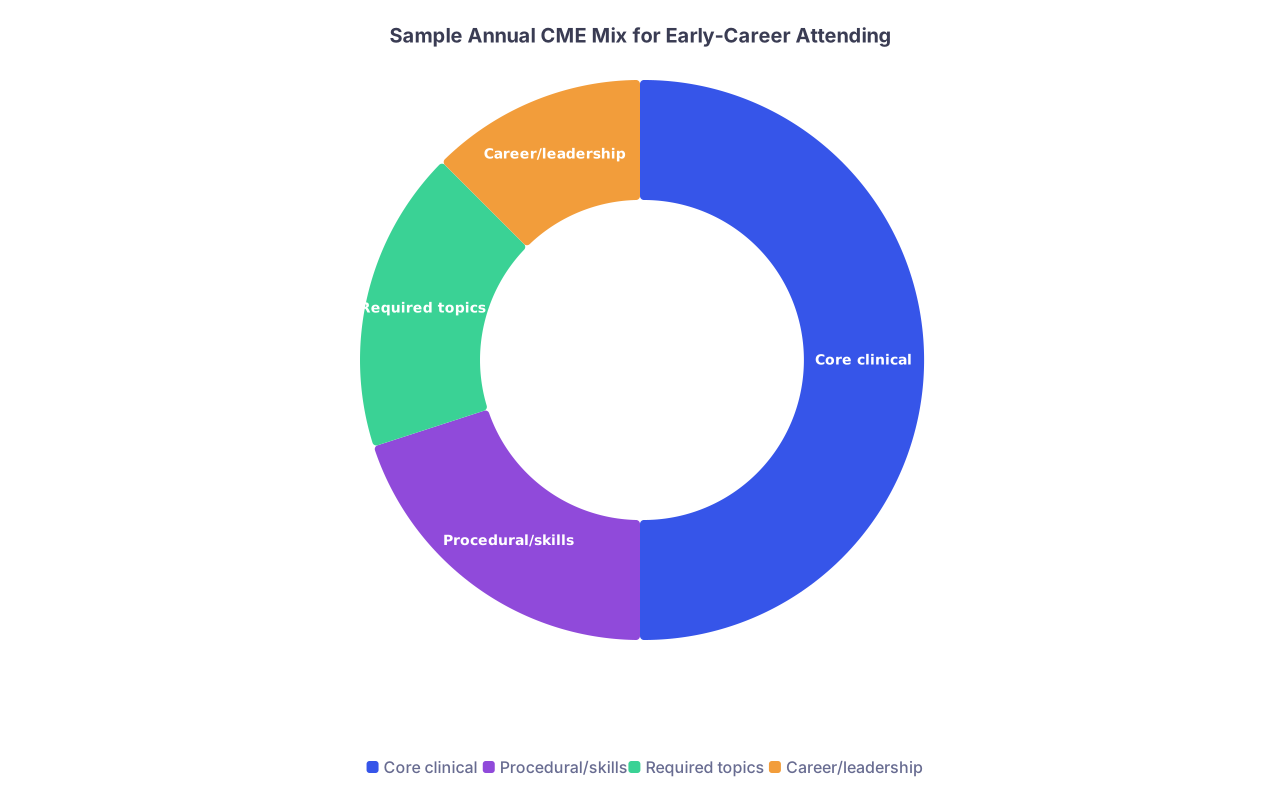
Here’s what a balanced 40‑credit year might look like:
| Category | Value |
|---|---|
| Core clinical | 20 |
| Procedural/skills | 8 |
| Required topics | 7 |
| Career/leadership | 5 |
You’re not just chasing a number; you’re building a portfolio that keeps you safe, employable, and steadily more capable.
Step 4: A Simple Annual CME Plan (So You’re Not Scrambling)
Let’s be practical. You’re busy. You don’t want CME to become its own part‑time job.
Here’s a dead‑simple annual template that gets most early-career attendings to 35–50 credits without drama.
Anchor 1: One Major Meeting or Course (15–25 credits)
Pick:
- Your main specialty society annual meeting (ACP, ACEP, ATS, ACOG, etc.), or
- A focused skills course (critical care, ultrasound, EKG, endoscopy, etc.)
That usually gives you 15–25 Category 1 credits in 3–5 days.
Yes, it costs money and time off. But it’s usually the single largest and highest‑yield chunk of CME you get all year.
Anchor 2: Routine Online CME (10–15 credits)
Throughout the year, do short, targeted activities:
- Journal‑based CME articles
- Specialty‑specific online modules
- On‑demand webinars or microlearning videos
Do:
- 1–2 short modules a month (0.5–1.5 credits each)
- That alone can comfortably give you 10–15/year if you’re consistent
Anchor 3: Compliance / Required Modules (5–10 credits)
Every hospital and board will shove some modules at you:
- Opioid prescribing
- Risk management / malpractice avoidance
- Ethics / professionalism
- Quality improvement projects
Don’t ignore these. Knock them out early; they often count for 5–10 credits without a lot of brainpower.
Put those together, and you’re easily in the 35–50 range. No December panic.

| Step | Description |
|---|---|
| Step 1 | Start of Year |
| Step 2 | Pick 1 main conference or course |
| Step 3 | Schedule time off and funding |
| Step 4 | Set monthly online CME goal |
| Step 5 | 1 to 2 modules per month |
| Step 6 | List mandatory state and hospital topics |
| Step 7 | Complete required modules mid year |
| Step 8 | Total from conference 15 to 25 credits |
| Step 9 | Total from online CME 10 to 15 credits |
| Step 10 | Total from required modules 5 to 10 credits |
| Step 11 | Annual CME total 35 to 50 plus |
Step 5: Common Pitfalls (And How to Avoid Them)
I’ve watched plenty of early-career attendings screw this up. Same patterns every time.
Pitfall 1: Ignoring Category Types
Not all credits are equal:
- Some states require specific Category 1 hours
- Some specify live vs enduring material
- Some demand exact topics (e.g., 3 hours opioid prescribing)
Fix: When you log CME, tag each one in whatever system you use:
- Category 1 vs 2
- Topic (opioids, ethics, safety, etc.)
- Live vs online
Takes 10 seconds each time. Saves you from trying to untangle it 3 years later.
Pitfall 2: Doing 90% of CME in the Final 6 Months of a Cycle
This is where terrible, low‑yield CME happens. You’re exhausted, clicking next on some miserable interface, absorbing nothing.
Fix: Set a monthly floor:
- For example: 2 credits/month minimum, plus 1 meeting/year
- That’s 24+ credits from routine work plus your big meeting, and you’re basically done without ever sprinting.
Pitfall 3: Not Syncing CME With Your Real Career Needs
If you’re a hospitalist, and half your CME is about outpatient dermatology, you’re wasting time.
Fix: Once a year, ask yourself:
- What cases made me most uncomfortable this year?
- What do I want to be “the go‑to person” for in my group?
- Where am I consistently Googling or UpToDating mid‑shift?
Your CME should answer those questions.
Putting It All Together: A Realistic Recommendation
If you want a one‑line answer you can actually use:
As an early‑career attending, aim for 35–50 CME credits per year, with at least 25–30 Category 1, making sure you hit your state, board, and employer’s topic requirements while prioritizing high‑yield clinical skills.
Do that for your first 5 years out, and you’ll:
- Stay well ahead of any renewal deadlines
- Avoid the end‑of‑cycle panic that burns people out
- Actually get better at the parts of your job that matter
Not glamorous. But very workable.
FAQ (Exactly 6 Questions)
1. What’s the absolute minimum CME I can get away with as a new attending?
Technically, you can survive at ~20 credits/year in many situations if your state, board, and employer are all on the lenient side and on multi‑year cycles. But I think that’s reckless. One bad year, one state rule you misread, or one board change, and you’re in a bind. Treat 20 as “bare survival,” not a smart target.
2. Do I really need more than what my state requires for license renewal?
Yes, almost always. State requirements are just one layer. Your specialty board may need more, your employer might expect annual CME, and some malpractice carriers want proof of risk‑management CME. If you only track to your state, you can be “licensed but non‑compliant” with your board or hospital, which is a career problem.
3. How much CME should I do if I’m part-time?
State and board requirements usually don’t shrink just because you’re 0.6 FTE. You’re either licensed and certified or you’re not. If you’re truly clinically minimal and planning to step away, you might let certification lapse. But if you’re staying active and want future options, I’d still aim for 30–40/year, maybe on the lower side of the 35–50 range.
4. Are free CME sources enough, or do I need to pay for expensive courses?
You can absolutely meet your numeric requirements on free CME (journals, online modules, industry‑sponsored education). The catch is quality and relevance. I’d use free CME for routine updates and mandated topics, and I’d spend real money on 1–2 big, high‑impact events per year (skills courses, major conferences) that actually move your practice forward.
5. How do I track CME without going crazy?
Pick one main system and stick with it. Most people use:
- Their specialty board’s portal,
- A third‑party app, or
- An internal hospital tracking tool.
Every time you complete CME, log: date, title, provider, credits, category type, and topic. Snap a PDF or screenshot of certificates and dump them in a single cloud folder by year. Boring, but saves you hours later.
6. Does doing more CME make any difference for jobs, promotions, or pay?
Raw number of credits almost never impresses anyone. But what you choose absolutely does. If your CV shows CME concentrated in ICU, POCUS, advanced heart failure, or leadership, that tells a story. That can support you when you pitch for a niche role, a medical directorship, or a move to a more competitive group. So don’t just chase hours—chase a theme that fits where you want your career to go.
Key takeaways:
- For early‑career attendings, 35–50 CME credits/year is the smart, sustainable target—above the legal minimum but nowhere near crazy.
- Build your CME around one big meeting/course, some steady online work, and required topics, and you’ll stay compliant without scrambling.
- Use CME strategically to build the skills and niche you actually want, not just to tick boxes for your license and board.