
Most residents are guessing about CME credit at conferences. That’s a problem.
Here’s the bottom line: some residency conferences absolutely count as CME, some absolutely don’t, and a big chunk sit in a gray zone that depends entirely on accreditation and documentation. If you don’t know how to tell the difference, you’re setting yourself up for a headache when you’re credentialing, renewing a license, or applying for hospital privileges later.
Let’s clean this up.
Do residency conferences count as CME?
Short answer you can actually use: residency conferences count as CME if — and only if — they’re formally accredited as CME activities and you have documentation.
No accreditation = no CME.
No documentation = it might as well not exist.
So what does “accredited” actually mean?
For physicians in the U.S., CME that “counts” usually means:
- The activity is approved by an ACCME-accredited provider (or equivalent state medical society, AOA, etc.), and
- It awards AMA PRA Category 1 Credits™ (or equivalent state/board-acceptable format), and
- You can get a certificate or transcript with your name, date, activity title, and the number/type of credits.
If your residency conference doesn’t meet those criteria, it may still be educational, but it’s not CME that’s going to satisfy license renewal or credentialing.
Types of residency conferences and whether they usually count
You’re probably seeing a mix of these during training. Here’s how they generally shake out.
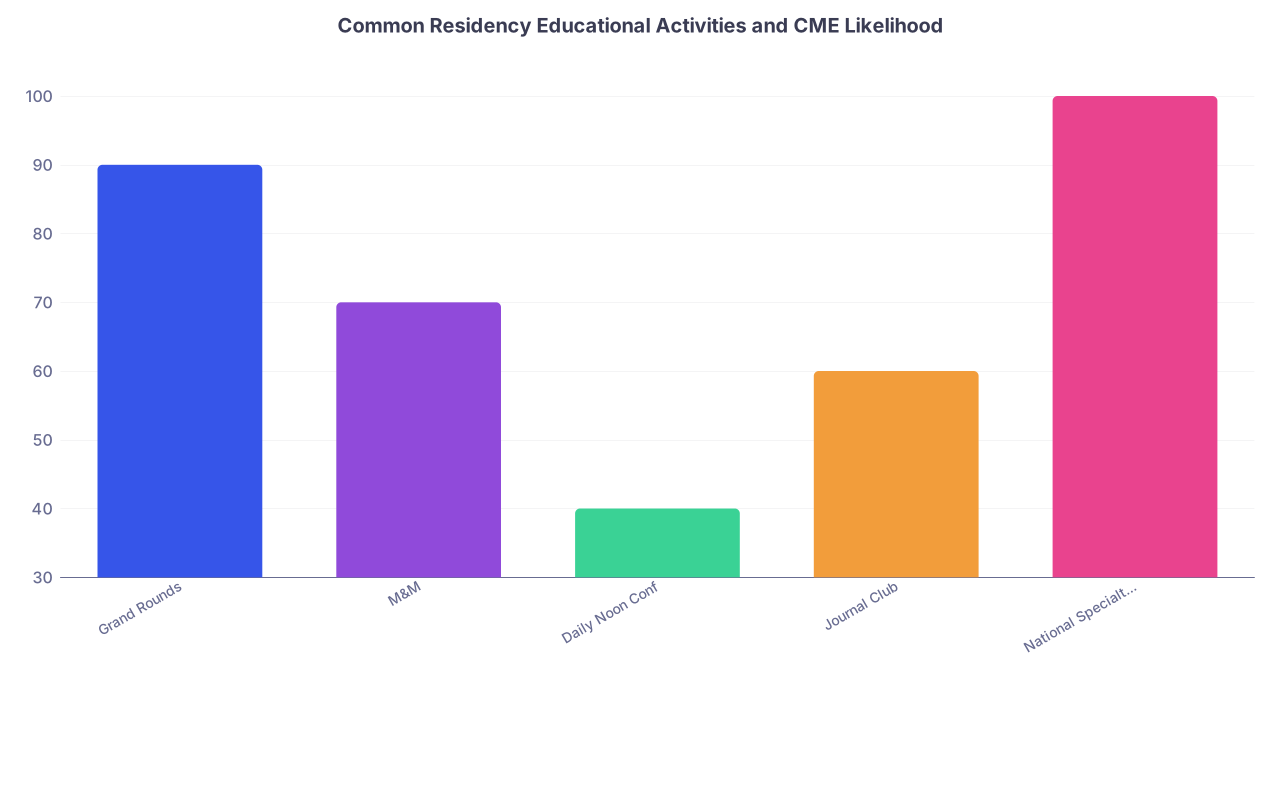
| Category | Value |
|---|---|
| Grand Rounds | 90 |
| M&M | 70 |
| Daily Noon Conf | 40 |
| Journal Club | 60 |
| National Specialty Conf | 100 |
(Values reflect rough “likelihood of being CME-accredited” in percent, not actual data. You get the point.)
1. Grand rounds
Most academic centers treat grand rounds as formal CME.
Typical signs it counts:
- You get emails or flyers saying “This activity has been approved for AMA PRA Category 1 Credit™.”
- There’s a sign‑in (physical or electronic) specifically labeled for CME.
- You can later download a CME certificate or transcript from the hospital/academic CME office.
If all you ever did was attend grand rounds weekly and actually document the credits, you’d often have enough CME to satisfy early licensing/credentialing requirements.
2. Morbidity and Mortality (M&M)
M&M is tricky. At many places, it’s eligible CME, but only if:
- The conference is set up and reviewed by the institution’s CME office, and
- There’s a formal educational design (learning objectives, faculty, evaluation), and
- Attendance is captured as part of a CME activity.
If it’s a casual, resident-run M&M with no CME sponsor, it’s just education, not CME.
Ask a blunt question: “Is this M&M accredited for CME, and where do I find the credit record?” If nobody can answer, assume it’s not.
3. Daily noon conference / didactics
Program directors love to talk about how “you’re getting so much CME already from noon conference.” That’s… sometimes true.
Scenarios:
Formal CME-accredited noon series
The residency or GME office works with the CME office, there’s a structured curriculum, attendance is logged, and at the end of the year you get a transcript.
→ Yes, that counts.Informal teaching with no CME infrastructure
Speaker just shows up, no objectives, no evaluation, nobody mentions CME, no certificates.
→ Educational, sure. Not CME.
You can’t just multiply “days you showed up for noon conference” and write that as CME. Licensing boards will reject that.
4. Journal clubs
These can go either way.
They may count as CME if:
- They’re organized under a department or program that has CME accreditation, and
- Each session is designated for a specific number of CME credits, and
- There’s a record of who attended.
If your journal club is: “show up, chat about a paper, pizza, no documentation” — that’s professional growth, but it’s not documentable CME.
5. National or regional specialty conferences
These are usually the cleanest source of CME.
Think:
- American College of Physicians (ACP) Internal Medicine Meeting
- CHEST Annual Meeting
- American Academy of Neurology (AAN) Annual Meeting
- American College of Emergency Physicians (ACEP) Scientific Assembly
These conferences almost always:
- Are run by CME-accredited organizations
- Explicitly state how many AMA PRA Category 1 Credits you can earn
- Provide detailed certificates or transcripts
If you attend the sessions and complete the online evaluation, you’ll walk away with real, recognized CME that’s extremely easy to use later.
How to tell if a specific conference counts as CME
Don’t guess. Look for these signals, in roughly this order.

| Step | Description |
|---|---|
| Step 1 | See conference |
| Step 2 | Look for AMA PRA Category 1 Credit statement |
| Step 3 | Ask organizer about CME status |
| Step 4 | Attend and keep certificate |
| Step 5 | Clarify with CME office |
| Step 6 | Educational only, not CME |
| Step 7 | CME mentioned on flyer or website |
| Step 8 | Accredited provider named? |
| Step 9 | Accredited? |
What to check:
The flyer/announcement/website
Look for phrases like:- “This activity has been approved for AMA PRA Category 1 Credit™.”
- “Accredited by the ACCME through [Institution].”
- “Eligible for up to X hours of CME credit.”
Who’s sponsoring it?
If it’s run by:- A medical school / teaching hospital CME office
- A major specialty society
- A state medical society
Good sign.
If it’s just “organized by the residency” with no mention of a CME office? Assume no until proven otherwise.
Is there a process to claim credit?
Real CME usually means:- Sign-in/tracking of attendance
- Evaluation form or post-activity survey
- A way to print or download your certificate
No sign‑in, no evaluation, no certificate = red flag.
Ask directly
Use this exact question:
“Is this conference accredited for AMA PRA Category 1 Credit, and how do I access my CME record afterward?”If the answer is hand‑wavy, don’t count on it as CME.
What you should track during residency (even if CME isn’t “required” yet)
Most residents don’t really need CME for licenses until late PGY‑2 or PGY‑3, but waiting until then to scramble through old emails is painful.
Just track this from day one:
- Each CME-accredited activity you attend (grand rounds, conferences, workshops).
- Date, title, provider, and number of credits.
- Type of credit: AMA PRA Category 1, AOA Category 1‑A, state-specific, etc.
Here’s what a clean tracking setup looks like.
| Field | Example Entry |
|---|---|
| Date | 2026-03-14 |
| Activity Title | Internal Medicine Grand Rounds – Heart Failure Updates |
| Provider | University Hospital CME Office |
| Credit Type | AMA PRA Category 1 |
| Credits Earned | 1.0 |
Tools that actually work:
- A simple spreadsheet in Google Sheets or Excel.
- A notes app with a “CME” note and one line per activity.
- Dedicated CME tracking apps (if your institution or specialty society offers one).
- Many academic centers have a CME portal that keeps an official transcript — still wise to keep your own backup list.
Don’t overbuild this. One tab, 5–6 columns, done.
How many CME credits from residency conferences should you expect?
It varies a lot by program and specialty, but a realistic pattern might look like this:
- Weekly grand rounds: ~40–45 sessions/year → often 40–45 credits (if all accredited and attended).
- Occasional accredited workshops or symposia: another 5–15 credits/year.
- One big annual specialty conference: 15–30 credits per meeting.
So even as a resident, you could easily collect 50+ CME credits per year if things are set up properly and you keep track.
That’s more than many states require annually for licensed physicians.
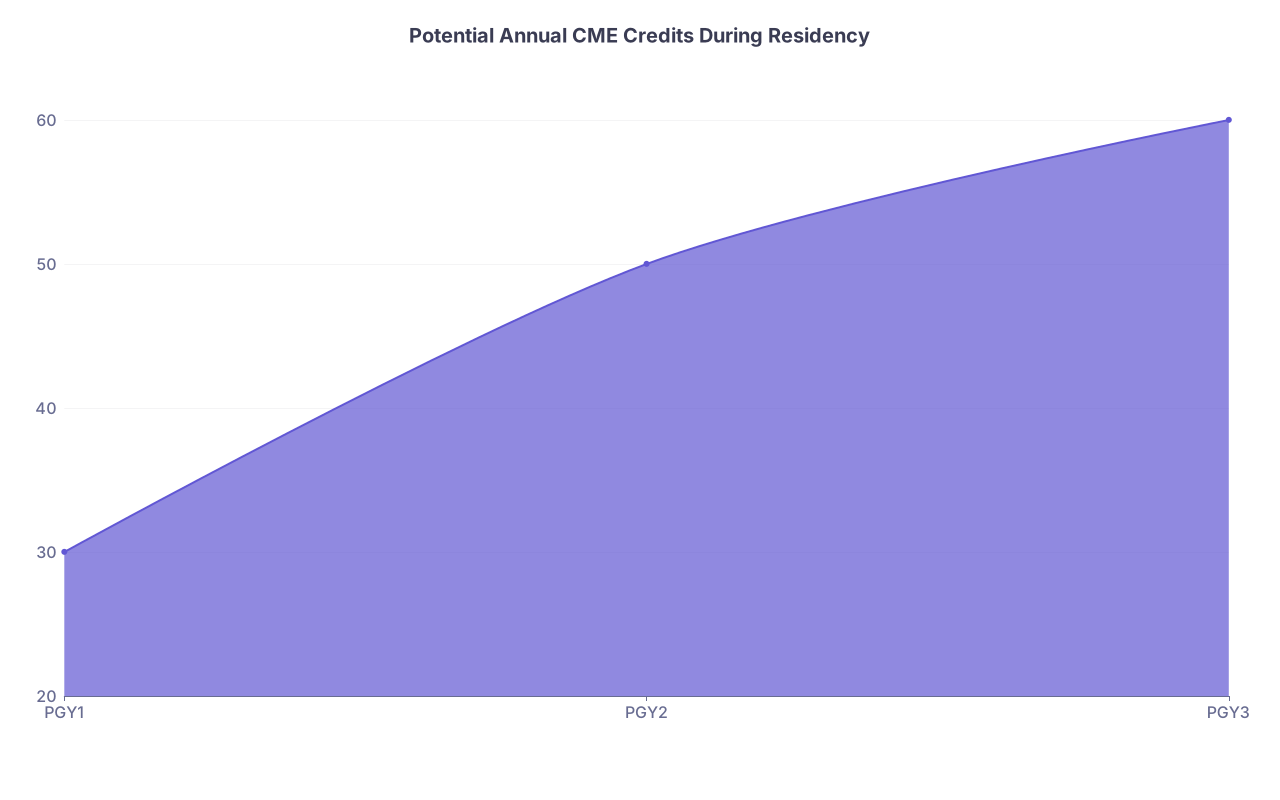
| Category | Value |
|---|---|
| PGY1 | 30 |
| PGY2 | 50 |
| PGY3 | 60 |
Again, these are illustrative, not official numbers — but it shows how quickly it can add up.
What actually matters for licenses and boards?
Residents get confused because everyone’s requirements are slightly different. Boil it down like this:
State medical boards
- Usually require X hours of CME per license cycle (often 25–50 credits per year or per 2 years).
- Some have specific content requirements (opioids, ethics, pain management, cultural competency).
- Most expect Category 1–equivalent credit, not just “I went to a lecture.”
Hospitals / credentialing
- May require a minimum number of CME hours in the previous 1–2 years.
- Sometimes require CME specifically relevant to your specialty or privileges (e.g., procedural).
ABMS boards (for after residency)
- For MOC (Maintenance of Certification), most boards want self-assessment and ongoing CME, sometimes in specific formats they approve.
- Board review courses and specialty conferences usually qualify, but you still need documentation.
Residency conferences that are properly accredited and documented can absolutely be used toward these requirements. That’s why this matters now, not “later.”
Common mistakes residents make with CME and conferences
I’ve seen these play out over and over:
Assuming “all teaching equals CME”
Sitting in sign-out, curriculum review, or informal case discussions is valuable… but not CME unless it’s an accredited activity.Not keeping their own records
Relying entirely on the GME office to track everything. Then the CME system changes, emails get lost, you switch institutions, and you’re stuck.Losing access to conference portals
You attend a national meeting, never complete the evaluation, and the portal closes after 90 days. No evaluation, no credit, no certificate.Not checking the type of credit
Some activities offer only “attendance certificates” or non-physician CE, which may or may not count for your board/state. You need to confirm.Trying to reconstruct CME at the last minute
Two weeks before a license application is due is a horrible time to dig through 3 years of unread emails hunting for certificates.
How to make conferences work for you (instead of just burning time)
Here’s a practical game plan you can start this week.
Ask your program: which recurring conferences are CME-accredited?
Get a list: grand rounds, M&M, journal club, special series. If nobody knows, contact the hospital CME office.After every conference that says it’s CME, do this the same day:
- Sign in (in person or online).
- Complete any post-activity evaluation.
- Download or screenshot the certificate if available immediately.
- Add a line to your personal CME log.
For big external conferences:
- Before you register, confirm: “How many AMA PRA Category 1 Credits are offered?”
- When you get back, block 30 minutes to complete the online evaluation and print/save the CME certificate.
- Store PDFs in a single online folder labeled “CME Certificates.”
At least once a year (end of PGY year):
- Export your institution’s CME transcript, if they have a portal.
- Cross-check it with your log and certificates.
- Fix any gaps now, while people still remember the event.
When in doubt, use this test
If you’re trying to decide whether to treat a residency conference as CME-eligible, ask yourself three questions:
Is there an explicit CME statement from an accredited provider?
If no → assume not CME.Is there a way for me personally to get a named credit record or certificate?
If no → assume not verifiable CME, even if “technically” accredited.Would I feel comfortable sending this certificate or transcript to a state board or hospital privileging committee?
If no → it’s probably not something you want to rely on.
If you can’t answer “yes” to at least #1 and #2, don’t count it as CME in your official totals.

FAQs
1. Do resident conferences automatically count as CME because I’m in training?
No. Residency itself doesn’t magically turn every lecture into CME. An activity only counts as CME if it’s formally accredited by a recognized provider (e.g., ACCME-accredited institution) and you have documentation of the credits. Tons of teaching in residency is never submitted for CME approval.
2. Can I claim CME just by estimating hours spent in conference?
Not for anything that regulators actually care about. State boards and credentialing offices expect documented credits, not self-estimated hours. You can’t just say “I attended noon conference 200 times, so that’s 200 hours of CME.” Without an accredited activity and a record from a provider, it’s just education, not CME.
3. If my hospital tracks grand rounds attendance, do I still need my own record?
Yes. Systems change, people move, and you may switch institutions. Always keep your own tracking log and save copies of any certificates or annual transcripts. Think of the hospital record as a backup, not the primary. You’ll be the one filling out license and credentialing forms, not the CME office.
4. Do online modules and question banks count as CME like conferences do?
Sometimes. Many online platforms (NEJM Knowledge+, ACCP modules, specialty society courses) are fully CME-accredited and issue AMA PRA Category 1 Credits. Others are “educational only” with no CME. The same rules apply: look for an accreditation statement, confirm credit type, complete the evaluation, and save your certificate.
5. I’m a PGY-1. Should I even care about CME yet?
Yes, but lightly. You don’t need to obsess, but you should:
- Learn which of your recurring conferences are CME-accredited.
- Start a simple CME log now.
- Save certificates from any big conferences or online CME you do.
If you do this from PGY‑1, you’ll walk into licensing and early-practice credentialing with a clean, easy record—while your co-residents are digging through years of email.
Key points to walk away with:
- Residency conferences only count as CME if they’re formally accredited and you can prove it with documentation.
- Track your CME from day one with a simple log and saved certificates – future you will be very grateful.
- When in doubt, look for an accreditation statement, a specific credit amount, and a way to download a certificate. If those are missing, don’t count it as CME.