Licensing boards do not care how flashy your CME looks; they care how defensible it is when they audit you.
Let’s be blunt: most physicians massively overestimate how closely boards “like” certain formats and underestimate how quickly they’ll flag lazy, low‑value patterns. The good news? You can use almost any CME format safely if you understand what boards actually scrutinize.
Below is the practical breakdown you actually need.
The Short Answer: What Boards Really Look At
Boards almost never say, “We prefer webinars over conferences.” That is not how they think.
They focus on four things across all CME formats:
- Is it accredited by an appropriate body (ACCME, AOA, state, specialty society)?
- Is it relevant to your practice and scope?
- Is the volume and pattern reasonable (not 40 hours in a single night of click‑through tests)?
- Can you document it clearly if they ask?
If a format causes trouble, it’s usually because of documentation and pattern of use, not because the format itself is “bad.”
CME Formats Most Commonly Trusted vs Scrutinized
| CME Format | How Boards Tend to See It |
|---|---|
| Live in-person conferences | Strong, low scrutiny |
| Live webinars (real-time) | Strong, low-moderate scrutiny |
| Enduring online modules | Acceptable, moderate scrutiny |
| Journal-based CME | Strong, low scrutiny |
| Industry-sponsored dinners | Higher scrutiny |
| Self-reported/self-study hours | Highest scrutiny |
1. Live In‑Person Conferences: The Gold Standard (Still)
Large, accredited, in‑person CME conferences are the least controversial format.
Think: specialty society meetings (ACC, ACR, ASCO, AAFP, ACEP), board review courses, hospital‑sponsored symposia.
Why boards like them:
- Clear, formal accreditation.
- Easy to verify with certificates and programs.
- Strong presumption of educational value.
- Typically planned by content committees with built‑in conflict‑of‑interest oversight.
Where they might scrutinize:
- If the meeting is clearly non‑clinical or loosely related (e.g., a “medical business summit” where all your CME is financial marketing and zero clinical content).
- If you claim an absurd amount of credit compared to the agenda (e.g., 40 hours for a 2‑day meeting).
Documentation that holds up:
- Certificate of attendance with your name, dates, and number of AMA PRA Category 1 Credits (or equivalent).
- Conference agenda or program if the content focus is ever questioned.
2. Live Webinars and Virtual Conferences: Generally Safe, But Pattern Matters
Virtual has become mainstream. State boards and specialty boards accept live webinars and virtual conferences as long as they’re accredited.
Why boards usually accept them:
- They’re treated similarly to live in‑person activities if they’re synchronous and interactive (Q&A, polling, etc.).
- Most major societies now offer a virtual track; boards adapted during COVID and did not go back.
Where scrutiny increases:
- If all your CME for several cycles is from one low‑effort webinar vendor with identical formats and limited depth.
- If the provider is obscure, not clearly accredited, or heavily branded by a single industry sponsor.
Practical rule: Use a mix—some society conferences, some webinars, maybe some journal CME. A diverse CME portfolio looks like ongoing professional development, not box‑checking.
3. Enduring Online Modules / On‑Demand Courses: The Favorite Target in Audits
This is where a lot of people get sloppy. On‑demand online modules, slide‑based courses, and click‑through quizzes are accepted—but these are exactly what boards watch the closest.
Typical issues boards worry about:
- “Click‑through” behavior: finishing many hours of CME in implausibly short time.
- Suspicious vendors: infomercial‑style content, minimal learning objectives, or confusing accreditation details.
- Mass repetition: dozens of near‑identical modules from the same low‑reputation platform.
What makes an online module defensible:
- It’s clearly labeled as ACCME‑accredited or approved by a recognized society or state.
- The topic aligns with your specialty or your documented role (e.g., internal medicine physician doing lot of diabetes, hypertension, and preventive care modules).
- You have certificates naming the provider, the activity, the date, and the number/type of credit.
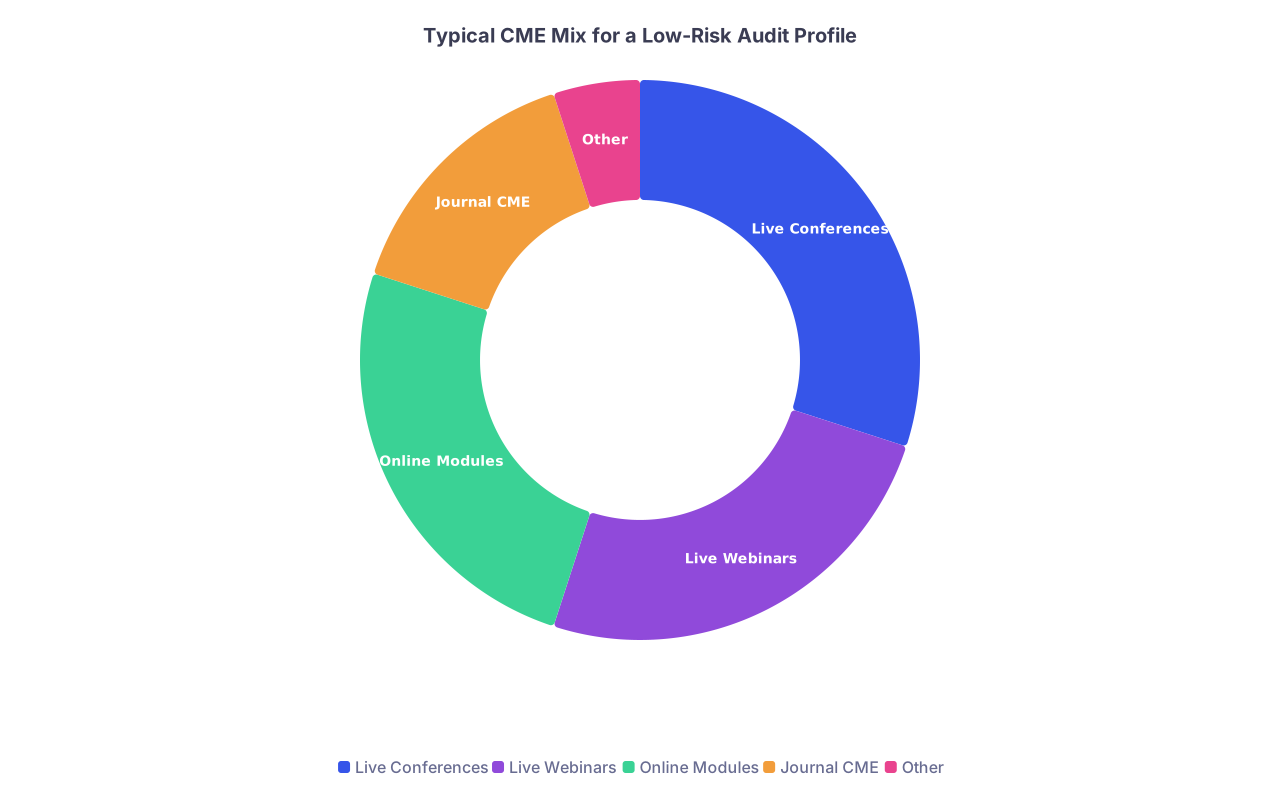
| Category | Value |
|---|---|
| Live Conferences | 30 |
| Live Webinars | 25 |
| Online Modules | 25 |
| Journal CME | 15 |
| Other | 5 |
Smart defensive strategy:
- Use online modules, but not exclusively.
- Stick to recognizable names: major specialty societies, large health systems, well‑known CME companies.
- Spread them out over the year instead of bingeing in December.
4. Journal‑Based CME: Quietly High‑Value and Low‑Risk
Journal CME (e.g., NEJM, JAMA, specialty journals) is rarely a problem and often looks very good in an audit.
Why boards like it:
- Clear linkage to peer‑reviewed content.
- Generally strong educational quality.
- Often very specialty‑relevant by definition.
Potential issues:
- Vague or missing certificates. “I read the journal” is not credit.
- Self‑claimed reading time with no quiz or official credit mechanism.
Make it bulletproof:
- Use the journal’s official CME process (online post‑test, claim form, certificate).
- Save PDFs of completion confirmations and your credit summary.
5. Industry‑Sponsored Dinners and Promotional CME: Technically Allowed, Frequently Scrutinized
Many boards accept industry‑sponsored CME if the activity is accredited and compliant with ACCME standards. But this category is politically and ethically charged, so it draws more attention.
Real concerns boards (and hospitals) have:
- Perceived or real conflict of interest, especially if your prescribing patterns or device use look odd and your CME is 90% from one company.
- Programs that feel more like marketing than balanced education.
- Poor or ambiguous disclosure statements.
If you use these:
- Make sure the activity is explicitly accredited (AMA PRA Category 1 Credit or equivalent).
- Keep them as a minority of your total CME, not the backbone.
- Expect more questions if you’re under investigation for prescribing, device use, or billing.
6. Self‑Reported / Self‑Study CME: The Board’s Favorite Thing to Question
Here’s where people get burned.
Self‑study formats—reading guidelines, attending informal local talks, independent chart review, teaching residents without a formal CME credit mechanism—might be allowed as Category 2 or “unstructured” credits in some states or boards. But these are always the first thing probed in an audit.
Common problems:
- Vague logs: “Read multiple articles about hypertension – 25 hours.”
- No dates, no sources, no learning objectives, no way to verify.
- Attempting to use self‑reported hours to satisfy requirements that explicitly say “Category 1 only.”
How to use self‑study safely:
- Check your specific state and specialty board rules; many limit or exclude self‑reported CME from license renewal requirements.
- If allowed, document in an organized way: date, topic, source, approximate time, and how it relates to your practice.
- Do not rely on self‑reported hours for the majority of your requirement unless your board clearly permits it and you can defend it.
What Boards Really Scrutinize: Patterns, Not Single Credits
Most audits are not witch hunts. They’re pattern hunts.
Red flags I’ve seen trigger deeper questions:
- All CME from one small vendor nobody has heard of.
- Massive amounts of credit claimed in unrealistic timeframes (e.g., 50 hours in one weekend of online modules).
- CME topics that do not match your listed specialty or practice (e.g., a dermatologist with 80% of CME in advanced cardiac life support and critical care ultrasound, with no ER or ICU role).
- Heavy reliance on unaccredited/self‑reported CME where rules call for accredited activities.

| Step | Description |
|---|---|
| Step 1 | Review CME Log |
| Step 2 | High Scrutiny |
| Step 3 | Moderate Scrutiny |
| Step 4 | Low Scrutiny |
| Step 5 | Accredited Provider? |
| Step 6 | Reasonable Volume? |
| Step 7 | Relevant to Practice? |
If your pattern looks balanced and sane, the specific format rarely becomes a problem.
State Boards vs Specialty Boards vs Hospitals: Who Cares About What?
Different entities see CME through slightly different lenses.
| Entity Type | Main Focus |
|---|---|
| State Medical Board | Compliance & documentation |
| Specialty Board | Relevance & quality |
| Hospital/Employer | Policy adherence & risk |
| DEA (for CS CME) | Topic-specific completion |
State medical boards
They care whether you hit the number of hours, in the right categories (e.g., opioid prescribing, ethics, implicit bias), from recognizable providers. Format is secondary; proof is primary.
Specialty boards (ABIM, ABFM, ABS, etc.)
They emphasize relevance and quality. For maintenance of certification, they often prefer:
- Specialty‑specific modules.
- Performance improvement activities.
- Assessment‑based CME.
Hospitals and employers
They may restrict what “counts” for hospital reappointment. For example, some bylaws require a portion of CME from specialty societies or prohibit industry dinners from counting toward mandatory hours.
DEA and controlled substance CME
For mandated controlled substance prescribing CME, they do not care whether you attended in person or online, but they care a lot whether the course is explicitly approved to meet that requirement.
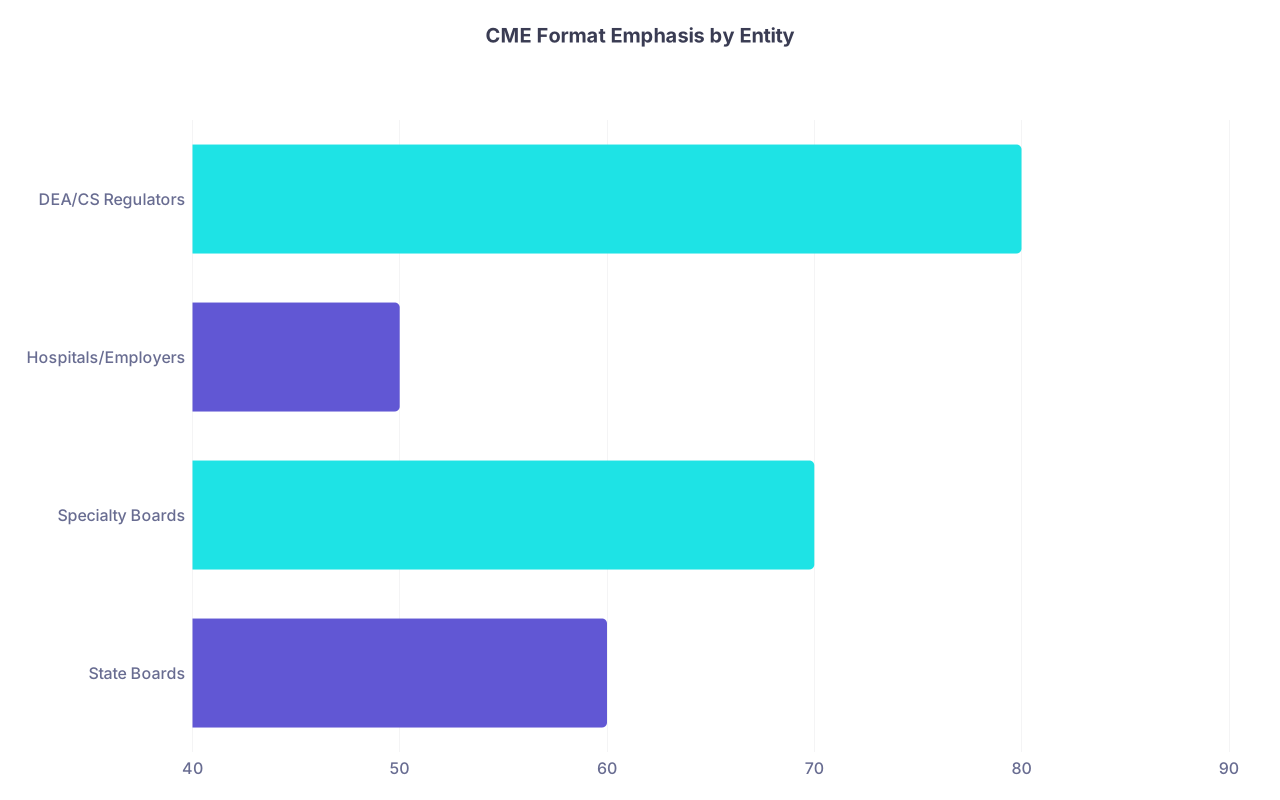
| Category | Value |
|---|---|
| State Boards | 60 |
| Specialty Boards | 70 |
| Hospitals/Employers | 50 |
| DEA/CS Regulators | 80 |
(Values here represent relative focus on format and content specificity—DEA and specialty boards are typically the strictest about exact topic alignment.)
How to Make Your CME Portfolio Audit‑Proof
Let me give you a simple framework so you do not have to guess.
Start with your board/State rules
- Confirm how many total hours.
- Check how many must be Category 1 (or equivalent).
- Identify any mandated topics (opioids, ethics, pain, cultural competence, risk management, etc.).
- Check if there’s a cap on self‑reported or non‑accredited CME.
Build a core from “undeniable” formats
Aim for at least 70–80% of required hours from:- National or state specialty society meetings (live or virtual).
- Hospital‑sponsored accredited CME.
- Well‑known journal CME.
- Major, recognizable online CME platforms.
Use online enduring material strategically
- Treat it as a complement to conferences and journals, not a replacement.
- Avoid huge last‑minute binges.
- Pick high‑quality, clearly accredited content.
Keep industry‑sponsored CME clearly documented and limited
- Acceptable as a minority share of your hours.
- Make sure the accreditation is explicit, not implied.
- Be ready to show it’s balanced and evidence‑based.
Treat self‑reported CME as “bonus,” unless your board says otherwise
- Use it to round out topics or hours, not to anchor your requirements.
- Document with more detail than you think you’ll need.

| Step | Description |
|---|---|
| Step 1 | Check Board Rules |
| Step 2 | Define Hour Targets |
| Step 3 | Select Core Activities |
| Step 4 | Add Online Modules |
| Step 5 | Limit Industry CME |
| Step 6 | Document Self Study |
| Step 7 | Review for Balance |
- Keep clean documentation
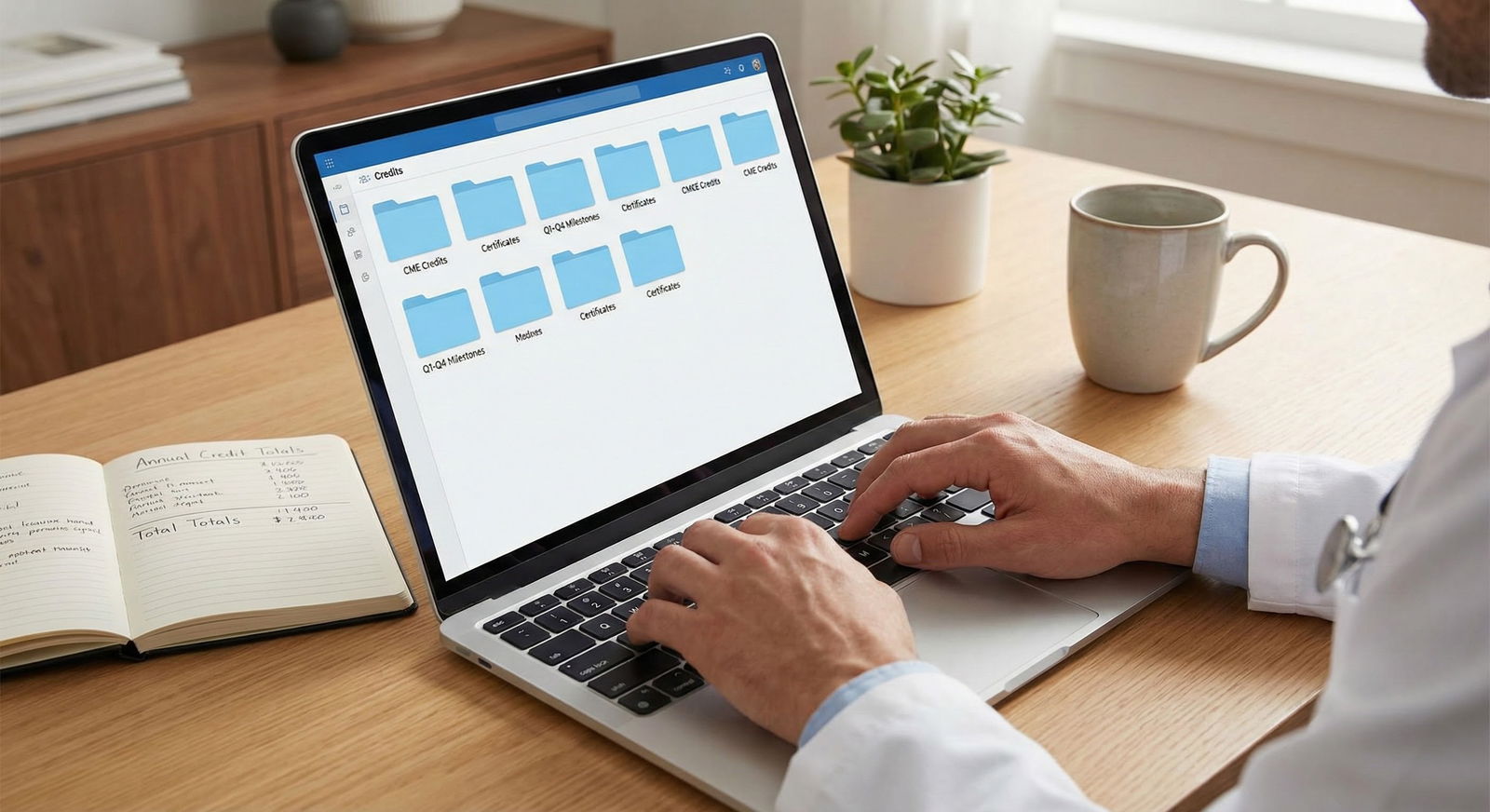
- Save certificates as PDFs in a labeled folder by year.
- Keep a simple spreadsheet log: date, provider, title, format, hours, credit type, topic.
- Back it up somewhere that isn’t your dying laptop.

FAQs: Exactly 7 Questions
1. Do licensing boards prefer live CME over online CME?
Most do not explicitly “prefer” one over the other anymore, as long as both are accredited. What they trust more is high‑quality, recognizable providers and reasonable patterns over time. A mix of live (in‑person or virtual) and online enduring material looks better than 100% click‑through modules, but format alone is rarely the deciding factor.
2. Are free, industry‑sponsored CME activities risky to use?
They’re not automatically risky, but they are more likely to be scrutinized, especially if they make up a large percentage of your total CME or are all from the same sponsor. If you use them, keep them as a minority share, verify the accreditation, and balance them with non‑industry, society‑based CME.
3. How many self‑reported or Category 2 CME hours can I safely claim?
That depends entirely on your state and board. Some allow a portion of self‑reported CME; others give it zero weight for license renewal. As a general safety rule, try to meet your core requirement with accredited Category 1‑type hours and treat self‑reported learning as supplemental unless your board explicitly encourages or requires it.
4. Will boards reject CME if it’s not exactly in my specialty?
Not usually, as long as it’s logically related to your practice. An internist doing diabetes, CKD, and cardiovascular CME is fine. An orthopedic surgeon doing mostly cosmetic dermatology and cryptocurrency in medicine modules would look odd. You should be able to explain how each major chunk of CME supports your actual clinical or administrative role.
5. Is it a problem if I earn most of my CME in the last month before renewal?
It looks bad. Technically, if the activities are accredited and the hours are accurate, boards may still accept them. But clustered, last‑minute CME increases the odds of scrutiny. It suggests box‑checking rather than ongoing education. Spreading your activities over the renewal cycle creates a safer, more professional pattern.
6. How do boards verify that an online CME provider is legitimate?
They usually look for recognized accrediting bodies (ACCME, AOA, state medical societies, specialty societies) listed on your certificate or on the provider’s materials. If the accreditor is unknown, vague, or missing, they may ask you or the provider directly. This is why it’s smart to stick to well‑known organizations for most of your hours.
7. What should I do if I discover some of my past CME doesn’t meet my board’s rules?
Do not panic, but do not ignore it. First, verify the rule—many physicians misinterpret requirements. If you truly used non‑qualifying CME to count toward a requirement, fill the gap with compliant CME as soon as possible and keep the documentation. If you’re already under audit or investigation, talk to your medical staff office or an attorney experienced with licensing issues before responding.
Key points: Boards don’t obsess over format; they care about accreditation, relevance, and documentation. Live conferences and journal CME are hard to challenge, while on‑demand modules and self‑reported activities get the most scrutiny. Build a balanced, well‑documented CME portfolio, and most licensing boards will have nothing to argue with.