
Industry‑sponsored CME can be safe for compliance—but only if you’re ruthless about how you choose and document it.
If you take anything away from this: regulators care about independence and documentation, not who paid the AV bill. You can absolutely meet CME compliance requirements with industry-supported activities, but you cannot be naïve about commercial influence.
Let’s unpack this in a way that actually helps you decide “yes or no” on a given activity.
The Short Answer: Yes, With Conditions
Here’s the bottom line:
Industry‑sponsored CME can count toward compliance (state licensure CME, hospital/credentialing CME, DEA MATE Act training, risk management CME, etc.) if:
- It’s provided by an accredited CME provider (ACCME, state medical society, specialty society, AOA, etc.).
- It follows accreditation standards on independence and commercial support.
- You get and keep proper documentation (certificate, activity description, number of hours, topic).
It becomes a compliance hazard when:
- The activity is essentially a promotional talk dressed up as CME.
- The sponsor has input on content, speakers, or outcomes.
- There’s no clear accreditation statement or no disclosure of commercial support.
- You depend heavily on it for required ethics, opioids, or risk management hours without confirming it meets those specific requirements.
So the question isn’t “Is industry-sponsored CME safe?” The real question is “Is this specific industry‑sponsored CME safe enough for compliance, and can I prove it later?”
What Actually Matters for Compliance
Regulators and credentialing bodies care about four things:
- Accreditation status
- Content type (clinical vs non‑clinical, risk management, opioids, etc.)
- Independence from promotion
- Proof you completed it
If those four are tight, they do not care that Pharma X wrote a check to support the activity, as long as the money went to the accredited provider and not straight to a speaker’s pocket.
1. Accreditation: Non‑negotiable
Look for a clear statement like:
“This activity has been planned and implemented in accordance with the accreditation requirements and policies of the Accreditation Council for Continuing Medical Education (ACCME)… [Provider] is accredited to provide continuing medical education for physicians…”
If you do not see language like that, assume it will not count for compliance.
This is the gatekeeper. Industry support is secondary. No accreditation statement = not safe for compliance, even if the logos are pretty.
2. Content Type vs. Your Specific Requirement
Most doctors make the same mistake: they assume “Category 1 CME” automatically meets every requirement. It doesn’t.
Examples:
- DEA MATE Act hours (opioid/substance use CME) have very specific topic requirements. The course must match those, or it’s useless.
- Some states require ethics, professionalism, or cultural competency hours.
- Some hospitals require patient safety or QI specific activities.
Industry‑sponsored CME is often focused on therapeutics, diagnostics, procedures. That works great for generic “X hours of CME” but not always for:
- Jurisprudence
- Ethics
- Cultural competence
- Practice management/record keeping (in some states)
You need to match the content label on the CME to your actual requirement—not just toss all CME into one pile.
Where Industry Support Crosses the Line
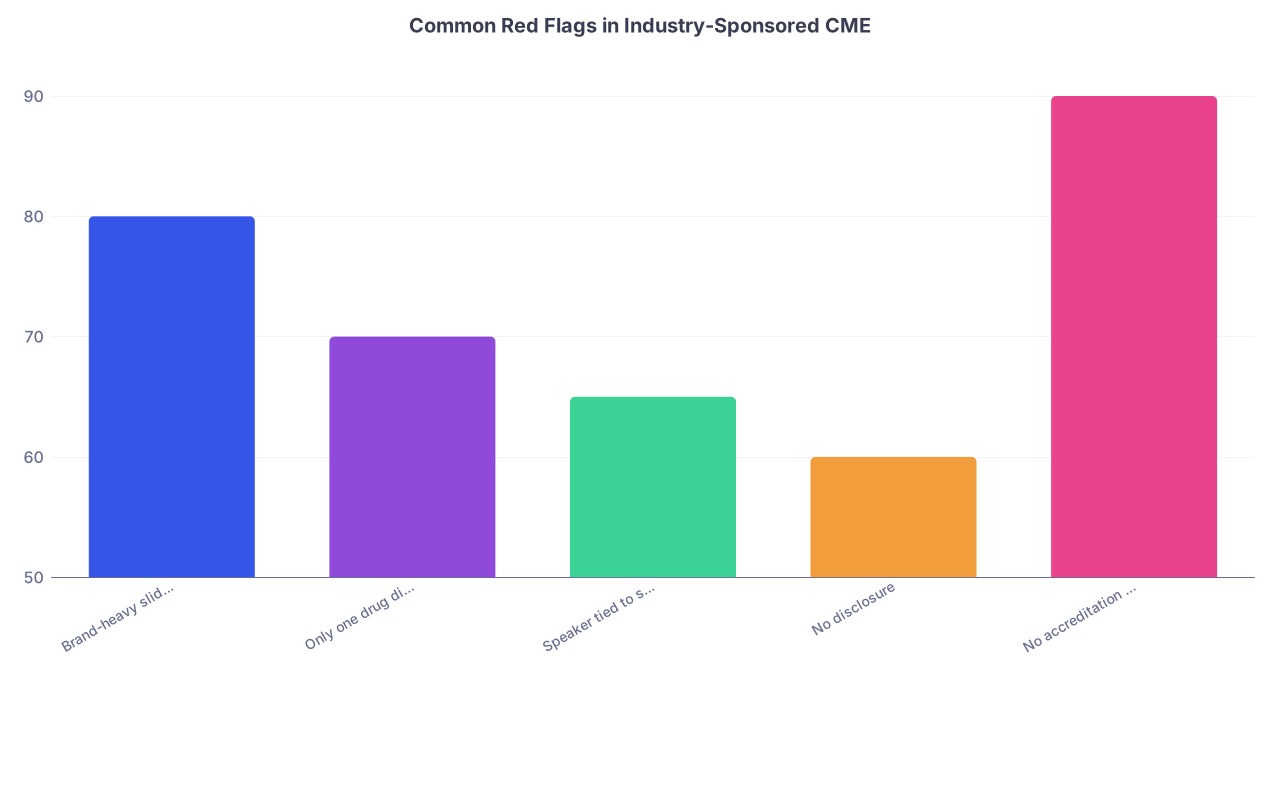
| Category | Value |
|---|---|
| Brand-heavy slides | 80 |
| Only one drug discussed | 70 |
| Speaker tied to sponsor | 65 |
| No disclosure | 60 |
| No accreditation statement | 90 |
There’s a difference between “industry‑supported CME” and “promotional dinner with a CME logo slapped on it.”
Red flags that this activity is risky for compliance:
- The brand name is all over the slides or title.
- Only one company’s product is discussed, with no mention of competitors or generics.
- The speaker openly pitches a product rather than discussing a category.
- You cannot find:
- A balanced discussion of options.
- Mention of generic alternatives.
- Evidence‑based references beyond company data.
- There’s no or vague disclosure of commercial support.
- The commercial supporter is listed as the provider (e.g., “This CME is provided by Pharma X”) instead of “supported by an educational grant from…”
If you see two or more of these together, I would not rely on that activity to satisfy any meaningful compliance requirement. Keep it for curiosity if you want, but don’t hang your license on it.
How to Tell if an Industry-Sponsored CME Is “Safe Enough”
Here’s the practical checklist I’d actually use.
| Question | What You Want to See |
|---|---|
| Accredited provider listed? | ACCME/AOA/state/specialty society explicitly named |
| Clear accreditation statement? | “Designates this live activity for a maximum of X AMA PRA Category 1 Credits” |
| Commercial support disclosed? | “Supported by an independent educational grant from…” |
| Control of content? | Statement that accredited provider controls content, not the sponsor |
| Balanced content? | Multiple treatment options, including generics/non‑pharmacologic |
If any of the first three are missing, I’d stop right there and not count it toward compliance.
What Regulators and Hospitals Actually Expect
Different bodies care about different things. Let’s split it out.
State medical boards
Most state boards accept any AMA PRA Category 1™ CME or AOA equivalent from an accredited provider, regardless of commercial support, as long as topic and hours meet state rules.
They focus on:
- Total hours
- Required subcategories (opioids, ethics, risk management, etc.)
- Time period
They do not typically single out industry support as disqualifying.
Hospitals/credentialing
Hospitals are similar but sometimes stricter around:
- Patient safety
- Quality improvement
- Procedural privileges (e.g., needing specific CME for new procedures)
Again, they care more about accreditation and topic relevance than whether industry support exists.
Federal (DEA, CMS-related requirements, etc.)
For DEA-required opioid training, the key is:
- Content matches DEA’s defined domains (pain, OUD, addiction medicine, multimodal treatment, risk mitigation, etc.).
- Accredited provider.
- Proper documentation.
Industry‑supported is allowed if everything else is done correctly.
Best Practices to Stay Out of Trouble
If you want to use industry‑sponsored CME and sleep at night during an audit, do these five things:
Prefer reputable providers.
Academic medical centers, major specialty societies, long‑standing CME companies that live or die by ACCME compliance. They’re usually fanatical about separation from industry.Scan the disclosure slide and save the certificate.
Take a screenshot if needed. It should show:- Accredited provider name
- Credit type and hours
- Title and date
- Your name (or a way to retrieve it from a portal)
Check for content balance.
Page through the slide deck or agenda. Is every therapy option covered? Or just the sponsor’s drug? If it looks like a sales deck, treat it as such.Diversify your CME sources.
If 90% of your CME is coming from one company’s grant-supported activities, that’s…not great optics. Mix in independent CME from:- Your specialty society
- Hospital system
- University‑based programs
- Non‑commercial CME platforms
Use industry‑supported CME mostly for “general hours,” not niche requirements.
For high‑risk categories (opioids, ethics, risk management after a board action, remediation plans), I’d lean toward non‑industry‑supported CME from clearly independent sources when possible. It’s not always mandatory—but it’s safer.
How Industry-Sponsored CME Is Supposed To Be Firewalled
Under ACCME Standards for Integrity and Independence, if a program is properly run:
Commercial supporters cannot:
- Choose speakers
- Control content
- Review or approve slides
- Influence the learning objectives
Money flows through the accredited provider, not the faculty directly.
All commercial relationships of faculty and planners must be disclosed and mitigated.
Product promotion is physically and temporally separated from the education (e.g., exhibit hall vs. CME session).
When this system is functioning, industry‑supported CME is reasonably safe—for compliance and for your clinical practice.
The problem is when you, as a learner, can’t tell if these rules were followed. That’s why I push you back to two things: the accreditation statement and the quality of the content in front of you.
Simple Decision Framework You Can Use in 30 Seconds
Here’s how I’d think about it on a busy day:

| Step | Description |
|---|---|
| Step 1 | Find CME activity |
| Step 2 | Do not use for compliance |
| Step 3 | Proceed with caution |
| Step 4 | Safe for most compliance needs |
| Step 5 | Accredited provider named? |
| Step 6 | Accreditation statement present? |
| Step 7 | Commercial support disclosed? |
| Step 8 | Content looks balanced? |
- Land at G → Safe for general CME requirements, likely fine even if industry-supported.
- Land at E → Maybe watch for your own education, but I wouldn’t lean on it for sensitive compliance categories.
- Land at X → Treat as non‑CME or at least non‑compliant CME.
Example: Using Industry-Sponsored CME for Different Requirements
| Requirement Type | Industry-Sponsored CME Status |
|---|---|
| Generic state CME hours | Usually safe if accredited and documented |
| Hospital reappointment CME | Generally safe if topic relevant and accredited |
| DEA MATE Act opioid hours | Can be safe, must match content rules |
| Ethics/professionalism | Safer to use non‑industry sources |
| Remediation/disciplinary CME | Prefer non‑industry, board-approved only |

The Real Risk: Clinical Bias More Than Paper Compliance
From a pure compliance standpoint, industry‑supported, ACCME‑accredited CME is usually fine.
The bigger risk is in your clinical decisions:
- Over‑adoption of expensive branded therapies
- Under‑appreciation of non‑pharmacologic options
- Skewed understanding of risk/benefit when trials are industry‑funded
You protect yourself by:
- Actively asking: “What’s the absolute risk reduction? How does this compare to generic options?”
- Checking independent sources (guidelines, Cochrane, UpToDate, society statements) for confirmation.
- Being extra skeptical when a “miracle” therapy that happens to be on patent seems to solve every problem.
Compliance is the minimum bar. Practicing good medicine demands more critical thinking than that.
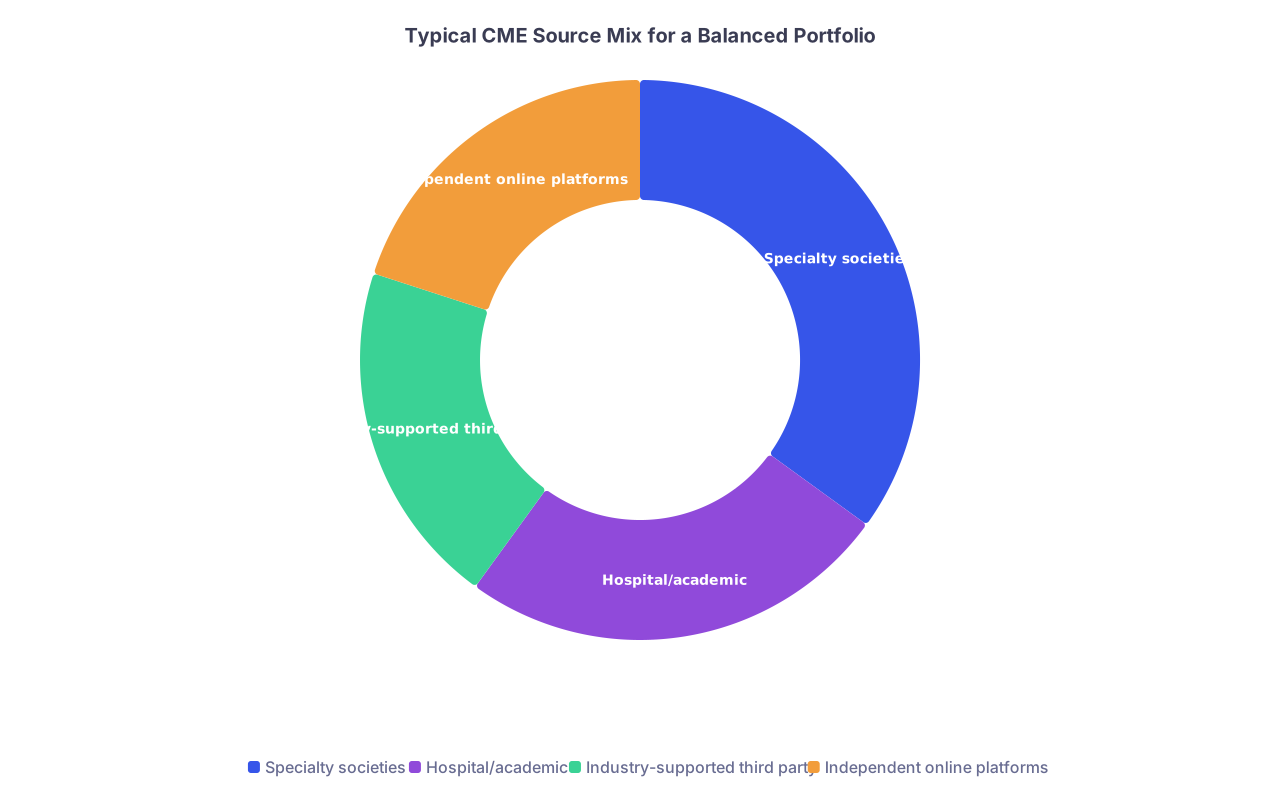
| Category | Value |
|---|---|
| Specialty societies | 35 |
| Hospital/academic | 25 |
| Industry-supported third party | 20 |
| Independent online platforms | 20 |

FAQ: Industry-Sponsored CME and Compliance
1. Can I use industry-sponsored CME to meet my state’s license renewal requirements?
Yes—if the activity is provided by an accredited CME provider, carries AMA PRA Category 1 (or equivalent) credit, and the topic aligns with your state’s specific requirements (opioids, ethics, etc.). The presence of industry support alone does not usually disqualify it. Lack of accreditation does.
2. Does the DEA allow industry-funded CME to count toward the MATE Act opioid training?
They care about content and accreditation, not who paid the grant. If the course is from an accredited provider and explicitly states it meets the MATE Act requirements (often labeled as such), it can count even if supported by industry. Always save detailed documentation in case of future questions.
3. Do hospitals or credentialing committees ever reject industry-sponsored CME?
Rarely because of the industry support itself. Rejections typically happen when: the provider is not accredited, the topic isn’t relevant to the privilege you’re seeking, or the documentation is weak (e.g., no hours listed, no learner name). Some institutions may prefer non‑industry‑supported CME for certain quality or safety initiatives, but that’s policy, not law.
4. How can I quickly spot promotional “CME” that’s unsafe for compliance?
Red flags: no clear accreditation statement, sponsor listed as “provider,” heavy brand emphasis, only one drug discussed, and no explicit disclosure of commercial support. If you can’t easily tell who accredited it and what type of credit it carries, don’t count it for your compliance requirements.
5. Are there topics where I should avoid industry-sponsored CME altogether?
For generic clinical updates, it can be fine if carefully chosen. For more sensitive areas—ethics, professionalism, cultural competency, remediation after board action—I strongly prefer fully independent CME (no commercial support) from trusted academic or professional organizations. It reduces both real and perceived conflicts.
6. What documentation should I keep if I use industry-supported CME for compliance?
At minimum: the CME certificate (with your name, date, hours, provider, and credit type), plus a copy or screenshot of the activity description showing learning objectives and topic. For opioid or special-topic requirements, keep proof that the course explicitly addressed required domains. If audited years later, you want to be able to demonstrate accreditation, relevance, and completion.
Key points to remember:
Industry‑sponsored CME is not automatically dirty; accreditation, independence, and documentation are what matter for compliance. Use a quick mental checklist—accredited provider, clear statement, balanced content—to decide whether to count a given activity. And when in doubt, reserve industry‑supported CME for general hours, while leaning on clearly independent sources for high‑stakes, sensitive requirements.