
The way most new attendings handle CME in their first year is backward. They react to deadlines, emails, and panic… instead of running a simple, deliberate plan from day one.
You are now in the “no one is checking, but everything still counts” phase of your career. CME, MOC, state requirements, hospital mandates—none of this got simpler when you finished training. It just became your problem.
Here’s the fix: treat CME like a 12‑month project, not a last‑minute chore.
Below is a month‑by‑month first‑year guide. At each point, I’ll tell you exactly what you should be doing so you finish year one with:
- All CME, MOC, and state requirements met
- No end‑of‑cycle scramble
- A growing professional niche (not just random credits)
- Minimal money wasted on junk conferences
Big Picture: Your First-Year CME Targets
Before we slice the year, you need rough numbers. Typical ranges:
| Requirement Type | Typical Amount |
|---|---|
| Annual CME hours | 25–50 credits |
| License cycle total | 50–100 credits / 2–3 yrs |
| MOC (board) points | 10–40 points / year |
| DEA opioid training | 8 hours (one-time) |
Your specific targets will vary, but this is the ballpark. You’ll confirm your exact numbers in Month 1.
Month 1: Orientation to Your CME Reality
At this point, you should get brutally clear on your requirements. No guessing. No “I think my board needs…”
Week 1–2: Inventory Everything
Sit down once, for 60–90 minutes, and pull this together:
State Medical License
- Go to your state medical board website.
- Find:
- License cycle dates (start/end).
- Total CME hours required per cycle.
- Any specific topics required this cycle (opioids, pain, ethics, implicit bias).
- Write it down. Don’t trust your memory.
Specialty Board (ABIM, ABEM, ABFM, etc.)
- Log in to your board portal.
- Look for:
- Annual or cycle‑based CME/MOC requirements.
- Any “by end of year” tasks (e.g., longitudinal assessment questions, quality improvement modules).
- Deadlines for this calendar year.
- Screenshot the requirement page. Save to a “CME” folder.
Hospital / Health System / Group
- Check:
- Credentialing office emails.
- Medical staff bylaws and policies.
- Confirm:
- Any additional CME obligations (e.g., minimum annual CME, focused topics like sepsis or stroke protocols).
- Deadlines tied to re‑credentialing.
- Check:
DEA & Prescribing Requirements
- If you prescribe controlled substances, verify:
- DEA 8‑hour opioid/SUD requirement (if not already done).
- State opioid prescribing CME requirements (often 2–4 hours per cycle).
- If you prescribe controlled substances, verify:
Professional Societies
- If you’re joining e.g., ACEP, AAFP, ASCO, ACC:
- Check which member benefits include CME.
- Note recurring annual meetings and dates.
- If you’re joining e.g., ACEP, AAFP, ASCO, ACC:
Week 3–4: Build a One-Page CME Dashboard
Create a simple, ugly‑but‑useful document or note. Columns:
- Requirement (e.g., “State license CME”)
- Total needed
- Cycle dates
- Topics required
- Status
- Deadline
Then decide on your first-year targets, not just minimums. Example:
- Aim: 30 CME credits this year
- Must include:
- 2 hours opioid prescribing
- 1–2 credits ethics or professionalism (if required)
- Board MOC:
- Complete at least 1 QI module
- Stay current with longitudinal questions
End of Month 1, you should know your numbers cold and have them in one place.
Month 2: Design Your Annual CME Game Plan
Now that you know the rules, you design the game. This is where most people fail—they drift and then panic in year 3.
Week 1: Decide Your CME “Portfolio”
Think in three buckets:
Baseline compliance CME
- Cheap or free
- Online modules
- Hospital offerings
High-value, career-shaping CME
- National or regional conference in your specialty
- Hands‑on skills course (ultrasound, procedures, leadership)
Mandatory oddball topics
- Opioids, ethics, implicit bias, cultural competency, etc.
Decide:
- 1 major conference or regional meeting this year? Yes or no.
- 1 focused skills course? (e.g., POCUS, simulation, leadership)
- Rest filled by online CME and hospital content.
Week 2–3: Pick Your Major Activities
Look up:
- National specialty conference dates for the next 12 months
- Relevant regional/state society meetings
- Any hospital‑sponsored CME days that give a big credit chunk
Then lock in:
- Primary conference target (month and city)
- Backup/alternative if call schedule or life blows up
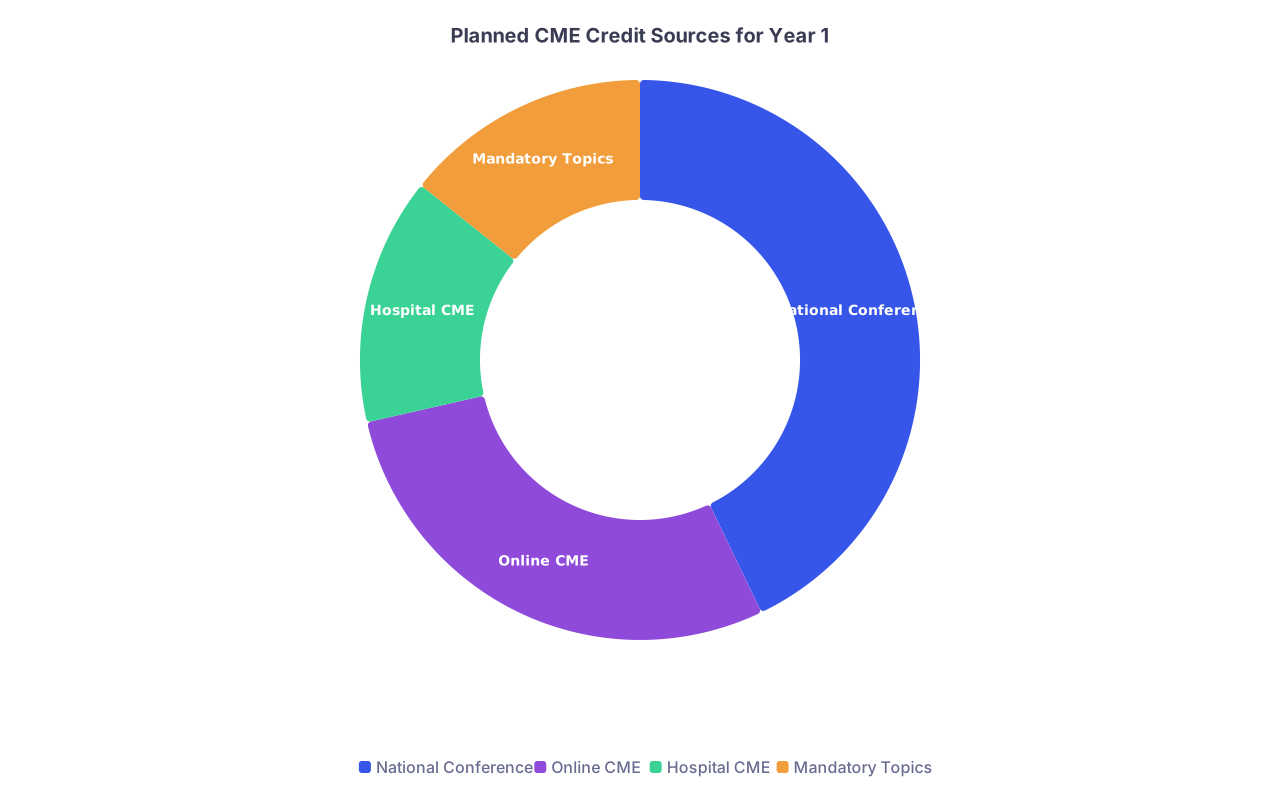
| Category | Value |
|---|---|
| National Conference | 15 |
| Online CME | 10 |
| Hospital CME | 5 |
| Mandatory Topics | 5 |
Week 4: Rough Monthly Credit Targets
Divide your year‑one CME goal across months. Not perfectly. Just enough to avoid a December disaster.
Example for a 30‑credit year:
- 15 credits at conference (Month 7)
- 10 credits online – 1 credit/month for 10 months
- 5 credits from hospital/mandatory topics spread over the year
So practically:
- Aim: ~1 online CME credit per month
- Plus 1–2 months heavier when you’re lighter on call
Write this down in your calendar as repeating monthly reminders.
Months 3–4: Systems, Subscriptions, and Easy Wins
At this point, you should be building automation so CME happens in the background, not in panicked bursts.
Month 3: Set Up Your CME Infrastructure
Week 1: Choose One Primary CME Platform
Pick at least one main source:
- NEJM Knowledge+, UpToDate CME, specialty‑specific platforms, or your society’s portal
- Many hospital systems give access to certain platforms for free—ask IT or library services
Criteria:
- Automatically tracks CME and generates certificates
- Relevant to your daily practice
- Offers both quick 0.25–0.5 credit activities and longer modules
Then:
- Create your account.
- Update profile with NPI, license numbers, board details if they allow syncing.
Week 2–3: Build a Simple Tracking System
You need redundancy:
- Platform tracking (automatic).
- Personal log (manual backup).
Set up a simple spreadsheet or note with:
- Date
- Activity name
- Provider (ACCME‑accredited)
- Credit type (AMA PRA Category 1, etc.)
- Credits earned
- Topic (opioid, ethics, general, etc.)
- Certificate file link or location
Create a “CME Certificates” folder in cloud storage. Every time you finish an activity, drop the PDF in immediately.
Week 4: Get 2–3 Credits Quickly
Grab low‑friction credits:
- Complete a 1–2 hour opioid or pain module if required.
- Do 2–3 short clinical update modules on your chosen platform.
You want an early psychological win: credits already on the board by end of Month 3.
Months 5–6: Lock in Your Conference and Fill Gaps
Now you’re balancing real attending life—patients, call, notes—with your plan.
At this point, you should have 5–8 credits completed and your major conference selected.
Month 5: Finalize Travel and Schedule
Week 1–2: Confirm Conference Logistics
- Register for the conference (do not wait; costs go up).
- Submit any necessary time‑off or schedule requests.
- Book travel and hotel if it’s out of town.
Check:
- How many CME credits offered?
- Any pre‑conference workshops with extra credits? (Sometimes these give high-yield, practical skills and bonus CME.)
Week 3–4: Strategic Topic Choices
If the conference program is available:
- Flag sessions on:
- Your niche or future subspecialty interest
- Required topics (opioids, risk management, quality)
- Avoid filling your entire schedule with general review topics you already know. Get value—new skills, new connections.
Month 6: Mid‑Year Reality Check
Do a 30‑minute review:
- How many CME credits do you actually have so far?
- Are you behind your 1 credit/month rough goal?
- Any upcoming mandatory hospital modules you can count?
If you’re behind by more than 3–4 credits:
- Block off one half‑day this month.
- Do 3–5 credits of high‑quality online CME in that block.
- Update your tracker and certificates folder.
Month 7: The Conference Month (or Main CME Push)
This is where you stack a big chunk of your credits and also actually improve as a physician.
Before the Conference (Week 1)
- Re‑check how many CME credits are available.
- Download the conference app if there is one.
- Mark sessions that:
- Clearly state CME credit per session.
- Cover gaps in your practice or upcoming changes (new guidelines, therapies).
- Count toward special requirements (opioids, quality, safety, ethics).
During the Conference (Week 2–3)
Your only job, CME-wise:
- Attend sessions fully.
- Make sure badge scanning or QR code check‑ins happen properly.
- Take 2–3 minutes after each day to:
- Mark attended sessions in the app or program.
- Write quick notes (clinical pearls, things to implement).
Immediately After (Week 3–4)
Within 7 days of returning:
- Complete any required evaluations for CME credit.
- Download the official CME certificate (total credits). Sometimes you may download session‑specific docs too.
- Save certificates to your CME folder.
- Update your personal tracker with a single line (e.g., “Specialty Annual Meeting – 15 credits”).
By end of Month 7, you should be sitting on a large portion of your annual CME goal.
Months 8–9: Fill the Remaining Requirements and Start QI/MOC Work
Now it’s less about volume, more about precision.
At this point, you should know:
- How many credits you’ve earned.
- Which specific requirement boxes are still empty (e.g., 1 hour ethics, 1 more opioid credit, certain MOC modules).
Month 8: Tighten Up Required Topics
Look at your dashboard:
- Are all state‑mandated topic areas satisfied?
- DEA or opioid training done and documented?
- Any hospital‑specific training still pending for this year?
If you’re missing required topics:
- Search your main CME platform or specialty society site for:
- “Ethics”
- “Risk management”
- “Opioid”
- “Implicit bias”
- “Cultural competency”
- Choose the shortest high‑quality modules that meet requirements.
- Complete those before anything extra or “fun.”
Month 9: Board MOC and QI Work
If your board uses points/modules (ABIM, ABP, etc.):
- Log into your board portal again.
- Check:
- Number of MOC points earned this year.
- Progress on longitudinal assessment questions.
- QI/PI or practice assessment modules needed in this cycle.
Then:
- Block a 2–3 hour session this month to attack:
- One QI or practice improvement module.
- A batch of longitudinal assessment questions if you’re behind.
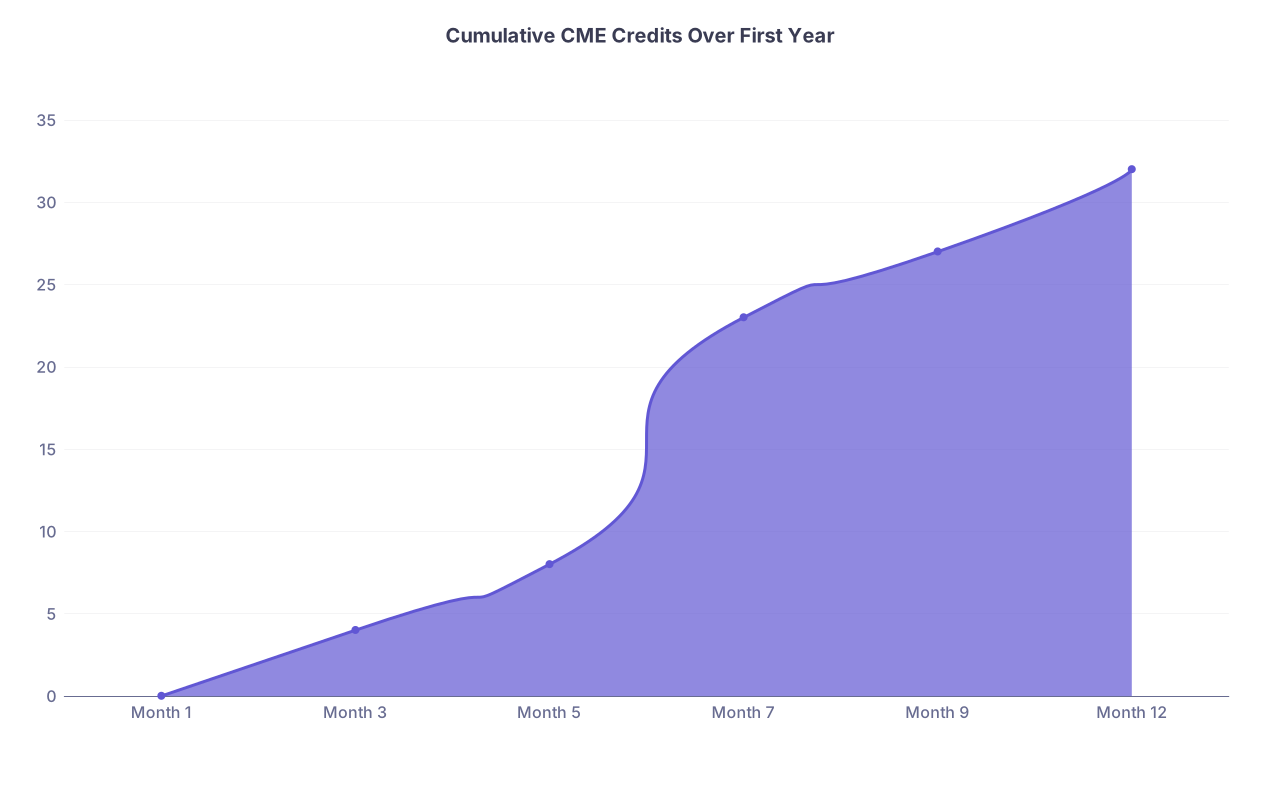
| Category | Value |
|---|---|
| Month 1 | 0 |
| Month 3 | 4 |
| Month 5 | 8 |
| Month 7 | 23 |
| Month 9 | 27 |
| Month 12 | 32 |
Months 10–11: Clean-Up, Verification, and Insurance Alignment
This is where you avoid the “oh no, my license renews next month” panic.
At this point, you should be very close to your annual goal and have mandatory topics covered.
Month 10: Full CME Reconciliation
Do a 45‑minute deep dive:
Open:
- State license requirements page.
- Board portal.
- Hospital medical staff requirements (if applicable).
- Your CME log.
- Your certificates folder.
For each requirement, ask:
- Do I have enough total hours/credits for this cycle?
- Do I have the specific required topics?
- Are all credits from acceptable sources (ACCME‑accredited, AMA PRA Category 1, etc.)?
Fix any discrepancies:
- If you’re short 2–3 credits, schedule them this month.
- If you’re missing documentation for something you remember doing, log in to that provider’s site and re‑download certificates.
Month 11: Align with License and Insurance Renewals
Check:
- When is your next license renewal?
- When is your next hospital credentialing cycle?
- When does your malpractice insurance re‑credential?
Align your documents:
- Create a single PDF or folder with:
- Summary CME log.
- Key certificates for mandatory topics (opioids, ethics, state‑specific).
- Label files clearly (e.g., “Opioid_CME_3hrs_2026.pdf”).
If your renewal is upcoming:
- Fill out any online CME attestation forms now.
- Double‑check that any “attestations” you click actually match your real CME completed.
Month 12: Year-End Review and Year 2 Setup
You’ve made it through your first attending year without a CME disaster. Now you make it repeatable.
Week 1–2: Year-End Audit
Ask yourself:
- How many total CME credits did I complete?
- How many were high‑value vs. checkbox?
- Did I feel rushed at any point?
- Which sources or conferences were actually worth the time and money?
Update your CME dashboard:
- Mark this year as “Complete” with total credits.
- Note any courses or conferences you’d definitely repeat.
- Note any complete wastes of time.
Week 3–4: Build Next Year’s Skeleton
Do not start from scratch each year. Reuse your system:
- Copy this year’s CME dashboard to a new tab or file labeled “Year 2.”
- Update:
- New conference dates you’re considering.
- Any new state or board requirements you’ve become aware of.
- Set up calendar reminders again:
- Quarterly: “CME check‑in – update log”
- 6 months before license renewal: “Verify CME for license”
- 3 months before: “Finalize CME for license”
And make a simple rule for yourself going forward:
- No quarter ends with zero CME done. Ever.
Quick Timeline Snapshot
Here’s your first year in one view:
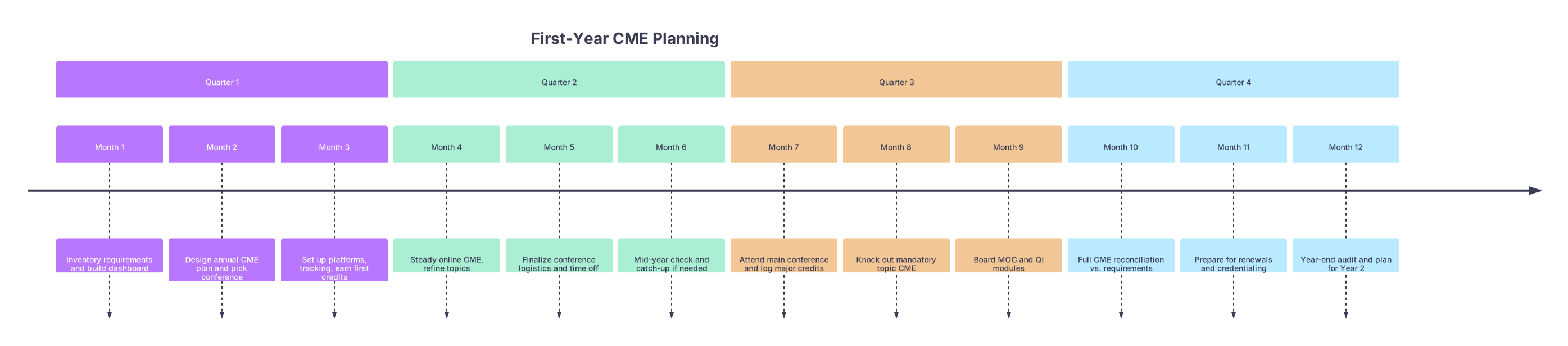
| Period | Event |
|---|---|
| Quarter 1 - Month 1 | Inventory requirements and build dashboard |
| Quarter 1 - Month 2 | Design annual CME plan and pick conference |
| Quarter 1 - Month 3 | Set up platforms, tracking, earn first credits |
| Quarter 2 - Month 4 | Steady online CME, refine topics |
| Quarter 2 - Month 5 | Finalize conference logistics and time off |
| Quarter 2 - Month 6 | Mid-year check and catch-up if needed |
| Quarter 3 - Month 7 | Attend main conference and log major credits |
| Quarter 3 - Month 8 | Knock out mandatory topic CME |
| Quarter 3 - Month 9 | Board MOC and QI modules |
| Quarter 4 - Month 10 | Full CME reconciliation vs. requirements |
| Quarter 4 - Month 11 | Prepare for renewals and credentialing |
| Quarter 4 - Month 12 | Year-end audit and plan for Year 2 |
What You Should Do Today
Open a blank note or document titled “CME – Year 1 Dashboard.”
Write five headings: State License, Board, Hospital, DEA/Opioid, Conference. Spend 30 minutes right now filling in every concrete number and deadline you can find. Once that’s done, you’re not guessing anymore—you’re running a plan.