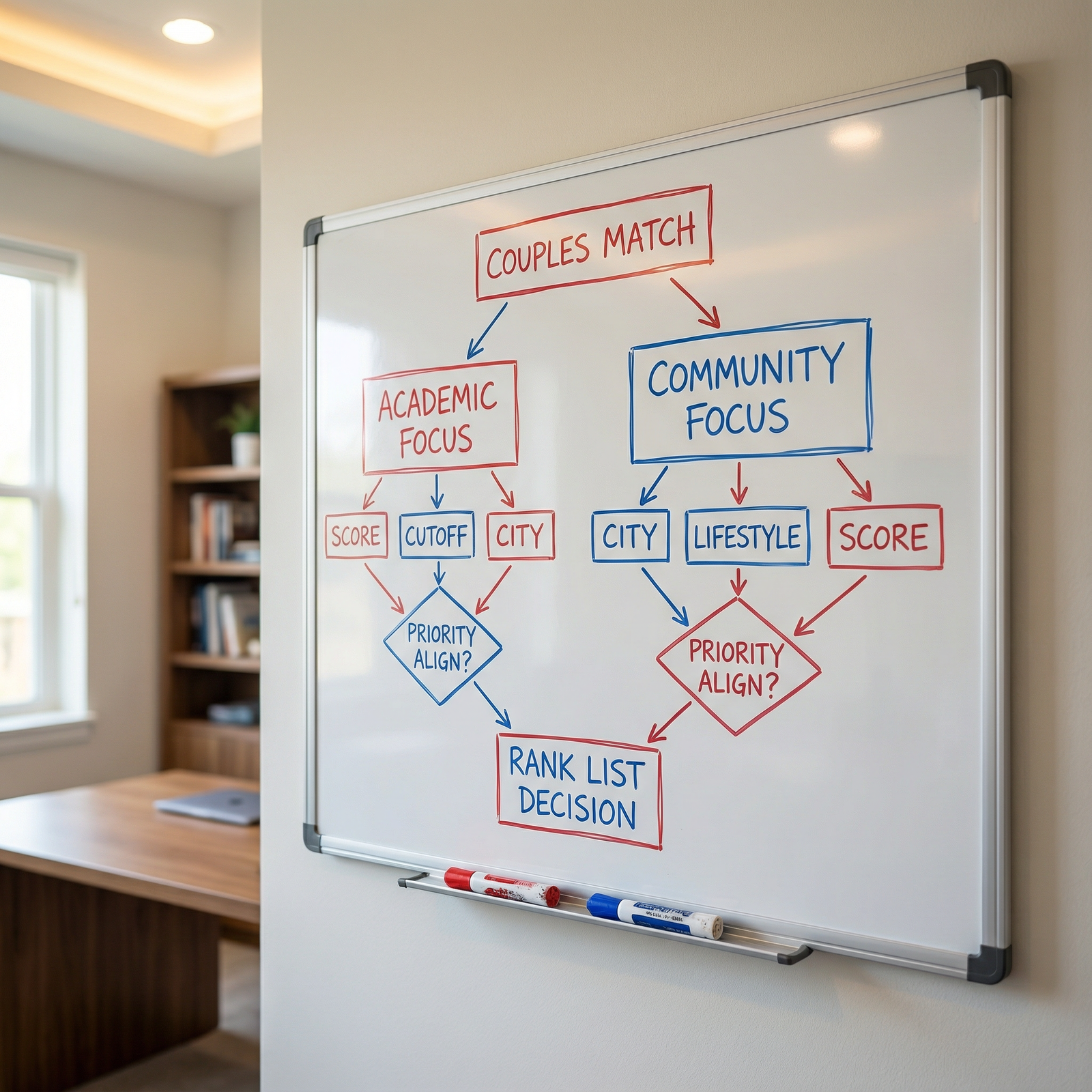
Introduction: Love, Medicine, and the Couples Residency Match
Pursuing medicine is demanding under any circumstance—long hours, high stakes, and constant evaluation. When both partners in a relationship are on this path, the complexity multiplies. The residency matching process doesn’t just determine where you train; it shapes where you live, which communities you join, and how you will build your lives together.
For couples, especially those aiming for Couples Residency Matching through the NRMP, the stakes can feel even higher. You’re not only trying to secure strong training positions—you’re also trying to stay together geographically and protect the relationship that has likely carried you through medical school.
This guide breaks down the Couples Match step-by-step, with practical strategies, realistic expectations, and specific examples. It focuses on:
- How the Couples Match actually works
- How to balance relationship priorities with medical careers
- Effective communication and stress management strategies
- How to build rank lists and backup plans that protect both partners
- What to do when things don’t go exactly as planned
The goal is to help you navigate Residency Matching as a couple with more confidence, less confusion, and a shared plan you both believe in.
Understanding Couples Match in Residency
What Is the Couples Match?
The NRMP Couples Match allows two applicants to link their rank order lists so that the algorithm attempts to place them in the same program, the same institution, or at least the same geographic area. You do not need to be married, engaged, or even in the same specialty to participate—any two applicants can designate themselves as a couple.
Key points:
- You remain two separate applicants with individual applications, interviews, and evaluations.
- The “couples” part is in how your rank lists are paired and processed.
- The algorithm tries to maximize both partners’ preferences simultaneously.
This can be a powerful tool for maintaining your relationship while still pursuing strong training opportunities—if you use it thoughtfully.
How the Couples Match Process Works
The process has the same broad steps as the traditional match but with an added layer of coordination:
Application Submission (ERAS)
- Each partner submits ERAS separately with their own personal statement, letters, and program list.
- You do not “apply as a couple” in ERAS. The couples designation happens later, in NRMP.
Registration with NRMP and Pairing as a Couple
- Both partners register with NRMP for the Main Residency Match.
- In NRMP, you actively choose to participate as a couple and link accounts using the system’s pairing function.
- This must be done before the NRMP deadline; otherwise, your lists will not be treated as a couples residency match.
Ranking Preferences as a Pair
- Instead of each partner submitting a solo list, you create a joint list of pairs of programs (e.g., Partner A: Internal Medicine Program X + Partner B: Pediatrics Program Y in the same city).
- Each line on your rank list is a combination: (Program for Partner 1, Program for Partner 2).
- You can also rank “Program + No Match” pairs if one partner is willing to go unmatched to keep the other at a top-choice program (rare and risky, but an option in specific scenarios).
Match Algorithm
- The NRMP algorithm attempts to match you to the highest-ranked pair of programs that both partners can obtain simultaneously.
- If one of you cannot match to the program in that pair, the algorithm moves to the next pair on your list.
Understanding this structure is crucial. Many couples underestimate how much time it takes to build a thoughtful, comprehensive list of pairs.
Why Communication Is Non-Negotiable
Couples Residency Matching adds another dimension to an already stressful process. Your best tool is proactive, honest, and ongoing communication.
Critical conversations to have early and often:
- Specialty priorities: How much flexibility does each partner have in specialty choice (e.g., IM vs. FM vs. combined programs)?
- Geographic constraints: Are there must-have cities (family support, visas, children, health considerations)?
- Program competitiveness: Are there significant differences in competitiveness between your specialties or applications?
- Deal-breakers: Are there locations, work cultures, or living situations either partner absolutely cannot accept?
Couples who navigate Residency Matching well almost always describe extensive, sometimes uncomfortable conversations about goals, fears, and trade-offs—long before rank lists are due.
Strategic Planning for a Successful Couples Residency Match
Start Early: Planning in M3 and Early M4
You cannot “wing” the Couples Match. Begin discussions and planning by the end of third year or very early in fourth year.
Key early steps:
Clarify each partner’s specialty interests
- Create a realistic range: “ideal,” “acceptable,” and “backup” specialties if flexibility exists.
- Discuss whether either partner might consider prelim or transitional years as part of a longer-term couples strategy.
Assess competitiveness honestly
- Compare step/board scores, clerkship grades, research, and institutional reputation.
- Seek advisor input separately and together to understand how competitive your specialties and target programs are.
Agree on priorities before visiting programs
- Decide what matters most: proximity, program quality, cost of living, family, visas, fellowship potential, etc.
- Write these down as a shared document. Revisiting it later helps avoid decision fatigue and conflict.
Researching Residency Programs Together
Doing your homework together is one of the most powerful ways to reduce anxiety and conflict.
Focus on Location and Geography
For couples, location often matters as much as program prestige:
- Target clusters instead of single institutions
- Example: When considering Boston, don’t just think of one hospital—look at all realistic IM, FM, EM, or pediatrics programs in that metro area for each partner.
- Transportation and commute realities
- A “same city” match may still mean 45–60 minutes apart. Discuss whether that’s acceptable.
- Cost of living and financial stress
- High-rent cities can strain both your mental health and relationship—especially with resident salaries and debt repayment.
Evaluate Program Culture and Support
Not every program is equally familiar or friendly to couples:
Look for:
- Evidence of wellness initiatives and reasonable duty-hour enforcement
- Flexible scheduling accommodations for family needs (children, partners’ schedules)
- Current or former resident couples you can talk to informally
Questions to ask current residents:
- “Are there any resident couples here? How has the program supported them?”
- “How responsive is leadership to major life changes—marriage, illness, pregnancy?”
- “Is there flexibility with vacation alignment for couples or co-residents?”
Use Data and Tools
- NRMP data reports, FREIDA, and specialty-specific resources help evaluate:
- Program size (more positions = more flexibility for couples)
- Historical fill rates and competitiveness
- Presence of multiple programs within the same institution or city
This research helps you create realistic “tiers” of programs that can accommodate both partners, which simplifies later ranking decisions.

Networking, Advocacy, and Building a Strong Application Strategy
Leverage Mentors Who Understand Couples Match
Not all advisors fully grasp the logistics and emotional stakes of the Couples Match. Intentionally seek:
- Faculty or program directors who’ve mentored couples before
- Residents who successfully navigated Couples Residency Matching
- Deans or student affairs professionals with specific experience in this area
Ask mentors directly:
- “Given our specialties and scores, what geographic strategy would you recommend as a couple?”
- “Are there programs in [City/Region] historically friendly to couples?”
- “Would you be comfortable reaching out to colleagues at X or Y program to advocate for us as a couple?”
Use Social Media, Forums, and Alumni Networks Wisely
Professional platforms can expand your information and support:
- Twitter / X, specialty Slack groups, and alumni networks:
- Look for threads or groups on residency matching, couples match, and relationship support.
- Reddit (e.g., r/medicalschool, r/Residency):
- Good for hearing diverse experiences—just filter advice critically.
- School alumni:
- Alumni who matched as couples can share program-specific and city-specific insights you won’t find publicly.
Be professional online—programs increasingly see your digital footprint as part of your broader professional persona.
Crafting Your Application Narrative as a Couple
You do not need to center your relationship in every application component, but you can:
- Align your geographic preferences in your personal statements where appropriate.
- Mention your partner and Couples Residency Matching briefly in:
- ERAS geographic preferences section
- Supplemental application (where available)
- Late-cycle emails to programs (politely noting you are a couple, especially if both have applied or interviewed).
Avoid making your relationship the primary justification for your specialty choice, but it is appropriate to acknowledge that training location impacts your shared life.
Building and Finalizing Couples Rank Lists
Creating a joint Rank Order List is where your planning, research, and communication all converge. This is usually the most time-consuming and emotionally demanding part of the process.
How Couples Rank Lists Actually Work
Instead of each partner ranking programs independently, you create a list of pairs:
- Each entry is: (Partner A’s Program, Partner B’s Program)
- Example entries:
- (A: Medicine at University X, B: Pediatrics at University X)
- (A: Medicine at University X, B: Pediatrics at Community Hospital Y in same city)
- (A: Medicine at University Z, B: No Match) — only if you intentionally choose that risk
You can rank multiple combinations in the same city:
- (A: IM at Academic Hospital 1, B: Peds at Academic Hospital 1)
- (A: IM at Academic Hospital 1, B: Peds at Community Hospital 2)
- (A: IM at Community Hospital 3, B: Peds at Academic Hospital 1)
This allows geographic flexibility while still trying to maximize training quality for both.
Practical Steps to Construct Your List
Tier programs for each partner independently
- Tier 1: Dream programs (high quality and good location)
- Tier 2: Solid options
- Tier 3: Acceptable / safety programs
Identify overlap regions
- Where do both partners have at least one Tier 1 or 2 program?
- Where does one have Tier 1 and the other Tier 2–3 but still acceptable?
Create a shared spreadsheet
- Columns for: City/Region, Program A, Program B, Program Quality Tier, Geographic Tier, notes on culture and support.
- Color-code combinations by how desirable they are to each partner.
Rank combinations in tiers, not individual programs
- Top of the list: Pairs where both partners are truly happy.
- Middle: Pairs where one partner is slightly compromising, but still content.
- Lower: Pairs where there are real sacrifices, but still better than being apart or unmatched.
Balancing Individual Ambitions with Relationship Goals
You will likely face trade-offs such as:
- A top-10 academic program for one partner vs. a strong but less prestigious program that allows you to live in the same city
- Slightly less competitive city where both can match at solid programs vs. a big-name city where only one partner’s odds are strong
Important conversations:
- “Would we rather both be at very good programs in the same city or one person be at a dream program and the other more distant?”
- “If one of us is particularly competitive, does that person accept more compromise now, with the understanding that fellowship may offer more choice later?”
Taking a long-term view helps: residency is 3–7 years; your medical careers and relationship are decades long.
The Role of Compromise and Flexibility
Compromise does not mean one partner silently sacrifices everything. Healthy compromise in Residency Matching looks like:
Both partners agreeing on shared principles:
- “We will not rank any pair where one partner is miserable.”
- “We will prioritize being together in the same city above prestige differences.”
- “We are willing to sacrifice city preferences for program quality, but only if both training environments are supportive.”
Revisiting assumptions as interviews and information evolve:
- A “dream” program may feel less appealing after an interview.
- A smaller program may reveal outstanding mentorship or couples-friendly policies.
Flexibility reduces regret and keeps you aligned as circumstances change.
Common Challenges in Couples Residents Matching and How to Manage Them
Emotional Stress, Conflict, and Decision Fatigue
The mix of high stakes, uncertainty, and relationship interdependence can trigger conflict—even in strong relationships.
Actionable stress management strategies:
- Schedule non-match time
- Have evenings or weekends where residency talk is off-limits.
- Use structured decision-making
- Instead of arguing, list pros/cons, assign values, and work through decisions systematically.
- Normalize anxiety
- Acknowledge that fear and doubt are expected during this process—not signs that something is “wrong” with your relationship.
If conflict escalates, consider:
- Brief couples counseling (often accessible via student health or employee assistance programs)
- Peer support from other couples going through the process
Balancing Medical Careers with Personal Life
Residency Matching is just the beginning of managing dual medical careers.
During and after match:
- Set protected time together, even if brief—shared meals, short walks, or one weekly “no medicine” activity.
- Discuss division of labor at home: chores, finances, meals. Deciding this ahead of time reduces resentment.
- If you have or plan to have children, talk early about schedules, backup childcare, and support systems.
Healthy relationship habits established now will serve you throughout residency and beyond.
Post-Match Outcomes: When Things Don’t Go as Planned
Despite careful strategy, not every couple lands their ideal outcome:
Both matched, but not in top-choice city/programs
- Allow time to grieve what you hoped for.
- Then, get curious about the strengths of where you landed—many residents end up loving “backup” programs.
Matched in the same city but different institutions
- Strategize commute, shared car use, and call schedules.
- Ask programs about aligning vacations or days off when possible.
One partner doesn’t match (or SOAPs into a distant position)
- This is one of the hardest scenarios. Your response plan might include:
- Reapplying next cycle with strengthened application (research year, prelim year, etc.)
- Considering whether the unmatched partner can seek opportunities near the other’s program next year.
- Honest discussions about long-distance for a finite period while preserving the relationship.
- This is one of the hardest scenarios. Your response plan might include:
In any scenario, open communication and mutual support are crucial. Your relationship doesn’t fail because the match outcome is imperfect; it’s how you respond together that matters.

Frequently Asked Questions (FAQ) About Couples Residency Match
1. Can we participate in Couples Match if we are in completely different specialties?
Yes. Couples Residency Matching is designed to accommodate any two applicants, regardless of specialty. You might be applying to Internal Medicine and Pediatrics, EM and OB/GYN, or even something like Anesthesiology and Psychiatry.
The key is understanding:
- Some cities or institutions are richer in certain specialties than others.
- You may need to be more flexible with geography or program type to create enough viable pairings on your rank list.
- Certain specialty combinations (e.g., two extremely competitive fields) require especially careful planning and broader geographic spread.
2. Does Couples Match increase or decrease our chances of matching?
It depends on how you use it.
Advantages:
- The algorithm tries to honor your joint preferences, helping you stay together or at least in the same region.
- It can make your geographic planning more intentional and reduce the risk of being placed on opposite coasts.
Potential disadvantages:
- If your rank list is too short or too restrictive, you could reduce your chances of matching as a pair.
- Couples sometimes under-apply geographically because they prioritize a limited set of cities.
In general, couples who create long, realistic rank lists with multiple geographic options do well. Those who are overly narrow are at greater risk.
3. Are certain programs more accommodating to couples than others?
Yes, some programs:
- Have more positions per year, making it easier to accommodate linked applicants.
- Are part of large health systems with multiple specialties under one umbrella.
- Have a culture that is explicitly supportive of resident wellness, families, and couples.
To identify these:
- Ask current residents and alumni if there are known “couples-friendly” programs.
- Look for programs that already have resident couples and ask about their experiences.
- Pay attention on interview day: Do faculty acknowledge and respect your Couples Residency Match situation?
4. Should we tell programs that we are couples matching?
In most cases, yes, but be strategic and professional:
- It is appropriate to mention you are participating in Couples Match:
- In brief email updates after interviews (especially when both partners applied or interviewed at the same institution/region).
- During interviews if asked about geographic preferences or partner considerations.
Emphasize that:
- You are both committed to high-quality training and contributing to the program.
- Your goal is to find a setting where you can both thrive professionally while maintaining relationship stability.
Programs generally appreciate transparency and often try, within reason, to support couples.
5. What can we do to manage stress and protect our relationship during the match process?
Stress management and relationship protection are central to surviving the Couples Residency Match:
Create structure:
- Weekly “match planning” meetings with a clear agenda.
- Designated “no match talk” times or days.
Support each other’s individual identities:
- Celebrate your partner’s achievements and milestones, not just joint goals.
- Encourage independent hobbies and friendships to prevent everything from revolving around the match.
Use your support systems:
- Friends, family, mentors, mental health professionals, and peer groups.
- You don’t have to carry the emotional load alone.
Remember that the match is a finite process. How you communicate and cope together during this time can strengthen your foundation for residency and beyond.
By combining clear communication, thoughtful program research, strategic ranking, and deliberate stress management, couples can navigate the Residency Matching process in a way that honors both their medical careers and their relationship. Love and medicine can absolutely coexist—when you plan together, advocate for each other, and approach Couples Residency Matching as a shared, long-term journey rather than a single high-stakes event.