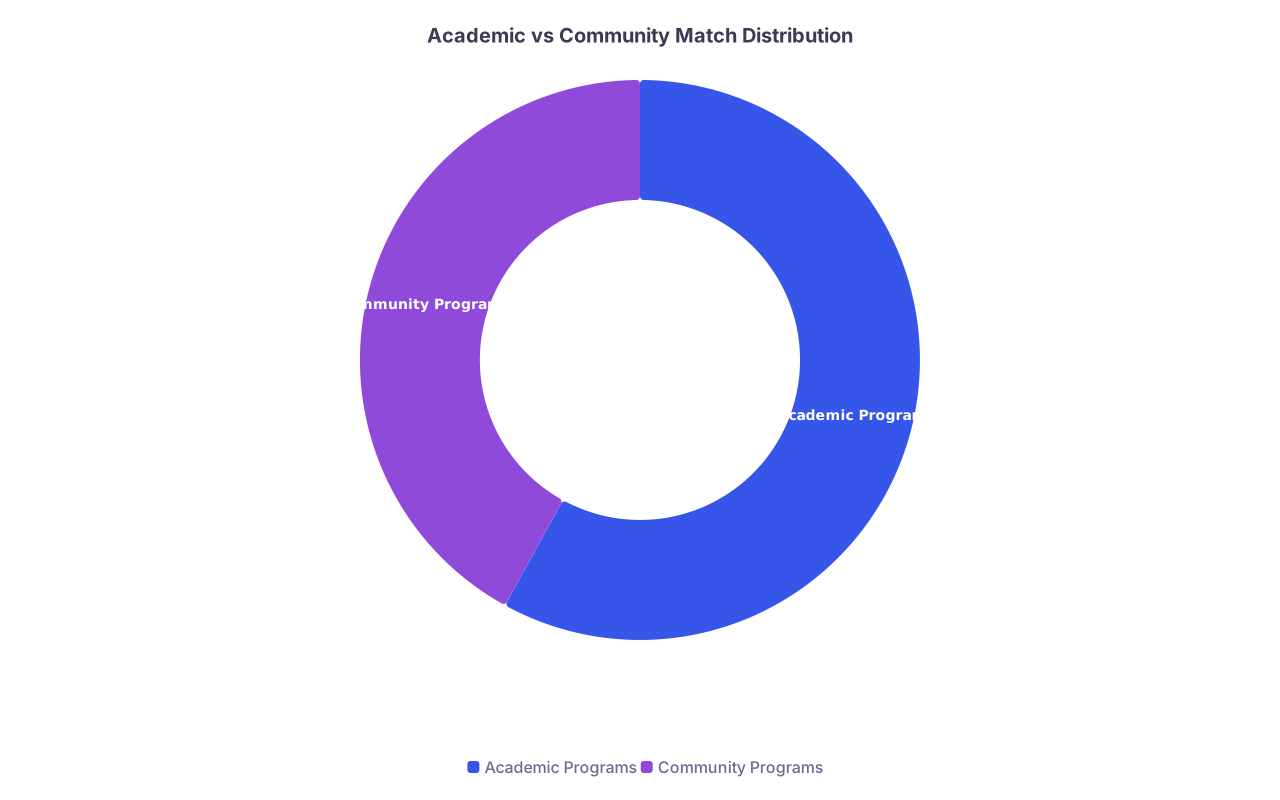
| Category | Value |
|---|---|
| Academic Programs | 58 |
| Community Programs | 42 |
The mythology around “academic vs community programs” is lazy. The data show very different CV patterns for applicants who match into each, and pretending they are interchangeable is how people end up with mismatched rank lists and wasted effort.
You are not building “a strong CV.” You are optimizing for a specific ecosystem. Academic. Community. Or a hybrid in between. The match data, NRMP surveys, and program director reports all point the same way: different program types reward different signals.
Let’s walk through those signals like an analyst, not a cheerleader.
1. What the data say about academic vs community trajectories
Strip away the branding and websites. Program behavior shows you what they value.
Across NRMP “Charting Outcomes in the Match” (most recent cycles, aggregated trends) and Program Director (PD) surveys, three patterns repeat:
Academic programs:
- Higher Step 2 CK score medians.
- More applicants with ≥1 publication, abstract, or presentation.
- Greater weight on research and academic productivity.
- More residents expressing interest in fellowship or academic careers.
Community programs:
- Slightly lower but still very selective score medians.
- More weight on clinical performance, letters, and “fit.”
- Less emphasis on formal research outputs; more tolerance for minimal scholarly output.
- Higher proportion of residents going straight into practice.
Hybrid academic–community programs:
- Sit in the middle; often community-based with a university affiliation.
- Value both clinical throughput and some academic signal (even if modest).
That is not “better vs worse.” It is different optimization.
If you want to improve your CV, the first serious question is: improve it for which environment?
2. Core CV signals: how they diverge by program type
Let me quantify the big five CV domains where academic vs community patterns meaningfully diverge:
- Standardized test performance (Step 2 CK and shelf exams)
- Research output
- Letters of recommendation / writer type
- Clinical experiences and rotations
- Leadership, teaching, and service
We will anchor this to typical internal medicine and general surgery trends, because those are well reported and representative.
| Dimension | Academic Match Trend | Community Match Trend |
|---|---|---|
| Step 2 CK score | Often ≥ 5–10 pts above national mean | Around national mean, some lower accepted |
| Publications/Abstracts | Commonly ≥ 1–3 items | Frequently 0–1, often local projects |
| Home/Away Rotations | Home + 1–2 away rotations at academic centers | More weight on strong home / local rotations |
| Letter Writers | Department chairs, division chiefs, PIs | Core clinicians known for teaching |
| Leadership/Service | Often tied to research or academic roles | Often tied to patient care and community work |
These are not strict cutoffs; they are distributions. Think probabilities, not absolutes.
3. Step scores and exams: how much they really matter
Community programs do not “ignore scores.” That is fantasy. They simply operate with a slightly different threshold and tradeoff curve.
Look at Step 2 CK patterns:
- Across competitive academic IM or surgery programs:
- Median Step 2 CK often lands around 245–255, with interquartile ranges maybe 240–260+.
- Across typical community IM or surgery programs:
- Median Step 2 CK often in the 235–245 band, with broader tails.
The PD surveys are brutally consistent:
- Over 80% of PDs rate Step 2 CK as “very important” or “critical” for interview offers.
- Academic PDs are more likely to report using explicit score cutoffs above national mean.
So how does this show up on CVs?
For academic-leaning applicants who matched:
- Step 2 CK:
- Often 245+ for competitive specialties/programs.
- Fewer red flags on shelves or repeats.
- For community-leaning matches:
- 230–245 is common.
- Slightly more exam hiccups tolerated if offset by strong clinical evals and letters.
If you are aiming academic and your Step 2 CK is < 235, the data say you are now swimming upstream. Not impossible. But you must overperform in other academic signals (research, institutional letters) to compensate.
If you are aiming community and sitting at 225–235:
- Improving your CV means:
- Crushing your clinical rotations.
- Securing strong, concrete letters.
- Showing reliability and work ethic in your experiences.
Do not waste a year chasing a single extra publication if your core issue is mediocre clerkship feedback.
4. Research: the single largest differentiator
Now to the major fork: research productivity. This is where academic vs community CVs truly separate.
Look at NRMP Charting Outcomes and PD surveys:
For academic IM or surgery programs:
- The majority of matched residents have:
- At least 1 publication, abstract, or poster.
- Often more, especially at top 20–30 institutions.
- Program directors routinely place research output in their top 5 selection criteria.
- The majority of matched residents have:
For community programs:
- A large fraction of matched residents:
- Have 0 publications.
- List 1–2 “scholarly projects” at most: QI, morbidity and mortality reviews, case reports that never got published.
- PDs tend to rank research much lower, sometimes not even in the top 10.
- A large fraction of matched residents:
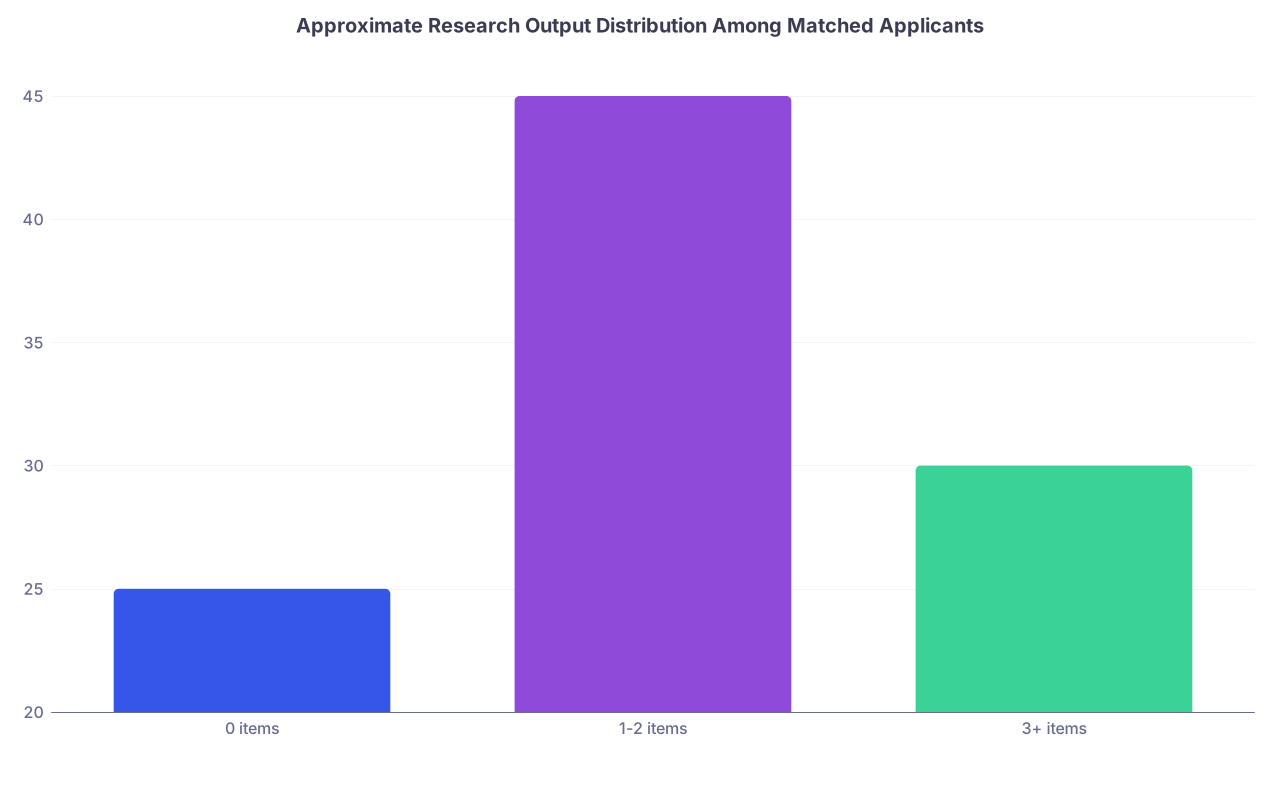
To visualize this:
| Category | Value |
|---|---|
| 0 items | 25 |
| 1-2 items | 45 |
| 3+ items | 30 |
Now split that mentally:
- Academic matches are heavily weighted toward the 1–2 and 3+ categories.
- Community matches are more evenly distributed, with a meaningful chunk at 0.
So how should you react?
If your target is an academic program:
Countable outputs matter more than vague “interest in research.”
- Abstracts presented at a regional or national meeting.
- PubMed-indexed publications (yes, case reports count).
- Posters at major specialty conferences.
Typical successful academic-bound CV patterns I see:
- 1–3 posters/abstracts + 0–1 publication for solid mid-tier academic programs.
- 3–10+ total items (mix of posters, papers, presentations) for top-tier.
Time investment:
- Students who match into strong academic programs often start research in:
- Late MS1 / early MS2 for U.S. schools.
- During preclinical years or even gap years for IMGs.
- A dedicated research year correlates strongly with matching into academic-heavy institutions, especially in competitive specialties.
- Students who match into strong academic programs often start research in:
If your target is mostly community:
- One or two modest academic signals are usually enough:
- A single case report.
- Participation in a QI project with a poster at hospital research day.
- Involvement in a registry or chart review.
For you, time is better allocated to:
- Extra sub-internships.
- Stronger clinical letters.
- More direct patient care work / scribe / MA experience.
Pursuing a full research year when you have little genuine interest in academics and mainly want community practice is an inefficient trade unless you have major Step issues and need a story of “rehabilitation + productivity.”
5. Letters of recommendation: who writes them and what they say
Same category, very different texture.
Academic program–matched CVs often show:
- Letter writers:
- Department chairs.
- Division chiefs.
- NIH-funded PIs.
- Program directors from academic institutions.
- Content pattern:
- Explicit comments about:
- Research potential.
- Presentation skills.
- Fit for an “academic career.”
- Direct comparisons: “top 5% of students I have worked with in the last decade.”
- Explicit comments about:
Community program–matched CVs lean differently:
- Letter writers:
- Core teaching attendings on busy clinical services.
- Community-based physicians who are known to the PDs.
- Content pattern:
- Heavy emphasis on:
- Work ethic.
- Reliability.
- Team behavior.
- Clinical judgment and patient rapport.
- Phrases like “would happily have them as a partner in my practice.”
- Heavy emphasis on:
From your standpoint: improving your CV means aligning your letter strategy.
If you want academic:
- Prioritize:
- 1–2 letters from academic faculty with titles that signal clout.
- At least one letter that specifically references your research involvement.
- Practical move:
- When you join a project, aim to present the work or write a section. That gives your PI tangible material for the letter.
If you want community:
- Prioritize:
- Letters from clinicians who saw you manage large clinical loads.
- People who can truthfully say, “I asked them to stay late, and they did, without complaining.”
- Optimize:
- Rotate at the exact institutions and services where you plan to apply.
- Get at least one letter from a site culturally similar to your target programs.
6. Rotations and clinical experience: how programs interpret your CV
Rotations tell programs where you have actually functioned, not just what you aspire to.
Patterns I see repeatedly:
Academic matches:
- Often have:
- Strong home institutional reputation or clear affiliation with a major university hospital.
- 1–2 away rotations at high-volume academic centers.
- CV shows:
- Sub-internships in high-intensity services (ICU, surgical subspecialties, academic inpatient wards).
- Honors on many core clerkships.
Community matches:
- Often have:
- Substantial time in community hospitals and smaller systems.
- Electives geared toward bread-and-butter clinical care and outpatient continuity.
- CV shows:
- Continuity clinic experiences.
- Longitudinal patient relationships.
- Sometimes work experience as a scribe, MA, EMT, or nurse.
If you want to improve your CV for academic programs:
- Prioritize:
- At least one away elective at a target academic program or its peer.
- Rotations in services that align with research-heavy fields (oncology, cardiology, transplant, critical care).
- On your CV, emphasize:
- Honors/High Pass on academic sub-Is.
- Any teaching roles during those rotations (student leader, case presenter).
If your focus is community:
- Prioritize:
- Sub-Is at strong community hospitals, preferably ones with residencies.
- Rotations where you can demonstrate efficiency and patient ownership.
- On your CV, highlight:
- Continuity clinics, free clinics, rural rotations.
- Quantifiable patient care responsibilities (number of patients per day, call responsibilities).
7. Leadership, teaching, and service: academic vs community flavor
Leadership is not monolithic; the context matters.
For academic-focused CVs:
- Patterns include:
- Teaching assistant roles for preclinical or clerkship courses.
- Leadership in specialty interest groups that run research symposia or journal clubs.
- Involvement in national organizations (e.g., ACP, ACS, subspecialty societies) with conferences or committees.
Programs read those as:
- Evidence you will:
- Teach residents and students.
- Present at conferences.
- Possibly pursue an academic position.
For community-focused CVs:
- Patterns include:
- Leadership in student-run clinics.
- Volunteer work in local health fairs, free clinics, rural outreach.
- Organizing community education sessions or screening days.
Programs read those as:
- Evidence you will:
- Fit patient populations they serve.
- Stay connected to local community needs.
- Be comfortable with primary care or generalist practice.
If your CV is thin here, improving it does not require reinvention:
Academic path:
- Volunteer to lead a short board-review session for juniors.
- Start or revive a small journal club under a faculty mentor.
- Take a tangible role in a research group (coordinating meetings, abstract submission).
Community path:
- Commit to one longitudinal service project (6–12 months), not five random one-offs.
- Aim for a measurable outcome: number of patients screened, vaccinations provided, etc.
- Put these metrics on your CV. Numbers carry more weight than vague “participation.”
8. A simple, data-driven CV strategy based on your target
Let me strip this into a decision flow, because too many people blindly “academic-wash” their CVs when their scores, interests, and geography scream community.

| Step | Description |
|---|---|
| Step 1 | Identify Target Programs |
| Step 2 | Prioritize Research and Academic Letters |
| Step 3 | Prioritize Clinical Rotations and Work Ethic Letters |
| Step 4 | Push for 2-4 Outputs and Academic SubIs |
| Step 5 | Strengthen Research Plus Clinical Honors |
| Step 6 | Maximize SubIs at Similar Programs |
| Step 7 | Consider Extra Year or Broader Specialty Choices |
| Step 8 | Majority Academic or Community |
| Step 9 | Step 2 CK >= 240? |
| Step 10 | Step 2 CK >= 225? |
Operationalizing this:
If your rank list is >60% academic programs:
- Minimum targets:
- Step 2 CK: push for ≥235–240 if still pending.
- Research: ≥2 countable scholarly outputs.
- Letters: at least one from a research mentor or academic leader.
- Rotations: one away elective at an academic program in your top 30.
- Minimum targets:
If your rank list is >60% community programs:
- Minimum targets:
- Step 2 CK: secure ≥225–230 if still pending; avoid fails/red flags.
- Research: 0–1 light projects are fine; not your main investment.
- Letters: 2–3 from clinicians who supervised you directly; clinical heavy.
- Rotations: sub-Is at community or hybrid programs that resemble your targets.
- Minimum targets:
For many people, the actual answer is a mixed strategy. You can carry:
- A baseline academic signal (one project, one academic letter)
- Strong community signal (multiple sub-Is, heavy clinical responsibilities)
That plays well for the hybrid or mid-tier academic–community programs most applicants end up at.
9. Quantifying your current CV vs your target
To make this less abstract, score yourself across a few core dimensions on a simple 0–2 scale, then compare to the typical academic vs community pattern.
| Domain | 0 points | 1 point | 2 points |
|---|---|---|---|
| Step 2 CK | < 225 or fail | 225–239 | ≥ 240 |
| Research Outputs | 0 | 1–2 posters/abstracts/case reports | ≥ 3 items or ≥1 peer-reviewed paper |
| Academic Rotations | None | One core rotation at academic site | Home + away at major academic center |
| Clinical Sub-Is | 0 | 1 Sub-I | ≥ 2 Sub-Is with strong eval language |
| Letters (Academic) | None from academic leaders | 1 moderate academic letter | ≥ 1 strong letter from recognized leader |
| Community Exposure | Minimal, short experiences | Some clinic/volunteer work | Longitudinal community/patient work |
Now approximate targets:
- Typical academic-leaning matched CV:
- 7–10 total points with at least 4 points across Step 2 + Research + Academic Rotations.
- Typical community-leaning matched CV:
- 5–8 total points with at least 3 points across Step 2 + Clinical Sub-Is + Community Exposure.
If you are 3–4 points below the pattern that matches your goal, you do not need a pep talk; you need a specific plan for which dimensions to raise and how, in the time you have left.
10. Key takeaways: improve the right CV, not a generic one
Compressing this down to the essentials:
Academic and community programs select for different CV patterns. Academic centers overweight research and academic letters; community programs overweight clinical performance, reliability, and community exposure.
To “improve your CV,” start by defining your target mix of academic vs community programs, then align your next moves: research and academic rotations for the former, clinical sub-Is and strong clinician letters for the latter.
Use numbers to guide decisions. Step 2 CK bands, countable scholarly products, number and type of sub-Is, and the profile of your letter writers all give you a measurable gap between your current CV and the profile that actually matches where you want to train.