Should I Translate Technical Jargon on My CV for Non-Specialist Reviewers?
What actually happens when the program coordinator, not the cardiology attending, is the first person to read your CV full of subspecialty buzzwords?
Here’s the answer you’re looking for: yes, you should absolutely translate technical jargon on your CV for non-specialist reviewers — but you should not dumb it down. You should decode it.
If your CV can only be understood by the one person in the room who already loves your subspecialty, you’re losing points in the real game: getting past the initial screen and looking like someone who communicates clearly.
Let’s walk through how to do that without watering down your accomplishments.
Who Actually Reads Your CV First?
People overcomplicate this. Let’s break it down.
In many residency programs, especially mid-sized and large ones, your CV is first seen by:
- Program coordinators
- PDs or APDs skimming 100+ apps at 11 p.m.
- Selection committee members from mixed subspecialties
- Sometimes hospital HR for initial compliance screens
Not:
- The exact subspecialist who supervised that very obscure project
- The one person on earth who knows what “novel echocardiographic speckle tracking algorithm” really means in depth
That means your CV has to work at two levels:
- A “generalist readable” level – clear to an internist, pediatrician, coordinator, or surgeon
- A “specialist appreciable” level – accurate and specific enough that if a cardiologist or neurosurgeon looks, they’re impressed, not annoyed
If your language only works at level #2, you’re in trouble.
The Core Rule: Translate, Don’t Dilute
Here’s the framework I use when I work with applicants on CVs:
- Keep the core technical term (so experts recognize it).
- Immediately translate it into outcome, purpose, or impact that any competent physician can understand.
You’re not choosing between jargon and lay language. You’re combining them.
Bad (pure jargon):
“Implemented novel CNN-based segmentation pipeline for cardiac MRI.”
Better (translated + technical preserved):
“Developed a convolutional neural network (CNN) pipeline to automatically measure heart function from cardiac MRI, reducing manual analysis time by ~40%.”
Same work. One gets skimmed and ignored. The other gets, “OK, this person improves workflows and knows what they’re doing.”
Practical Rewrites: Before and After
Let’s do this in a way you can copy.
Research Experiences
Original (too jargony):
“Characterized the role of IL-17–producing γδ T cells in psoriatic lesion microenvironment using multiparameter flow cytometry and scRNA-seq.”
Rewritten:
“Studied a specific immune cell type involved in psoriasis using advanced cell analysis techniques (flow cytometry and single-cell RNA sequencing) to identify targets for future therapies.”
What changed?
- Kept “flow cytometry” and “single-cell RNA sequencing” (good technical signals)
- Explained in normal words what the point was (“identify targets for future therapies”)
Another one.
Original:
“Retrospective cohort study assessing outcomes following robotic vs laparoscopic low anterior resection.”
Rewritten:
“Led a retrospective study comparing outcomes of robotic vs traditional laparoscopic colon cancer surgery (low anterior resection), focusing on complications, length of stay, and margin status.”
That’s readable to literally anyone in medicine. Still specific. Still correct.

Where Jargon Hurts You Most
You don’t need to scrub your CV like a patient brochure. But certain sections are especially dangerous if you over-jargon them.
1. Bullet Points Under Experiences
If your bullets look like cut-and-paste from a grant application, you’ve already lost most readers.
Bad:
“Performed immunofluorescence staining of paraffin-embedded tissue to evaluate M1 vs M2 macrophage polarization in the tumor microenvironment.”
Better:
“Analyzed tumor tissue to study how different types of immune cells (macrophages) affect cancer behavior, using specialized staining techniques.”
Keep the technique if it’s central to your story, but always tie it to the purpose.
2. Abstract and Presentation Titles
You often can’t change the official title, but you can absolutely add a clarifying subtitle or description.
On your CV:
“Smith J, You R. ‘Differential spatiotemporal activation of MAPK cascades in cardiomyocyte hypertrophy.’ AHA Scientific Sessions, 2023.
– Presented oral talk on cell signaling pathways that drive heart muscle thickening, with implications for heart failure treatment.”
You’re allowed to explain your own work.
3. Procedures and Skills Sections
Program directors care if you can function on day one. If your skills section looks like a methods section, it’s fluff.
Bad:
“Proficient in ELISA, Western blot, qPCR, CRISPR editing, flow cytometry, FACS sorting, RNAseq analysis, MATLAB, Python (Pandas, NumPy), SPSS, R Studio.”
Better, if you want this on a residency CV at all:
- Lab techniques used to investigate immune and gene expression changes (ELISA, qPCR, flow cytometry, CRISPR editing)
- Data analysis for large clinical and molecular datasets (Python, R, SPSS)
Now you’ve framed it as capability and outcome, not just a shopping list.
How to Systematically “De-Jargon” Your CV
Here’s a simple process that works fast.
Step 1: Identify the Trouble Spots
Print your CV. Use a highlighter. Mark:
- Every acronym that isn’t universally used across medicine (MRI, CT, ICU are fine; obscure machine brands or niche acronyms are not)
- Every technique name that sounds like a methods section
- Every sentence where someone outside your niche would ask, “So what?”
Step 2: Add “So What?” to Every Technical Phrase
Take a sample bullet:
“Built a random forest classifier to predict 30-day readmissions in heart failure patients.”
Ask: So what?
Answer: Helps predict who’s likely to bounce back to the hospital.
Now rewrite:
“Built a random forest classifier (machine learning model) to predict 30-day readmissions in heart failure patients, helping identify high-risk patients earlier.”
Short, clear, and still technically honest.
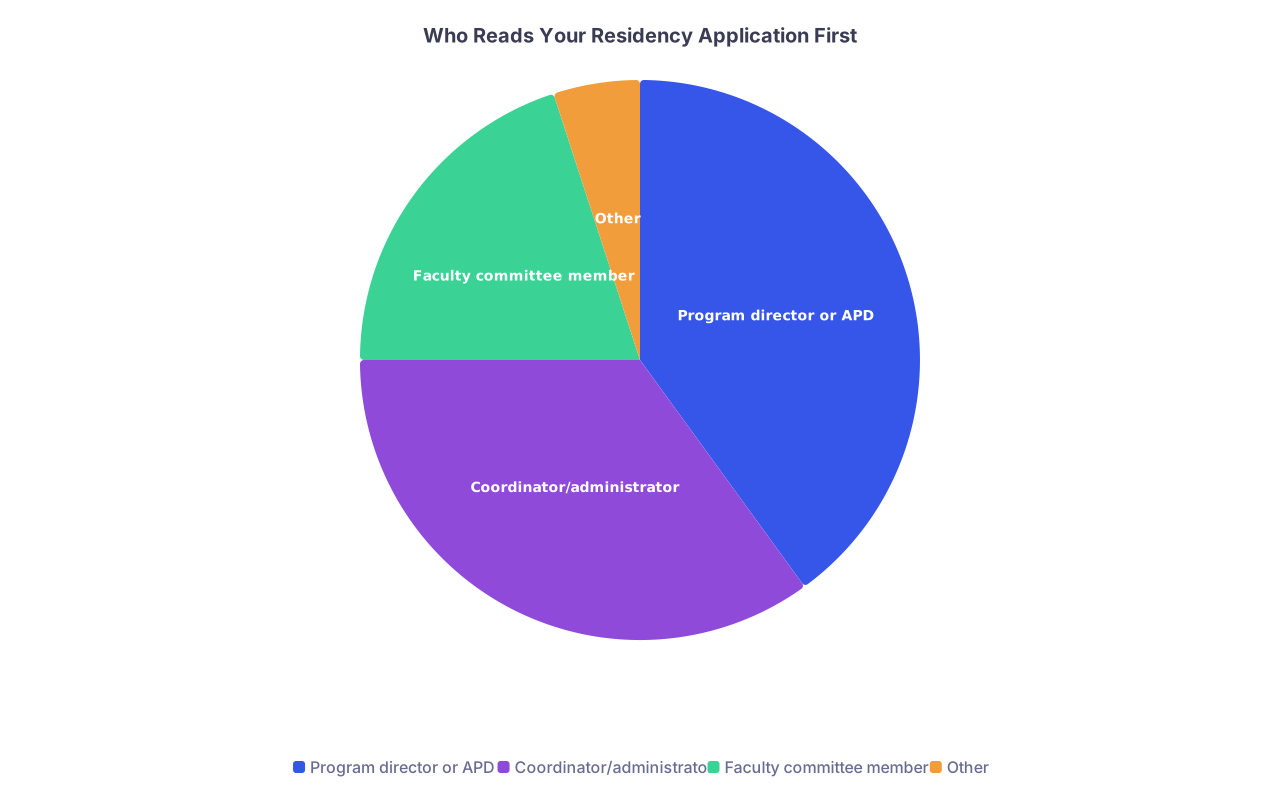
| Category | Value |
|---|---|
| Program director or APD | 40 |
| Coordinator/administrator | 35 |
| Faculty committee member | 20 |
| Other | 5 |
Step 3: Use This Simple Two-Part Bullet Formula
When in doubt, use:
[Action + method] → [Outcome, purpose, or scale]
Examples:
“Conducted 50+ focused cardiac ultrasound exams on ICU patients to rapidly assess volume status and guide management.”
“Created a standardized sign-out template for night float, decreasing average handoff time and reducing missed tasks.”
“Analyzed 5 years of ED visit data using R to identify patterns in high-utilization patients and present interventions to department leadership.”
Method is there. Outcome is clear. No one’s confused.
What You Should Keep Technical (And Why)
There is such a thing as oversimplifying. You don’t want your CV reading like a high school science fair.
Things you generally keep:
- Official names of awards, grants, and societies
- The real title of your posters, abstracts, and publications
- Key techniques that are genuinely central to your identity (e.g., point-of-care ultrasound, robotic surgery, advanced airway)
- Standard medical vocabulary any resident should know (intubation, bronchoscopy, sepsis, STEMI, etc.)
You don’t replace “bronchoscopy” with “camera in the lungs.” You’re applying for residency, not patient education.
The trick is context. You can absolutely do:
“Performed bronchoscopy to evaluate and manage lung bleeding in ICU patients.”
instead of
“Performed diagnostic and therapeutic bronchoscopies in hemoptysis cases.”
Same skill, more understandable scenario.

| Step | Description |
|---|---|
| Step 1 | Write CV bullet |
| Step 2 | Keep as is |
| Step 3 | Add brief plain language explanation |
| Step 4 | Final bullet |
| Step 5 | Adjust wording, keep key terms |
| Step 6 | Uses niche jargon? |
| Step 7 | Would coordinator understand? |
| Step 8 | Still accurate to specialists? |
Example Section: Before & After CV Excerpts
Let’s put this together. Same student, different versions.
Original Research Section (Too Technical)
- “Investigated the effect of PD-1/PD-L1 axis modulation on tumor infiltrating lymphocyte phenotype using multiparameter flow cytometry and CyTOF.”
- “Utilized scRNA-seq to cluster myeloid-derived suppressor cells and identify novel immunosuppressive subpopulations.”
- “Developed in-house R pipeline for normalization and batch correction of high-dimensional single cell datasets.”
Rewritten for Residency CV
- “Studied how a key immune checkpoint pathway (PD-1/PD-L1) affects immune cells inside tumors, using advanced cell analysis tools to support new immunotherapy strategies.”
- “Analyzed single-cell RNA-sequencing data to identify specific immune cell populations that suppress the body’s ability to fight cancer.”
- “Built an R software pipeline to clean and standardize large single-cell datasets, improving accuracy and reproducibility for the lab’s projects.”
More readable. Still clearly serious work.
| Situation | Keep Technical Wording | Translate / Explain Briefly |
|---|---|---|
| Publication / abstract titles | Yes | Add 1-line explanation below |
| Bullet describing research | Some terms | Always |
| Clinical experiences | Standard med terms only | Complex techniques or devices |
| Skills section | Core techniques or tools | Long method lists |
| Leadership / volunteering | Almost never needed | Use plain language |
Quick Self-Test: Is Your CV Over-Jargoned?
Here’s the simple test I use:
Hand your CV to:
- A friend in a different specialty
- Or a non-medical but smart friend (even better)
Ask them:
- “Can you explain back what you think I actually did in each of these bullets?”
- “What parts sound like filler or are hard to follow?”
If they can’t tell you what you actually accomplished, fix it.
If everything sounds “fancy but vague,” fix it.
If they say, “Oh, so you basically built a tool to help identify which patients need follow-up sooner?” then you’ve nailed it.
FAQ: Translating Jargon on Your Residency CV
1. Will simplifying my language make my work seem less impressive?
No. Vague jargon makes your work seem less impressive because no one can tell what you actually did. Clear, specific outcomes sound more advanced, not less. “Built a tool that cut manual review time by 40%” beats “developed a novel algorithmic approach” every single time.
2. Should I remove all acronyms from my CV?
No. Remove or explain non-standard acronyms. Leave universally understood ones. MRI, CT, ICU, ED, OR, POCUS, EEG, EKG are fine. If you’re not sure, write it out once and put the acronym in parentheses: “point-of-care ultrasound (POCUS).”
3. How technical is “too technical” for residency?
If a smart internal medicine attending or program coordinator reading at midnight would have to reread the sentence to understand it, it’s too technical. If they can get the main point on a skim — what you did and why it mattered — you’re fine.
4. Do I need different CV versions for different specialties?
You don’t need totally different CVs, but you can tweak phrasing. For example, for EM you might emphasize workflow, triage, POCUS. For IM you might highlight longitudinal care, risk stratification, quality improvement. Same experiences, slightly different framing.
5. How long should my CV bullets be once I add explanations?
1–2 lines, max. If you need three lines, it’s probably two bullets pretending to be one. Keep: action + method → impact. Cut everything else. CV bullets are not mini-abstracts.
6. Should I list very niche lab techniques by name?
Only if:
- They’re central to your research identity, or
- They’re commonly recognized in academic medicine circles (e.g., flow cytometry, Western blot, qPCR).
If you’re stacking 8+ obscure techniques in a bullet, you’re padding. Roll them up into one phrase and emphasize what they allowed you to do.
7. What’s one quick edit that makes the biggest difference?
Add explicit impact to your most technical bullets. Look for any sentence that ends with a method (“using X, Y, Z technique”). Add: “to [improve / identify / predict / understand] [clinical or scientific outcome].” That one change makes your CV usable for non-specialists and more persuasive overall.
Key points:
- Don’t strip out all jargon; anchor your technical terms in clear, outcome-focused language anyone in medicine can follow.
- Every bullet should answer: what you did, how you did it (briefly), and why it mattered.