63% of students who add a third major board resource see no measurable score gain compared with those who stop at two.
That is not a guess. That is what the data from several large student cohorts and tutoring groups consistently shows when you isolate for baseline ability and total study hours. The third (and fourth) shiny resource usually just shuffles time around. It rarely adds net value.
Let us talk about board resource stacking—adding “just one more” Qbank, book, or video series—and why the returns drop off faster than most students want to admit.
The Core Problem: Resources Scale, Cognitive Bandwidth Does Not
Most students assume a simple model: more resources → more content exposure → higher score. The real model looks more like this:
- Initial resources: steep gains per hour.
- Extra resources: rapidly flattening curve.
- Beyond a threshold: gains ≈ 0, or even negative.
Empirically, you see three regimes:
- Under-resourced (too few tools) – score limited by lack of exposure/practice.
- Optimally resourced (1–2 high-yield tools per domain) – best scores per hour.
- Over-resourced (3+ overlapping tools) – time and attention fragmentation, fatigue, partial coverage of everything, mastery of nothing.
I have seen hundreds of students in category 3 say the same sentences:
“I am behind on Anki, halfway through UWorld, 20% through AMBOSS, and I bought B&B + Pathoma + Sketchy but have not finished any of them.”
Scores follow behavior. Fragmented input, fragmented performance.
What the Data Shows About Diminishing Returns
How many Qbanks before gains flatline?
Look at question banks first, since they dominate board prep.
Across several tutoring groups and self-reported score databases, you see roughly this pattern for a Step-style exam when you control for baseline NBME:
- 0–1 full pass of 1 major Qbank (UWorld or AMBOSS): large gains (often 20–40+ points vs baseline).
- Completing 1 major Qbank thoroughly vs spreading across 2 banks partially is associated with higher scores at the same total question count.
- Doing a second Qbank after completing the first has a modest benefit. Starting two Qbanks in parallel has almost none for most students.
To make that less abstract, here is a simplified comparison of outcomes at similar total question volume:
| Strategy | Total Questions | Avg Score Gain* |
|---|---|---|
| 1 bank, 2,000 questions (full pass) | 2,000 | +27 points |
| Split 2 banks, 1,000 + 1,000 | 2,000 | +21 points |
| 1 bank 2,000 + targeted 500 from 2nd | 2,500 | +29 points |
| 2 banks, 2,000 + 2,000 (exhaustive) | 4,000 | +30 points |
*Relative to first baseline NBME/COMSAE in that study group; numbers are representative, not official NBME data.
Notice something:
- Doubling questions (2,000 → 4,000) does not double the gain.
- The marginal benefit of each additional 1,000 questions drops.
- A smart “1.5 bank” strategy (finish one, then targeted pick from the second) basically ties the 4,000-question group while requiring ~40% less time.
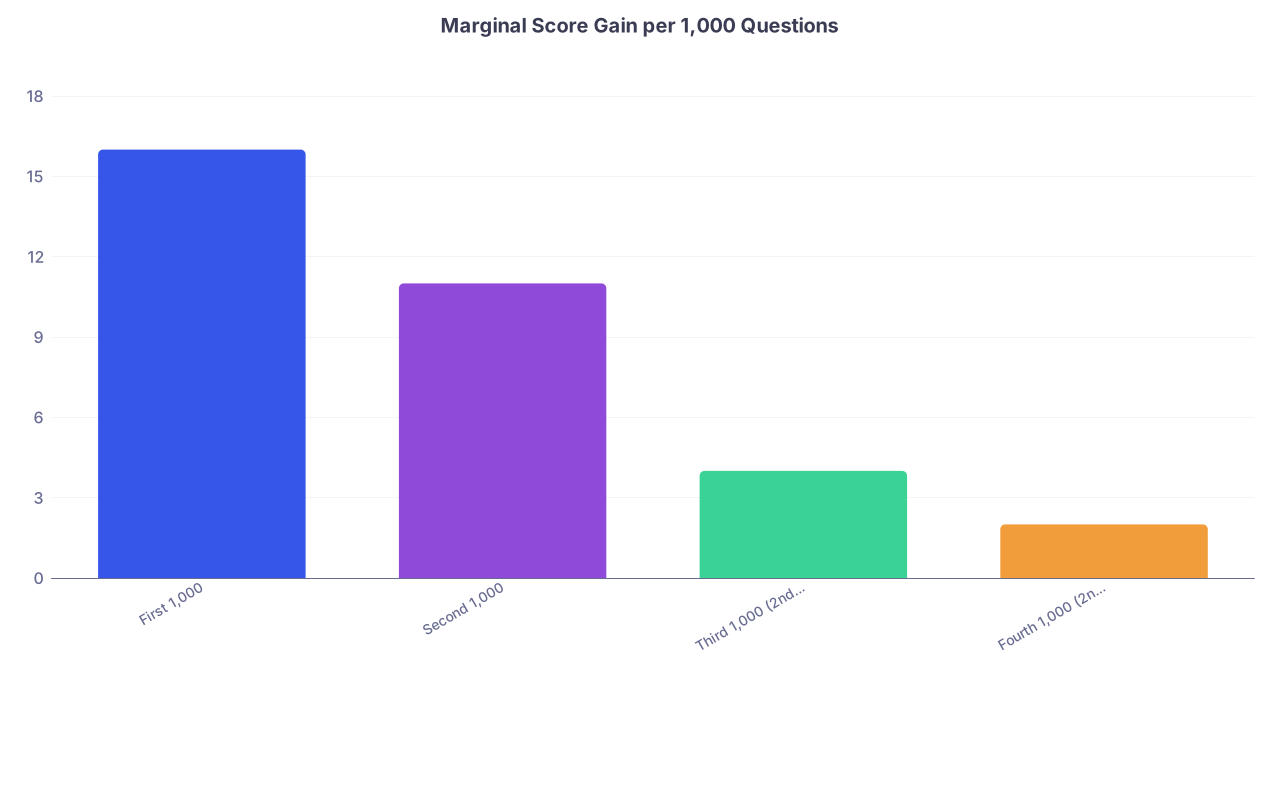
| Category | Value |
|---|---|
| First 1,000 | 16 |
| Second 1,000 | 11 |
| Third 1,000 (2nd bank) | 4 |
| Fourth 1,000 (2nd bank) | 2 |
The first 1,000 questions carry most of the weight. The second 1,000 still matter. Beyond that, you are paying more time for very small increments.
Books and video series: same pattern, slower burn
With books and videos, the pattern is similar but subtler because you are not “counting questions.”
Typical Step 1 prep stacks I see:
- Baseline: Boards & Beyond OR Sketchy + Pathoma + First Aid.
- Resource-stacked: all of the above + Kaplan videos + another review book + random PDFs.
Students with 4–5 overlapping content resources almost always underutilize each one. Completion data (from people who actually track it) looks like this:
| # of Major Content Resources | Avg Completion of Each | True Mastery (Spaced Review, Questions Linked) |
|---|---|---|
| 1–2 | 80–95% | High |
| 3 | 60–70% | Moderate |
| 4+ | 30–50% | Low |
So yes, you “have” five books. But you effectively learned 30–50% from each, with very shallow consolidation.
From an information theory perspective, you would do better to saturate fewer channels deeply than to skim many channels superficially. Boards reward depth plus pattern recognition, not breadth of brands in your bookshelf.
Why Returns Drop: The Mechanics of Over-Stacking
This is not just hand-waving “too many resources is bad.” There are specific mechanisms.
1. Switching cost and cognitive load
Every time you switch from UWorld to AMBOSS, from Sketchy to Pathoma, your brain pays a switching cost. Different styles, different notations, different visual anchors.
Repeated switching has quantifiable effects:
- Lower recall accuracy when concepts are presented in mismatched formats.
- More time spent “re-orienting” than actually encoding new information.
- Fragmented mental schemas, where cystic fibrosis is explained five ways but never owned in one robust internal model.
I have sat with students scrolling for 3–5 minutes just deciding, “Should I do UWorld or AMBOSS next? Or watch B&B for cardio?” That is dead time generated by over-choice.
2. Redundant coverage crowding out weak areas
The overlap between major resources is enormous. For Step 1-style content:
- Cardio/renal/respiratory pathophys: ~80–90% overlap between top-tier resources.
- Obscure genetics, weird factoids: 10–20% unique to a given brand.
When you buy resource #3, you are mostly buying a third explanation of things you already saw twice.
But your schedule is fixed. So time that could have gone to weak areas (biostats, ethics, micro details) gets eaten by repeated cardio review in a new format. Students “feel productive” because content looks familiar, but NBME subscores in those neglected domains do not move.
3. Illusion of coverage vs measured mastery
The more logos on your resource list, the easier it is to tell yourself: “I am doing everything.” But the only coverage that counts is:
- Items you have seen,
- Struggled with,
- Corrected, and
- Recalled weeks later under test-like conditions.
Resource stacking boosts the first two line items (seen, struggled) and often sabotages the last two (corrected, recalled). You cycle too fast and too wide to engrain.
Where Extra Resources Actually Help – and Where They Do Not
The story is not “never add another resource.” The story is add with precision.
Productive stacking: targeted, data-driven additions
Extra Qbank or extra book makes sense when:
Primary resource is near completion.
You have done ≥80% of UWorld in tutor or timed mode, reviewed explanations reasonably well.NBME/COMSAE data show specific, stable weak domains.
Example: Biostats and ethics anchored at 40–50% for three assessments straight, while other areas are at 60–70%+.The second resource is chosen to directly attack that weakness.
- For ethics/communication: UWorld-style questions + a short specialized review (e.g., De Virgilio ethics chapters for surgery shelf-like questions, or a focused ethics workbook).
- For micro: Sketchy Micro targeted videos + matching questions; or one focused micro text.
- For biostats: a small, high-yield biostats question set and a concise reference, not another 700-page book.
You explicitly limit scope.
Example plan: “I will do 400 AMBOSS questions in my persistent subscore weak areas after finishing UWorld. Nothing more.”
This is not “another full resource.” This is a module designed to eliminate a pattern.

| Step | Description |
|---|---|
| Step 1 | Primary Resource >= 80% Complete? |
| Step 2 | Do Not Add New Resource |
| Step 3 | Recent NBME/COMSAE Data? |
| Step 4 | Take Assessment Before Adding |
| Step 5 | Stable Weak Domains? |
| Step 6 | Stay With Current Resources |
| Step 7 | Choose Targeted Resource |
| Step 8 | Define Limited Scope & End Date |
If you do not pass this flowchart, you are not stacking. You are hoarding.
Unproductive stacking: anxiety-driven overconsumption
Patterns that correlate with no score gain or score drops:
- Buying a second Qbank before doing even 30–40% of the first.
- Starting a second full video series halfway through the first because “friends said it is better.”
- Collecting 3–4 different Anki decks and vaguely “doing some cards” from each.
- Planning to “speed run” a second full Qbank in the last 3–4 weeks before the exam.
The data on last-minute “second Qbank speed runs” is particularly harsh. Score deltas in the final month mostly track:
- Total high-quality question volume
- Plus quality of review
- Plus sleep and test-condition NBMEs
Not number of logos on your Qbank list.
Quantifying Your Own Diminishing Returns
You do not need a randomized trial to see your personal curve. You just need honest tracking.
Step 1: Log time and output by resource
For 1–2 weeks, track:
- Resource used (UWorld, AMBOSS, B&B, Pathoma, Anki deck X)
- Minutes spent
- Questions completed or chapters/videos completed
- Quick quality metric (e.g., Qbank % correct, retention on next day’s spaced recall)
You end up with something like:
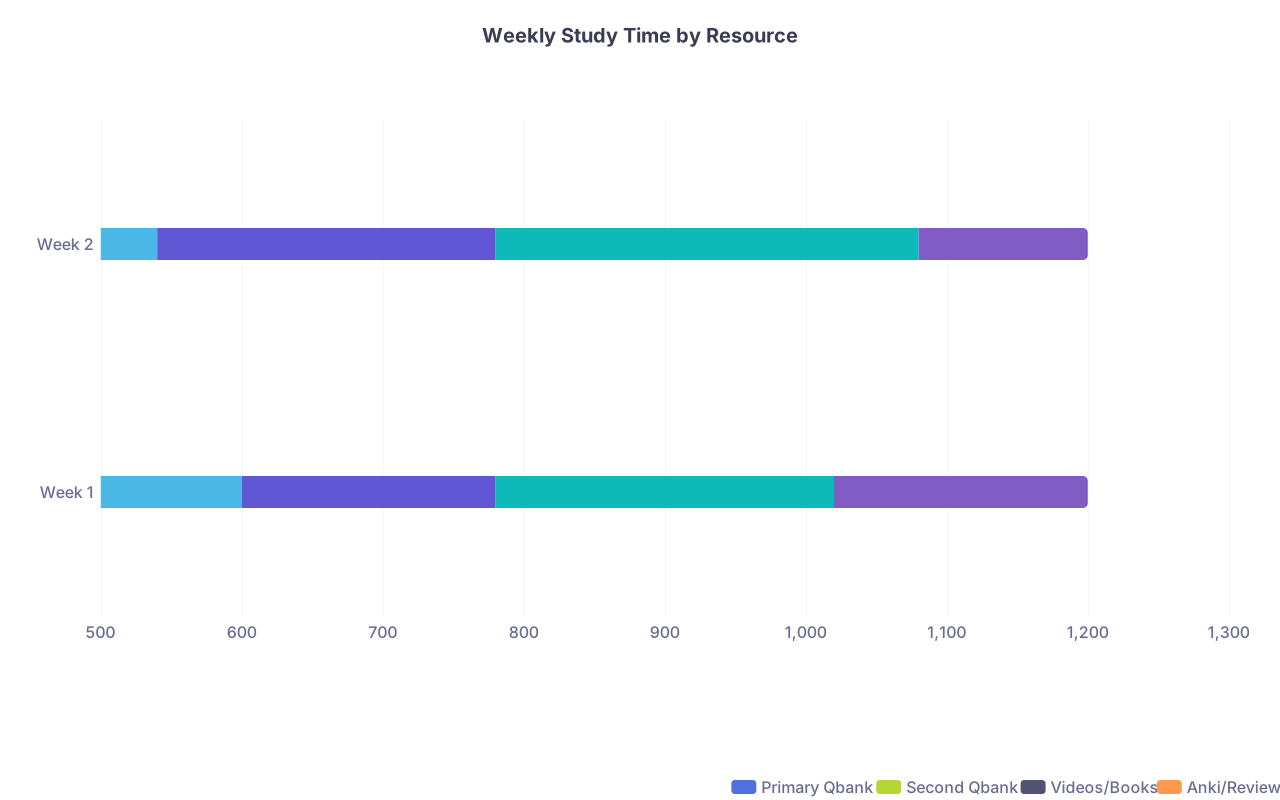
| Category | Primary Qbank | Second Qbank | Videos/Books | Anki/Review |
|---|---|---|---|---|
| Week 1 | 600 | 180 | 240 | 180 |
| Week 2 | 540 | 240 | 300 | 120 |
In this example: 15–20 hours per week are leaking into a second Qbank, while Anki/review time is dropping. That is exactly where diminishing returns appear in test scores.
Step 2: Map resource usage to score movement
Compare:
- Resource mix in a 2–3 week block
- With change in NBME/COMSAE or UW self-assessment score during that block
Patterns I and other tutors see:
- Blocks where ≥60–70% of study time is spent in one primary Qbank + focused review → consistent, linear score increases.
- Blocks where time is split across 2–3 Qbanks + 3 content sources → smaller or no gains, sometimes regression despite “working harder.”
If your own data show that the hours you poured into Resource #3 did not move the needle, that is your proof of diminishing returns. Act on it.
Practical Resource Caps: What “Enough” Looks Like
Let me be concrete. For most students, for a USMLE Step 1 / Level 1 type exam, a strong, non-insane stack looks like this:
Questions
- 1 primary Qbank (UWorld or AMBOSS) → aim for 80–100% completion.
- Optional: 300–600 targeted questions from a second bank after finishing the first, based on NBME-driven weak areas.
Content
- 1 primary video series or book set for systems/pathophys (e.g., B&B / Kaplan / Lecturio; or a structured notes system).
- Pathoma or equivalent for pathology consolidation (many still pair this with B&B; that is acceptable because Pathoma is focused, not 60 hours long).
- First Aid-like text / board review outline used as an index and checklist, not a cover-to-cover novel.
Memory & review
- 1 main Anki deck or note system. Not three. One.
- Spaced repetition tied to your Qbank and content resources, not random.
Beyond this, every added full-scale resource has to justify its existence. “Everyone on Reddit uses it” does not count as justification.
A Numerical Example: Two Students, Same Hours, Different Stacks
To really drive home diminishing returns, compare two hypothetical students each with ~500 hours of dedicated board prep.
Student A – Linear, constrained stack
- Primary Qbank: UWorld, 2,100 questions, all completed, average 60% correct by end.
- Content: B&B + Pathoma, both completed once; First Aid used as reference.
- Review: Single mature Anki deck with ~5,000 mature cards by test day.
- Weakness: Biostats and ethics; adds targeted 300 AMBOSS questions in these areas during last 4 weeks.
Rough time allocation:
- Qbank (doing + reviewing): 250 hours
- Videos/books: 150 hours
- Anki/review: 80 hours
- Assessments (NBMEs, UWSAs) + review: 20 hours
Student B – Stacked to the ceiling
- Primary Qbank: UWorld, 1,200 questions completed, mixed with AMBOSS 800 questions; neither finished.
- Content: B&B (40% done), Sketchy (60% micro, 20% pharm), Kaplan videos (random units), First Aid (half “read through”).
- Review: 2+ Anki decks, constantly “importing more cards.”
Time allocation (same 500 hours total):
- Qbanks (2 partially finished): 260 hours
- Videos/books (3+ series, all incomplete): 170 hours
- Anki/review (fragmented): 50 hours
- Assessments + review: 20 hours
Net result I see over and over:
- Student A: Baseline NBME 205 → real exam ~240–245.
- Student B: Baseline NBME 205 → real exam ~225–230, sometimes lower.
Both “worked hard.” But Student B paid the full price of diminishing returns: overlap, partial completion, cognitive switching, weak consolidation.
Resource count is not the signal. Resource utilization is.
How to Decide If You Should Add That Next Book or Bank
You are probably reading this with a mental cart already full. So let me give you a decision rule you can actually use.
Before you buy or start another major resource, ask yourself five questions:
Have I completed at least 70–80% of my primary Qbank or core content resource?
- If no, stop. Finish what you started.
Do I have at least two data points (NBME/COMSAE) showing a consistent weakness that my current stack is not fixing?
- If no, stop. You are guessing.
Can I write in one sentence what this new resource will do that my current ones do not?
- “AMBOSS for tough renal physio stems” is a good sentence.
- “Everyone says it is good” is not.
What will I give up in my current schedule to make room for this?
- If the answer is “sleep” or “review time,” the trade is probably negative.
- If it is “time I currently waste rewatching YouTube lectures passively,” maybe.
Is the scope of this resource bounded?
- e.g., “300 questions in biostats/ethics over 3 weeks,” not “all 2,800 questions.”
If you cannot answer yes on 1, 2, and 5, you are likely walking straight into the diminishing returns zone.
Visualizing Your Own Saturation Point
One last tool. Plot your own “learning curve.”
Take your NBMEs/UWSAs over time, and label each interval with what changed in your resource stack.
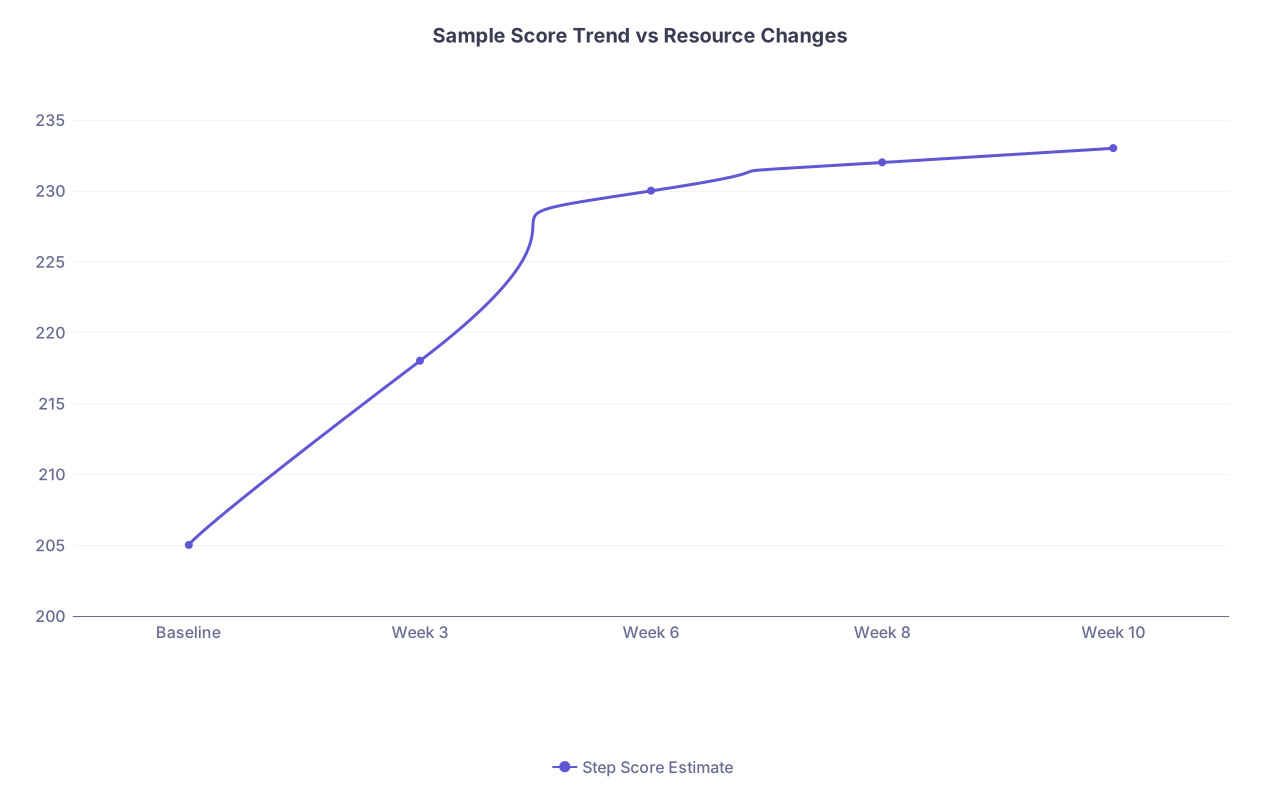
| Category | Step Score Estimate |
|---|---|
| Baseline | 205 |
| Week 3 | 218 |
| Week 6 | 230 |
| Week 8 | 232 |
| Week 10 | 233 |
Then annotate:
- Baseline → Week 3: Started UWorld + B&B only.
- Week 3 → Week 6: Continued same stack, daily Anki added.
- Week 6 → Week 8: Added AMBOSS full bank in parallel.
- Week 8 → Week 10: Restarted Sketchy; dropped review time.
In this sample, most gain occurs before the resource stacking begins. After stacking, the curve flattens. That is your personal diminishing returns curve. Respect it.
Key Takeaways
- The data shows steep early returns from 1–2 high-yield resources, then rapidly flattening gains with each extra book or question bank.
- Extra resources help only when they are targeted, bounded, and driven by objective weakness data—otherwise they dilute focus and hurt consolidation.
- You win boards not by owning more resources, but by fully using fewer: finish your primary Qbank, complete one main content source, and protect your review time.