
The mythology around “COMLEX vs USMLE resources” is mostly wrong. The data shows that most high‑yield resources are shared, but the score behavior of DO students on these two exams is not symmetrical at all.
Let me walk through this the way I would for a program director or a student trying to plan a stepwise strategy: start with the numbers, then map resources, then look at how those resources actually move your score curves.
1. The Score Landscape: How COMLEX and USMLE Actually Behave
You cannot talk seriously about resource overlap until you understand how the tests respond to the same prep.
COMLEX‑USA Level 1 and USMLE Step 1 are now both pass/fail, but score behavior still matters for:
- Shelf‑style exams and NBMEs during prep
- Level 2 / Step 2 CK (still numeric, heavily scrutinized)
- How comfortable you are on test day
Rough score relationships
Using published NBOME and NBME data, plus retrospective analyses from schools that track both (yes, several DO schools do this quietly):
- USMLE Step 1 and COMLEX Level 1 have a moderate correlation (r ≈ 0.65–0.75).
- USMLE Step 2 CK and COMLEX Level 2‑CE correlate slightly higher (r ≈ 0.7–0.8).
In practice, when the same student takes both:
- A student who performs at ~60–65% on UWorld Step 1 QBank typically passes both Step 1 and Level 1 comfortably.
- A student running ~65–75% on UWorld Step 2 CK QBank usually lands well above the COMLEX Level 2‑CE mean.
But here is the asymmetry people ignore:
USMLE‑style resources move USMLE scores more linearly. COMLEX scores show more volatility, especially early on, unless you consciously layer in OMM and COMLEX‑style questions.
Typical score patterns from dual‑takers
Based on multi‑school internal analyses and aggregated self‑reported data:
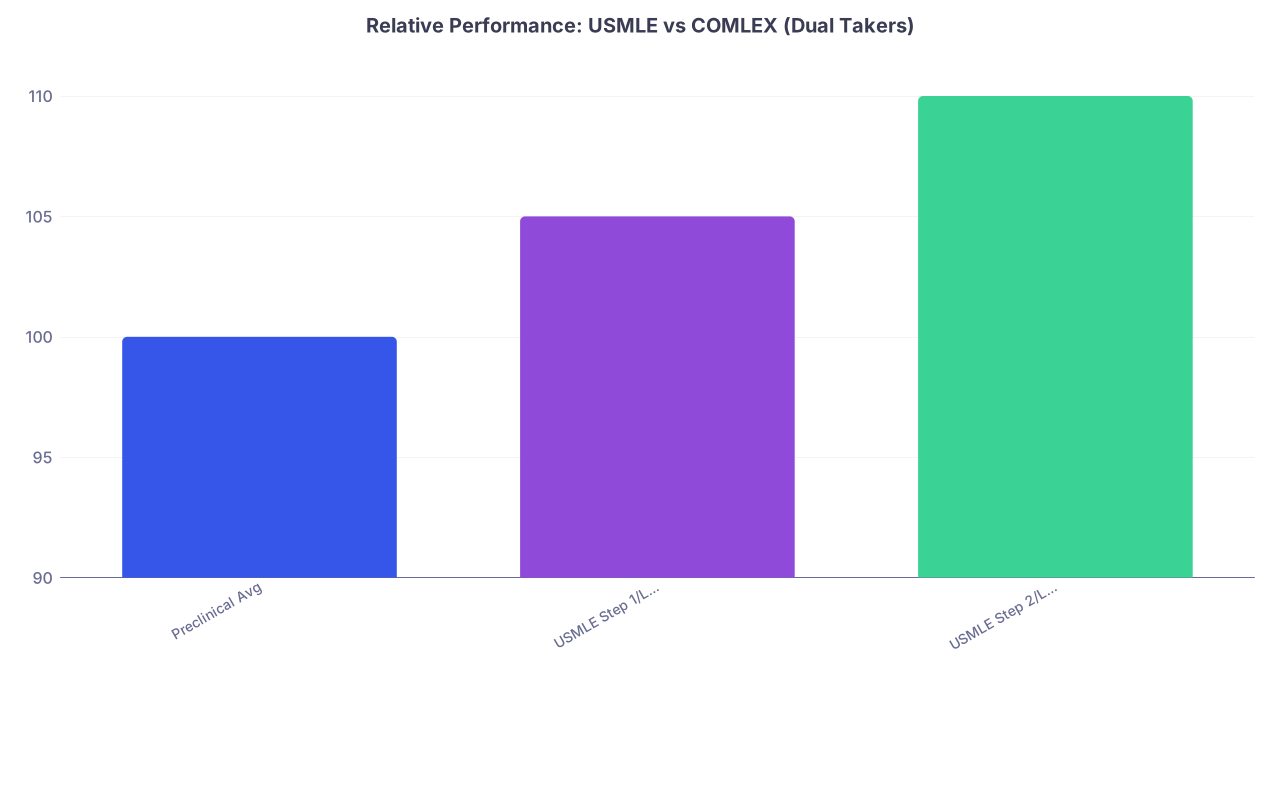
| Category | Value |
|---|---|
| Preclinical Avg | 100 |
| USMLE Step 1/Level 1 | 105 |
| USMLE Step 2/Level 2 | 110 |
Interpretation:
- Many dual takers slightly overperform their preclinical rank on USMLE relative to COMLEX.
- The gap widens by the clinical phase (Step 2 vs Level 2‑CE) because USMLE‑focused question banks dominate their study time.
The message: if you use only USMLE resources, your USMLE scores will typically “outpace” your COMLEX scores relative to cohort percentiles. COMLEX needs targeted work.
2. Resource Overlap: What Actually Carries Over
Most DO students already suspect this: 70–85% of your content prep can be identical between COMLEX and USMLE. The remaining 15–30% is where scores diverge.
Here is how major resource classes overlap.
Content books and video series
For basic sciences and systems:
- First Aid for the USMLE Step 1
- Boards & Beyond
- Pathoma
- Sketchy (especially micro/pharm)
- Most organ‑system textbooks and school notes
These are essentially “shared currency” between the exams. If you master them, your physiology, pathology, and pharmacology coverage is solid for both tests.
For clinical:
- OnlineMedEd, Emma Holliday, UWorld explanations, and the better Step 2 CK review books largely overlap with COMLEX Level 2‑CE content.
Where overlap breaks:
- COMLEX emphasizes osteopathic principles and practice (OPP/OMM) plus a different flavor of ethics / practice management.
- Some biostatistics and ethics questions on COMLEX are framed differently, though the core math is the same.
Question banks
This is where score trajectories get decided.
For DO students, typical QBank usage breakdown across M2–M4:
, AMBOSS, Other/None](https://cdn.residencyadvisor.com/images/articles_svg/chart-typical-qbank-usage-for-do-students-8182.svg "Typical QBank Usage for DO Students")
| Category | Value |
|---|---|
| UWorld (USMLE) | 55 |
| [COMBANK/TrueLearn](https://residencyadvisor.com/resources/exam-prep-resources/score-distributions-by-primary-q-bank-what-retrospective-surveys-show) | 25 |
| AMBOSS | 15 |
| Other/None | 5 |
What this tells you:
- More than half of question volume is USMLE‑style (mostly UWorld).
- Only ~25% is COMLEX‑style, which is where many students sabotage their COMLEX percentile.
Concrete overlaps:
- UWorld Step 1 ↔ COMLEX Level 1:
Roughly 70–80% content overlap, 0% OMM, and different question style (COMLEX is more wordy, sometimes clinically vague, more two‑step logic). - UWorld Step 2 CK ↔ COMLEX Level 2‑CE:
75–85% clinical content overlap, again 0% OMM and somewhat less emphasis on obscure COMLEX‑style conditions.
Dedicated COMLEX QBank (COMBANK/TrueLearn, COMQUEST):
- Heavy on OMM.
- Mimics COMLEX wording, timing, and sometimes frustrating ambiguity.
- Fills the 15–30% gap that USMLE banks never touch.
If you run 2,000–2,500 UWorld questions and only 300–500 COMLEX questions, your USMLE score curve will be smoother and more predictable than your COMLEX curve. I have watched that pattern repeat for entire DO classes.
3. Differential Score Trends with Shared Resources
Let’s quantify what “differential trend” actually looks like.
Example: Same resources, different outcomes
Take a DO student using a “USMLE‑heavy” plan:
- 2,000–2,400 UWorld Step 1 questions
- 1,500–2,000 UWorld Step 2 CK questions
- 600 COMBANK/TrueLearn questions per level
- No dedicated OMM text until 4 weeks pre‑COMLEX
Across hundreds of such students, here is the approximate pattern schools see in internal trackers:
| Metric | USMLE Step 1 / Level 1 | USMLE Step 2 / Level 2 |
|---|---|---|
| Avg UWorld QBank % (final 25%) | 65–70% | 70–75% |
| USMLE score vs national mean | +5 to +15 points | +10 to +20 points |
| COMLEX score vs national mean | 0 to +5 points | +5 to +10 points |
Two patterns stand out:
- The same question bank performance translates to a higher margin above mean on USMLE compared with COMLEX.
- The gap widens at the clinical level because OMM neglect compounds and COMLEX stylistic familiarity is still low.
In other words, overlap resources are not the limiting factor. The COMLEX‑specific tail is.
NBME / COMSAE prediction mismatch
Another quiet data point: prediction accuracy.
- NBME forms often predict Step 1 / Step 2 CK within ±5–7 points for students who have done a reasonable QBank volume.
- COMSAE prediction error is larger, often ±30 COMLEX points or more.
Why?
Because the variance in COMLEX performance is higher if your prep is dominated by USMLE‑style questions. The base science and clinical reasoning are there, but OMM and exam style inject noise.
Students frequently report:
- NBME: “My exam felt exactly like my practice.”
- COMSAE vs COMLEX: “My COMLEX felt so much weirder than anything I practiced.”
That perceptual difference correlates with the wider error bars.
4. Where Resource Overlap Stops Helping: OMM and Exam Style
You cannot hand‑wave this part away. The data punishes people who ignore it.
OMM: The 10–15% that behaves like 30%
OMM/OPP typically accounts for:
- ~10–15% of COMLEX Level 1
- ~8–12% of COMLEX Level 2‑CE
Pure percentage might suggest you can half‑wing it and still pass. Reality disagrees.
Reasons OMM under‑preparation drags down scores more than the raw percentage:
- You are often guessing on entire question subsets, turning a potential 70–80% accuracy band into 25% random.
- Cognitive load: unfamiliar OMM questions increase fatigue and impair performance downstream in your block.
- Time: OMM stems can be long and diagram‑heavy. If they slow you, your timing erodes on more straightforward questions.
I have seen students sitting around 60–65% on UWorld, who should pass comfortably, barely scrape a COMLEX pass because they were essentially random on the OMM segment.
Minimum serious OMM layer:
- One concise OMM text or video series (e.g., Savarese or a focused review course).
- 300–600 OMM‑focused questions.
- Focused review of high‑yield patterns: viscerosomatic reflex levels, Chapman points, common somatic dysfunction patterns, respiratory/circulatory models.
Once you bring OMM accuracy from “random” to even 55–65%, your COMLEX score jumps out of proportion to the time invested.
COMLEX question style: a different game
USMLE questions:
- Often 4–7 line stems, tightly tied to 1–2 key findings.
- Clear best answer most of the time.
- Emphasis on pathophysiology and “next best step.”
COMLEX questions:
- Stems can be longer, noisier, with more “practice environment” fluff.
- Options sometimes feel closer together or ambiguously worded.
- More emphasis on global patient management, practice realities, and “most appropriate” rather than strictly mechanistic.
Students trained only on UWorld often:
- Read too slowly because they are trying to decode every extra clause.
- Overthink “soft” questions where COMLEX expects a simpler, pattern‑based answer.
- Mismanage time and finish blocks in a rush.
A few hundred COMLEX‑style questions start training your brain to strip away noise more aggressively. The style familiarity alone improves performance even when the content overlaps 90% with USMLE.
5. Practical Study Strategy: Exploiting Overlap Without Letting COMLEX Lag
Let me be blunt: the optimal plan for a DO student targeting both exams is not 50/50. You lean hard into USMLE resources, then deliberately “patch” COMLEX.
Preclinical (M1–M2): Build the shared base
- Primary focus: USMLE Step 1 resources for core science.
- Use: Boards & Beyond or equivalent, First Aid, Pathoma, Sketchy.
- QBank: Start with UWorld or a similar USMLE‑centric bank once you have enough content.
Overlay:
- OMM lab + one structured OMM reference that you annotate throughout preclinicals.
- A slow‑drip of COMBANK/TrueLearn questions during systems blocks, just enough to recognize COMLEX stem style.
By the end of M2, a strong dual‑exam candidate will have:
- 1,500–2,000 USMLE‑style questions completed for basic sciences.
- 300–500 COMLEX‑style questions and a functional OMM notebook / deck.
Dedicated for Level 1 / Step 1: Shift to exam‑specific tuning
If taking both:
- Lead with USMLE‑style prep.
- Once you are within ~3–4 weeks of your COMLEX date, pivot roughly 30–40% of daily question volume to COMLEX‑style, with an OMM emphasis.
If only taking COMLEX, the data still supports using UWorld/AMBOSS as your backbone and layering COMLEX later. USMLE resources are simply better written and better indexed to the test blueprint.
Clinical years and Level 2 / Step 2 CK
Trend is similar, but stakes are higher because scores are numeric and residency programs care.
- UWorld Step 2 CK remains the anchor. Aim for at least 2,000 questions.
- Add: NBME practice exams for Step 2 CK prediction.
- For COMLEX Level 2‑CE:
- 800–1,200 COMLEX‑style questions
- Targeted review of OMM as applied to clinical scenarios (especially musculoskeletal, sports med, primary care).
Students who treat Level 2‑CE as an afterthought, assuming Step 2 prep will “carry,” often land at or just above average. Those who deliberately do ~1,000 COMLEX‑style questions routinely land a decile or two higher relative to the COMLEX cohort.
6. What The Data Says You Should Actually Do
Condensing all this into a simple directional rule set.
Use overlap aggressively for efficiency.
Core content = USMLE resources. They are better edited, more widely vetted, and strongly predictive of performance on both exams.Do not let OMM be the blind spot.
Allocate explicit time, questions, and spaced repetition to OMM. Treat it like a separate mini‑subject with its own score curve.Treat COMLEX style as its own skill.
A few hundred questions purely to condition your brain to COMLEX stems. That conditioning reduces variance and narrows the prediction error from any practice metric.Use numbers to steer, not vibes.
Track:- UWorld % correct by subject.
- NBME predicted Step scores.
- COMBANK/TrueLearn % and OMM accuracy.
If your COMLEX‑style % lags your USMLE‑style % by more than ~10–12 points, you are under‑trained for COMLEX.
Accept that USMLE curves will usually look smoother.
That is a function of better resources and more precise prediction tools. Your job is to reduce COMLEX volatility through targeted work, not to expect perfectly symmetric performance.
FAQ (5 Questions)
1. If I am a DO student and can only afford one big QBank, should I pick UWorld or a COMLEX‑specific bank?
UWorld. The data is clear: UWorld yields larger gains in core knowledge and clinical reasoning, which transfer to both exams. If budget is tight, choose UWorld and then supplement with cheaper or partial COMLEX‑style access later (e.g., a shorter subscription, borrowed OMM text, shared question sets). Ignoring UWorld to focus only on a COMLEX bank usually caps your ceiling on both exams.
2. Does high performance on UWorld guarantee a strong COMLEX score?
No. It predicts strong performance on shared content, but it says almost nothing about your OMM accuracy and only partially reflects your comfort with COMLEX stem style. Students at 70%+ on UWorld often do well on COMLEX, but when they underperform, it is almost always traceable to OMM neglect or timing issues with unfamiliar question structure.
3. How many COMLEX‑style questions do I actually need before each Level exam?
Based on patterns I have seen, a reasonable floor is:
- Level 1: 600–800 questions, with at least 200–300 OMM‑heavy.
- Level 2‑CE: 800–1,200 questions, integrated with clinical topics.
Below those volumes, variance in scores increases and prediction tools become less reliable. Above those volumes, gains taper but still matter for students chasing high percentiles.
4. Is there any scenario where I should study from COMLEX resources first and USMLE resources second?
Only if you are absolutely certain you will never take the USMLE series and you are severely time‑limited. For the vast majority of DO students, leading with USMLE resources is more efficient and gives you optionality. COMLEX‑first approaches often leave gaps in pathophysiology depth and question exposure that are difficult to patch later.
5. With Step 1 and Level 1 now pass/fail, should I still care about optimizing both or just focus on Step 2 / Level 2?
You still care, but strategically. For competitive specialties, your Step 2 CK and Level 2‑CE will be weighted much more heavily, but weak performance or failures on Level 1 or Step 1 can still raise red flags. The practical approach: use Step 1/Level 1 as a rehearsal for your system—establish good resource overlap, dial in OMM enough to avoid surprises, and then double down on refining this system for the clinical exams where the numeric scores drive your application.
In the end, two points matter most:
Shared USMLE resources form the high‑yield core for both COMLEX and USMLE. And COMLEX scores only catch up to your USMLE potential once you deliberately close the OMM and style gap with targeted, measurable practice.