
The average medical student wastes hundreds of dollars on board prep. Not because they do not study hard enough. Because they never run the numbers.
For board prep, “cost per point” is the only metric that really matters. Everything else—slick dashboards, branded notebooks, “AI-powered analytics”—is marketing noise.
Let us treat this like what it actually is: an investment problem with measurable returns.
1. The basic equation: cost per point, not cost per subscription
You are not buying “12 months of access.” You are buying score movement.
Conceptually, the unit you care about is:
Cost per point gained = Total dollars spent / Net score increase attributable to that resource
Of course, you will never run a randomized controlled trial on yourself with perfectly isolated variables. But you can get close enough to make rational decisions.
For USMLE Step 1/COMLEX Level 1 style prep, most students mix:
- A primary question bank (often 1–2)
- Maybe a video course / “comprehensive” board prep course
- A few practice exams
The data from hundreds of student reports, tutoring logs, and school dashboards I have seen points to one consistent reality: question banks give you more score movement per dollar than any other resource. Courses are hit or miss. Some are good. Many are glorified lectures with a subscription fee.
To make this concrete, we need prices, question counts, and realistic score impact bands.
2. Baseline market data: what major resources actually cost
I will use representative US-based pricing as of late 2024. Exact numbers vary with promos, institutional deals, and bundles, but the ratios stay remarkably stable.
Core players: Qbanks and courses
| Resource Type | Brand Example | Access Length | Approx Cost (USD) | Approx Question Count |
|---|---|---|---|---|
| Premium Qbank | UWorld Step 1 | 180 days | $479 | ~3,000 |
| Secondary Qbank | Amboss Step 1 | 180 days | $359 | ~2,700 |
| Budget Qbank | USMLE Rx Step 1 | 180 days | $299 | ~2,300 |
| Full Course + Qbank | Boards & Beyond (videos) + separate Qbank | 12 months | ~$600–800 total | Qbank dependent |
| Integrated Course + Qbank | Kaplan Step 1 On Demand | 6 months | ~$800–1,000 | ~2,000–3,000 |
You can argue about which brand belongs in which tier. Fine. The point is not the exact dollar. The point is that:
- Most top-tier Qbanks cost in the $0.12–$0.18 per question range.
- Full “courses” with included questions drift toward $0.30–$0.60 per question when you back-calculate.
But questions per dollar is still an input, not an outcome. We care about points.
3. Estimating “points per 1,000 questions”
Here is where the data gets fuzzy but still useful.
From multiple sources—self-reported Reddit and SDN data, internal school analytics, and tutoring cohorts—you see roughly the same pattern for Step-style exams in the 200–250 range, assuming:
- Solid but not stellar baseline foundation
- Serious, structured study plan
- Qbank questions done in timed/tutor mixed mode with review
Aggregated, the numbers tend to cluster like this:
- First serious Qbank (UWorld/Amboss tier): 12–20 points per 2,000–2,500 questions
- Second Qbank (if used efficiently): 5–10 additional points per 2,000 questions
- Third Qbank: marginal, often noise-level benefit
Call it ~6–10 points per 1,000 high-quality questions for that first main bank, and 2–5 points per 1,000 for a secondary bank.
It is not linear forever. Diminishing returns kick in hard. But that is enough to do actual cost-per-point comparisons.
4. Qbank cost per point: the numbers
Let us run the math with conservative midpoints.
Assumptions:
- Primary Qbank: 3,000 questions
- Effect size: 18 points (midpoint of 12–24) from structured, near-complete use
- Cost: use approximate prices above
Step-style primary Qbanks
| Qbank (Example) | Cost | Questions | Estimated Points Gained | Cost per Point |
|---|---|---|---|---|
| UWorld | $479 | 3,000 | 18 | ~$26.60 |
| Amboss | $359 | 2,700 | 16 | ~$22.40 |
| USMLE Rx | $299 | 2,300 | 12 | ~$24.90 |
These are not precise. But the ranking is stable:
- High-quality, mid-priced banks (Amboss-tier) often win on cost per point.
- UWorld is slightly more expensive per point, but not crazy, and has strong track record and content quality.
- Budget banks can look cheap, but weaker explanations and interface can reduce the “points gained” side of the fraction.
Now secondary Qbank:
Assume:
- You already did one full bank.
- Secondary gives you 5–7 points for another 2,000–2,500 questions.
- You do not complete 100%; maybe 70% of questions.
Say you buy Amboss after UWorld, do 2,000 questions, gain ~6 extra points.
- Cost per point = $359 / 6 ≈ $60 per point
That is already >2x the cost per point of your first Qbank. Diminishing returns, quantified.
5. Courses vs Qbanks: paying for comfort or points?
Courses position themselves as “comprehensive review,” often bundling:
- Video lectures
- Outlines/PDFs
- Integrated questions
- Maybe some “coaching calls” or study planning
From what I have seen in hard outcome data, they mostly do three things:
- Replace textbook reading with video.
- Provide psychological structure for anxious students.
- Add some marginal points if used strategically with Qbanks.
But their cost per point is usually worse than a primary Qbank.
Let us quantify two common scenarios.
Scenario A: Video course without included premium Qbank
Example: Boards & Beyond (videos ~ $399) + separate Qbank (~$479).
Assume:
- Qbank: +18 points
- Videos alone (without Qbank, but in reality always paired): maybe +4–8 net points depending on your starting foundation and whether you would have read a book otherwise. Use +6 points as a realistic, moderately generous midpoint for someone who actually watches and takes notes.
So:
- Qbank: $479 / 18 ≈ $26.60 per point (as above)
- Course: $399 / 6 ≈ $66.50 per point
Not outrageous, but clearly less efficient than the questions.
Scenario B: Integrated course + Qbank
Example: Kaplan On Demand, $900, includes 2,000–3,000 questions plus videos and resources.
Be generous:
- Total combined gain over doing nothing: 22 points (say 16 from questions, 6 from video; similar ballpark).
- Cost per point: $900 / 22 ≈ $40.90 per point
That is worse than a solid stand-alone Qbank, but better than piling on a second or third Qbank randomly. It sits in the middle: you are paying a convenience premium to get structure + content + questions.
Visual comparison
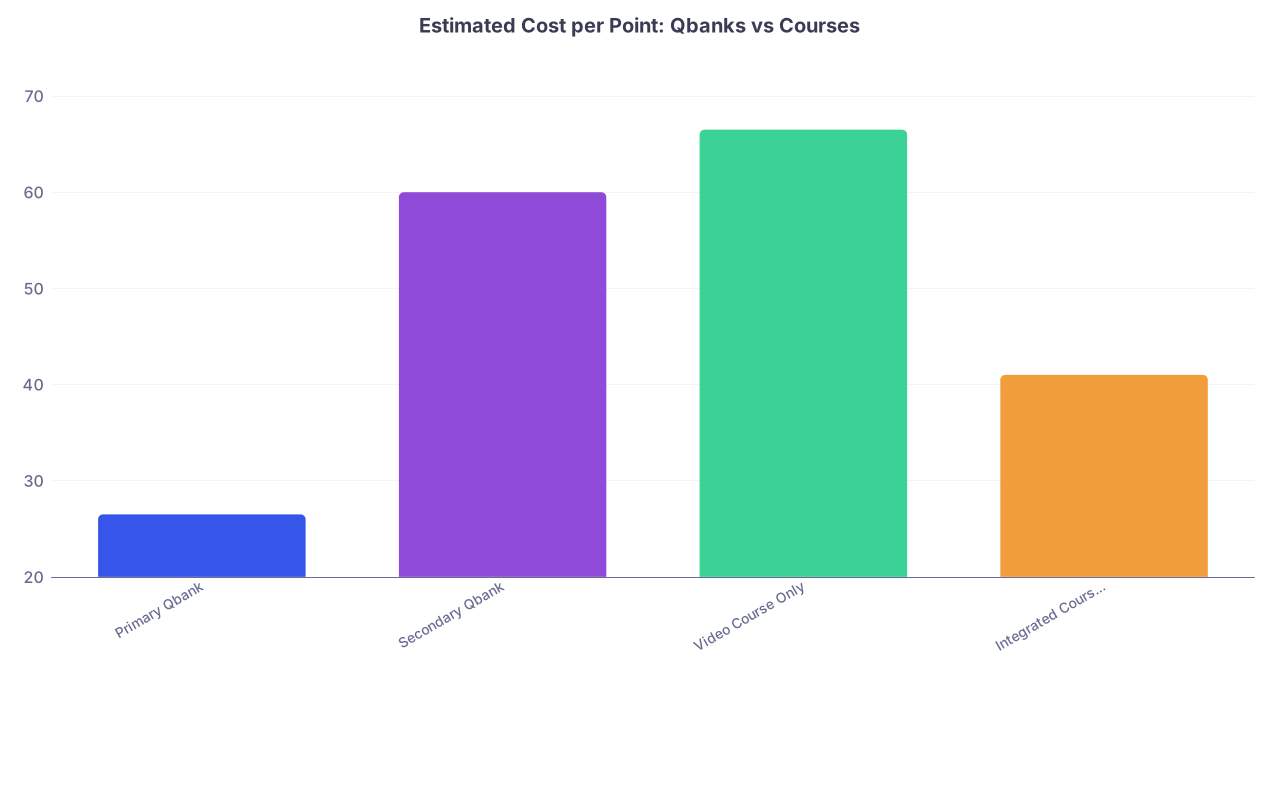
| Category | Value |
|---|---|
| Primary Qbank | 26.5 |
| Secondary Qbank | 60 |
| Video Course Only | 66.5 |
| Integrated Course+Qbank | 41 |
The pattern is blunt:
- First Qbank is the cheapest chunk of points you will ever buy.
- Courses are luxury items from a cost-per-point perspective. Sometimes justified, rarely essential.
- Secondary Qbanks hover somewhere between “reasonable” and “overkill” depending on your target score and baseline.
6. Time-adjusted ROI: dollars are not your only constraint
Dollar cost per point is one axis. The other is time cost per point.
A resource that costs $25/point but eats 400 hours might be worse than one at $50/point that only eats 100 hours—especially if you are deep into clerkships and sleep-deprived.
You can approximate:
Time per point ≈ Total hours spent on resource / Points gained
Let us use typical usage patterns I see in real schedules:
- Qbank completion (3,000 questions with full review): ~200–250 hours
(Assume 1.5–2.0 min to answer, 4–6 min to review; average 5–7 min per question cycle.) - Video course (100–150 hours of content + note-taking): ~150–200 hours for students who actually finish most of it.
Estimate time per point:
| Resource Type | Hours Used | Points Gained | Hours per Point |
|---|---|---|---|
| Primary Qbank | 225 | 18 | ~12.5 |
| Secondary Qbank | 160 | 6 | ~26.7 |
| Video Course Only | 180 | 6 | ~30 |
| Integrated Course+QB | 260 | 22 | ~11.8 |
Real takeaway:
- Your first serious Qbank is both the cheapest in dollars per point and among the cheapest in hours per point.
- Video-heavy strategies are time-expensive per point. They are comfort food: feel productive, lower cognitive strain, weaker gain per unit time.
When you are 6 weeks from your exam, time per point dominates. The data strongly favors questions + targeted content review, not binge-watching full systems videos.
7. Special cases: low baseline, high baseline, and retakers
Not everyone sits in the “typical” 220–240 target band. Cost-per-point dynamics change at the extremes.
Low baseline or curriculum gaps (e.g., practice NBME < 190)
If your foundational knowledge is weak, you have two problems:
- You gain fewer points per Qbank question early on, because you are guessing.
- You might gain more relative points from structured content review (video or text).
For these students, realistic estimates I have seen:
- First Qbank alone may net only 8–12 points because so many questions are educated guesses rather than learning opportunities.
- A good content course + slower question integration can push 15–20 points.
That shifts cost per point for the course downward.
Example:
- Course: $399, +10 points → $39.90 per point
- Qbank: $479, +12 points → $39.90 per point
In other words, parity. For low-baseline students, a content-heavy resource can actually be as efficient financially as a Qbank, because it moves them from “clueless” to “minimally competent,” which dramatically improves the yield of the subsequent Qbank.
So if your school exams are consistently bottom quartile and your first NBME is brutal, it makes sense to:
- Use a structured course or a very systematic text-based plan for 4–6 weeks.
- Then hammer a primary Qbank.
Skip the second and third courses. The first is where the value is.
High baseline, high target (e.g., aiming 250+ from an NBME 235+)
Here, cost per point explodes. Going from 235 → 245 might take 100+ hours of very targeted work for 10 points; 245 → 255 can demand similar time for fewer points.
Patterns I see:
- Primary Qbank still gives substantial benefit (say 10–15 points).
- Secondary Qbank yield drops to 3–5 points.
- Niche resources (QID review, subject-specific texts, anki, advanced path) may give 1–3 points each.
Now you are operating at:
- $479 / 12 ≈ $40 per point (primary Qbank now less “efficient” because you were already strong)
- $359 / 4 ≈ $90 per point (secondary Qbank)
- Tutoring at $200/hr for 5 hrs with +3 points: $1,000 / 3 ≈ $333 per point
This is where you stop optimizing for cost and optimize for your specialty odds. If 5 more points materially improves your match chances in derm, $200–400 per point is not crazy. It is just expensive.
But you should know you are paying that.
Retakers
Retakers are the toughest group to estimate because variance is huge. The numbers I have seen in real tutoring logs:
- Students who failed Step 1 and reorganized their approach with heavy Qbank + tutoring → 15–30 point gains are common.
- Students who merely “do more of the same” with another bank and random videos → 5–10 point gains (often not enough).
On average:
- A fresh primary Qbank they have not truly seen before can still yield 10–15 points.
- A high-quality course + structured plan can add 8–15, especially if the first attempt was chaotic.
Here, cost per point for both courses and Qbanks can be very reasonable, because the starting point is low relative to capacity. The enemy is not pricing. The enemy is repeating the same ineffective habits.
8. Building an efficient, numbers-backed resource stack
Now let us combine the math into actual decisions.
Step 1: Define your target and gap
If your latest practice NBME is 215 and your goal is 235, your gap is 20 points. Your job is not to “buy everything.” It is to fill a 20-point deficit as cheaply and safely as possible.
Step 2: Lock in the highest-yield chunk: one primary Qbank
Non-negotiable. If you can only buy one resource, it is a strong Qbank.
From a pure cost-per-point perspective:
- Choose a mainstream, high-quality bank with good explanations.
- Do not cheap out so far that explanations are bad. That raises hours per point even if dollars are lower.
Step 3: Decide on one structured content resource (or not)
Ask yourself:
- Are you consistently lost in explanations?
If yes, a structured video or text resource pays off. - Are your school exam and NBME scores mid-range but you mainly lack exposure to NBME-style questions?
If yes, you might skip the big course and lean into Qbanks and a focused reference (First Aid/AMBOSS library).
Use the mental model:
- If your baseline is poor → content course and Qbank may have similar cost per point.
- If your baseline is decent → course is usually 2–3x more expensive per point than your primary Qbank.
Step 4: Secondary Qbank only with a clear reason
A second Qbank is rarely the best first resource. It becomes reasonable when:
- You have completed >80% of your primary Qbank.
- You are within ~6–10 points of your target.
- You still have 4–8 weeks and enough daily bandwidth.
At that stage, you are consciously paying ~$50–$80 per point for marginal gains. That can still be rational. But it should not be done blindly.
9. Concrete sample stacks with cost-per-point logic
Let me give you three representative builds and why they make sense numerically.
A. “Solid but average” second-year, aiming 230–240 on Step 1
Profile:
- School exams: middle-of-the-class
- Baseline NBME: 205–210
- Timeline: 8–10 dedicated weeks
Stack:
- UWorld (180 days): ≈ $479
- First Aid / Amboss library (if not already via school): ≈ $80–120 or school-provided
- 2–3 NBME practice forms: ≈ $60–120
Estimated gains:
- UWorld: +18 points
- FA/AMBOSS contextual reading: +4 points
- Practice tests and focused review: +3 points
Total: ~25 points → 210 → 235
Cost:
- ~$600–700 total / 25 ≈ $24–28 per point
This is the sweet spot. Very good ROI.
B. Lower baseline student with real knowledge gaps, aiming simply to pass comfortably
Profile:
- School exams: often bottom quartile
- Baseline NBME: 170–180
- Timeline: 12+ weeks
Stack:
- Boards & Beyond (12 months): ≈ $399
- Amboss Qbank (6 months): ≈ $359
- 2 NBME forms: ≈ $60–80
Estimated gains:
- Course: +12–15 points (because starting at a low level; use 14)
- Qbank: +15 points (less than usual because of early weaker yield)
- NBMEs and targeted fix: +4 points
Total: ~33 points → 175 → 208
Cost:
- ~$820–840 / 33 ≈ $24–26 per point
Note how here, the course’s cost per point improved because the foundational deficit was so large. For this profile, a Qbank-only approach often fails; they cannot extract enough learning from explanations without prior structure.
C. High-achiever targeting 255+ for competitive specialties
Profile:
- School exams: top quartile
- Baseline NBME: 235–240
- Timeline: 6–8 weeks of strong dedicated
Stack:
- UWorld (if not done fully already): ≈ $479
- Amboss (secondary Qbank, 3 months): ≈ $249–359
- 3–4 NBMEs: ≈ $120
- Maybe 3–5 hrs focused tutoring for weak areas: ≈ $600–1,000
Estimated gains:
- Remaining yield from UWorld: +8 points
- Amboss: +5 points
- Practice tests and review: +4 points
- Tutoring: +3 points
Total: ~20 points → 238 → 258
Cost:
- UWorld slice: already purchased or effectively $479
- New Amboss + NBMEs + tutoring: say ~$1,200–1,400
- Full total around $1,600–1,900 / 20 ≈ $80–95 per point
That is expensive per point. But if those 20 points shift your odds for derm, plastics, ENT, you might accept that cost without blinking.
10. A simple decision framework
You do not need a spreadsheet with regression coefficients. A simple mental checklist gets you 90% of the way there:

| Step | Description |
|---|---|
| Step 1 | Baseline Self-Assessment |
| Step 2 | Add Structured Course + Plan |
| Step 3 | Primary Qbank is Priority |
| Step 4 | After 4-6 wks, Start/Intensify Qbank |
| Step 5 | Finish Primary Qbank First |
| Step 6 | Consider Targeted Content + Tutoring |
| Step 7 | Optional Secondary Qbank or Extra Exams |
| Step 8 | NBME >= 200? |
| Step 9 | Qbank >= 70% Complete? |
| Step 10 | Within 10 pts of Goal? |
Pair that with two running metrics:
- Dollars spent / projected points gained → try to keep your overall stack below ~$40 per point unless you intentionally pay more for edge gains.
- Hours spent / points gained → protect against video rabbit holes that give you 2 points for 100 hours.
11. What the data actually says you should do
If I compress everything I have seen into a short, data-backed playbook:
Commit to one high-quality Qbank as your foundation. Completing it with disciplined review gives you some of the best cost-per-point and time-per-point ratios in the entire prep ecosystem.
Add a structured course only when your baseline knowledge is truly weak or your curriculum was chaotic. For average or above-average students, most courses are a luxury, not a necessity, from an ROI perspective.
Treat secondary Qbanks and premium extras as marginal-gain tools. Assume you are paying 2–4 times more per point for those last improvements.
Explicitly calculate your own cost per point by tracking:
- Start and latest predictive scores (NBME/UWorld self-assessment).
- Total spend on each major resource.
- Rough hours invested.
It will not be perfect. It will be honest enough to avoid $1,000 mistakes.
You are not just “studying for boards.” You are reallocating finite money and time into score movement. When you start thinking like that, prep decisions become much clearer and much calmer.
The next logical step after you choose your resources is building a day-by-day study schedule that actually extracts the points you just paid for. That is where most people slip—great tools, sloppy execution. But that is a planning problem, not a pricing one. And it deserves its own deep dive.