
High‑yield vs low‑yield book labels are mostly marketing, not medicine. And the more seriously you take those stickers, the more likely you are to sabotage your own exam prep.
Let me be blunt: there is no official, NBME- or USMLE-sanctioned definition of “high-yield.” None. Zero. Yet the term gets thrown on covers, lecture titles, even Anki decks like it’s a regulated content category. It is not.
You’re in medical school, drowning in content, desperate for shortcuts. Publishers know this. So they sell you “high-yield” as if it’s a data-backed promise, when most of the time it’s a vague vibe.
Let’s rip this apart properly.
What “High-Yield” Actually Means (And Doesn’t)
“High-yield” only has one useful definition:
Content that has a high probability of improving your exam score per unit of time you spend on it.
That’s it. Not “short.” Not “thin book.” Not “heavily tested topic” in isolation. The yield is time-relative and student-specific.
Yet what you actually see marketed as high-yield is usually one of three things:
- Condensed outlines (think First Aid style)
- Topic lists with lots of buzzwords and key associations
- Books that aggressively remove nuance and mechanisms in favor of straight facts
Some of those can be helpful. Some are absolute garbage. And none of them are inherently “high-yield” until you factor in who’s using it, how, and why.
The opposite problem: “low-yield.” The label is thrown on anything that’s:
- Detail-heavy
- Conceptual rather than list-based
- Not obviously testable in one sentence
So pathology atlases, physiology texts, or detailed explanations of mechanisms get mocked as “low-yield” in group chats. Ironically, those are often the very resources that transform vague memorization into actual understanding—especially when your test is more NBME-style than trivia quiz.
The Data Problem: Nobody Measures “Yield” Properly
Here’s the uncomfortable truth: almost nobody has real data on which book is “high-yield” beyond vibes, anecdotes, and survivor bias.
We do have some adjacent evidence:
- Performance on NBME practice exams and UWorld is a strong predictor of Step scores.
- Students who do large volumes of high-quality practice questions with review tend to outperform those who over-focus on reading.
- Repeated active recall (flashcards, questions) beats re-reading summaries almost every time.
What we don’t have: controlled trials comparing, say, “High-Yield Neuroanatomy” vs a standard neuro text vs no neuro book at all, with Step performance as outcome. Nobody’s funding that study.
So how do “high-yield” reputations form?
The usual pipeline looks like this:
- A resource is short and digestible.
- Top students, who would likely score well regardless, use it alongside lots of questions.
- They recommend it to junior students: “I used X and got a 250.”
- Survivorship bias kicks in; nobody hears from the dozens who used only that book and bombed.
- Reddit and forums canonize it as “must use” and “high-yield.”
At no point did anyone control for: baseline ability, prior knowledge, study schedule, or how the book was actually used. But the “high-yield” brand sticks.
Where “High-Yield Book” Thinking Goes Wrong
I’ve watched students make the same bad moves over and over, chasing that high-yield label like it’s magic.
Mistake 1: Confusing “short” with “efficient”
A 200-page “high-yield” book isn’t automatically better than a 600-page text. If:
- You read the 200 pages three times passively, no questions, no active recall
- And your friend reads 150 focused pages of the big text once, then does 500 questions on that subject
Your friend will almost certainly crush you on the exam.
The exam doesn’t care how thin your book was. It cares whether your brain can recognize patterns and apply concepts under time pressure. That comes from questions, feedback, and explanation quality. Not just summary density.
Mistake 2: Treating “low-yield” as “useless”
I’ve heard this exact line from MS2s staring at a pathology atlas:
“Dude, this is so low-yield. I’m not reading this.”
Then they get blindsided on NBMEs by questions that require recognizing how pathology presents, not just which mutation is associated. They knew the buzzword. They didn’t understand the disease.
The supposedly “low-yield” text often gives you:
- Realistic examples
- Edge cases that teach principles
- Clear explanations that make the “high-yield” mnemonics actually stick
You don't read the whole 1000 pages front to back. But selectively dipping in when your “high-yield” book is incomprehensible? That’s not low-yield. That’s smart.
Mistake 3: Thinking yield is universal
You’re weak in cardiology. Someone else is weak in biochem. The same book will not be equally “high-yield” for both of you.
If your foundation in a topic is trash, a super-condensed “high-yield” review might be the lowest yield choice. Because you’ll just memorize words you don’t actually understand.
For that person, a slightly longer, better-explained resource is higher yield per hour. Even if it has fewer highlighter-friendly buzzwords.
What Actually Predicts “Yield” for a Resource
Forget the sticker on the cover. Here’s what really drives yield.
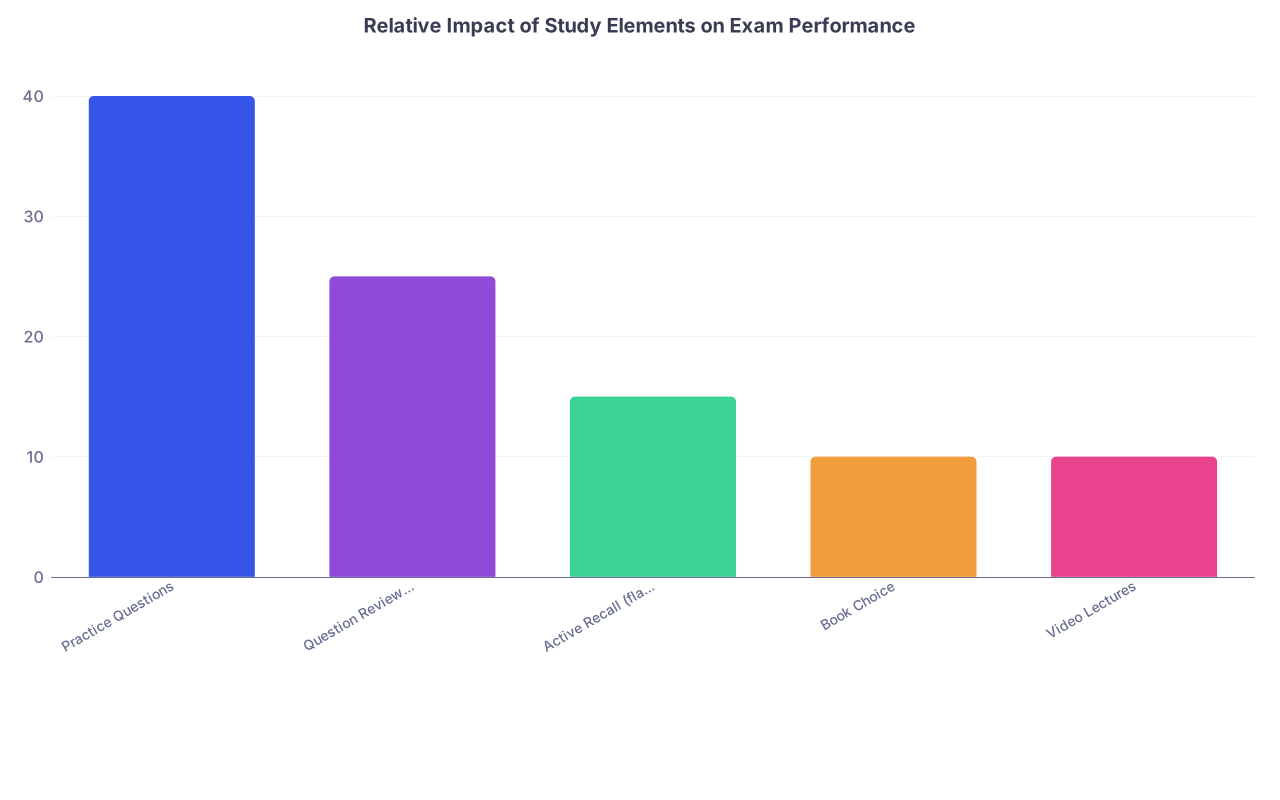
| Category | Value |
|---|---|
| Practice Questions | 40 |
| Question Review Quality | 25 |
| Active Recall (flashcards) | 15 |
| Book Choice | 10 |
| Video Lectures | 10 |
No, those percentages aren't from a randomized trial. They’re a synthesis of what multiple studies on learning show, plus what national-level performance patterns look like. They’re also brutally consistent with what I’ve seen across cohorts:
- Students who grind questions and review them well win.
- Students who obsess over which “high-yield” book to read but do fewer questions lose ground.
So how do you judge a book’s real yield?
Ask these questions:
Does it line up with NBME/UWorld style?
If the explanations and emphasis in the book echo what you see in official practice materials and good question banks, that’s a good sign.Does it improve your question performance after using it?
Track it. Do 20 questions in a topic, study the relevant section in the book, then do another 20. Did your percent correct noticeably increase? That’s yield. If not, you’re probably wasting time.Does it fix confusion or just rephrase it?
High-yield to you = “I actually get this now.” Not “I have a shorter version of something I still don’t understand.”Can you actively recall from it?
If a book naturally lends itself to you generating Anki cards, teaching a friend, or doing closed-book recall, good. If it’s a wall of text you skim and instantly forget, low-yield for you—even if it’s thin.
Example: When a “Low-Yield” Resource Beats a “High-Yield” One
Take neuroanatomy. The classic fear subject.
Scenario I’ve seen repeatedly:
- Student A uses a “High-Yield Neuroanatomy” outline. Memorizes spinal cord tracts, brainstem cross-sections in bullet form. No real clinical context.
- Student B uses a standard neuro text chapter plus a good question bank (say, UWorld or AMBOSS). Slower reading, but with diagrams and cases.
On a shelf or NBME, who usually does better? Student B. Because the exam isn’t just “name this tract.” It’s:
Lesion at X level → which symptom pattern → which structure → which vascular territory?
Outline-only resources are notorious for flopping on application-heavy questions. They raise false confidence: “I know this table.” You don’t know the concept.
The Marketing Game: Why Everything Is “High-Yield” Now
Publishers are not dumb. They know “High-Yield,” “Rapid Review,” “Crush,” “Secrets,” “Ultra High-Yield” all sell.
So you end up with:
- The same content repackaged into multiple short books
- Overlapping material marketed at slightly different angles
- Covers screaming “Now with more high-yield facts!” like they just discovered a new receptor
None of that is data. It’s branding.
Look at how specialty shelf resources get labeled:
| Label on Resource | Actual Typical Content |
|---|---|
| High-Yield | Condensed outline, sparse explanation |
| Rapid Review | Tables, lists, last-minute facts |
| Secrets | Q&A format, variable depth |
| Comprehensive Review | Longer text, more explanation, images |
| Atlas | Visual heavy, context-dependent yield |
None of these labels tell you if the content maps to current NBME style, matches question difficulty, or covers exam blueprints comprehensively. They just tell you format and marketing angle.
When “High-Yield” Is Actually Reasonable
I’m not saying every high-yield label is trash. Some are basically honest.
High-yield makes sense in these contexts:
- You’re 6–8 weeks from Step and need a review framework
- You already did a ton of questions and need a way to consolidate patterns
- You’re aiming to tighten weak areas, not build them from scratch
In that setting, thin, well-organized review books paired with question blocks are genuinely powerful. First Aid + UWorld for Step 1 (in its prime), for example, was lethal when used as summary + application, not as a primary textbook.
High-yield becomes nonsense when:
- You’re early in a course and think a 150-page high-yield book replaces learning physiology
- You’re weak in a subject and assume more condensation = better
- You treat the book as your main study activity rather than a supplement to active practice
How to Decide If a Book Is Worth Your Time
Skip the cover labels. Use a simple, ruthless test over 1 week.

| Step | Description |
|---|---|
| Step 1 | Pick Book |
| Step 2 | Do 20-30 questions in topic |
| Step 3 | Study 1-2 chapters with focus |
| Step 4 | Do 20-30 new questions |
| Step 5 | Keep using book |
| Step 6 | Drop or demote book |
| Step 7 | Score improved & concepts clearer? |
You’re treating the book like a drug trial. Pre-test, intervention, post-test.
Signal you want to see: your percent correct goes up, and your explanations to yourself get cleaner. If all that changed is “I recognize more bolded buzzwords,” that’s placebo.
The Quiet Truth: The Question Bank Is Your Real High-Yield Book
If you forced me to rank yield, in brutal honesty:
- UWorld/AMBOSS-style questions + solid review: top tier
- NBME practice exams: top tier for calibration
- Anki or other active recall systems: mid-to-high tier depending on how you build/review
- Any single “high-yield” book: lower tier, supportive role
- Mindless re-reading of any text, “high-yield” or not: bottom tier
So instead of obsessing, “Is this book high-yield?” ask a nastier but more accurate question:
“How much of my week is going to reading vs doing and reviewing questions?”
If the balance is skewed toward reading thin books and calling that efficient, you’re lying to yourself. And the exam will expose it.
A Quick Reality Check With Trends
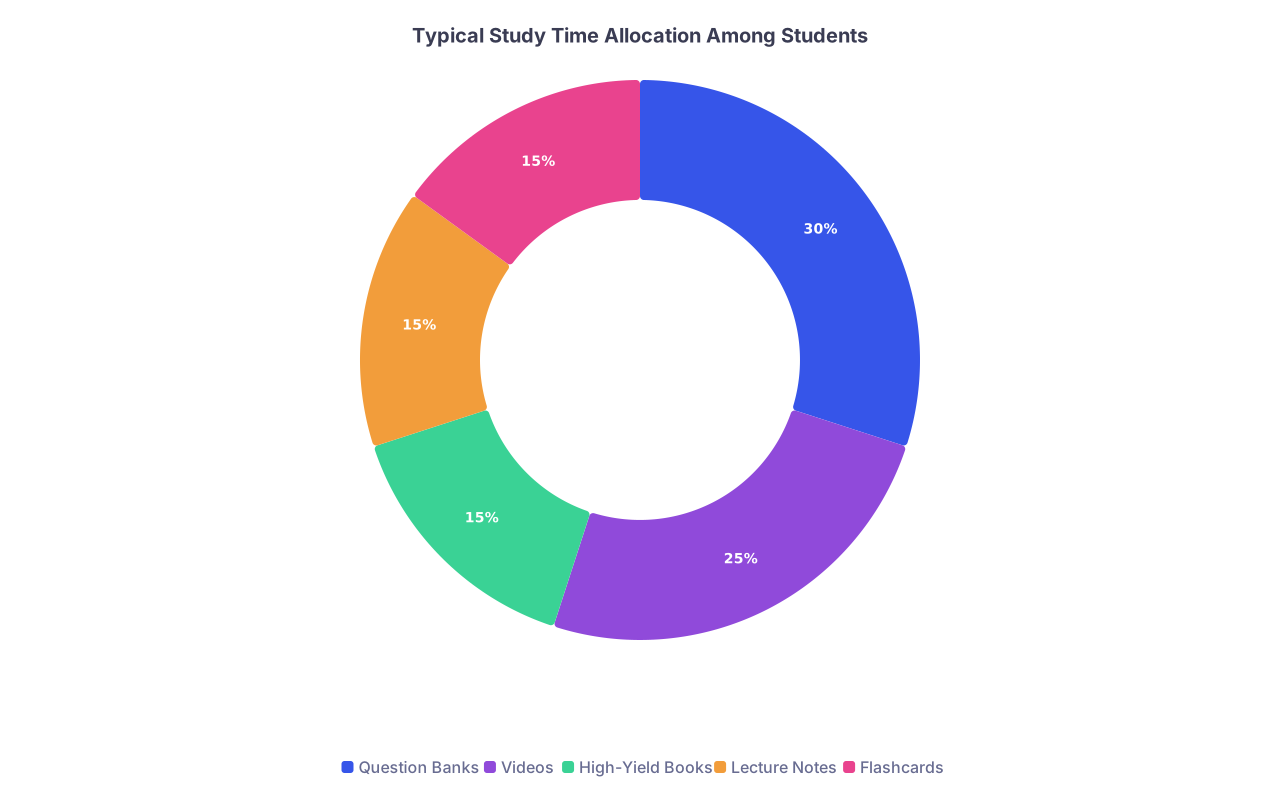
| Category | Value |
|---|---|
| Question Banks | 30 |
| Videos | 25 |
| High-Yield Books | 15 |
| Lecture Notes | 15 |
| Flashcards | 15 |
The tragic part: I’ve seen students where that “High-Yield Books” slice is more like 35–40%, with questions at 15–20%. Those are usually the ones shocked when their NBME scores plateau.
High-yield resources can be part of the arsenal. But when they become the centerpiece, you’ve swallowed the marketing whole.
So What Should You Actually Do?
A practical, non-delusional approach:
Use high-yield books as:
- A map of what’s fair game for the exam
- A glossary and quick review/refresher source
- A framework to organize what you learned from questions
Use more detailed “low-yield” resources:
- When you repeatedly miss a concept in questions
- When your “high-yield” book’s explanation is one useless sentence
- To bridge from rote memorization to actual comprehension
And keep the ratio brutally tilted in favor of:
- Practice questions
- Question review
- Active recall
Not book hopping.
Visualizing a Saner Study Mix
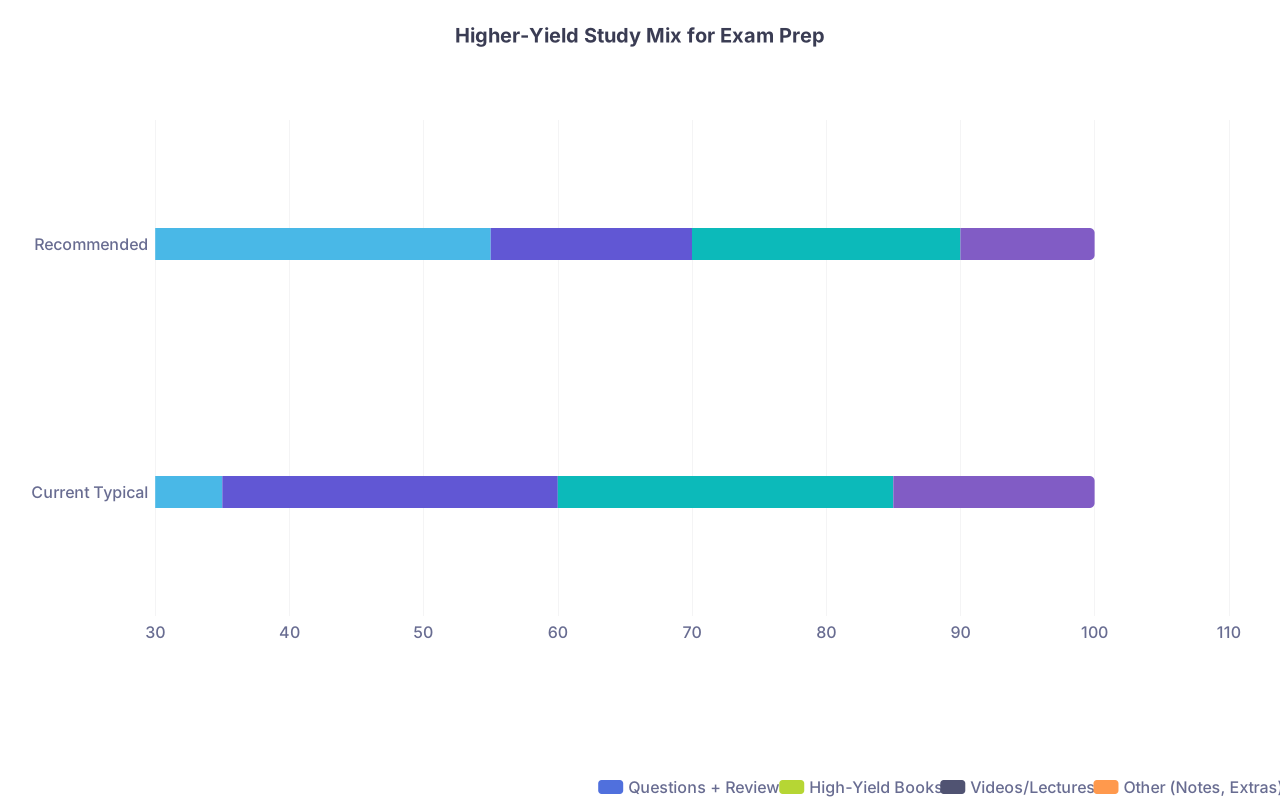
| Category | Questions + Review | High-Yield Books | Videos/Lectures | Other (Notes, Extras) |
|---|---|---|---|---|
| Current Typical | 35 | 25 | 25 | 15 |
| Recommended | 55 | 15 | 20 | 10 |
Notice the change: questions and review dominate. High-yield books shrink to their proper role.
The Bottom Line
Three takeaways, no fluff:
- “High-yield” and “low-yield” on book covers are marketing tags, not scientific categories. Yield is about your score gain per hour, not page count.
- Question banks and active recall drive exam performance far more than which “high-yield” book you pick. Books support; they do not carry.
- The only honest way to judge a resource: test yourself, study with it briefly, test again. If your question performance and understanding don’t move, it’s low-yield for you—no matter what the cover screams.