What if the reason you blank on questions you know you’ve “done 3 times in Anki” isn’t that you need more decks—but that you’ve turned your brain into a card-sorting machine instead of a problem-solving one?
Let’s go straight at the sacred cow: “I just need to find the right deck(s) and grind more cards.”
This mentality is all over med school Discords and Reddit. It is also one of the fastest ways to wreck your test-day recall while feeling weirdly productive.
You do not have a deck problem. You have a cognitive load and transfer problem.
What Anki Is Actually Good At (And Where It Quietly Fails)
Anki is built on spaced repetition and active recall. Those are real, well-supported learning principles.
The jump people make—incorrectly—is this: “Spaced repetition is good → more cards and more decks must be better.”
That’s not how this works.
There are three important, non-negotiable realities:
- Spaced repetition helps retention of discrete facts, especially when the prompts are clear and unambiguous.
- Board-style exams do not primarily test discrete facts in isolation, they test recognition and application in noisy contexts.
- Your working memory is limited, and shoving 7 decks into it at once is like opening 30 Chrome tabs on a 10‑year‑old laptop.
The research on flashcards is pretty consistent:
- Flashcards improve recall of simple information.
- They work best when:
- Information is well organized and limited in scope.
- Prompts are clear and closely match how you’ll be tested.
- You have time for multiple review cycles.
Med students throw that out the window. Instead, they:
- Download a massive deck (AnKing, Lightyear, Pepper, whatever’s trendy this week).
- Keep the preclinical deck, plus a question-bank deck, plus some random micro deck, plus an “EKG pearls” side deck “just in case”.
- End up with 1,000+ reviews per day and call it “grind mode” like that’s a good thing.
It’s not grind mode. It’s cognitive self-sabotage disguised as productivity.
The Multi-Deck Trap: Why More Decks ≠ More Recall
Here’s the core myth:
“If one deck helps, more decks will help more. I’ll cover all angles.”
No. You’ll cover almost nothing deeply and your test-day brain will short-circuit.
Let me translate what I’ve seen over and over in students who “do tons of Anki” and still underperform:
- They know hundreds of micro facts.
- They can recite the triad for some obscure disease.
- They get wrecked by a simple Step-style question that buries that disease in a 2–3 paragraph vignette with overlapping findings.
Because their practice has trained: “See keyword → spit keyword”
But the exam asks: “See noise → filter → identify pattern → choose best explanation or next step.”
More decks typically make this worse, not better.
Why?
1. Fragmentation of Context
When you use multiple decks built by different people, you inherit their structure (or lack of it).
Deck A: One card says “beta blocker”
Deck B: Another says “metoprolol”
Deck C: “↓ mortality in HFrEF: which drug?”
You feel like you’ve “seen” heart failure management 50 times.
But the actual web of understanding—how those cards connect, when and why you’d choose each drug—never gets built. You are reheating leftovers from three different kitchens and calling it a meal.
On test day, your brain has to assemble those fragments in real time, under time pressure. Too many students discover at 9:40 am in Prometric that this assembly process is slow, error-prone, and panicky.
2. Spaced Repetition Does Not Fix Garbage Prompts
Anki schedules the when, not the what.
If your decks are full of:
- Cloze deletions ripped straight out of boards-style resources with zero context
- Cards that test five facts at once
- Overly cryptic front sides (“Tx?” “Path?” “Bug?”)
…no amount of spacing will magically turn those into good learning.
Multiple decks multiply the problem: now you have inconsistent prompts and duplicate, low-yield, or conflicting cards. You think: “It’s okay, I’ll see it a lot, I’ll remember.”
No. You’ll remember that you’ve seen it. Not what it actually means or when to use it.
3. Review Load Crushes Quality
I’ve worked with students who hit 800–1,200 reviews per day for weeks. On paper, they look disciplined. In reality, they’re racing.
Racing means:
- Reading only the bolded word and smashing “Good”
- Ignoring explanations because “I’ve got 500 cards left”
- Auto-passing “familiar” cards you cannot actually explain out loud
With several decks active, your daily review count explodes. At that point, Spaced Repetition stops being a learning engine and becomes a guilt machine. Red numbers, overdue cards, and the feeling of constantly being behind.
There’s data on this. Overload reduces depth of processing and recall accuracy, especially when items are similar and interfere with each other. Exactly like 15 slightly different cards about glomerulonephritis split across three decks.
More decks → more interference → poorer discrimination.
4. The Transfer Problem: Anki ≠ Question Bank
Ask yourself bluntly: “Am I training to answer Anki cards, or to answer NBME-style questions?”
The two are not the same skill.
Multiple decks make this disconnect worse because they keep you in card mode longer:
Flashcard brain:
- Recognizes short cues
- Operates in clean, binary answer format
- Sees one concept at a time
Exam brain:
- Handles long vignettes
- Juggles multiple organ systems and time courses
- Chooses between plausible answer choices
You can absolutely make Anki closer to exam thinking. But that takes fewer, better cards, not six giant pre-made decks.
What the Data and Real Outcomes Actually Suggest
No, there isn’t an RCT of “AnKing + Pepper + Lightyear vs. single curated deck” for Step 1. But we have:
- Cognitive psychology research on retrieval practice and interference
- Observational outcomes from thousands of students
- Very consistent patterns in who scores well vs. who burns out
Here’s the unsexy truth: people who crush exams tend to:
- Use fewer resources.
- Limit deck sources and customize.
- Spend a large fraction of time on questions and explanations, not just flipping digital flashcards.
And the students who are constantly in “what other deck should I add?” mode? They tend to be the ones plateauing.
Let me give you a modeled comparison.
| Approach | Deck Sources | Avg Daily Reviews | Qbank Questions/Day | Typical Outcome Trend |
|---|---|---|---|---|
| Multi-deck grinder | 4–6 | 800–1,200 | 0–20 | Plateau, burnout |
| Focused deck user | 1–2 | 250–450 | 40–80 | Steady score growth |
| No-deck crammer | 0 | 0 | 20–40 | Spotty recall |
Is this a controlled trial? No. But it matches what faculty, tutors, and high-scorers see repeatedly.
And there is actual cognitive science behind this:
- You consolidate learning when you retrieve and then elaborate (e.g., via question explanations, teaching, integrating across systems).
- Overloaded flashcard usage starves you of time for elaboration and question-based learning.
The Real Levers: Card Quality, Alignment, and Integration
You want better recall on test day? Forget the Pokémon mentality of “gotta catch ’em all” with decks.
You need:
- Fewer, higher-quality cards
- Alignment with your primary learning resource
- Integration with questions and real reasoning
Let’s make this practical.
1. One Core Deck, Maybe One Supplement. That’s It.
Pick your main content spine: Boards & Beyond, Pathoma + a systems book, Sketchy, whatever your school uses.
Then:
- Use a single well-tagged, mature deck that aligns with that resource (e.g., a single adjusted AnKing setup tied to B&B/First Aid/Sketchy).
- If you absolutely must add another deck, it should fill a clear, narrow gap (e.g., a short pharm deck because you’re weak in mechanisms).
But once you hit two meaningful deck sources, you’re playing with fire. Any more and you’ve probably stopped studying and started collecting.
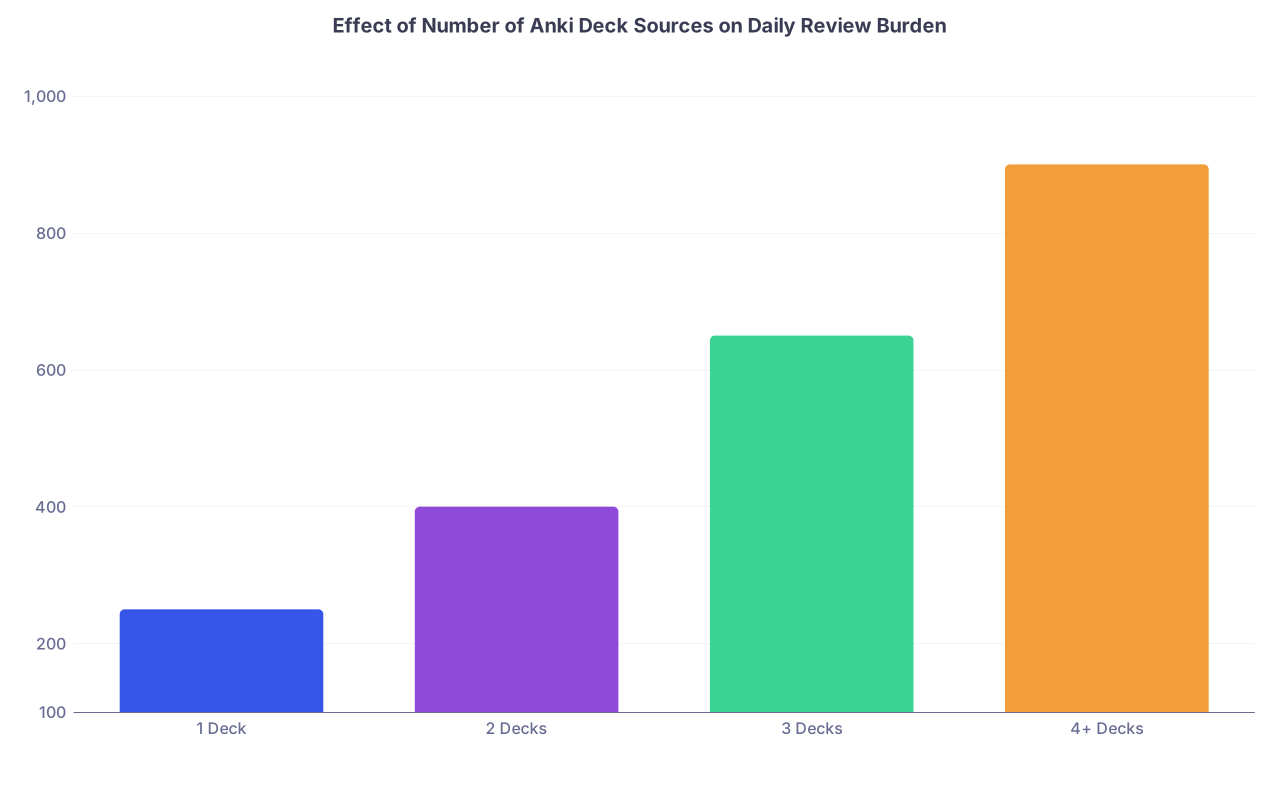
| Category | Value |
|---|---|
| 1 Deck | 250 |
| 2 Decks | 400 |
| 3 Decks | 650 |
| 4+ Decks | 900 |
That increase in review count is not free. It comes out of your question-bank time, sleep, or basic sanity.
2. Customize Ruthlessly: Suspend, Edit, Delete
Downloading a big deck doesn’t mean you owe every card your attention.
Strong students:
- Suspend low-yield or redundant cards aggressively.
- Edit confusing prompts into clear, exam-like questions.
- Delete cards that don’t fit how they’re learning.
If your multi-deck setup has you memorizing every single weird side effect of a fourth-line drug that’s never appeared on an NBME, you’re doing compliance, not studying.
Ask with each subdeck or tag: “Does this help me get more points on the exam?” If you can’t answer that, it probably doesn’t.
3. Tie Cards Directly to Questions and Misses
Your deck should increasingly become a reflection of what you miss in questions, not a shrine to everything ever written in First Aid.
Here’s a flow that actually builds test-day recall:

| Step | Description |
|---|---|
| Step 1 | Do Qbank Block |
| Step 2 | Review Explanations |
| Step 3 | Create/Edit Targeted Card |
| Step 4 | No New Card |
| Step 5 | Tag by System & Topic |
| Step 6 | Daily Anki Reviews |
| Step 7 | Missed or Unsure? |
Notice what’s missing: “Import three more massive decks because someone on Reddit said so.”
Cards built from your own confusion are:
- More meaningful
- Easier to remember
- More likely to match your actual exam weaknesses
That’s how you get recall that survives the chaos of test day.
4. Protect Question Time Like It’s Sacred
If your deck situation is cutting into Qbank time, the deck loses. Every time.
A rough but sane split for many students in board prep:
- 50–60% of study hours: Questions + detailed review
- 20–30%: Anki review (high-yield, targeted)
- Remainder: Primary resources / clarifying weak spots
When Anki flips and becomes 60–70% of your time, your scores stagnate. I’ve seen it enough times that I don’t consider it an edge case. It is the default outcome of multi-deck bingeing.
How to Tell If Your Deck Usage Is Hurting You
Run a quick self-audit. Be honest.
You might have a problem if:
- You feel anxious if you don’t clear your reviews, even when you haven’t touched questions in days.
- You know you’ve “seen” a topic in Anki 10 times but cannot explain it out loud for 30 seconds without stumbling.
- Your NBME or Qbank percent correct is flat or dropping, but your daily review count is climbing.
- You routinely hit ‘Good’ on cards you’d get wrong if they showed up as a vignette.
If that’s you, the fix is not “add another micro deck.” The fix is subtraction.
A Simpler, Saner Anki Strategy That Actually Boosts Recall
Here’s the streamlined version that works better than the maximalist deck hoarding:
- Pick your resource spine (B&B+First Aid, or your school notes+UWorld, etc.).
- Choose one main deck aligned to that. Disable whole chunks you know you won’t consistently see or you’re unlikely to be tested on.
- Keep daily reviews in a sustainable range (usually 200–400 for most students who also do serious question work).
- Use questions to drive new card creation/editing, not to justify adding entirely new decks.
- Periodically purge: once a week, suspend or delete cards that are too low-yield, duplicative, or not sticking despite repeated attempts.
And then—most people miss this part—actually accept that you will not memorize every fact. You’re aiming for exam performance, not an encyclopedic brain.
Because that’s the quiet poison inside the “more decks” myth: the belief that if you just memorize enough isolated flashcard facts, the exam will somehow collapse into a giant recognition task.
It won’t. It never has.
The Myth, Busted
To wrap this up without repeating every line:
- More Anki decks do not equal better recall. They equal more interference, higher review loads, and less time for the thing that moves scores most: high-quality question practice with deep review.
- Test-day recall comes from targeted, integrated practice, not from hoarding pre-made decks. Fewer sources, better cards, and question-driven customization beat “AnKing + 5 side decks” every single time.
- If your Anki setup feels like an arms race, you’ve already lost. Simplify, prune, and realign your decks to what actually gets points on your exam.