
Why More Q-Banks Don’t Automatically Mean Higher USMLE Scores
How many USMLE question banks are you logged into right now—three, four, five—and still feel like your score is stuck in the mud?
Let me be blunt: the cult of “more Q-banks = higher score” is one of the most persistent, expensive, and poorly supported myths in USMLE prep. It’s great for companies’ revenue. Not so great for your learning.
You’ve heard classmates brag: “Yeah I’m doing UWorld, Amboss, USMLE-Rx, and Kaplan—gonna crush Step.” They say it like hoarding logins is a study strategy. It isn’t.
Let’s actually pull this apart.
The Core Myth: Question Quantity = Score Quality
The popular script goes like this:
- Top students do tons of questions.
- Q-banks provide questions.
- Therefore, more Q-banks = more questions = more points.
The logic feels right. It’s also wrong in two critical ways.
First problem: correlation vs causation. High scorers do tend to complete a lot of questions. But they also tend to do a lot of other things well—active review, early start, tight feedback loops, honest self-assessment. Just copying the “lots of questions” part without the rest is like copying only the warmup of an athlete and expecting Olympic medals.
Second problem: diminishing returns. The difference between 0 and 2,000 high‑quality questions is massive. The difference between 4,000 and 8,000 is much smaller, and often negative once fatigue and shallow learning kick in.
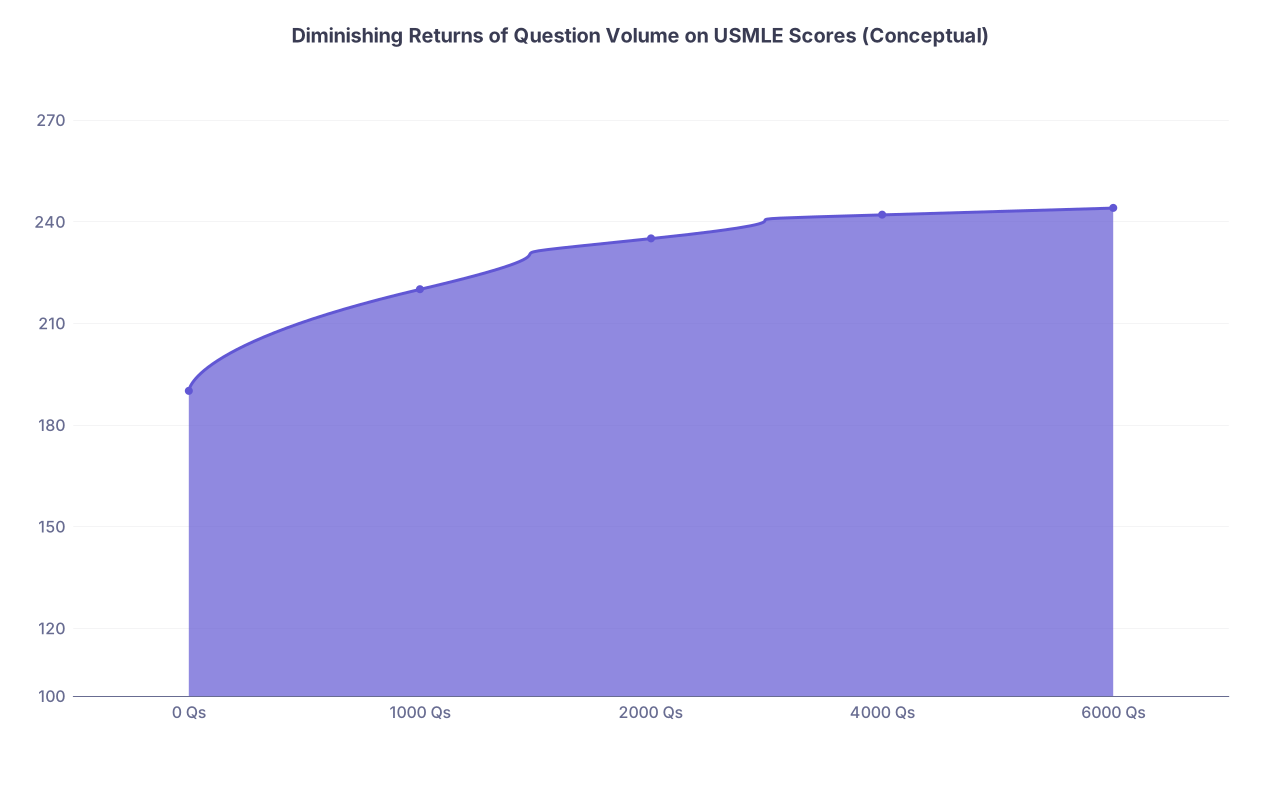
| Category | Value |
|---|---|
| 0 Qs | 190 |
| 1000 Qs | 220 |
| 2000 Qs | 235 |
| 4000 Qs | 242 |
| 6000 Qs | 244 |
The pattern I’ve seen repeatedly:
– Student A does one primary Q-bank deeply and systematically.
– Student B uses three Q-banks, rushes through blocks, and “sees everything once.”
Student A almost always wins. Even with fewer total questions.
What the Data (And Real Outcomes) Actually Show
No, there is not a randomized controlled trial of “1 Q-bank vs 3 Q-banks” for Step 1. But we do have several lines of indirect evidence and a lot of real-world outcome data from schools and tutoring programs.
Here’s what actually tracks with better scores:
- Mastery of one primary Q-bank (UWorld is the usual) with detailed review
- Performance on NBME practice exams and how that changes over time
- Quality of review (creating and revisiting Anki/notes from missed questions)
- Time spent in focused, test-like conditions vs scattered, low-attention grinding
What doesn’t show consistent incremental benefit once you’ve got one strong bank?
- Stacking multiple similar general Step-style Q-banks “just to see more questions”
If sheer volume were the magic ingredient, you’d see a clear, linear relationship: every 1,000 questions → X points added. You don’t. You see plateaus and, past a point, burnout.
A typical pattern I’ve heard from dozens of students:
“I did all of UWorld once (about 2,000 questions) with detailed review. Scores went from 210 to 235 on NBMEs. Then I added another Q-bank and tried to push through another 2,000 questions. Scores barely moved, my review got sloppy, and my last NBME actually dropped a bit.”
Not proof in the statistical sense, but the signal is loud and consistent.
The Three Things Q-Banks Actually Do (And Where Extra Ones Fail)
There are really only three core jobs a USMLE Q-bank can do for you:
- Teach and reinforce content in context
- Train test-taking and reasoning patterns
- Diagnose your weaknesses for targeted review
A single high-quality bank already does all three. So what does the second, third, or fourth bank really add?
1. Content Learning: There’s Only So Many Ways to Ask About DKA
There are a finite number of high-yield ways to test core pathophys and management.
Switching from UWorld to another general-purpose Step bank often gives you:
- Different stems, similar concepts
- Slightly different explanation style
- Sometimes worse editing or question quality
But concept overlap is huge. If you didn’t actually learn DKA from the first bank—mechanism, labs, key management steps—seeing four more variants from other banks doesn’t magically fix the problem. You’re just re-encountering your own confusion.
What improves your score isn’t seeing concept X five times in different banks. It’s seeing it once, struggling, then spending 15 minutes untangling why you were wrong and locking in the correct reasoning.
2. Test-Taking Skills: Style Adaptation vs Skill Mastery
Each Q-bank has its own writing style, density, and quirkiness. USMLE has its own too.
If you spend your time bouncing between three different “accents” of question-writing, you’re wasting adaptation cycles. Your brain keeps re-learning the interface and style instead of refining generalizable test-taking skills:
- Extracting the question’s actual ask
- Filtering relevant vs irrelevant info
- Tracking time and pacing
- Managing uncertainty and educated guessing
One primary high-quality bank plus a mix of NBME forms gives you enough style exposure without fragmentation.
3. Diagnostics: More Numbers ≠ More Insight
Most students with three or four Q-banks end up with this mess:
- UWorld: 62% correct
- Amboss: 55% correct
- Some other bank: 70% correct
- No clear interpretation, lots of anxiety
Different question difficulties. Different pools. No standardized curve. No meaningful benchmark.
By contrast, NBME practice exams are designed to be predictive and standardized. If you want to know where you stand, they’re far better than “my third Q-bank percentage is 64%.”
You don’t need five thermometers to know you have a fever. You need one good one, used properly.
Where Extra Q-Banks Do Make Sense (Sometimes)
Let’s be fair. More isn’t always useless. There are focused, defensible reasons to add targeted banks.
These are cases where extra banks can actually complement, not dilute, your prep:

1. Targeted Specialty/Discipline Reinforcement
Examples:
- You’re weak in pharmacology and use a pharm-heavy bank or section specifically for that.
- You struggle with biostats and use a small, focused biostats Q-bank.
- You’re prepping Step 2 CK and add a case-based or CCS-specific resource, not just another generic block bank.
Here, you’re not chasing volume. You’re plugging a known hole.
2. After Truly Mastering Your Primary Bank
Truly means:
- You’ve finished it
- You’ve reviewed every missed question thoroughly
- You can explain your logic for right and wrong answers
- Your NBME practice scores are close to your goal, but you want a bit more exposure to reduce test-day novelty
At that point, a curated set of extra questions—especially harder ones—can stress-test your understanding. But this is the last 10–15% of prep. Not the first 80%.
3. Early Preclinical Years, Low-Intensity Exposure
For an M1/M2 who:
- Isn’t in intensive dedicated study
- Wants to do topic-based questions aligned with current coursework
- Uses a broader mix of banks to see concepts from different angles over years, not weeks
In that long time frame, having multiple banks sprinkled in can be okay. But even there, depth beats breadth.
The Real Enemies: Shallow Review, Fragmentation, and Ego-Grinding
The biggest score killers I see aren’t “only used one Q-bank.” They’re these three:
1. Shallow Review Culture
Doing 120 questions in a day and “reviewing” them in 45 minutes is a disaster. I’ve watched students:
- Skim explanations for right answers as fast as possible
- Barely read explanations for wrong ones
- Not write down a single key takeaway
- Never revisit mistakes in any systematic way
Then they’re shocked when their NBME scores don’t budge.
You’d get more score movement from 40 questions thoroughly reviewed daily than 100 questions glanced over across three banks.
2. Fragmentation of Cognitive Context
Every time you switch platforms:
- Different interface
- Different keyword highlighting
- Different explanation style
- Different metrics and dashboards
That’s cognitive overhead. Not learning.
Your brain thrives on consistent formats when building pattern recognition. Jumping platforms constantly is like switching EMRs every shift. Doable. But inefficient as hell.
3. Ego-Grinding and Percentage Chasing
Some students collect Q-banks for the same reason people collect gym memberships: it feels like progress.
I’ve literally heard, “My Kaplan percentage is higher so I do that when I’m tired; makes me feel better.” That’s not prep; that’s psychological self-medication.
You don’t need comfort percentages. You need honest feedback and corrected reasoning.
Time, the Only Real Currency You Can’t Rebuy
The hidden cost of “just add another Q-bank” isn’t the subscription fee. It’s opportunity cost.
Say you add a second full Q-bank of 2,000 questions.
Conservative math:
- 40 questions / day
- 2 hours to do and properly review them
- 50 days of effort
What could those same 100 hours do if used differently?
- 8 full-length NBME practice exams, fully reviewed
- 6–8 weeks of consistent, high-yield Anki reviews
- Deep review of your incorrect UWorld questions, with consolidated notes
- Focused passes over your weakest systems (neuro, renal, etc.) using a textbook or boards resource
| Option | Approx. Hours | Likely Score Impact |
|---|---|---|
| Second full general Q-bank | 100 | Low to variable |
| 6–8 NBMEs + detailed review | 80–100 | High, targeted |
| Deep review of all UWorld wrongs | 60–80 | High, concept consolidation |
| Daily Anki + weak area review | 80–100 | High, durable retention |
If your schedule is already tight—like most real students—you can’t afford to burn 100 hours on low-yield redundancy.
A Simpler, Smarter Model for Using Q-Banks
Strip away the marketing, and an efficient Q-bank strategy looks more like this:
- Pick one primary bank that’s known for high-quality questions and explanations. For most, that’s UWorld.
- Do timed, random blocks once you’re far enough along. Simulate the real exam.
- Review each block slowly and brutally honestly.
- Why was the right answer right?
- Why was your chosen answer wrong?
- What concept did you actually miss?
- How will you remember this next time?
- Create a feedback loop. Missed concept → note/Anki card → revisit.
- Use NBME practice exams as your reality check, not random Q-bank percentages.
- Add a second resource only if it fills a specific, clearly identified gap (e.g., targeted pharm, biostats, or advanced questions late in prep).
You’ll notice that list isn’t sexy. It won’t fill your bookshelf or your browser with five colored logos. It does, however, align with how durable learning and skill acquisition actually work.

| Step | Description |
|---|---|
| Step 1 | Primary Q-bank block |
| Step 2 | Timed test conditions |
| Step 3 | Thorough review of each question |
| Step 4 | Move on |
| Step 5 | Create Anki/note |
| Step 6 | Regular spaced review |
| Step 7 | NBME practice exam |
| Step 8 | Optional targeted extra Q-bank |
| Step 9 | Concept mastered? |
| Step 10 | Score near goal? |
Why This Myth Refuses to Die
If “more Q-banks = better score” is so shaky, why does it keep spreading?
Simple:
- Companies profit from selling you “complementary” banks
- Students love feeling busy and “hardcore” by stacking resources
- Fear makes you think: “If I don’t do everything, I’ll fall behind.”
But here’s the reality: nobody on the score report cares how many Q-banks you had logins for. They care what number prints at the top.
You do not get extra points for:
- Completing three vendors
- Filling a spreadsheet with five different percentages
- Owning every resource someone on Reddit mentioned
You get points for recognizing patterns, understanding mechanisms, and executing calmly under time pressure. One well-used bank plus focused review does more for that than four half‑used ones.
The Takeaway You Probably Don’t Want, But Need
If your current plan involves three or more general Step-style Q-banks, you’re not “hardcore.” You’re probably inefficient.
A more honest question isn’t “Which extra Q-bank should I add?” It’s:
“Am I wringing everything I can out of the one I already have?”
Most students aren’t. They’re half‑reviewing, chasing comfort percentages, and hopping banks when boredom or anxiety hits.
Years from now, you won’t remember how many question banks you paid for. You’ll remember whether you built real understanding, or hid your anxiety under a pile of half‑finished blocks.