
You are not doomed because you hate reading dense review books.
Let me say that again, more bluntly: hating First Aid-style walls of text does not automatically put you behind your classmates. What puts you behind is forcing yourself to study in a way your brain hates until you burn out and give up.
But I get why you’re freaking out.
Everyone around you is walking around with BRS, Pathoma book, First Aid, UWorld notes printed out like a phone book. People say stuff like, “Yeah I just read First Aid cover to cover 3 times,” like that’s a normal hobby and not a form of psychological warfare. And you’re sitting there thinking:
- “I literally cannot get through two pages without my eyes glazing over.”
- “If I can’t grind these books, I’ll never score high enough.”
- “What if my brain just isn’t built for med school?”
Let’s pull this apart before you spiral.
The Big Lie: “Good Test-Takers Love Dense Books”
Here’s the ugly truth: a ton of people who say they’re “just reading review books” are actually doing 5 other things on top of that. You’re only seeing the book in their hand, not the 3 hours of question blocks, Anki, and videos they did before you walked into the library.
And dense review books? They’re not magical. They’re just:
- Condensed facts
- Organized in a particular way
- Written for people who already know 60–70% of the material
So if you crack open a big Step-style book and feel instantly dumb, that doesn’t mean you’re dumb. It means:
- You’re probably reading something designed as a summary, not a teacher.
- You might be earlier in your learning curve than the intended audience.
- Your brain doesn’t love that learning format. Which is extremely human.
There are really only three questions that matter:
- Can you understand the tested material deeply enough?
- Can you recall and apply that material under exam conditions?
- Can you sustain your study system without mentally breaking?
Notice what’s not in that list: “Did you read X review book cover to cover?”
Are You Actually at a Disadvantage?
Here’s the annoying, honest answer:
You’re only at a disadvantage if you refuse dense books but don’t replace them with something equally or more effective.
It’s not about what you won’t do. It’s about what you’ll do instead with that time.
Let’s compare.
| Approach | Strength | Weakness |
|---|---|---|
| Dense Review Books | Fast reference, high-yield list | Hard to focus, low retention |
| Question Banks | Application, feedback | Can feel slow, demoralizing |
| Videos | Explanations, visuals | Time-consuming, passive risk |
| Anki / Flashcards | Long-term retention | Repetitive, time sink to make |
| Diagrams/Whiteboard | Deep understanding | Takes effort, not “efficient” |
You’re not “behind” just because you hate one column of that table. You’re behind if you hate dense books and then… kind of just flail.
Let me be concrete.
If Student A reads 2 hours of dense review with 40% actual retention (because they’re zoning out), and
Student B does 1 hour of targeted questions + 1 hour of active recall + videos, with 70% retention…
Student B wins. Every time. Even if Student A “looks” more hardcore with a giant book.
So no, by default you’re not at a disadvantage.
You’re at a crossroads.
Why Dense Review Books Feel So Miserable
If you hate them, there’s usually a reason. More than one, actually.
You’re earlier in the learning curve than the book assumes.
Reading a Step-level summary when you barely understand the basics is like reading the last page of a mystery novel and trying to guess the plot.You’re a context-first learner.
Some people need the story, the mechanism, the reason. Pure lists of facts feel like static to these brains. That’s not a flaw; that’s wiring.Your attention span is already maxed.
You’ve sat through lectures, labs, small groups. Then you open a 700-page book with tiny font. Your brain taps out in self-defense.You equate “slow reading” with “being behind.”
So you skim. And then you retain nothing. And then you panic. Which makes it even harder to read. And now you’re in the death spiral.
None of those mean you’re going to be a bad doctor. They mean you’re trying to use the wrong tool for how you learn.
So What Do You Use Instead?
Let’s build out actual alternatives. Not vague “use active learning” nonsense. Concrete paths.
1. Question-First Learning (QBank-Centered)
You start from questions, not from text. For most med exams, this is underrated and incredibly powerful.
Rough sketch of a day:
- 20–40 questions (UWorld, AMBOSS, school question bank)
- For every missed or guessed question:
- Read the explanation
- Write down or Anki the 1–2 key ideas
- If it’s still fuzzy → quick targeted video or short reference
You’re building a knowledge graph from real test content outward. Questions tell you:
- What the exam actually cares about
- How concepts link together
- Where you are truly weak (not where you just feel weak)
If you did only questions + review and skipped dense text almost entirely, you’d still be in solid shape for many exams (Step 1, Step 2, shelves). I’ve seen people hit 240–250+ living almost entirely in UWorld + light resources.
2. Video + Active Recall Combo
If you learn better from someone explaining it out loud, own that. Just don’t let it turn into Netflix.
Something like:
- Watch a focused 10–20 minute video (Boards and Beyond, Pathoma, OnlineMedEd, Sketchy, etc.)
- Immediately close the video and:
- Summarize on paper from memory
- Teach an imaginary class
- Make 5–15 flashcards from your brain, not copying slides
Then a few hours later or next day:
- Do related QBank questions
- See how much sticks
You’re replacing dense paragraphs with verbal + visual explanation + retrieval, which for many people works way better.
3. “Micro-Use” of Dense Books (Targeted, Not Cover-to-Cover)
You don’t have to completely ban them from your life. You can treat them like dictionaries, not novels.
Use them for:
- Clarifying one confusing concept
- Skimming a section after you’ve already built a base from videos/questions
- Rapid review bullet points the last 1–2 weeks before an exam
Think: “5–10 minutes here and there,” not “I’m going to read 40 pages tonight.”
4. Diagrams, Whiteboards, and Ugly Sketches
This is the stuff people secretly do but never brag about because it doesn’t look “efficient.”
Drawing weird nephron diagrams, cytokine webs, biochem pathways from memory on a whiteboard and talking to yourself out loud looks ridiculous.
It also:
- Forces deep processing
- Exposes holes brutally fast
- Sticks long-term
If you hate reading paragraphs, write your own condensed versions. Draw your own flowcharts. It’s still review—but on your terms.
What About Exam Day Performance?
Your anxiety here is actually rational: exams are written; dense review books look like the exam; so shouldn’t you practice reading dense stuff?
Here’s what matters more:
- Can you pull the concept out of your head when you see a clinical stem?
- Can you recognize distractors?
- Can you apply knowledge in a slightly different scenario than you memorized?
Those skills come from:
- Doing lots of questions
- Practicing timed blocks
- Reviewing mistakes viciously
Not from staring at three columns of bullet points until your soul leaves your body.
To calm your brain a bit, here’s what successful prep commonly looks like across different “types” of students:
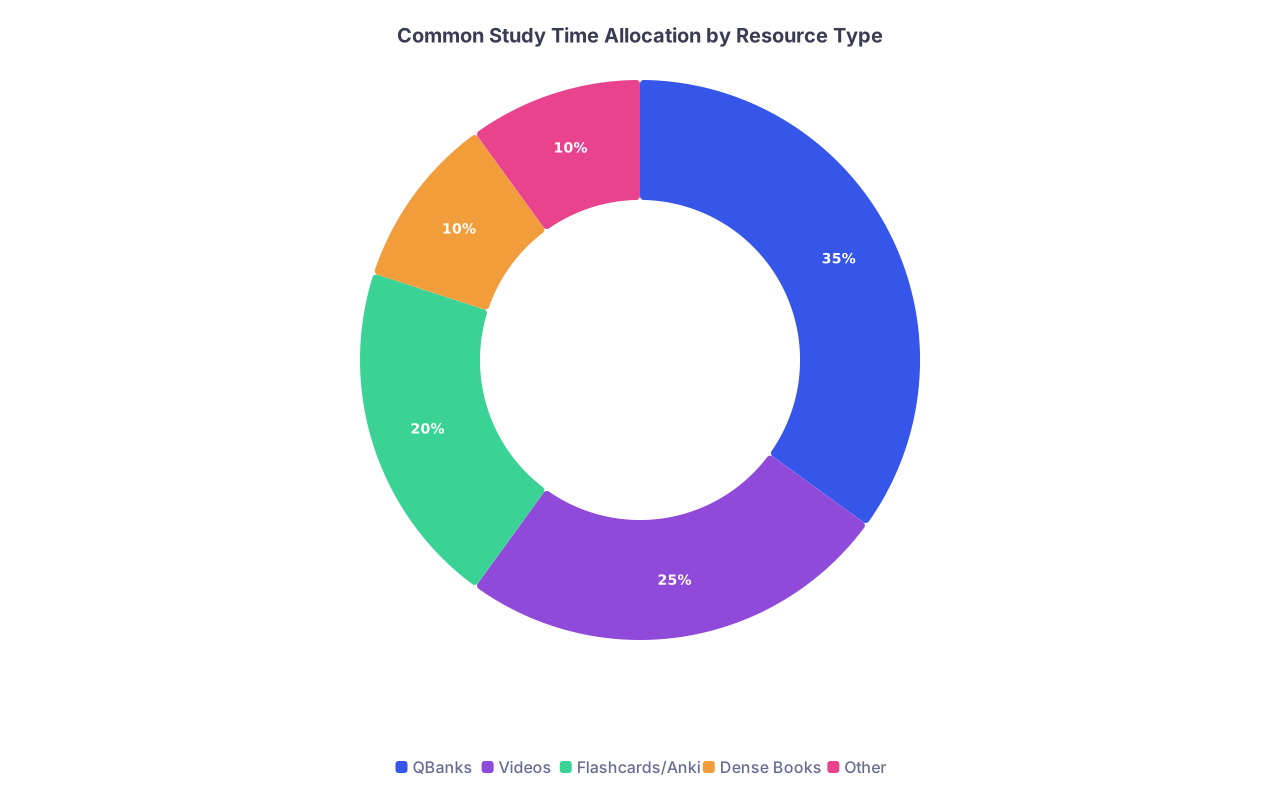
| Category | Value |
|---|---|
| QBanks | 35 |
| Videos | 25 |
| Flashcards/Anki | 20 |
| Dense Books | 10 |
| Other | 10 |
Notice that sliver for “Dense Books”? Most people doing well are not secretly spending 70% of their time on them. That’s your anxiety talking.
How to Stop Feeling Like You’re “Cheating” By Not Reading Everything
You probably have this running script: “Real med students read BRS cover to cover. If I don’t, I’m taking a shortcut.”
This is wrong. And destructive.
Your metric cannot be “Am I suffering in the same exact way as everyone else?” Your metric has to be:
- Are my practice scores improving?
- Do I understand more this week than last week?
- Can I explain the concept without peeking?
That’s it.
Let me be blunt: some of the highest scorers I’ve seen flat-out refused to grind entire review texts. They stitched together:
- QBank
- Anki / flashcards
- Sketchy / Boards and Beyond / Pathoma
- A tiny bit of First Aid only for final polishing
Did they feel guilty sometimes? Yup.
Did they complain, “I should really read more of X book…” while scoring in the 250s? Also yes.
Your brain will always try to convince you that the thing you’re not doing is the magic solution. It’s lying. The only thing that matters is what’s actually moving your scores.
A Rough Framework If You Hate Dense Books
If you want something to hold onto, here’s a simple, realistic structure that doesn’t depend on you being a reading robot:

| Step | Description |
|---|---|
| Step 1 | Start Topic |
| Step 2 | Watch focused video or lecture |
| Step 3 | Active recall: notes/teach/draw |
| Step 4 | Do related QBank questions |
| Step 5 | Review explanations & make flashcards |
| Step 6 | Check short section in review book or another video |
| Step 7 | Move on & schedule spaced review |
| Step 8 | Still confused? |
You’re only using dense text as a backup when questions + videos + recall fail. Not as your main weapon.
Signs Your Current Approach (Book or No Book) Is Actually Working
You want reassurance? Here are actual metrics to watch that mean you’re not secretly tanking your future:
- Your practice questions correct % is slowly trending up (even if it dips on bad days).
- When you miss questions, you think, “Ugh, I almost remembered that,” not “I’ve never seen this in my life.”
- You can explain core topics out loud without reading from notes.
- You don’t feel like you’re starting from zero every single morning.
If those are true—even faintly true—your hatred of dense books is not killing you.
When You Might Need to Suck It Up a Little
I’m not going to sugarcoat: there are some situations where you may need at least some tolerance for dense text:
- Last 1–2 weeks before a huge standardized exam when you’re filling in small gaps fast
- School exams written almost directly from a review book or syllabus
- Weak areas where there just aren’t good videos or question explanations
Even then, it doesn’t have to be hours. You can:
- Set a timer for 20–25 minutes (Pomodoro style)
- Pick a micro-section (1–3 pages max)
- Read with a highlighter and force yourself to write 5 memory-aid lines after
Then get out. Don’t camp in there for 3 hours.
You’re allowed to say: “My brain hates this. I’ll use the minimum amount of this tool required to get the job done, then switch back to what actually works for me.”
Bottom Line: Are You Screwed?
No.
You’re not behind because you hate dense review books. You’re behind if you:
- Hate them
- Don’t build a serious alternative
- Spend all your time worrying that everyone else’s method is better than yours
You’ll always find that one classmate who claims they got a 260 by “just reading First Aid twice.” Good for them. That’s their nervous system. You don’t have to cosplay as them.
You need:
- A question-based backbone (QBanks).
- An explanation source that’s not soul-crushing (videos, good notes, diagrams).
- A retrieval system (Anki, self-quizzing, whiteboard teaching).
- Micro-doses of dense text only when truly needed.
Do that consistently, and you’re fine. Really.
FAQ (Exactly 4 Questions)
1. Everyone in my class reads First Aid / BRS constantly. Am I missing something huge by not doing that?
You’re missing what looks like productivity, not necessarily what works. A lot of people “read” by skimming while half-dissociated. The exam doesn’t care how many pages you turned; it cares how many concepts you can apply. If your QBank performance and recall are improving with your method, you’re not missing anything crucial. If they’re not, adjust the quality of what you’re doing—not necessarily by forcing yourself to grind a book you hate.
2. Can I score 240+ (or honor shelves) without reading a dense review book cover to cover?
Yes. People do it every year. But they’re not winging it—they’re usually aggressive with practice questions, spaced repetition (often Anki), and high-yield videos or notes. They’re also brutally honest about their weak spots and hit them with questions + targeted review. The tradeoff is time: you might spend more hours doing questions and active recall than someone who can blast through text. But it’s absolutely possible.
3. I feel guilty if I’m not reading because it seems like the “serious” thing to do. How do I get over that?
Stop judging the aesthetic of your studying and judge the results. Track your QBank percentages, note how often you can teach concepts out loud, and monitor your practice exam trends. If your numbers are moving in the right direction, your guilt is just habit and comparison talking. If your numbers aren’t moving, change your strategy—but that still doesn’t mean “more dense reading” is the automatic fix. It might mean more questions, more review, or better sleep.
4. How can I tell if my non-book-heavy approach is actually failing and not just “different”?
Three red flags:
- Your QBank performance is flat or getting worse over several weeks.
- You repeatedly miss questions on the same concepts, even after supposed review.
- On practice exams, you constantly feel like the material looks unfamiliar, not just tricky.
If those are true, you probably have coverage gaps. At that point, it’s worth adding some structured review (maybe short book sections, a specific review resource, or a targeted syllabus) to systematically fill holes—still combined with active work, not passive reading marathons.
Key points:
You’re not handicapped just because you hate dense review books; you’re only in danger if you don’t replace them with strong alternatives.
Questions, active recall, and targeted videos can absolutely carry you, with dense text used sparingly as backup—not your main weapon.