
Introduction: Thriving Between Clinical Duties and Fellowship Preparation
Balancing demanding clinical duties with serious Fellowship Preparation is one of the defining challenges of Medical Residency. You are expected to function as a safe, efficient clinician while simultaneously building a competitive application, planning your Career Development, and preserving some semblance of a personal life.
The tension is real:
- Day and night call schedules
- Documentation and patient care responsibilities
- Board exam preparation
- Research, QI projects, teaching
- Plus researching fellowship programs, writing personal statements, requesting letters, and traveling for interviews
This guide lays out a practical, realistic roadmap for residents who want to excel clinically and submit a strong, timely fellowship application—without burning out. You’ll find strategies grounded in time management, workflow optimization, and intentional career planning, all tailored to the reality of residency life and challenges.
Why Balance Matters: The Hidden Upside of Doing Both Well
Balancing Clinical Duties and fellowship prep is not just about survival. When done thoughtfully, each side actually strengthens the other.
Enhanced Clinical and Academic Performance
Your day-to-day clinical work is the richest source of content for your fellowship application:
- Real patient stories fuel your personal statement and interviews
- Difficult cases highlight your critical thinking and growth
- Procedural and diagnostic skills demonstrate readiness for subspecialty training
Residents who remain engaged in their rotations often:
- Earn stronger evaluations and letters of recommendation
- Build better relationships with faculty in their target fellowship field
- Develop concrete examples they can use in interviews and ERAS essays
Reduced Stress Through Proactive Time Management
Fellowship deadlines do not move for night float or ICU months. Developing strong Time Management skills early in the process helps you:
- Avoid last-minute personal statement writing at 1 a.m. post-call
- Prevent missed or rushed letters of recommendation
- Spread the work out over months instead of weeks
Residents who plan ahead typically:
- Sleep more
- Feel more in control of their schedule
- Perform better both clinically and academically
Stronger Career Development and Networking
Being fully present on your rotations opens doors that directly impact your Career Development:
- Mentorship opportunities with attendings in your desired specialty
- Research and QI collaboration that can become CV boosters
- Early advocacy from faculty who may later champion you to fellowship programs
You are always “on stage” as a potential future fellow. When attendings see you balancing responsibilities effectively, it signals readiness for the demands of fellowship.
A More Persuasive Fellowship Application
Programs look for residents who can:
- Handle high clinical volume
- Engage in scholarship or teaching
- Show insight, maturity, and resilience
Balancing clinical work and Fellowship Preparation—and being able to articulate how you did it—can become a compelling theme in your personal statement and interviews. It demonstrates that you understand the real-world pressures of subspecialty training.
Building a Strategic Fellowship Preparation Plan During Residency
A strong fellowship application is rarely assembled in a few frantic weeks. It’s built gradually across PGY-2 and PGY-3 (and beyond for some specialties).

Clarifying Your Fellowship Goals Early
Start with clarity—even if your plans evolve:
Field of Interest
- Reflect on rotations that energized you versus those that drained you
- Consider lifestyle, procedural opportunities, patient population, and long-term growth
- Talk with fellows and recent graduates in each field about the day-to-day reality
Fellowship Type and Setting
- Academic vs. community-based
- Research-heavy vs. clinically focused
- Geographic and family considerations
Timeline Awareness
- Understand typical application seasons (e.g., many fellowships open ERAS late spring of PGY-2/early PGY-3)
- Look up your specialty’s match process (NRMP, SF Match, military, or specialty-specific systems)
- Note deadlines for:
- Application submission
- Letters of recommendation
- Program signaling (if applicable)
- Interviews and rank list certification
Action step: Create a simple one-page “Fellowship Roadmap” with:
- Target specialty and backup options
- Application cycle dates
- Broad goals (research, leadership, teaching, etc.) for each remaining year of residency
Revisit and refine this document every 3–6 months.
Creating a Comprehensive, Realistic Schedule
A schedule that ignores the intensity of residency will fail. Build one that accounts for your actual life.
Use Macro and Micro Planning
Macro (Long-Term)
- By month: When will you draft your personal statement?
- When will you complete your CV?
- Which months are best for interviews based on rotation intensity?
Micro (Weekly/Daily)
- Choose 2–3 protected fellowship-prep blocks per week (even 30–60 minutes each can matter)
- Use “low-energy time” for lighter tasks (e.g., editing a CV, listing achievements)
- Reserve high-energy time for writing, studying, and board prep
Account for Rotation Types
Heavy rotations (ICU, ED, night float):
- Focus on clinical excellence and survival
- Fellowship tasks: brief, low-cognitive load (e.g., jot accomplishments in a notes app)
Lighter rotations (electives, outpatient, research):
- Schedule longer work sessions for:
- Personal statement drafts
- Interview prep
- Research manuscript or abstract completion
- Schedule longer work sessions for:
Pro tip: At the start of each month, quickly scan your calendar and decide:
- Which 1–2 fellowship tasks are highest priority
- What is realistically achievable given your rotation
Using Clinical Rotations to Strengthen Your Fellowship Application
Your clinical work is not a distraction from Fellowship Preparation—it’s your greatest asset.
Engage Fully in Clinical Duties
Being clinically strong is non-negotiable for fellowship programs. To convert routine clinical duties into competitive advantages:
Show ownership of patient care
- Anticipate needs, call families, follow up on test results
- Be the resident your team trusts to “run the list”
Ask for teaching and feedback
- “Could you help me improve my assessment/plan for complex cases?”
- “What skills should I focus on for someone considering a fellowship in X?”
Document and track your accomplishments
- Interesting cases you presented
- Teaching sessions you led for students
- QI or system improvements you helped implement
This material becomes:
- CV entries
- Personal statement content
- Concrete examples in behavioral interview questions
Identifying and Cultivating Mentors
Mentorship is central to both Career Development and fellowship success.
Types of Mentors You Need
- Clinical mentors in your desired subspecialty
- Research mentors for scholarly productivity
- Career mentors who understand the fellowship landscape (e.g., program leadership)
How to Build These Relationships
- Ask attendings for brief career conversations at the end of rotations
- Send a short, professional email:
- Mention your interest in the field
- Highlight shared experiences (e.g., rotation, project)
- Ask for a short meeting to discuss Career Development and fellowship paths
Over time, these individuals may:
- Offer research or QI opportunities
- Write detailed, personalized letters of recommendation
- Advocate on your behalf to fellowship colleagues
Optimizing Study and Application Workflows
You likely have to prepare for board exams while also working on Fellowship Preparation.
Smart Study Strategies During Residency
Integrate studying into clinical work
- Look up primary literature on your patients’ conditions
- Use cases to drive reading (e.g., “one topic per patient per day”)
Use small time blocks effectively
- Question banks: 10–20 questions during downtime or commuting (if safe)
- Audio resources during commutes or walks
Study batches on off days
- Reserve part of a day off (e.g., 2–3 hours) to batch tasks:
- Board questions
- Fellowship reading (landmark trials, specialty guidelines)
- Literature relevant to your personal statement or interviews
- Reserve part of a day off (e.g., 2–3 hours) to batch tasks:
Study groups and peer support
- Join or form a small group with similar goals:
- Board review sessions
- Mock fellowship interviews
- Joint accountability for CV and application tasks
- Join or form a small group with similar goals:
Prioritizing Key Fellowship Application Components
Not all parts of the application are equally time-consuming. Start early with the ones that require introspection, editing, and other people’s time.
Crafting a Powerful Personal Statement
Your personal statement is your narrative bridge between residency and your chosen field.
Include:
- A specific, memorable clinical story that illustrates your interest
- Clear explanation of why this field and why you
- Reflection on your growth during residency
- Evidence of resilience, professionalism, and curiosity
- Your Career Development goals and how fellowship fits into them
Process:
- Aim for 3–4 drafts over 4–8 weeks
- Ask 2–3 trusted readers:
- One in your specialty
- One who knows you well personally
- Possibly a program director or associate program director
Protect at least one 60–90-minute block per week during your drafting phase.
Maintaining an Updated, Detailed CV
Your CV is much easier to maintain in real time than to reconstruct retrospectively.
Track:
- Rotations, leadership roles, and chief positions (if applicable)
- Presentations, posters, and publications (with dates and authors)
- QI projects and outcomes
- Teaching activities (lectures, workshops, small groups)
- Awards, scholarships, and committee work
Use a simple system:
- A running document or notes app
- Monthly 15-minute review to update
- Backup your CV on cloud storage
Managing Letters of Recommendation and Interviews
Letters and interviews are often decisive in fellowship selection.
Strategically Securing Strong Letters
Start thinking about letters 4–6 months before applications open.
Who to Ask
- Faculty in your target subspecialty
- Program leadership who can speak to your overall performance
- Research or QI mentors (especially for research-oriented fellowships)
How to Make It Easy for Your Recommenders
Provide:
- Your updated CV
- Draft of your personal statement (even if still evolving)
- A brief summary of your work with them (specific cases, projects, strengths)
- A list of programs and deadlines
Ask early and explicitly:
- “Would you feel comfortable writing a strong letter of recommendation for my application to [specialty] fellowship?”
Coordinating Fellowship Interviews with Clinical Duties
Interview season often overlaps with some of your busiest rotations.
Communicate early with your program director and chiefs:
- Share anticipated interview windows
- Ask about policies for interview days and scheduling adjustments
Batch and cluster interviews if possible to minimize disruptions
Use lighter rotations or elective time strategically during peak interview months
Prepare efficiently:
- Create a short “core story” about your path to the field
- Practice 5–10 common questions (e.g., strengths/weaknesses, challenging case, career goals)
- Keep a one-page summary of each program for quick review before interviews
Advanced Time Management and Wellness Strategies for Residents
Balancing Clinical Duties and Fellowship Preparation over many months demands strategies that are sustainable, not just intense.
Time-Blocking Techniques for Residents
Time-blocking helps ensure everything important gets some attention.
Create recurring blocks for:
- Clinical work (already dictated by schedule)
- Fellowship prep (2–3 sessions/week)
- Board study (questions + reading)
- Self-care and personal time (non-negotiable)
Tips:
- Pair time-blocking with alarms or calendar notifications
- Protect “high-value” blocks from interruptions (e.g., silent phone, quiet space)
- Accept imperfection: when shifts run over, adjust—not abandon—your plan
Leveraging Technology Thoughtfully
Use digital tools to offload cognitive burden:
Task and project management
- Apps like Todoist, Notion, Trello, or Asana for:
- Tracking application tasks
- Monitoring deadlines
- Organizing program research
- Apps like Todoist, Notion, Trello, or Asana for:
Cloud organization
- Create folders for:
- Personal statement drafts
- Program lists and notes
- CV versions
- Research output and certificates
- Create folders for:
Automated reminders
- Calendar alerts 1–2 weeks before key deadlines
- Recurring reminders to follow up with mentors, complete evaluations, etc.
Protecting Your Mental Health and Preventing Burnout
Fellowship Preparation adds another load on top of already intense Clinical Duties. You cannot ignore wellness.
Mindfulness and brief resets
- 2–5 minute breathing or grounding exercises between tasks or after difficult cases
- Apps or simple box breathing techniques can help
Physical activity
- Even 10–20 minutes of walking, stretching, or light exercise post-call
- Aim for movement rather than perfection
Social connection
- Debrief with co-residents about the application process
- Share resources, mock interview each other, normalize stress
Boundaries
- Identify what you will not sacrifice (sleep minimums, time with loved ones, one hobby)
- Protect at least one small weekly ritual (meal, walk, call with a friend)
If you are feeling overwhelmed, reach out:
- Program leadership
- Wellness or counseling services
- Trusted mentors or peers
Seeking support is a sign of professionalism and self-awareness, not weakness.
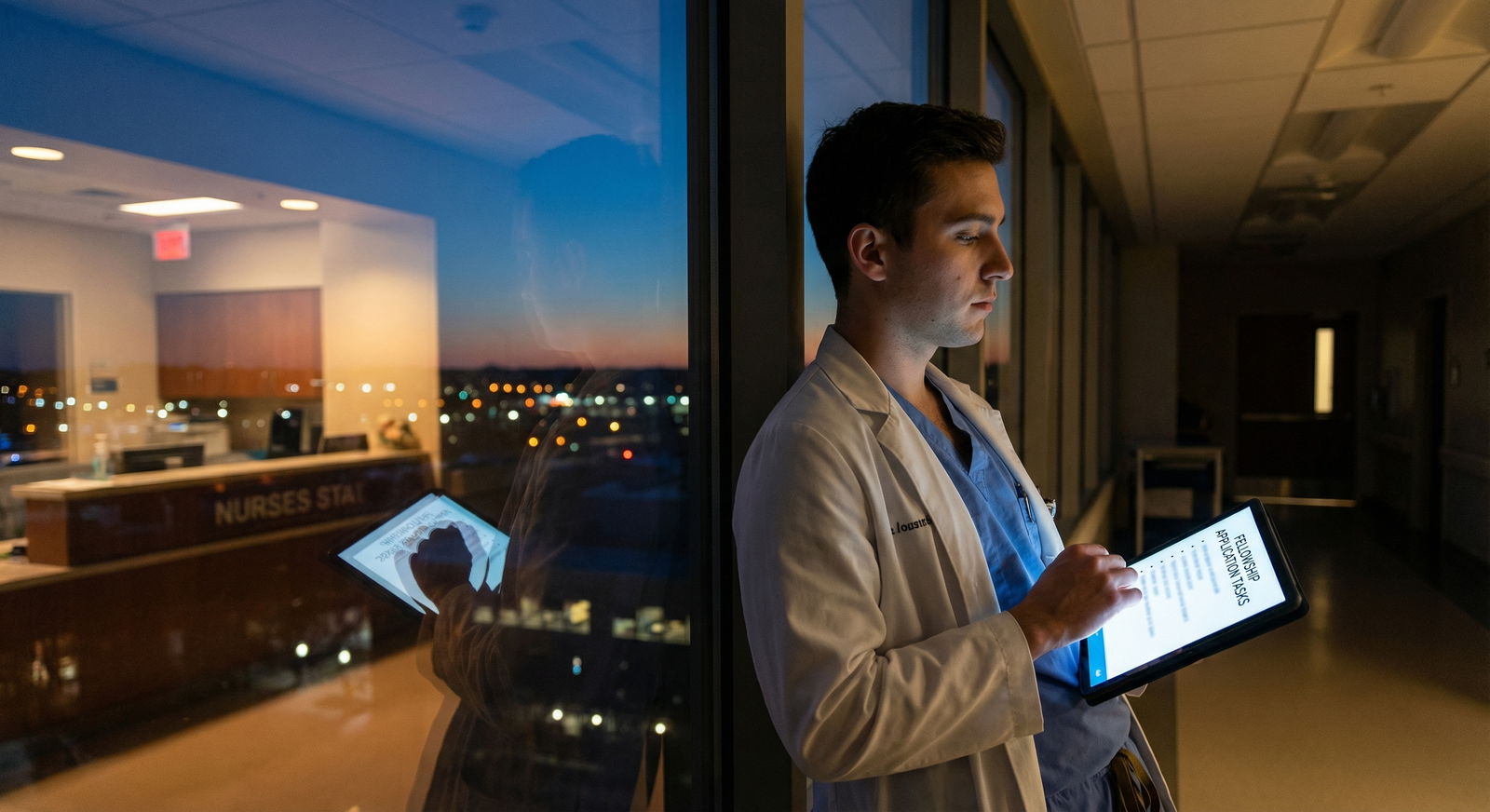
Conclusion: Turning a Challenging Season into a Launchpad for Your Career
Balancing Clinical Duties, Fellowship Preparation, and personal well-being during residency is demanding—but it’s also a training ground for the realities of your future career. The same skills you build now:
- Prioritizing under pressure
- Communicating effectively with teams and mentors
- Planning long-term while handling daily crises
- Protecting your mental health
…are exactly the skills you will need to thrive as a fellow and attending.
By:
- Setting clear fellowship goals
- Creating a realistic, flexible schedule
- Leveraging clinical rotations and mentorship
- Managing your application components strategically
- Practicing deliberate Time Management and stress management
you position yourself not only to match into a strong fellowship, but to arrive there prepared, confident, and resilient.
Frequently Asked Questions About Balancing Residency and Fellowship Preparation
1. When should I start preparing for fellowship during residency?
For most specialties:
- PGY-1: Focus on becoming a solid, reliable clinician. Start broad exploration of interests, but don’t stress heavily about fellowship.
- Early PGY-2: Narrow your field of interest, seek mentors, start or continue research/QI if relevant.
- Late PGY-2 / Early PGY-3: Begin focused Fellowship Preparation—CV polishing, personal statement, program research, letters of recommendation, and understanding match timelines.
If you are in a shorter residency or a highly competitive field, begin exploring and networking earlier, but do not neglect foundational clinical skills.
2. What are the most important things to include in my personal statement?
Aim to include:
- A specific story or experience that authentically sparked or deepened your interest in the specialty
- Reflection on your growth and key lessons from residency
- Concrete evidence of engagement (research, QI, leadership, teaching, or unique contributions)
- Clarity about your Career Development goals and how fellowship will help you achieve them
- Brief mention of what you bring to a program (work ethic, interests, values, or skills)
Avoid generic statements that could apply to any applicant or specialty. Programs want to see insight, specificity, and authenticity.
3. How do I handle fellowship interviews without compromising my clinical responsibilities?
- Communicate early with your program director and chief residents about your anticipated interview season.
- Try to schedule interviews on lighter rotations or elective blocks when possible.
- Cluster interview days to minimize repeated disruptions.
- Prepare efficiently (core answers, program-specific notes, mock interviews) so you’re not constantly studying during call or on post-call days.
- When in the hospital, stay fully present for patient care—then switch gears during scheduled interview times.
Most programs understand fellowship interviews are part of your Career Development and will try to support you if you are transparent and responsible.
4. What if I change my mind about fellowship focus during residency?
It’s common to refine or even shift your focus:
- Use your rotations to honestly assess what kind of work energizes you.
- Talk with mentors about your changing interests; they can help you think through implications and timelines.
- If you change directions, update your mentors, CV, and personal statement to reflect your current path.
- Be prepared to explain your evolution authentically in your personal statement and interviews.
As long as you can articulate a coherent story of growth and self-discovery, a change in direction can actually strengthen your application.
5. How can I stay competitive for fellowship if I don’t have much research?
Not all fellowships require extensive research, but scholarly activity helps. If your research is limited:
- Highlight other strengths: teaching, QI projects, leadership roles, community work, or systems-based initiatives.
- Ask mentors about small but meaningful projects (case reports, brief communications, QI posters) that can be completed within residency constraints.
- Emphasize your clinical excellence and letters of recommendation.
- Be transparent but confident in interviews—explain what you did focus on and why.
Programs value residents who are clinically strong, team-oriented, and teachable. Research is one component of your overall application, not the only one.
By approaching this season with intention, structure, and support, you can navigate residency life and challenges, excel in your Clinical Duties, and build a compelling Fellowship Preparation plan that moves you toward the career you envision.