Understanding Your Starting Point as a Caribbean IMG in EM
Caribbean international medical graduates (IMGs) in emergency medicine (EM) increasingly secure strong fellowship positions across the United States. Programs know that graduates from schools like SGU, AUC, Ross, Saba and others can be outstanding clinicians. However, you do face some additional hurdles compared with U.S. MD/DO graduates, especially at highly academic centers and in more competitive fellowships.
Before planning how to get fellowship after residency, you need a realistic appraisal of where you stand and what you can leverage.
Common Strengths of Caribbean IMGs in EM
Clinical grit and adaptability
Many Caribbean graduates have trained in diverse clinical environments, often with limited resources. This can be attractive for emergency medicine fellowship directors, especially in Global Health, Ultrasound, EMS, or Disaster Medicine.Strong work ethic
Your path has already required persistence through:- The Caribbean medical school residency application process
- USMLE(s) often taken under pressure
- Securing an EM match despite increased competition
Exposure to different health systems
This background may set you apart in:- International/Global EM fellowships
- Health equity and community EM tracks
- Administration and systems-based fellowships
Common Challenges for Caribbean IMGs
Residency program pedigree
Some competitive fellowships (e.g., critical care, ultrasound, toxicology at top-tier academic centers) may prioritize:- University-based EM residencies
- Residents with robust research infrastructure
Visa status
- J-1 or H-1B requirements can limit the number and type of programs you can apply to.
- Some fellowships sponsor only J-1, some both, and a few none.
Perception bias
Even with a strong SGU residency match or other Caribbean medical school residency placements, some academic programs may (consciously or not) prioritize U.S. MD/DOs.Limited academic exposure
Depending on your residency, you may have:- Fewer structured research opportunities
- Less formal mentorship for fellowship preparation
- Less familiarity with the fellowship application timeline
Your goal is to strategically overcome these obstacles and amplify your strengths.
Choosing the Right Fellowship Path in Emergency Medicine
Emergency medicine offers a wide range of fellowships. As a Caribbean IMG, your competitiveness will depend on aligning your interests, training environment, and profile with the right fellowship type and program level.
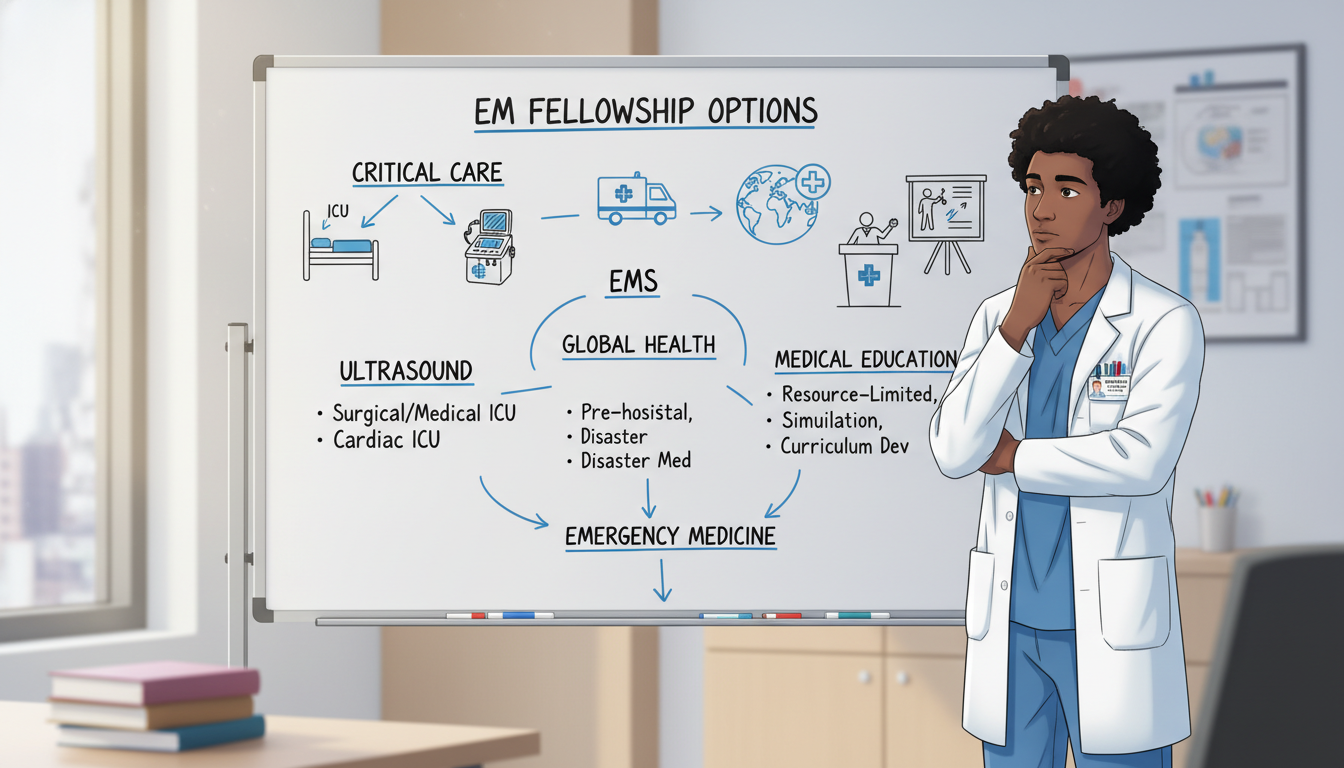
Common EM Fellowships and Caribbean IMG Fit
Below are some of the most common EM fellowships, with brief notes on fit and strategy for Caribbean IMGs.
1. Critical Care Medicine (CCM)
- Pros:
- High clinical demand, strong job market
- Multiple EM-CCM pathways (Anesthesia, Internal Medicine, Surgery-based)
- Challenges for Caribbean IMGs:
- Very competitive at major academic centers
- Programs may heavily weigh scholarly work and institutional reputation
- Strategies:
- Early ICU electives in residency
- Strong letters from intensivists
- At least one meaningful research or QI project
- Consider starting at community- or mid-tier academic CCM programs and building from there
2. Ultrasound (Point-of-Care Ultrasound – POCUS)
- Pros:
- High demand in EM and other specialties
- Skill-based, tangible expertise
- Many programs relatively open to strong clinicians, including those from Caribbean medical schools
- Challenges:
- Some high-prestige academic US fellowships favor applicants with prior ultrasound leadership or publications
- Strategies:
- Become a “go-to” ultrasound resident in your department
- Teach junior residents and medical students
- Create or update scanning protocols, image review sessions, or QA projects
- Obtain ultrasound certifications if available (e.g., through ACEP)
3. EMS (Emergency Medical Services)
- Pros:
- Great for those interested in operations, prehospital care, systems leadership
- Many programs open to diverse backgrounds
- Challenges:
- Need evidence of EMS interest (ride-alongs, EMS committee work, medical direction shadowing)
- Strategies:
- Join EMS committees in residency
- Participate in ride-alongs and educational sessions with EMS agencies
- Present on prehospital topics at local/regional meetings
4. Medical Education
- Pros:
- Ideal if you love teaching, curriculum design, and mentoring
- Usually more flexible regarding prior academic pedigree if your teaching record is strong
- Challenges:
- You must show sustained education involvement beyond “being a good resident”
- Strategies:
- Lead sim sessions, lectures, and workshops
- Develop curricula (e.g., EM bootcamps, ultrasound modules)
- Seek scholarly output: MedEd publications, FOAMed contributions, conference workshops
5. Toxicology, Research, Global Health, Sports Medicine, Administration, Disaster Medicine
- Each has its own competitiveness and niche requirements. In general:
- Toxicology & Research: require more academic/research foundation
- Global Health & Disaster: align very naturally with Caribbean IMG experiences
- Administration / Operations: benefit from QI work, leadership roles, and system-focused projects
- Sports Medicine: often run through Family Medicine, which may complicate the pathway but is not impossible
Matching Your Profile to Fellowship Type
Ask yourself:
Clinical vs. academic focus:
- Do you want to be primarily a clinician with a niche skill (e.g., ultrasound, EMS)?
- Or an academic physician-scientist (e.g., research, MedEd, critical care at an R1 institution)?
Lifestyle and geography:
- Will visa constraints limit your location options?
- Are you open to moving for a strong program, even if not “big name”?
Long-term career goals:
- Leadership? Academic promotion? Community niche expertise? International work?
Once you’re clear on your priorities, you can tailor your entire residency trajectory accordingly.
Year-by-Year Timeline: Fellowship Preparation During EM Residency
Your chances in the EM match were shaped years before ERAS opened. The same is true for fellowship. Think of fellowship preparation as a 3–4 year project, not a last-minute application.
Pre-Residency / Intern Orientation Period
If you’re still a student or just starting PGY-1:
- Clarify your interests, but keep an open mind.
Identify 2–3 fellowship areas that sound appealing and learn basic requirements. - Seek programs with fellowship exposure.
During the Caribbean medical school residency application process and ranking, give bonus points to EM residencies with:- In-house fellowships
- Strong academic tracks
- A history of sending residents to competitive fellowships
Even if you’re already in residency, this early clarity helps you line up rotations and mentors.
PGY-1: Foundation and Exploration
Goals: exposure, reputation building, and early mentorship.
Key actions:
Be clinically excellent.
- Your fellowship application will fail quickly if PDs or faculty perceive you as clinically weak.
- Prioritize reliability, work ethic, and teachability over chasing early CV lines.
Identify potential mentors.
- Note faculty who are:
- Fellowship-trained in areas you might pursue
- Actively involved in research, education, EMS, ultrasound, etc.
- Ask for brief career chats rather than “I need a fellowship letter” discussions.
- Note faculty who are:
Dip your toes in academic projects.
- Volunteer for manageable tasks:
- Case reports, small QI projects, or retrospective chart reviews
- Present a short conference talk or journal club
- Volunteer for manageable tasks:
Plan key electives.
- If interested in critical care: aim to secure ICU rotations early PGY-2 and possibly PGY-3
- For ultrasound: try to schedule an ultrasound rotation in PGY-2
- For EMS/Global/MedEd: seek rotations or half-days with those services
End-of-PGY-1 checkpoint:
- Do you have at least one mentor who knows you reasonably well?
- Have you started at least one project that might result in a poster, presentation, or paper?
PGY-2: Consolidation and Academic Output
PGY-2 is your most important year for fellowship preparation.
Goals: visible academic/leadership involvement and concrete accomplishments.
Key actions:
Choose 1–2 main tracks of interest.
- You don’t need to “marry” a fellowship yet, but narrow to 1–2:
- Example: Ultrasound + MedEd, or Critical Care + Research, or EMS + Administration.
- You don’t need to “marry” a fellowship yet, but narrow to 1–2:
Take on a substantial project.
Examples:- Ultrasound:
- Start a QA process or teaching series, aim for a regional presentation
- Critical care:
- Work on a sepsis management QI project, analyze pre- and post-intervention outcomes
- EMS:
- Develop protocol updates, create training modules for paramedics
- MedEd:
- Design a simulation curriculum or novel teaching tool for students/juniors
- Ultrasound:
Start collecting scholarly “deliverables”.
- Abstracts, posters, oral presentations (local/regional/national)
- Manuscripts (even if not yet accepted)
- FOAMed content for MedEd-bound residents: blog posts, podcasts, infographics (ensure professionalism and quality)
Strengthen relationships with letter writers.
- Schedule regular check-ins every 4–6 months.
- Ask for feedback on how to improve competitiveness.
- Tell them your tentative fellowship interests so they can help guide you.
Understand the fellowship application timeline.
Timelines vary by fellowship type, but many EM fellowships start applications:- As early as spring of PGY-3 (for 3-year programs)
- Or spring of PGY-4 (for 4-year programs)
During late PGY-2, you should:
- Research your fellowship type’s match system (SF Match, NRMP, NRMP subspecialty, or institutional)
- Build a spreadsheet of programs, visa policies, and requirements
- Note key dates so you’re not scrambling
End-of-PGY-2 checkpoint:
- At least one significant project underway or completed
- At least one conference abstract/poster (or in process)
- Clear sense of your top fellowship type(s) and an initial target list of programs
PGY-3 (or PGY-4 in 4-Year Programs): Application and Interview Year
This is execution time.
Goals: finalizing your portfolio, applying, and interviewing strategically.
Key actions:
Finalize your fellowship target list (6–12 months in advance).
For each program, track:- Visa sponsorship (J-1, H-1B, none)
- Typical resident background (community vs. academic, U.S. vs. IMG mix)
- Required materials and deadlines
- Whether they use a centralized match or direct applications
Secure strong letters early.
- Ask letter writers at least 2–3 months before applications open.
- Make it easy for them:
- Provide your CV, personal statement draft, and a summary of projects you worked on together
- Remind them of any notable cases, leadership roles, or presentations
Write a tailored personal statement.
- Clearly state:
- Why this fellowship field
- Why you’re well-prepared (specific examples)
- How your background as a Caribbean IMG and EM resident adds value
- For competitive fellowships, consider minor tailoring for:
- Highly academic vs. community-focused programs
- Specific program strengths (e.g., ultrasound, global outreach, EMS system size)
- Clearly state:
Prepare rigorously for interviews.
Be ready to discuss:- Complex clinical cases in your area of interest
- Your research/QI/education projects: motivation, methods, results, limitations
- Your long-term career plan and how this fellowship fits in
- Your Caribbean and IMG experience—frame it positively as a source of resilience and perspective
Have a realistic backup plan.
Even with a strong profile, fellowship spots are limited. Consider:- Re-applying in a year after a chief year or junior faculty position
- Adjusting to a less competitive geographic region or program tier
- Pivoting to another fellowship type that fits your strengths

Building a Competitive Fellowship Application as a Caribbean IMG
You don’t control where you went to medical school, but you control almost everything else on your fellowship application. Focus on what you can change.
1. Clinical Excellence and Reputation
Fellowships want to know you are:
- Safe, efficient, and reliable in the ED
- Able to function at a near-attending level by the end of residency
- Respected by nurses, consultants, and peers
Actions:
- Aim for strong end-of-shift evaluations and in-training exam performance
- Seek feedback and act on it—then document improvements (helps for letters)
- Volunteer for high-acuity or challenging shifts when appropriate
2. Strategic Scholarship, Not Just “More Lines”
You do not need a massive CV to match into many EM fellowships, but you do need purposeful academic activity.
Aim for:
- Depth over breadth: 1–3 significant projects with clear personal contribution
- Alignment with fellowship field:
- Critical care: sepsis, ARDS, shock protocols, ventilator management work
- Ultrasound: scanning logs, QA initiatives, ultrasound-based diagnostic pathways
- EMS: prehospital protocols, out-of-hospital cardiac arrest, trauma triage systems
- MedEd: curriculum design, educational research, FOAMed
Try to produce:
- 1–2 conference abstracts or posters
- 1–2 peer-reviewed papers (case reports count; review articles and small series are helpful)
- Or a robust portfolio of FOAMed/education materials for MedEd
3. Mentorship and Sponsorship
For Caribbean IMGs, mentorship matters even more. Strong advocates can counteract any residual bias about your background.
You should have:
- One primary mentor in your main fellowship area
- One program-level advocate (PD, APD, or other senior EM faculty)
- Optional: an external mentor from another institution via:
- Conferences
- National EM organizations
- Virtual networking events
Use your mentors for:
- Honest assessment of your competitiveness
- Strategic guidance on where to apply
- Feedback on your CV, personal statement, and interview prep
- Potential informal networking with fellowship directors
4. Letters of Recommendation (LORs)
Letters are often the most influential part of your file.
Strong EM fellowship LORs usually include:
- Clear statement: “I strongly support this candidate for fellowship in X”
- Comparisons: “Among the top 10% of residents I’ve worked with”
- Specific examples:
- A critical resuscitation you led
- An initiative you created or improved
- Your performance on a rotation directly relevant to the fellowship
Try to obtain:
- 1–2 letters from faculty in your desired field (e.g., ultrasound director for US fellowship)
- 1 letter from your PD or APD
- If applicable, 1 from a cross-department mentor (e.g., ICU for critical care, EMS director for EMS)
5. Owning Your Caribbean IMG Story
You will be asked—explicitly or implicitly—about your path as a Caribbean graduate.
Prepare to:
- Explain your trajectory without defensiveness or apology
- Emphasize:
- Resilience
- Adaptability to diverse systems
- Your commitment to self-improvement and life-long learning
- Highlight how training in a Caribbean medical school and then securing an EM match (e.g., SGU residency match or similar) reflects your determination and ability to thrive in unfamiliar environments
Visa, Geography, and Career Strategy
For many Caribbean IMGs, visa status is as important as CV strength. Fellowships vary widely in their policies.
Understanding Visa Constraints
J-1 visas:
- Common for residency
- Some fellowships sponsor J-1; others do not
- May require return-to-home-country obligations afterwards (with some workarounds via waivers, depending on circumstances and future job plans)
H-1B visas:
- Less common but sometimes available
- Many fellowships cannot or will not sponsor H-1B due to cost/complexity
Action steps:
- Check each fellowship program’s website and confirm visa policies by email if unclear.
- Discuss long-term visa strategy early with:
- Your GME office
- An immigration attorney if needed
- Mentors who have navigated this as IMGs
Geographic Strategy
Your best fellowship strategy may not be in the “hot” metro areas.
Consider:
- Expanding your search to:
- Mid-sized cities
- University-affiliated programs in less saturated regions
- Understanding that a solid fellowship in a less flashy location may:
- Offer more hands-on experience
- Provide stronger letters and mentorship
- Open academic or leadership doors later
Long-Term Career Planning
Start from the end and work backwards:
- Do you want:
- A purely clinical job with a niche skill?
- A hybrid academic role with research/teaching?
- A leadership role (department chair, EMS director, ICU director)?
Use your fellowship choice to:
- Build the story that leads to that final role
- Acquire necessary credentials (board certifications, publications, leadership experiences)
- Network with people already in positions you aspire to
FAQs: Fellowship Preparation for Caribbean IMGs in Emergency Medicine
1. As a Caribbean IMG in EM, do I really have a chance at competitive fellowships like critical care or ultrasound?
Yes—many Caribbean IMGs match into strong critical care and ultrasound fellowships each year. Your path may be steeper, especially at elite, research-heavy programs, but with:
- Strong clinical performance
- Focused scholarly work in the field
- Excellent letters from respected faculty
- Thoughtful program selection
you can absolutely match. Be realistic but ambitious: include a mix of highly competitive and more attainable programs.
2. How early in residency should I start preparing for fellowship?
Ideally:
- Exploration and mentorship: PGY-1
- Major projects and scholarship: PGY-2
- Application execution: PGY-3 (or PGY-4)
You don’t need everything figured out in PGY-1, but waiting until late PGY-3 to think about fellowship usually results in a weaker application or a rushed process.
3. What if my residency isn’t very academic and has limited research support?
You can still be competitive by:
- Focusing on QI, protocol development, and clinical projects that are feasible in your environment
- Collaborating with other departments (ICU, EMS, radiology, etc.)
- Seeking external mentorship through conferences, national EM organizations, and virtual collaborations
- Producing at least some scholarly work—case reports, QI abstracts, educational materials
Fellowship directors understand that not every program has the same resources; they focus on what you did with what you had.
4. I’m on a J-1 visa. Should I still pursue fellowship, or go straight into practice to get a waiver job?
This depends on your long-term goals. Factors to weigh:
- Some J-1 fellows later obtain waivers via underserved or academic positions after fellowship
- Fellowship may delay but not eliminate your need for a waiver
- If your ultimate career goal requires fellowship (e.g., intensivist, ultrasound director, EMS medical director at large systems), it may still be worth the extra training
Discuss this in detail with: - An immigration expert
- Mentors who have navigated similar pathways as IMGs
- Potential employers in your desired post-fellowship practice environment
Preparing for fellowship as a Caribbean IMG in emergency medicine is absolutely achievable with deliberate planning, strong mentorship, and strategic choices during residency. By understanding the fellowship application timeline, aligning your projects and rotations with your goals, and proactively addressing visa and geographic constraints, you can build a compelling application that showcases your unique strengths and sets you up for a fulfilling, specialized EM career.