Understanding the Fellowship Landscape as a Caribbean IMG in Family Medicine
Pursuing fellowship after a family medicine residency is absolutely realistic for Caribbean IMGs, but it requires earlier, more strategic planning than many residents expect. Whether you’re coming from SGU, Ross, AUC, Saba, or another Caribbean medical school, your path to fellowship can be successful if you understand the system and work it systematically.
As a Caribbean medical school graduate in a U.S. family medicine residency, you’re navigating:
- Biases (implicit and explicit) against IMGs
- Limited fellowship positions in some subspecialties
- Need for a stronger, more clearly documented track record to stand out
This article breaks down how to prepare for fellowship—from intern year through graduation—with practical, step-by-step guidance tailored to family medicine residents who trained in the Caribbean.
We’ll cover:
- What fellowships are realistic from FM and which are most IMG-friendly
- How to align your residency experiences with your fellowship goals
- A year-by-year fellowship application timeline
- Strategies for research, networking, and mentorship
- How to write a compelling application as a Caribbean IMG
- Common pitfalls and how to avoid them
Throughout, we’ll touch on specific issues like the FM match, SGU residency match experiences, and how Caribbean medical school residency trajectories can feed into competitive fellowships.
Fellowship Options After Family Medicine: What’s Realistic for Caribbean IMGs?
Not all fellowships are created equal in terms of accessibility, structure, and receptiveness to IMGs—especially Caribbean IMGs. Before you can plan how to get fellowship, you need to clarify which paths are realistic.
Common Family Medicine Fellowships
These fellowships are traditionally rooted in family medicine and are generally more accessible to FM graduates, including Caribbean IMGs:
- Sports Medicine
- Geriatric Medicine
- Hospice and Palliative Medicine
- Sleep Medicine
- Addiction Medicine
- Maternal-Child Health / Obstetrics (FM-OB)
- Faculty Development / Academic Medicine
- Community Medicine / Population Health
- Behavioral Medicine
- Rural/Underserved Medicine
Many of these are ACGME-accredited and listed in ERAS; some are run through institutional processes and don’t use a centralized match.
Non-Traditional / Highly Competitive Fellowships
Some fellowships are theoretically open to FM graduates but are more challenging for Caribbean IMGs:
- Cardiology, Gastroenterology, Pulmonary/Critical Care, Hematology/Oncology, Nephrology
- These are internal medicine-based; only a small minority accept FM graduates, and even fewer will consider Caribbean IMGs.
- Emergency Medicine Fellowships (toxicology, ultrasound, etc.)
- Often require EM residency; a handful may consider FM grads with EM-heavy training.
- Academic Clinical Informatics
- Sometimes open to any primary specialty, but competitive and research-heavy.
For most Caribbean IMG residents in family medicine, the highest-yield and most realistic options are:
- Sports Medicine
- Geriatrics
- Hospice & Palliative Medicine
- Addiction Medicine
- Sleep Medicine
- FM-OB / Women’s Health
- Community / Population Health
- Faculty Development / Academic Medicine
How Caribbean Background Impacts Fellowship Choices
Program directors may worry about:
- Your clinical foundation (perceptions about Caribbean medical school training)
- Your board performance (USMLE or COMLEX scores)
- Your “fit” within academic settings and research expectations
You can actively counter this by:
- Strong in-training performance and board pass on first attempt
- Strong letters from U.S.-trained faculty
- Concrete achievements (QIs, curriculum development, research, publications)
- Consistent documentation of excellence in the area of your target fellowship
Action step: In PGY-1, choose your top 1–2 fellowship interests and commit. Dabbling in five areas dilutes your profile; depth matters more than breadth.
Building a Fellowship-Ready Profile During Residency
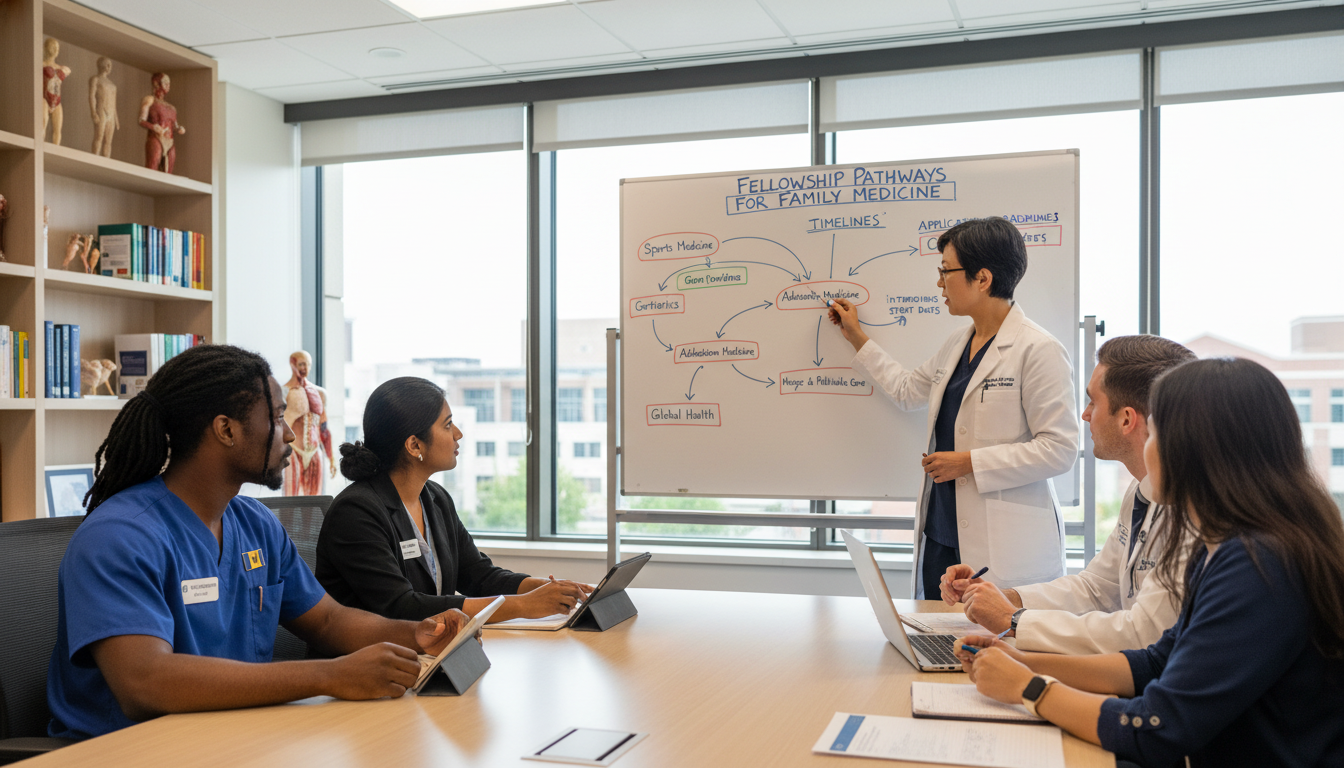
Your residency years are your foundation. For Caribbean IMGs, you need a deliberate strategy that shows fellowship directors: “This resident is already functioning at the next level in this subspecialty.”
PGY-1: Orientation, Exploration, and Early Positioning
Primary goals:
- Prove you can thrive clinically in a U.S. system
- Explore potential fellowship interests
- Establish your reputation as reliable, hard-working, and teachable
Key steps:
Dominate the basics.
- Be on time, prepared, and organized.
- Read daily—UpToDate, specialty texts, or key guidelines—for the patients you see.
- Early on, fellowship directors will ask, “Are they competent as a general FM doctor?” You must answer that with your performance.
Explore potential fellowship tracks.
Use your PGY-1 year to observe what you enjoy and where attendings see your strengths:- Do you like continuity with frail elderly? Think Geriatrics.
- Are you drawn to complex symptom management and goals-of-care discussions? Think Palliative.
- Are you energized by procedures and MSK? Think Sports Medicine.
- Are you passionate about women’s health and OB? Think FM-OB fellowship.
Tell your PD early.
Around mid-year, say to your program director (PD):- “I’m interested in hospice/palliative medicine (or other fellowship). I’d like to make sure I’m building the right experiences—what would you recommend?”
PDs are more supportive when you’re focused and realistic.
- “I’m interested in hospice/palliative medicine (or other fellowship). I’d like to make sure I’m building the right experiences—what would you recommend?”
Position yourself for US boards and in-training exams.
Strong ITE scores and ultimately ABFM board pass are critical. Poor performance may magnify concerns about your Caribbean background.Start light scholarly work.
- Ask upper-levels or faculty if they need help with:
- Case reports
- Chart reviews
- Small QI projects
- Even early involvement (data collection, literature search) sets you up for authorship later.
- Ask upper-levels or faculty if they need help with:
PGY-2: Intentional Development and Leadership
This is the most important year for fellowship preparation. Most of your application will reflect PGY-2 work.
1. Tailor your schedule and electives
Work with your chief residents and PD to align rotations with your goal:
- Sports Medicine:
- Extra MSK clinic, ortho sports rotations, coverage of high school/college sports, ultrasound exposure.
- Geriatrics:
- More time in nursing homes, geriatric clinics, memory clinic, home visits.
- Palliative Care:
- Hospice rotations, inpatient palliative consults, oncology clinic.
- Addiction Medicine:
- MAT clinic (Suboxone, methadone), inpatient withdrawal management, psychiatry/addiction services.
- FM-OB / Women’s Health:
- More continuity OB, L&D shifts, gyne procedures, high-risk OB clinics.
When elective scheduling opens, send a clear, organized request email:
“As I’m preparing for fellowship in hospice and palliative medicine, I’d like to arrange the following electives: [list]. These will help me strengthen my exposure and candidacy. Could we meet to discuss how to make this work within the schedule?”
2. Engage in research and scholarship
You don’t need a PhD, but you do need evidence of academic engagement:
- Aim for at least 1–2 tangible scholarly outputs by the time you apply:
- Poster or oral presentation at a regional or national conference
- Co-authorship on a paper or case report
- QI project with measurable outcomes
- Curriculum development (e.g., teaching module on chronic pain management)
How to start (concrete example):
- You notice polypharmacy and sedative use in your clinic’s elderly patients.
- Propose a QI project to:
- Identify all patients >65 on three or more CNS-active meds
- Implement deprescribing protocols and measure falls or ED visits
- Present your findings at your hospital QI day or state AFP meeting.
This can be turned into an abstract/poster and mentioned prominently in your fellowship personal statement.
3. Seek meaningful mentorship
Identify:
- A primary mentor in your target field (e.g., sports medicine physician, geriatrician, palliative specialist)
- A career mentor (often your PD or APD) who knows the overall landscape and your strengths
For Caribbean IMGs, mentors serve several crucial roles:
- Advocating for you when some PDs may unconsciously discount your application due to school background
- Helping you choose realistic programs and tailor your CV
- Providing strong letters that specifically address your clinical maturity and growth
Meet with mentors at least twice a year with a clear agenda (updated CV, goals, timeline).
4. Start laying the groundwork for letters of recommendation
By late PGY-2, you should know who will write for you:
- Fellowship director or specialist in your chosen area (ideally from a rotation)
- Your PD
- Possibly a research mentor or core faculty who knows you well
Tell them months in advance:
“I plan to apply for a geriatrics fellowship this upcoming season. Would you feel comfortable writing me a strong letter of recommendation?”
If they hesitate at all, politely find another writer.
PGY-3: Execution and Application Season
PGY-3 is where you convert preparation into results.
1. Finalize your target list
Use filters that matter for Caribbean IMGs:
- Programs that previously accepted FM graduates and IMGs
- Programs where your residency alumni (especially Caribbean IMGs) have matched
- Locations aligned with your visa situation (if applicable)
If you’re from an institution like SGU, leverage SGU residency match and fellowship match alumni networks—find out where SGU grads have gone in your desired subspecialty.
Aim for a balanced list of:
- “Reach” programs (larger academic centers)
- “Mid-range” programs with established FM presence
- “Safety” programs known to be IMG-friendly
2. Polish your application materials
Key components:
- Curriculum Vitae (CV):
- Organize by education, training, experience, scholarly work, leadership, and teaching.
- Highlight fellowship-relevant rotations and experiences.
- Personal Statement:
- Tell a focused story: why this field, why you, and how your Caribbean and FM background is an asset.
- Include specific patient encounters or project outcomes that demonstrate your commitment.
- Letters of Recommendation:
- Confirm that letters are uploaded early.
- Each letter should highlight: clinical reliability, teamwork, maturity, growth, and specific strengths related to the fellowship.
3. Prepare aggressively for interviews
Common themes for Caribbean IMGs:
- “Tell me about your path from Caribbean medical school to U.S. residency.”
- “How do you see your family medicine training contributing to this subspecialty?”
- “Where do you see yourself in 5–10 years?”
- “What did you learn from any setbacks (exam failures, gaps, etc.)?”
Practice with:
- Faculty mentors
- Co-residents
- Mock interview sessions offered by your program or medical school alumni office
Be ready to explain your choice of a Caribbean medical school residency path once, briefly, then pivot to your strengths and current accomplishments.

Fellowship Application Timeline for Caribbean IMG Family Medicine Residents
The fellowship application timeline varies depending on the subspecialty, but most ACGME-accredited fellowships that use ERAS follow a fairly predictable pattern. The key for Caribbean IMGs is to be early and organized.
Below is a general timeline (adapt to your specific fellowship):
PGY-1 (Months 1–12)
- Explore various subspecialties
- Establish relationships with faculty
- Begin light involvement in scholarly activities
- Take your first In-Training Exam seriously
- Start thinking about long-term goals (especially if preparing for fellowship in competitive fields)
PGY-2 (Months 13–24)
July–December (early PGY-2):
- Decide on a primary fellowship goal
- Arrange targeted electives for the rest of PGY-2 and early PGY-3
- Initiate at least one significant scholarly project
- Identify and approach potential mentors
January–June (late PGY-2):
- Solidify your fellowship interest and CV items
- Request feedback on your evolving CV from mentors
- Confirm who will write your letters of recommendation
- Start brainstorming and drafting your personal statement
PGY-3 (Application Year)
Specific dates vary, but for fellowships using ERAS:
January–March (PGY-3)
- Finalize your target program list
- Collect information about each program (visa policy, prior FM/IMG fellows, curriculum, call)
- Refine your personal statement (ask mentors and peers for edits)
April–June
- ERAS typically opens for applicants for many fellowships in late spring or early summer
- Upload:
- Completed CV
- Polished personal statement
- Program-specific documents, if required
- Ensure your letters are requested and being written
July–September
- Programs begin downloading applications and offering interviews
- Respond quickly to interview invitations; popular dates fill fast
- Continue strong clinical performance—PDs often receive phone calls from fellowship programs about you
October–December
- Interviews continue, some programs rank earlier or later depending on specialty
- Send thank-you emails after each interview, focusing on genuine points of connection
- Some fellowships use a match process; others offer rolling decisions—know which applies to your field
January–March (depending on specialty)
- Match results or final offers are typically announced
- Coordinate with your PD about schedule adjustments and transitions into fellowship
Important note for Caribbean IMGs:
Visa considerations (J-1, H-1B) can shift your application strategy. Start talking about this with your PD and GME early, ideally mid-PGY-2, because some programs will not sponsor certain visas.
Overcoming Common Challenges for Caribbean IMGs in Fellowship Preparation
1. Perceived Stigma Around Caribbean Medical Schools
You cannot change where you went to medical school, but you can control:
- Your clinical excellence in residency
- The strength and specificity of your letters
- Your scholarly output
- Your demeanor and maturity in interviews
Frame your Caribbean experience as:
- Evidence of resilience and adaptability
- Exposure to diverse pathology and resource-limited settings
- Motivation for your interest in underserved care, community medicine, or global health (if relevant)
Avoid sounding defensive; instead, be factual and forward-looking.
2. Lower or Borderline USMLE Scores
If your board scores are not stellar (a common concern among Caribbean IMGs), offset this with:
- Excellent in-training exam performance
- Consistently high clinical evaluations
- Strong narrative comments in letters from respected faculty
- Concrete project outcomes (QI, research)
If asked about scores, use a structured, brief response:
- Acknowledge: “I didn’t perform as well as I wished on Step 1.”
- Insight: “Since then, I’ve changed my approach—structured study plans, question banks, and early review.”
- Outcome: “That change is reflected in my improved In-Training scores and clinical performance.”
3. Limited Research Environment
Many community FM programs—where many Caribbean IMGs match after the FM match—have fewer research opportunities. You can still build a competitive profile through:
- QI projects that improve patient care (these count as scholarship)
- Collaborations with:
- Nearby academic centers
- State or regional AFP chapters
- Your Caribbean school alumni network (e.g., connecting with SGU residency match alumni who now work in academic centers)
- Case reports from interesting or unusual cases you see in clinic or hospital
Document every presentation—even local ones: morbidity and mortality conferences, journal clubs, resident teaching sessions.
4. Balancing Fellowship Prep with Residency Burnout
Family medicine residency is demanding. Adding fellowship preparation can feel overwhelming, especially when you’re also thinking about FM match statistics and your peers’ paths.
To manage:
- Set small, monthly goals instead of vague large ones:
- “This month, complete literature review for QI project.”
- “By end of next month, send draft personal statement to mentor.”
- Protect one half-day per week (when off-duty) for career development tasks instead of leaving them for random free time.
- Use templates and checklists to streamline work:
- Standard CV layout
- Email templates for contacting potential mentors or programs
Remember that preparing for fellowship is a marathon, not a sprint.
Practical Tips: How to Make Your Application Stand Out
Connect your family medicine identity to your fellowship choice.
Fellowship directors want to see you as a great family doctor plus extra skills, not someone running away from primary care.Example (Palliative Care):
- “My continuity-panel work with complex, multimorbid patients deepened my interest in symptom management and serious-illness conversations, which naturally evolved into my passion for hospice and palliative medicine.”
Highlight specific, measurable achievements.
Instead of “participated in a QI project,” write:- “Led a deprescribing QI initiative that reduced benzodiazepine prescribing by 30% over 6 months in adults ≥65 in our continuity clinic.”
Demonstrate longitudinal commitment.
Programs are wary of “last-minute” fellowship decisions. Your timeline should show:- PGY-1: Early exposure and curiosity
- PGY-2: Focused electives and projects
- PGY-3: Consolidation and leadership (e.g., teaching junior residents, leading a relevant committee)
Use the interview to show maturity, not just ambition.
Emphasize:- Your ability to work within teams
- Your understanding of scholarship and systems-level thinking
- Your awareness of limitations and how you handle feedback
Leverage alumni and networks.
- Reach out to fellowship alumni from your residency, especially IMGs or Caribbean grads.
- If you’re from SGU, Ross, AUC, or another Caribbean school, ask your alumni office for a list of graduates who matched into your desired fellowship.
- A quick, professionally worded email can lead to practice interviews, insight into specific programs, and even quiet advocacy on your behalf.
FAQs: Fellowship Preparation for Caribbean IMG in Family Medicine
1. As a Caribbean IMG in family medicine, is fellowship realistically within reach?
Yes. Many Caribbean IMGs successfully obtain fellowships in areas like sports medicine, geriatrics, hospice and palliative medicine, addiction medicine, and FM-OB. The key is early, focused preparation, strong performance during residency, and strategic program selection. While some highly competitive medicine-based fellowships (like cardiology or GI) are significantly harder to access from FM, especially as a Caribbean IMG, many family medicine–based fellowships actively welcome strong FM graduates.
2. When should I start preparing for fellowship during residency?
For most residents, serious preparation should begin by early to mid–PGY-2 at the latest. That’s when you should:
- Decide on your primary fellowship interest
- Arrange targeted electives and experiences
- Start or solidify scholarly projects
- Identify mentors and letter writers
PGY-1 is mainly about clinical adjustment and exploration, but keeping fellowship in mind from the start will help you recognize opportunities instead of scrambling in PGY-3.
3. How important is research for fellowship applications as a Caribbean IMG?
Research is not everything, but it’s more important if:
- You’re applying to academic programs
- You’re aiming for more competitive fellowships or locations
For most family medicine–based fellowships, meaningful scholarship (QI projects, case reports, educational projects, posters) is often sufficient. As a Caribbean IMG, scholarship helps demonstrate your academic potential and commitment, especially to programs that may be less familiar with your medical school. Even one well-executed QI project with a poster presentation can add significant strength to your application.
4. How do I choose programs if I’m worried about bias against Caribbean medical school graduates?
Use a data-driven, network-based approach:
- Prioritize programs where:
- FM graduates (especially IMGs) have historically matched
- Your residency alumni or Caribbean school alumni have trained
- Faculty respond positively when you reach out with questions
Ask your PD and mentors bluntly:
- “Which programs have historically been IMG-friendly?”
- “Have any of our recent graduates matched to [X fellowship]?”
Building your list around these insights—and balancing “reach,” “mid-range,” and “safety” programs—will increase your chances of a successful fellowship match despite any existing biases.
By starting early, aligning your residency experiences with clearly defined fellowship goals, and leveraging mentors and networks, you can turn your Caribbean medical school residency background into a compelling strength rather than a liability. With focused preparation, the transition from family medicine residency to fellowship is a realistic, achievable next step in your career.