Understanding the Fellowship Landscape for a Caribbean IMG in Diagnostic Radiology
For a Caribbean IMG in diagnostic radiology, fellowship preparation starts much earlier than most people think. Your clinical interests, exam strategy, research output, and networking all influence where you’ll land for advanced training—and ultimately your first attending job.
Because you’re coming from a Caribbean medical school, you’ve already proven that you can overcome structural disadvantages and navigate complex systems (visas, clinical rotations, SGU residency match or similar pathways). Those same skills will serve you well as you plan for subspecialty training.
This article will walk you through:
- How the radiology fellowship market works in the US
- When and how to prepare, starting in medical school and PGY-1
- How to strategically build a fellowship-ready portfolio as a Caribbean IMG
- The fellowship application timeline and how to stay on top of it
- Common mistakes—and how to avoid them
Throughout, we’ll focus on actionable steps you can take, regardless of whether your path was via SGU, AUA, Ross, AUC, or another Caribbean medical school residency route.
Mapping Out Your Fellowship Goals Early
Fellowship planning doesn’t start in your final year of residency; it starts the moment you commit to diagnostic radiology as a career path.
Step 1: Clarify Why You Want a Fellowship
Almost all US diagnostic radiology residents now pursue a fellowship. As a Caribbean IMG, a strong fellowship can:
- Differentiate you in a competitive job market
- Offset perceived bias about Caribbean medical school training
- Improve your chances of academic or large-group practice jobs
- Help you obtain H-1B or O-1 sponsorship if you need a work visa
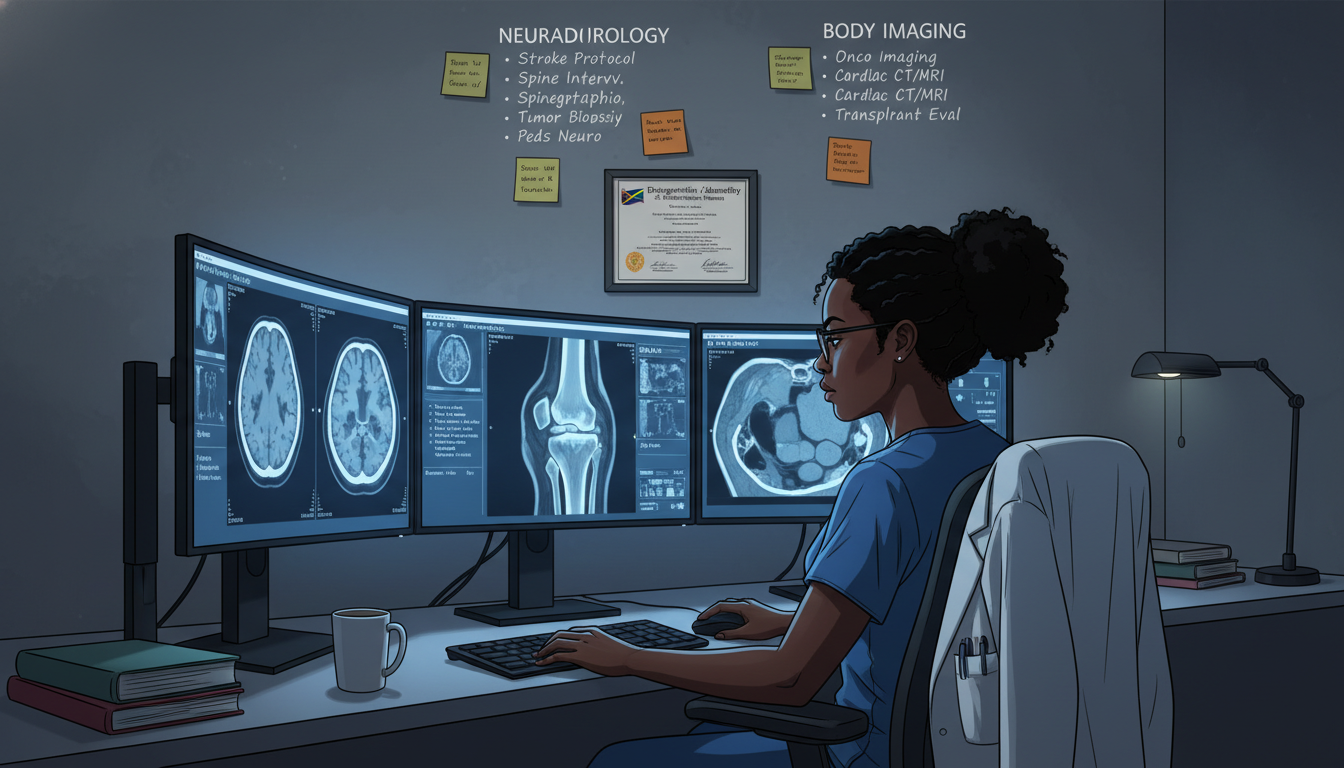
Common diagnostic radiology fellowships include:
- Neuroradiology
- Interventional radiology (independent)
- Musculoskeletal (MSK) radiology
- Body imaging / abdominal imaging
- Breast imaging / women’s imaging
- Cardiothoracic imaging
- Pediatric radiology
- Nuclear medicine / molecular imaging
Ask yourself:
- What imaging modalities or organ systems do I enjoy most?
- Do I want more procedures (IR, MSK) or mostly interpretation (neuroradiology, body, chest)?
- Am I aiming for academics, private practice, or a hybrid model?
- How much do I care about geography versus program prestige?
You don’t need all the answers on day one, but having a direction helps you choose research, rotations, and mentors that make sense.
Step 2: Understand the Competitive Landscape
Different fellowships have different levels of competitiveness. As a Caribbean IMG, it’s important to know where you’ll face more scrutiny.
Typically more competitive:
- Neuroradiology at top academic centers
- MSK radiology at sports-heavy institutions
- Certain high-profile IR, body, or chest programs in major urban centers
Moderately competitive to less competitive (varies by region/year):
- Breast imaging
- General body imaging at mid-tier programs
- Nuclear medicine
- Pediatric radiology (except at top children’s hospitals)
This doesn’t mean you can’t match into a top-tier neuroradiology or MSK fellowship. It does mean you’ll likely need:
- Strong letters from well-known radiologists
- Solid research (preferably in your chosen subspecialty)
- Convincing narrative that addresses any concerns about your background
Building a Fellowship-Ready Profile: From Medical School to PGY-3
During Caribbean Medical School (Pre-Residency)
Even before residency, you can set yourself up for a smoother fellowship path.
Maximize exposure to radiology
- Electives in radiology during clinical years, ideally in US teaching hospitals
- Audition rotations at institutions with strong diagnostic radiology departments
Engage in basic research or scholarly work
- Case reports and case series in radiology-related topics
- Quality improvement (QI) projects involving imaging
- Presentations at student or local radiology society meetings
Cultivate mentors who understand the US system
- Faculty who have trained or practiced in the US
- Alumni of your Caribbean school who matched into radiology (e.g., SGU residency match lists are often public and can be used for networking)
Your primary goal here is to be competitive for a diagnostic radiology residency, but every radiology-related activity also lays groundwork for future fellowship applications.
PGY-1 (Transitional Year or Preliminary)
Use PGY-1 to:
- Nail down your long-term visa strategy (if applicable)
- Maintain or start low-intensity radiology research projects
- Attend radiology grand rounds or multidisciplinary conferences when possible
- Keep in touch with mentors who can help you later with fellowship contacts
If you already know, for example, that you’re headed toward a neuroradiology or MSK radiology residency match in the US, you can start following leaders in those fields on Twitter/X, LinkedIn, or through society newsletters (ASNR, SSR, RSNA).
PGY-2 (R1 Year in Diagnostic Radiology)
This is your launchpad year.
Sample multiple subspecialties deliberately
As you rotate through neuroradiology, body, chest, MSK, and neuro/MSK call, ask yourself:- Which rotations make time fly?
- Where do I feel I’m improving the fastest?
- Which attendings’ careers look appealing to me?
Start at least one serious project
Ideally related to a potential fellowship interest. Think:- Retrospective chart review in MSK trauma imaging
- QI project in stroke imaging turnaround times
- Educational poster or exhibit for RSNA
Build early relationships
- Identify 1–2 attendings in each subspecialty who like to teach and mentor
- Let them know you’re considering fellowship in that area, but remain open-minded early on
Aim by the end of PGY-2 to have at least one project underway and a rough sense of your top two fellowship fields.
PGY-3 (R2 Year): Transition from Exploration to Focus
This is the inflection point: fellowship programs will eventually judge you primarily on what you’ve built by the end of PGY-3.
Your goals:
Narrow your fellowship target field
By mid-PGY-3, you should usually be leaning strongly toward one subspecialty. For example:- “I’m 70% sure I want neuroradiology but keeping MSK as backup”
- “Body and chest imaging both appeal to me; will apply broadly in both”
Strengthen your academic footprint
- Convert at least one project into a submitted abstract or manuscript
- Present at a national or regional meeting if possible (RSNA, ARRS, ASNR, SBI, etc.)
- Ask mentors for opportunities to co-author review articles or book chapters
Start thinking strategically as a Caribbean IMG
- Seek mentors who have influenced fellowship leadership or who trained at well-known programs
- Be realistic but not self-limiting: apply broadly, including both highly competitive and solid mid-tier fellowships
- Ask for honest feedback about your competitiveness from trusted faculty
By late PGY-3, many top programs have already started to informally identify and court promising applicants. Make sure you’re on the radar by showing engagement and productivity in your chosen specialty.
Fellowship Application Timeline & Strategy for Radiology Residents
Understanding the fellowship application timeline is critical. It’s not uniform across all subspecialties, and it has changed over recent years as specialties moved in and out of the official Match process.
Below is a generalized framework—always confirm details with the specific fellowship and your subspecialty society.
General Timing (Variable by Subspecialty)
Most diagnostic radiology fellowships are one year and taken immediately after your R4/PGY-5 year. That means:
- You apply during R3 (PGY-4) year
- You interview during R3–early R4
- You start fellowship July 1 after R4
A rough timeline, assuming a typical schedule:
Late PGY-2 to Early PGY-3
- Start researching fellowship programs and subspecialty societies
- Make a list of:
- Programs with visa sponsorship (if needed)
- Programs with Caribbean IMG or IMG-friendly histories
- Geographic regions where you realistically want to live
Mid–Late PGY-3
- Finalize your target subspecialty and a preliminary program list
- Meet with mentors and your program director to align on strategy
- Request letters of recommendation early from attendings who know your work well
Early PGY-4
- Submit fellowship applications as soon as portals open (ERAS, direct applications, or subspecialty-specific systems—varies by fellowship type)
- Attend interviews, often clustered in the fall and winter
- Update programs with new publications, presentations, and major achievements
Mid–Late PGY-4
- Rank programs (if in a formal Match) or respond to offers (if outside Match)
- Clarify expectations for call, case mix, teaching responsibilities, and post-fellowship job prospects
Match vs. Non-Match Fellowships
Some radiology fellowships are in the Match; others use direct offers. For example:
- Breast imaging and many body imaging fellowships are often outside a central Match, using direct contracts.
- Neuroradiology and certain other fellowships have used the NRMP Match in various cycles.
As a Caribbean IMG, non-Match fellowships can be a mixed blessing:
Advantages:
- If you’re proactive and well-prepared, you can secure positions earlier.
- Programs that struggle to recruit may be more open to strong IMGs.
Disadvantages:
- Offers may come quickly with short response deadlines.
- You may face pressure to accept early without fully comparing programs.
Keep meticulous records of each program’s application process and deadlines in a spreadsheet or project management tool. The complexity of the fellowship application timeline can catch even strong residents off guard.

Strengthening Your Application as a Caribbean IMG
Coming from a Caribbean medical school residency pathway means you’ll need to be intentional about addressing potential concerns and highlighting your strengths.
Academic and Clinical Strength
Fellowship directors will look closely at:
- Performance on rotations in the target subspecialty
- On-service evaluations and 360-degree feedback
- ABR Core Exam results
- Evidence of progressive independence in call and daytime work
Practical tips:
Own your call experiences
Use call as evidence of your readiness. Keep informal logs of:- Number of overnight CTs, MRIs, US, and emergent studies interpreted
- Key cases you handled (e.g., acute stroke, trauma, PE, aortic dissection)
These become compelling stories in interviews.
Be visibly engaged on rotations
- Pre-read cases and have tentative impressions ready
- Ask high-yield, focused questions that show you’ve thought about the material
- Volunteer for conference presentations or case conferences
Research and Scholarly Output
You do not need 20 publications to match a solid fellowship, but as a Caribbean IMG, research helps counteract assumptions about your training origin.
Aim for during residency:
- 1–3 peer-reviewed publications (can be case reports, clinical studies, or reviews)
- 2–5 national or regional presentations (posters, oral talks, educational exhibits)
- Some output specifically in your target subspecialty
How to get fellowship-enhancing research:
- Join existing projects with productive faculty rather than trying to start everything from scratch.
- Look for:
- Educational projects (atlas, teaching files, curriculum design)
- Retrospective imaging studies (often easier to complete in time)
- Multidisciplinary work (e.g., with neurology, orthopedics, oncology)
If you started residency with limited research experience due to Caribbean medical school constraints, be transparent about that—but show how you’ve ramped up quickly.
Letters of Recommendation
For fellowships, letters can be as important as your CV.
You ideally want:
- One or two letters from subspecialty faculty in your target field
- One from your program director or associate program director
- An additional letter from a faculty member who knows your character and work ethic deeply
As a Caribbean IMG, strategically seek letters from:
- Faculty who trained at or have strong ties to your desired fellowship programs
- Faculty who are active in national societies or have recognizable names in the field
Tips for strong letters:
Meet with your letter writers early. Provide:
- Your updated CV
- A one-page summary of your goals and subspecialty interests
- Specific examples of cases/research you did with them that you’d like highlighted
Politely ask:
“Do you feel you can write me a strong, enthusiastic letter for fellowship in [subspecialty]?”
This phrasing gives them an opening to decline if they can’t be supportive.
Personal Statement: Tell a Coherent Story
Your personal statement for fellowship doesn’t need to be dramatic. It does need to be:
- Clear about why this subspecialty
- Honest about your background as a Caribbean IMG without being defensive
- Focused on what you will bring to their program (teaching, research, service, diversity of experience)
Addressing Caribbean training directly can work in your favor:
- Emphasize resilience: handling diverse patient populations, adapting to various hospital systems.
- Highlight your path through the Caribbean medical school residency pipeline, including SGU residency match–style competitiveness if that’s part of your story.
- Show that you’ve matched or outperformed peers from US schools during residency.
Visas, Networking, and Planning for Post-Fellowship Careers
Visa and Sponsorship Considerations
If you’re on a J-1 or H-1B visa, how to get fellowship often comes down to:
- Whether programs sponsor your visa type
- Whether you have enough time left in your status
- Whether fellowship training aligns with future waiver or green card paths
Key steps:
Know your status thoroughly
- How many years of J-1 have you used?
- Are you subject to the 2-year home residency requirement?
- Does your desired fellowship accept J-1s or H-1Bs?
Start visa conversations early
- Talk with your GME office and an immigration attorney if needed.
- Ask fellowship coordinators directly (politely, early in the process) about visa options.
Integrate fellowship into long-term plans
- If you need a J-1 waiver job after fellowship, consider subspecialties and locations with better waiver opportunities (e.g., certain rural or underserved areas may be more open to neuroradiology or body imagers).
Networking and Mentorship: Your Hidden Strength
As a Caribbean IMG in diagnostic radiology, networking often matters more than for US graduates.
Where to network:
- National meetings (RSNA, ARRS, ASNR, SBI, SSR, SCBT-MR, etc.)
- Subspecialty society mentorship programs
- Alumni groups from your Caribbean school who went into radiology
- Online communities (Twitter/X “RadTwitter,” specialty-specific boards, or Slack groups)
How to network effectively:
Prepare a short, genuine introduction: who you are, where you train, your subspecialty interest.
Ask for advice, not favors initially. For example:
“I’m a PGY-3 radiology resident with a Caribbean IMG background, interested in neuroradiology. How would you recommend I prepare to be a strong fellowship applicant?”Follow up with a thank-you email summarizing what you learned and asking if you can keep them updated.
These relationships can lead to:
- Informal advocacy when your application is reviewed
- Research collaboration opportunities
- Job referrals after fellowship
Preparing for Fellowship and Beyond
Fellowship is not just an extra year; it’s the bridge between training and independent practice. While preparing for fellowship, also keep your post-fellowship goals in view:
Do you want an academic career? Then:
- Seek fellowships with robust research infrastructure.
- Prioritize programs where fellows publish frequently.
Are you targeting private practice? Then:
- Choose fellowships known to feed into strong private groups.
- Focus on developing high-speed, high-quality reading skills and practical procedure competence.
Are you visa-limited after fellowship? Then:
- Ask potential programs about graduates’ placement in waiver or sponsor-friendly jobs.
- Talk to current or recent fellows with similar visa situations.
Thinking two steps ahead will shape not just how to get fellowship, but how to use it as a springboard into the career you want.
FAQs: Fellowship Preparation for Caribbean IMG in Diagnostic Radiology
1. Does being a Caribbean IMG significantly hurt my chances for a competitive radiology fellowship (e.g., neuroradiology, MSK)?
It can add an extra layer of scrutiny, but it’s not a deal-breaker. Fellowship directors mainly care about your residency performance, letters, research, and interview. If you perform strongly in a US diagnostic radiology residency, especially at a reputable program, you can absolutely match into competitive fellowships. You may need to apply more broadly and be proactive in networking, but many Caribbean IMGs have successfully matched into top-tier subspecialty programs.
2. How much research do I need for a good fellowship match, and is it too late if I started in PGY-3?
For most fellowships, quality and relevance matter more than raw quantity. One or two solid projects, ideally leading to publications or national presentations, can be enough. Starting in PGY-3 is not too late if you work efficiently: join existing projects with defined timelines, target abstracts with relatively short turnaround times, and aim for at least one submission before applications open. Your mentors can help prioritize realistic projects.
3. When should I start contacting potential fellowship programs or directors?
You typically don’t need to email program directors in PGY-2 unless you have a very specific reason (e.g., a niche research interest). In mid–late PGY-3, it can be appropriate to reach out if:
- You have a strong interest in a particular program
- You’re presenting at a meeting where their faculty will attend
- You have updated achievements you’d like them to be aware of
Keep the emails concise, focused, and respectful of their time. Often, your own attendings’ informal calls or emails on your behalf are even more influential.
4. How should I choose between two fellowship offers as a Caribbean IMG (e.g., one more prestigious vs. one more visa-friendly or job-connected)?
List your priorities in order: prestige, geography, visa security, job placement, academic support, workload, and lifestyle. As a Caribbean IMG, visa stability and post-fellowship job prospects often carry extra weight. A slightly less prestigious program that reliably helps IMGs obtain jobs and visas may be a better choice than a “name-brand” program with little experience navigating your specific needs. Whenever possible, speak directly with current and recent fellows—especially those with Caribbean or IMG backgrounds—about their experiences and outcomes.
By understanding the unique challenges and opportunities of the Caribbean medical school residency pathway and aligning your efforts early, you can build a compelling application for a diagnostic radiology fellowship. With strategic planning, mentorship, and disciplined execution, your background becomes an asset—not a barrier—as you move from residency to subspecialty training and beyond.