Understanding Fellowship Preparation in Diagnostic Radiology
Fellowship preparation in diagnostic radiology starts much earlier than most residents realize. The transition from radiology residency to fellowship is now an almost universal step in many regions, particularly in the U.S. For many residents, a subspecialty fellowship is not just “nice to have” but essential for competitiveness in both academic and private practice.
This guide walks you through how to think about fellowship preparation from the very beginning of radiology residency, how it intersects with the diagnostic radiology match experience, and how to structure your fellowship application timeline so you are not caught off guard. It also offers practical strategies for choosing subspecialties, building your portfolio, and understanding how to get fellowship positions in a rapidly evolving market.
1. Why Fellowship Matters After Radiology Residency
1.1 The reality of modern radiology practice
In contemporary practice, most graduating residents pursue at least one fellowship. The reasons:
Subspecialization is expected
Many groups now expect at least one area of added expertise: neuroradiology, musculoskeletal radiology, interventional radiology (independent), breast imaging, body imaging, nuclear medicine/molecular imaging, pediatric radiology, cardiothoracic imaging, or emergency radiology.Market competitiveness
Fellowship training can distinguish you in a crowded job market. Employers often look for “the MSK person” or “the neuro person” to develop a service line, lead protocol optimization, or support growing clinical volumes.Clinical confidence and autonomy
Fellowship offers protected time to deepen skills, handle complex cases, and gain comfort with high-stakes decision-making before entering unsupervised practice.Academic career preparation
If you are interested in academic radiology, fellowship training is almost mandatory. It builds research credibility, mentorship networks, and early leadership opportunities.
1.2 How your diagnostic radiology match journey shapes fellowship
Your experience in the diagnostic radiology match often influences fellowship decisions:
Program case mix and subspecialty strength
Training at a program with strong neuroradiology or MSK may expose you more to that field and provide stronger mentorship, steering you toward that fellowship.Availability of in-house fellowships
Many departments have fellowship programs; residents who train there may have priority or at least a “home-field advantage.”Geographic and lifestyle preferences
Your experience during residency—call structure, work culture, academic vs community feel—will inform what you seek in fellowship.
Recognizing this early can help you be intentional during residency rotations and networking so that fellowship preparation is not a rushed, last-minute effort.
2. Choosing a Subspecialty: Aligning Interests, Skills, and the Market
One of the earliest—and most important—steps in preparing for fellowship is choosing a subspecialty that fits you and your goals.
2.1 Key questions to guide your choice
Ask yourself:
What kind of cases energize me?
- Do you enjoy brain and spine pathology? Consider neuroradiology.
- Love sports injuries and orthopedic imaging? MSK may fit.
- Prefer high-acuity ED cases with quick decisions? Emergency radiology or trauma-focused body imaging.
- Drawn to women’s health and patient-facing procedures? Breast imaging can be ideal.
How much patient interaction do I want?
- High interaction: breast imaging, some interventional and procedural-heavy body/MSK practice.
- Moderate: pediatric radiology (more communication with clinicians and families), cardiac imaging.
- Low: high-volume neuroradiology or teleradiology-type work.
What practice setting am I targeting?
- Academic: neuroradiology, pediatric radiology, cardiothoracic imaging, nuclear medicine are heavily represented.
- Private practice: MSK, body imaging, breast, neuro, and emergency radiology are all in demand.
- Hybrid models: Often value strong generalists with one or two subspecialty areas.
What is the job market like in my region of interest?
Talk to recent graduates and program leadership about:- Current demand (e.g., breast imagers and neuro imagers are often in high demand)
- Geographic saturation or shortages
- Evolving technologies (e.g., AI, theranostics in nuclear medicine) that may shape future demand.
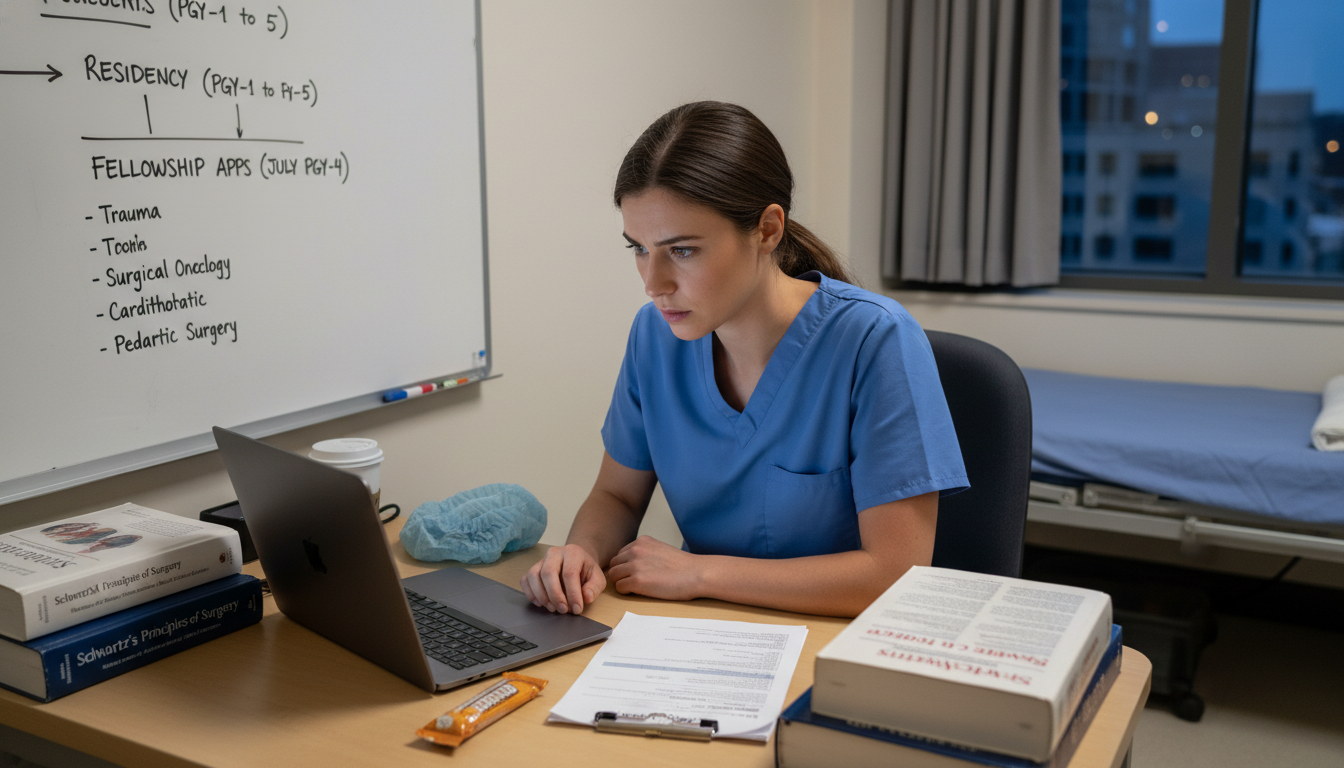
2.2 Timing: When to decide on a fellowship track
In a typical four-year diagnostic radiology residency (PGY-2 to PGY-5):
- PGY-2 (R1): Explore broadly. Use your first year of radiology to experience multiple subspecialties. Keep open notes: what rotations you liked, what you disliked, and why.
- Early PGY-3 (R2): Start narrowing to 1–2 serious contenders. Seek informal mentorship.
- Late PGY-3 to early PGY-4 (R3): In many places, this is when you must commit to a specialty—because fellowship application cycles often begin 1.5–2 years before you start fellowship.
- PGY-4 to PGY-5 (R4/R5): Refine your choice, strengthen your CV within that subspecialty, and prepare for fellowship-related interviews.
Because of how early many programs open applications, you must be quite intentional by early PGY-3; waiting until late PGY-4 is often too late for the most competitive fellowships.

3. Building a Strong Fellowship Application During Residency
Your radiology residency years are your primary runway. Fellowship preparation is not just about choosing a subspecialty—it’s about deliberately accumulating experiences that tell a coherent story.
3.1 Clinical performance and evaluations
Consistent solid performance matters more than isolated brilliance.
Fellowship program directors pay close attention to:- Attending evaluations
- Professionalism and reliability
- Initiative on service
Demonstrate subspecialty interest early.
In your area of interest:- Volunteer for extra cases or call coverage (within duty-hour limits).
- Seek feedback on your reads.
- Ask to participate in complex case reviews or tumor boards.
These behaviors make you memorable; letters from attendings who have seen your progression are far stronger than generic letters from brief rotations.
3.2 Academic engagement and research
You do not need a long publication list to match fellowship, but academic engagement helps, especially for competitive subspecialties and academic tracks.
Suggested milestones:
PGY-2:
- Join or initiate 1 simple case report or educational poster in your area of interest.
- Attend your first radiology conference if possible (e.g., RSNA, ARRS, subspecialty meetings).
PGY-3:
- Aim for a more substantial project: retrospective chart review, protocol improvement, educational curriculum.
- Present at regional or national meetings if feasible. Abstractions and posters are strongly valued.
PGY-4+:
- Round out projects and aim for at least one submitted manuscript or high-quality abstract in your chosen field.
- Use your work as a talking point during fellowship interviews.
Even if you are targeting private practice, research demonstrates initiative and helps your application stand out.
3.3 Teaching and leadership
Fellowship programs appreciate candidates who will contribute to the academic environment:
Teaching activities:
- Lead resident or medical student teaching sessions.
- Create online modules or case conferences.
- Participate in journal clubs.
Leadership roles:
- Chief resident
- Curriculum committees
- Wellness, diversity, or quality improvement committees
Mention these roles in your personal statement and CV; they signal maturity, collaboration, and potential for future leadership.
3.4 Strategic networking
Networking is often underestimated in learning how to get fellowship training positions you truly want.
Within your own department:
- Meet with fellowship program directors early (late PGY-2 or early PGY-3) to express interest and ask for guidance.
- Request targeted feedback from subspecialty attendings about how you can be a stronger applicant.
Beyond your institution:
- Introduce yourself to faculty from other programs at conferences.
- Present posters or talks at subspecialty meetings; these are natural networking opportunities.
- Ask your mentors to connect you with colleagues at other institutions where you might apply.
Well-timed emails, short Zoom meetings, or casual introductions can significantly strengthen your visibility to fellowship decision-makers.
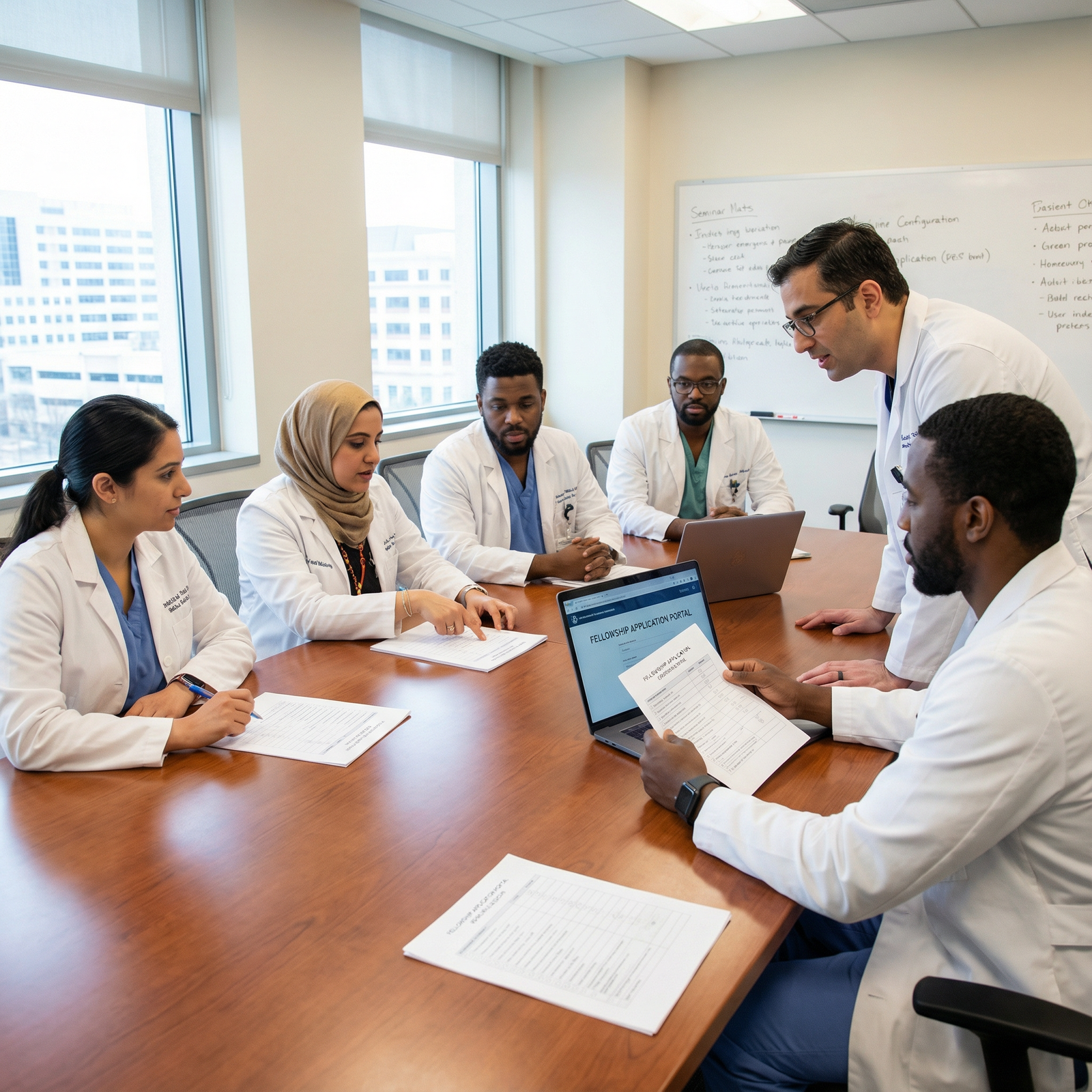
4. Fellowship Application Timeline and Process
Understanding the fellowship application timeline is crucial, as it varies by subspecialty and changes over time. Always verify current cycles through the appropriate societies and program websites, but the general principles are consistent.
4.1 Global overview of the fellowship application timeline
For most U.S. diagnostic radiology fellowships:
- You apply during PGY-3 or early PGY-4.
- You matriculate into fellowship right after residency (PGY-6).
A working framework:
- PGY-2 (R1): Exploration phase—no applications yet, but start CV-building.
- Early PGY-3 (R2): Narrow your subspecialty; begin researching programs.
- Mid to late PGY-3:
- Request letters of recommendation.
- Write your personal statement.
- Submit applications as program portals open (ERAS for some, direct applications for others).
- PGY-4:
- Interview season and ranking (if applicable).
- Confirm position and complete any institutional onboarding requirements.
- PGY-5:
- Finalize logistics: contracts, credentialing, visas (if applicable), and relocation planning.
Because specific subspecialties (like neuroradiology or MSK) may have earlier or centralized match processes, staying updated via specialty societies and your program’s fellowship coordinator is essential.
4.2 Core application components
Curriculum vitae (CV)
Should clearly highlight:- Education and training
- Honors/awards
- Research and publications
- Presentations and teaching
- Leadership and committees
- Professional memberships and extracurriculars
Personal statement
Focus on:- Why this subspecialty fits your interests and strengths
- Key formative clinical or research experiences
- Career goals (academic vs private practice, specific niches)
- Why their program’s environment aligns with your growth
Avoid generic narratives; be concrete and specific.
- Letters of recommendation
Typically 3 letters, often including:- 1–2 from subspecialty attendings who know you well
- 1 from a program director or other senior faculty member
Ask for letters early (at least 1–2 months before deadlines) and provide:
- Your CV
- Draft personal statement
- A list of programs and your goals
- USMLE/COMLEX and board status
Maintain up-to-date transcript and credentials. Passing your core exams on time is important; chronic exam issues can raise concerns unless transparently contextualized.
4.3 Program selection strategy: Building your application list
When deciding where to apply, consider:
Program reputation and strengths
- Do they have strong case volume in your area of interest (e.g., advanced neuro-oncology, high-volume MSK sports imaging)?
- Are there notable faculty in research or clinical innovation?
Clinical duties and call structure
- Amount of independent responsibility vs supervision
- Call frequency and intensity
- PACS/IT infrastructure and work environment
Fellowship culture and mentorship
- Stability and satisfaction of recent fellows
- Faculty accessibility and feedback culture
- Support for conferences and academic pursuits
Geographic and personal factors
- Proximity to family or partner’s career
- Cost of living
- Long-term job opportunities in that region
Construct a list of:
- ~3–5 “reach” programs
- ~5–10 “target” programs
- ~3–5 “safety” programs that you would still be happy to attend

5. Acing the Fellowship Interview and Making the Final Decision
5.1 Preparing for interviews
Whether in-person or virtual, your preparation should mirror that of the diagnostic radiology match, but with deeper subspecialty focus.
Before the interview:
Review:
- Each program’s website
- Faculty interests, key research, and clinical strengths
- Your own prior work and how it fits with their environment
Prepare short, clear answers to:
- “Why this subspecialty?”
- “Why our program?”
- “Tell me about a challenging case or situation and how you handled it.”
- “Where do you see yourself in 5–10 years?”
Have 4–6 thoughtful questions ready, such as:
- How is feedback provided to fellows?
- What differentiates your fellowship from similar programs?
- How have recent fellows fared in the job market?
- What opportunities exist for research or teaching?
5.2 Common interview themes
Expect questions about:
Clinical judgment and independence:
Stories where you recognized critical findings, communicated effectively, or handled uncertainty.Professionalism and collaboration:
Interactions with technologists, referring clinicians, and other residents.Resilience and growth:
How you have responded to mistakes, heavy workloads, or complex feedback.
Be honest. Panelists appreciate self-awareness and growth more than an appearance of perfection.
5.3 Evaluating offers and fit
After interviews, you may have a formal ranking process (for match-participating fellowships) or a direct offer system.
Consider:
Training quality over name prestige alone
- Will you see enough volume and complexity to be confident on day one as an attending?
- Are you likely to be overburdened with service duties at the expense of learning?
Mentorship and future support
- Are there mentors who align with your career goals?
- Do they have a track record of helping fellows secure jobs or academic positions?
Lifestyle and well-being
- Commute, call, vacation structure
- Department culture: collegial vs hierarchical, inclusive vs isolating
Long-term trajectory
- Does this fellowship open doors where you want to practice?
- Are you building a network valuable to your intended geographic or practice niche?
Ultimately, your decision should align with both your professional aspirations and your personal needs.
6. Preparing for Fellowship and Beyond: Practical Next Steps
Once you’ve matched a fellowship or accepted an offer, fellowship preparation doesn’t stop. The year between finalizing your position and starting fellowship is pivotal for maximizing the experience.
6.1 PGY-5: Transition preparation during your final residency year
Negotiate your residency schedule if possible
- Seek additional elective time in your future subspecialty.
- Join relevant multidisciplinary conferences (tumor boards, spine boards, sports conferences).
Solidify your knowledge base
- Identify “must-read” texts and key articles in your subspecialty.
- Set a realistic reading schedule (e.g., 1–2 chapters per week).
Finish or hand off research projects
- Try to submit at least one project for publication or a national meeting.
- If ongoing projects will extend into fellowship, clarify expectations and authorship with your mentors.
6.2 Administrative and logistical preparation
Licensing and credentialing
- Medical license in the new state/region if required.
- Hospital credentialing packets, background checks, occupational health appointments.
Financial and personal logistics
- Budget for relocation costs and consider cost-of-living differences.
- Plan housing early; some institutions offer limited on-campus or subsidized options.
Career planning beyond fellowship
- Begin informal exploration of post-fellowship jobs midway through your fellowship year.
- Maintain connections with your residency program and previous mentors—they are often key advocates for your first job.
6.3 Preparing for fellowship while considering long-term goals
If you’re preparing for fellowship with an eye to further specialization or multiple fellowships, plan deliberately:
Ask whether your chosen fellowship:
- Enables or encourages a second fellowship (e.g., neuro followed by neuro-intervention or head & neck).
- Offers flexibility for research blocks that support an academic trajectory.
For those aiming at particular niches (e.g., advanced cardiac CT/MR, theranostic nuclear medicine, emergency radiology leadership), identify training environments where those experiences are robust and mentors exist.
Preparing for fellowship is really preparing for the rest of your radiology career. Thoughtful choices and strategic planning now will profoundly shape your professional opportunities, job satisfaction, and long-term growth.
FAQs About Fellowship Preparation in Diagnostic Radiology
1. When should I start thinking about fellowship during radiology residency?
You should start seriously thinking about fellowship by early PGY-3 (R2) at the latest. Use PGY-2 to explore, then narrow interests and connect with subspecialty mentors. Because many fellowship application cycles open during PGY-3 or early PGY-4, delaying your decision risks missing opportunities or scrambling with a rushed application.
2. Do I need publications to match into a good fellowship?
Publications are helpful but not mandatory for all fellowships. Strong clinical performance, solid letters, and clear interest in the subspecialty are foundational. For highly competitive fellowships—especially in academic neuroradiology, MSK, or pediatric radiology—having at least one or two research experiences (even case reports or posters) is advantageous. Focus on doing a few high-quality projects rather than many superficial ones.
3. How many fellowship programs should I apply to?
It depends on subspecialty competitiveness and your application strength, but many residents apply to 8–15 programs. A balanced list includes reach, target, and safety options, all of which you would be willing to attend. Discuss your specific strategy with your program director or trusted faculty—they know your performance and the market.
4. What if I’m unsure between two subspecialties?
This is common, especially among residents who enjoy general radiology. If you’re torn:
- Seek short “mini-rotations” or electives in both fields.
- Talk to attendings and recent fellows about job prospects and lifestyle.
- Reflect on which day-to-day cases genuinely excite you.
If your career goal is community or hybrid practice, remember that a single fellowship doesn’t lock you permanently into one narrow niche. Many radiologists practice predominantly in one subspecialty while maintaining a broad general practice, especially in smaller groups.
By understanding the fellowship application timeline, actively tailoring your radiology residency experiences, and making thoughtful subspecialty and program choices, you can navigate fellowship preparation confidently and position yourself for a fulfilling, sustainable career in diagnostic radiology.