Understanding the Fellowship Landscape for Family Medicine MD Graduates
For an MD graduate in family medicine, fellowship training can be an excellent way to deepen clinical expertise, expand career options, and position yourself for leadership roles. Whether you trained at an allopathic medical school and navigated the allopathic medical school match into a family medicine residency, or you transitioned from another pathway, the fellowship world can seem confusing and fragmented.
Family medicine–friendly fellowships are diverse. Common options include:
- Sports Medicine
- Geriatric Medicine
- Hospice and Palliative Medicine
- Addiction Medicine
- Obstetrics/Maternal–Child Health
- Academic Medicine/Medical Education
- Integrative Medicine
- Behavioral Medicine
- Health Policy/Population Health
- Pain Medicine
- Point-of-Care Ultrasound (POCUS)
- Global Health
Some are ACGME-accredited and tied into NRMP; others use independent application processes, rolling offers, or institution-specific timelines.
Before you can plan how to get fellowship training, you need clarity on why you want to do it. Fellowship is another year (or more) of relatively modest salary, intense training, and career narrowing. Strong reasons might include:
- Desire for a clear niche (e.g., “I want to be the palliative care expert in my system.”)
- Long-term academic or leadership aspirations
- A defined clinical interest that’s been consistent across medical school and residency
- A need for enhanced procedural or subspecialty skills (e.g., sports injections, OB operative skills)
- A strategic step toward a future role (e.g., medical director of a hospice program, sports team physician, residency core faculty, etc.)
A weak reason might be: “I don’t know what else to do after residency.” If that’s your main motivator, it’s worth pausing and reevaluating.
Your first step in fellowship preparation should be a structured self-assessment:
- Clinical Interests: Which rotations or patient populations energize you?
- Skills and Strengths: Are you strongest in procedures, communication, systems thinking, or teaching?
- Lifestyle Goals: In 10 years, what do you want your clinical week to look like?
- Geographic Preferences: Are you tied to a region for personal reasons? Some fellowships are regionally concentrated.
- Financial and Personal Considerations: Loans, family plans, partner’s career, childcare.
Write down your answers; they will guide every decision you make about fellowship.
Choosing the Right Fellowship Path within Family Medicine
There is no single “best” fellowship for an MD graduate in family medicine. The best fit depends on your interests and long-term vision. Below are common pathways and what kind of resident they tend to suit.

1. Sports Medicine Fellowship
Ideal for: Residents who loved musculoskeletal (MSK) medicine, enjoyed clinic procedures, and want to work with athletes or active populations.
Career outcomes:
- Primary care sports medicine clinics
- Team physician for schools, universities, or professional teams
- Sideline coverage, mass-participation events
- Academic sports medicine, MSK ultrasound teaching
Key preparation steps:
- Maximize MSK rotations and continuity clinic exposure
- Seek sports medicine electives; join training room or sideline coverage opportunities
- Get involved in sports medicine research or quality improvement (QI)
- Find a sports medicine preceptor to mentor you
2. Geriatric Medicine Fellowship
Ideal for: Those who thrive working with complex, multi-morbid, and cognitively impaired older adults.
Career outcomes:
- Outpatient geriatric primary care
- Nursing home and long-term care medical directorship
- Geriatric consult services, memory clinics
- Academic and policy leadership in aging
Key preparation steps:
- Choose electives in geriatrics, palliative care, and neurology
- Take leadership roles in nursing home or geriatrics-related QI projects
- Develop skill in goals-of-care conversations and polypharmacy management
3. Hospice and Palliative Medicine Fellowship
Ideal for: Residents drawn to serious-illness communication, symptom management, and interprofessional teamwork.
Career outcomes:
- Inpatient palliative consult services
- Hospice medical director positions
- Integrating palliative care principles into primary care or oncology practices
- Academic palliative medicine
Key preparation steps:
- Take palliative care rotations and electives
- Document experience with complex pain and symptom management
- Engage in communication skills training workshops or OSCEs if offered
- Build relationships with your institution’s palliative team
4. Obstetrics / Maternal–Child Health Fellowships
Ideal for: Residents who want to provide high-volume continuity OB, possibly with operative skills (C-sections) in rural or underserved settings.
Career outcomes:
- Family medicine OB with C-section privilege in community/rural hospitals
- Maternal-child health leadership in FQHCs or academic departments
- Global maternal health initiatives
Key preparation steps:
- Maximize continuity deliveries and OB call
- Seek additional night float, L&D time, and high-risk OB exposure
- Keep a detailed OB log; some programs have specific volume requirements
- Clarify which fellowships are FM-based vs OB/Gyn-based and what credentials they confer
5. Addiction Medicine Fellowship
Ideal for: Residents committed to treating substance use disorders (SUDs), especially in primary care and community settings.
Career outcomes:
- Specialty addiction clinics
- Integrated SUD care within primary care, mental health, or justice systems
- Policy and advocacy around SUD treatment
- Academic addiction medicine
Key preparation steps:
- Take addiction medicine and psychiatry electives
- Obtain training in medications for opioid use disorder (MOUD)
- Participate in harm reduction or community outreach programs
6. Academic Medicine / Medical Education Fellowships
Ideal for: Residents who enjoy teaching, curriculum design, and scholarship more than purely clinical practice.
Career outcomes:
- Core residency faculty
- Clerkship or residency program director track
- Institutional educational leadership roles
- Education research
Key preparation steps:
- Seek chief resident role (if offered and aligned with your goals)
- Teach students; request feedback and evaluations
- Engage in curriculum development projects or education research
- Present posters/workshops at regional or national meetings (e.g., STFM, AAFP)
7. Other Niche Fellowships
Global health, population health, integrative medicine, behavioral medicine, POCUS, and other emerging fellowships are excellent fits for specific career visions. The principles of preparing for fellowship are the same: align your residency experiences, scholarly work, and mentorship with the fellowship’s core focus.
Timeline: When to Start Preparing for Fellowship During Residency
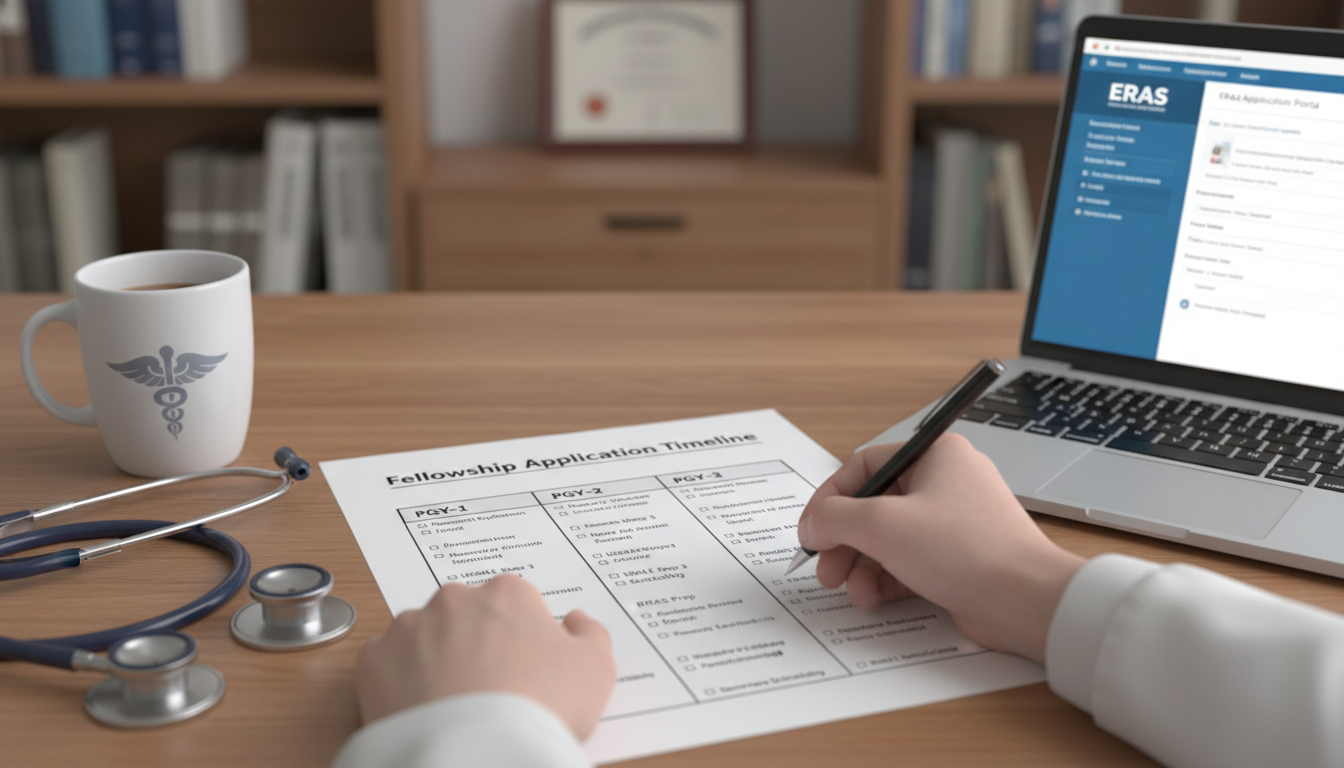
Understanding the fellowship application timeline is critical. Different fellowships may use different cycles, but in broad strokes, if you are a traditional three-year family medicine resident:
- Intern Year (PGY-1): Explore and observe
- PGY-2: Decide on a direction, build your portfolio
- Early PGY-3: Apply, interview, and rank
Because specific deadlines vary by subspecialty and program, the following should be considered a general roadmap.
PGY-1: Laying the Groundwork
1. Reflect on your residency experience so far
You’ve successfully completed the MD graduate residency match and are navigating your early rotations. During this year:
- Notice which rotations you look forward to and why.
- Keep a simple log of memorable clinical experiences; these become raw material for your personal statement.
- Start an ongoing CV file and update it quarterly.
2. Seek mentorship early
Identify:
- A family medicine faculty mentor
- A content-specific mentor (e.g., sports medicine, geriatrics, palliative care)
Ask them:
- What fellowship options exist for family medicine residents in this niche?
- Which programs have strengths aligned with your interests (procedural vs academic vs community focus)?
- What should you be doing this year to stay competitive?
3. Get involved without overcommitting
PGY-1 is not the time to lead five projects. It is the time to:
- Join one QI or research project aligned with your budding interest
- Attend local or virtual conferences if feasible
- Volunteer for one meaningful educational or leadership activity (e.g., help with journal club, M&M presentations)
PGY-2: Focus and Build a Competitive Profile
This is the critical year for fellowship planning.
1. Clarify your fellowship target by mid-PGY-2
Aim to decide by around the halfway point of PGY-2:
- Which field you’re applying in
- Which “type” of program you want (academic vs community; heavy inpatient vs outpatient; geographic priorities)
This allows time to shape rotations, projects, and letters.
2. Optimize rotations and electives
Strategically schedule:
- Relevant electives (e.g., more palliative, sports, geriatrics, OB)
- Away rotations if they’re valued in your subspecialty (sports and OB often appreciate this)
- Time with programs you might eventually apply to, if your institution allows it
3. Strengthen your scholarly and leadership portfolio
Examples:
- Sports medicine: small study on MSK ultrasound accuracy or QI around injection documentation
- Geriatrics: QI project reducing polypharmacy, or a chart review on anticholinergic burden
- Palliative: project on improving documentation of code status or goals-of-care discussions
- Academics: design a teaching module, co-author a curriculum, or lead a resident teaching workshop
Present your work whenever possible: residency research day, state academy meetings, national conferences. This signals commitment and follow-through.
4. Begin compiling program lists and understanding requirements
By late PGY-2:
- Make a spreadsheet of fellowship programs with:
- Application platform (ERAS, direct application, email)
- Required documents (letters, case logs, procedures, scholarly work)
- Deadlines and anticipated interview windows
- Identify programs with strong track records of preparing for fellowship-bound graduates (e.g., those whose alumni go into your desired field).
PGY-3: Application Execution and Transition Planning
Most MD graduate family medicine residents will apply at the end of PGY-2 or early PGY-3. The pace and structure differ from the FM match, but certain patterns hold.
1. Months 1–3 of PGY-3: Finalize application materials
- Personal statement tailored to the subspecialty
- Updated CV including:
- All presentations, posters, publications
- Leadership roles (chief resident, committees)
- Teaching activities
- Letters of recommendation (more on this in the next section)
- Program-specific essays or supplemental applications
2. Months 3–6 of PGY-3: Interviews and ranking
Many fellowships:
- Conduct interviews in the fall or winter of your final year
- Use rolling offers, especially non-NRMP programs
- May expect relatively quick decisions from invited candidates
Keep a dedicated calendar to avoid conflicts with inpatient rotations and to coordinate travel if in-person interviews are used.
3. Months 6–9 of PGY-3: Negotiation and transition
Once you have an offer:
- Clarify salary, benefits, moonlighting policies, and call expectations
- Ask about scholarly expectations and support
- Confirm start date and credentialing timelines
At this point, your focus shifts to graduating residency, studying for boards, and preparing for fellowship both professionally and personally.
Building a Strong Fellowship Application: What Programs Look For
Compared with the allopathic medical school match, fellowship selection is less numbers-driven and much more about fit, narrative, and demonstrated commitment. Metrics still matter, but your story matters more.
1. Clinical Performance and Evaluations
Programs want fellows who are:
- Clinically solid and safe
- Reliable team members
- Excellent communicators with patients and staff
- Able to manage complex family medicine cases
You can’t “fix” all earlier evaluations, but from now forward:
- Be consistently prepared and on time
- Communicate proactively with supervisors
- Ask for actionable feedback and implement it visibly
If you had remediation or performance issues, work with a mentor to frame them honestly and highlight growth.
2. Letters of Recommendation
For fellowship, letters are crucial. Aim for:
- At least one letter from a subspecialist in your target field
- One from a family medicine leader (program director or chair)
- One from someone who knows you in depth and can speak to your character and professionalism
Approach letter writers early:
- Provide them with your CV and a short summary of your fellowship goals
- Highlight specific cases or projects you worked on together
- Gently remind them of deadlines and submission instructions
A strong letter is specific, narrative, and comparative: “Among the top 5% of residents I’ve worked with in the past decade.”
3. Personal Statement and Narrative Cohesion
Unlike the FM match where you were an MD graduate positioning yourself broadly for primary care, fellowship statements must show focus.
Your personal statement should:
- Explain why this field fits you, grounded in specific clinical experiences
- Demonstrate a trajectory (e.g., continuity interest from medical school > targeted rotations > scholarship)
- Articulate what you hope to contribute to the field in 5–10 years
Avoid generic statements: “I like working with old people” or “I enjoy teaching.” Instead:
- Tell a concise story: a patient or pivotal moment that clarified your direction
- Connect that story to activities you’ve pursued during residency
- Conclude with what you seek from the fellowship and how you will contribute to that program’s mission
4. Scholarly Work and Teaching
For highly academic fellowships, prior scholarship is often a gatekeeper. For more community-oriented programs, it’s still beneficial but interpreted differently.
You don’t need a long PubMed list. You do benefit from:
- At least one completed project—poster, QI initiative, or paper
- Evidence of persistence and closure (not just “in progress” items)
- Any role in curriculum design, resident teaching, or educational leadership
Even if you’re more clinically inclined, one well-executed QI project plus active involvement in teaching can significantly strengthen your application.
Life After Fellowship: Planning Backwards from Your Future
Your fellowship preparation should start from a clear idea of where you want to land after training. Think of it as preparing for fellowship while already preparing for your career beyond fellowship.
Clarify Your Post-Fellowship Vision
Ask yourself:
- Do I want an academic, hybrid, or community practice?
- How much of my time do I want to spend on:
- Direct patient care
- Teaching
- Administration or leadership
- Research or QI
- What kind of institution culture do I thrive in?
Your answer shapes both which fellowship you choose and how you engage during the fellowship year.
For example:
- A future academic palliative care physician should maximize teaching and research opportunities as a fellow, pursue national presentations, and cultivate mentors who can champion faculty positions.
- A sports medicine fellow aiming for community practice with a large orthopedic group may focus more on procedural volume, ultrasound skills, and networking with local practices than on research.
Preparing for Fellowship During Residency: Practical Steps
Board Preparation
- Pass your family medicine boards early if possible. Studying during fellowship can be challenging.
- A strong board pass reassures fellowship directors about your fund of knowledge.
Financial Planning
- Understand your post-residency and post-fellowship salary projections.
- Consider income-based loan repayment during fellowship.
- Create a budget for potential relocation and moving costs.
Professional Identity and Branding
Think intentionally about how you present yourself:
- Keep a polished, updated CV and, if appropriate, a simple professional LinkedIn profile.
- Attend relevant professional societies (e.g., AAFP, AMSSM, AAHPM, AGS) and introduce yourself to leaders in your interest area.
- Ask mentors how to get fellowship-level committee or workgroup involvement early.
Personal and Family Considerations
- Discuss geographic flexibility with your partner or family early.
- Investigate childcare, spouse/partner employment opportunities, and support systems near potential fellowship sites.
- Consider how extra call and evening responsibilities may impact your non-work life and plan support accordingly.
Frequently Asked Questions (FAQ)
1. When is the best time to decide on pursuing fellowship during family medicine residency?
Ideally, you should narrow your direction by the middle of PGY-2. This gives you enough time to tailor electives, complete meaningful scholarly projects, and secure strong letters of recommendation. You don’t need to know at the start of intern year, but by late PGY-2 you should have a clear primary target and a backup plan if fellowship doesn’t materialize on the first try.
2. Are fellowship programs competitive for MD graduate family medicine residents?
Competitiveness varies widely by subspecialty and individual program. Some fellowships (e.g., certain sports medicine or OB/maternal–child health programs in major academic centers) can be highly competitive. Others are more accessible but still expect a clear record of interest, solid clinical performance, and good letters. Compared with the family medicine match, fellowship is more about fit and demonstrated commitment than strictly about test scores.
3. What if I’m unsure between two fellowship options, like geriatrics and palliative care?
It’s common to like overlapping areas. Start by:
- Meeting with mentors in both fields
- Doing targeted rotations in each
- Asking yourself what kinds of patients, settings, and daily tasks you enjoy most
You can also look at combined opportunities or positions that allow overlap (e.g., working as a geriatrician with strong palliative skills, or a palliative physician who focuses on older adults). However, for the fellowship application itself, it’s usually best to present a focused narrative toward one primary target.
4. Can I go straight into fellowship after residency, or should I work in practice first?
Both paths are viable. Most family medicine MD graduates who know they want subspecialty training from early in residency proceed directly to fellowship. Delaying can make it harder to gather updated letters and stay academically active, but it can also:
- Provide financial breathing room
- Clarify your interests in real-world practice
- Strengthen your application if you gain relevant experience
If you choose to work first, maintain some connection to your intended subspecialty (e.g., extra OB shifts, palliative consults, geriatric panels, sports coverage) to keep your fellowship application compelling.
Fellowship preparation as an MD graduate in family medicine is ultimately an exercise in intentional career design. Start with honest reflection, seek targeted mentorship, align your residency activities with your desired subspecialty, and stay organized about timelines and requirements. If you treat the process as building a focused, authentic professional narrative rather than simply “checking boxes,” you will be far better positioned for both an effective FM match into fellowship and a fulfilling long-term career.