
Understanding the Big Picture: From General Surgery Residency to Fellowship
For a US citizen IMG in general surgery, fellowship preparation starts far earlier than most people think. As an American studying abroad, you’re competing not only with US MDs and DOs, but also with US citizen IMGs and non‑US IMGs from all over the world—all aiming at a limited number of fellowship spots.
You are balancing several layers:
- Your identity as a US citizen IMG (an advantage over non‑US IMGs, especially for funding/visa issues).
- Your status as an internationally trained medical graduate (a barrier in some programs and some competitive fellowships).
- Your aspiration to move from general surgery residency into a strong surgical fellowship (MIS, surgical oncology, vascular, colorectal, trauma/critical care, etc.).
Your goal is to convince fellowship selection committees that:
- You are well-trained and clinically excellent despite non-US medical schooling.
- You have a clear, sustained commitment to a specific surgical field.
- You understand the realities of that fellowship’s career path.
- You will bring value to their program—academically, clinically, professionally.
That requires an intentional, multi-year strategy extending from early residency through the fellowship application timeline.
Mapping the Fellowship Application Timeline for General Surgery
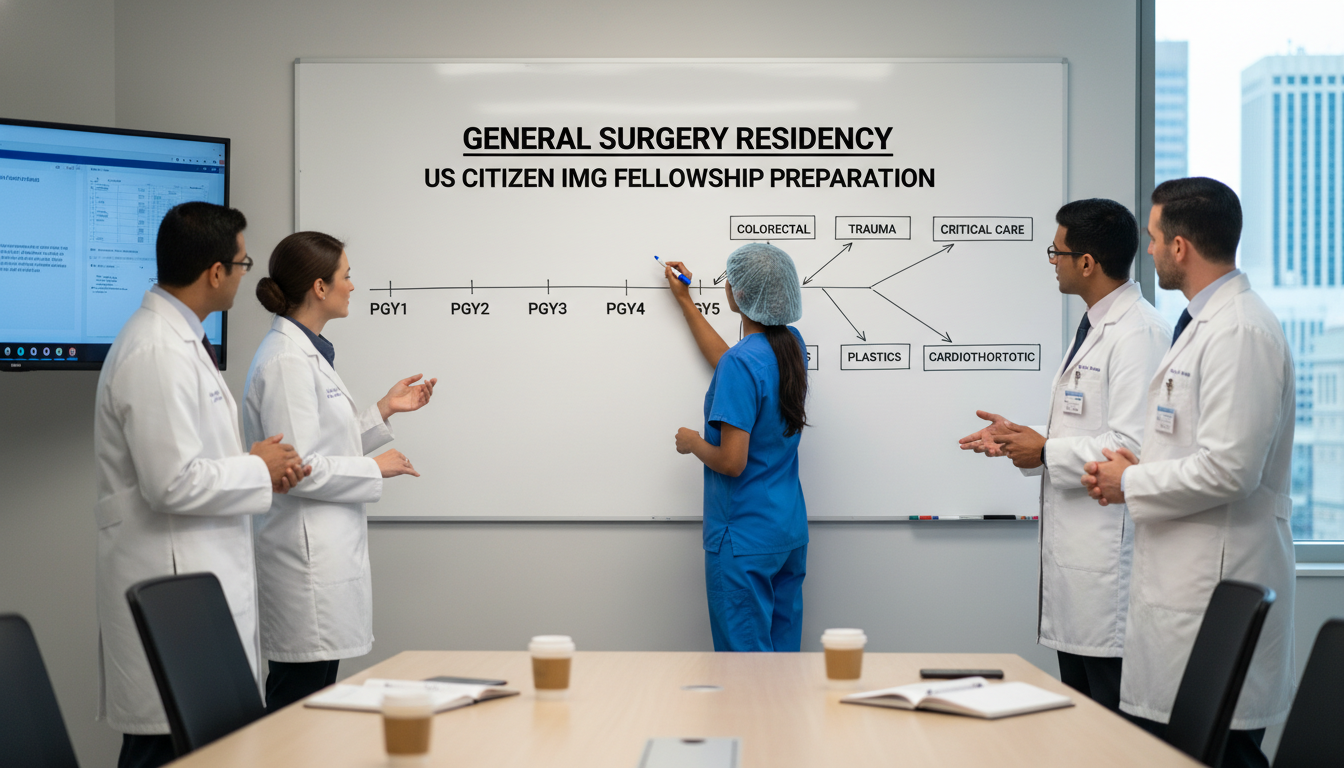
Understanding when to act is as important as understanding what to do. Below is a year-by-year guide tailored for a US citizen IMG in general surgery training in the US.
PGY-1: Laying the Foundations
Key goals:
- Show you are a reliable, hardworking intern.
- Explore subspecialties within surgery.
- Start early networking and CV building.
Action items:
- Rotate through as many core general surgery services as possible; note which fields energize you (e.g., HPB, thoracic, vascular, MIS, trauma).
- Establish a relationship with an academic mentor (or at least a residency advisor) during your first year.
- Attend department grand rounds and subspecialty conferences (e.g., surgical oncology, vascular conference).
- Get involved in at least one research project—even if small—to show early academic engagement.
Why it matters for US citizen IMGs: Program leaders often want reassurance early that an IMG intern can handle the workload, documentation, and systems-based practice. Strong PGY-1 performance reduces bias and opens doors for later support of your surgery residency match into competitive fellowships.
PGY-2: Clarifying Your Fellowship Target and Building Credibility
Key goals:
- Decide on 1–2 potential fellowship areas.
- Start building a track record aligned with that field.
Action items:
- Narrow down to a primary interest (for example, surgical oncology or MIS) and a secondary “backup” field.
- Ask your mentor for introductions to faculty in that subspecialty.
- Take on targeted research projects in your area of interest; focus on at least one first-author opportunity if possible.
- Present a poster or oral abstract at a major meeting (e.g., ACS, SAGES, EAST, AAST depending on specialty).
- Volunteer for teaching roles with medical students or junior interns—shows leadership and communication skills.
Timeline mindset: By the end of PGY-2, you should:
- Have at least one completed or ongoing project in your target field.
- Be known by at least 2–3 faculty in that field who can later speak to your potential.
PGY-3: Transition From “Interested” to “Serious Candidate”
Key goals:
- Become a go-to resident for your subspecialty.
- Deepen research and academic productivity.
- Begin structured planning for the fellowship application cycle.
Action items:
- Request to rotate again (or more extensively) on your target service(s) if your program structure allows.
- Seek opportunities as “chief-equivalent” on that service (even if you’re not a true chief yet) to show ownership and leadership.
- Submit manuscripts from earlier projects; aim to have at least one publication by end of PGY-3.
- Attend national meetings and actively network—meet program directors, fellows, and faculty in your intended fellowship field.
- Start creating an organized fellowship prep folder:
- Updated CV
- List of programs (with notes)
- Draft personal statement points
- Timeline for exams, research deadlines, conference abstracts.
US citizen IMG–specific advice: At meetings, don’t hide your background as an American studying abroad. Instead, frame it as a source of adaptability and resilience:
- “I’m a US citizen IMG, trained in [Country], now a PGY-3 in [Program]. I’m working toward a future in [Subspecialty], especially interested in [niche].”
This shows clarity and confidence rather than apologizing for your IMG status.
PGY-4: The Critical Application Year
This is when your fellowship application timeline becomes very concrete.
Key goals:
- Finalize fellowship target(s).
- Apply early and strategically.
- Secure strong letters.
Action items (general timeline, may vary by specialty):
Summer – Early Fall (PGY-4):
- Confirm which fellowship match your field uses:
- NRMP/ERAS (e.g., vascular surgery)
- SF Match (e.g., thoracic surgery)
- Institutional or society-based matches (e.g., some surgical oncology or MIS pathways)
- Finalize your personal statement with a focus on:
- Your training journey as a US citizen IMG.
- Clear reasons for your chosen fellowship.
- Evidence of sustained interest (research, rotations, QI projects, leadership).
- Request letters of recommendation from:
- At least 1–2 subspecialty faculty in your field.
- Program director.
- Another senior surgeon who can attest to work ethic, operative skill, and professionalism.
Fall – Winter (PGY-4):
- Submit applications early in the cycle.
- Respond promptly to interview offers.
- Prepare intensively for interviews (more below).
- Continue clinical excellence—your PGY-4 performance further shapes letters and informal feedback.
PGY-5: Interviews, Ranking, and Transition Planning
Key goals:
- Excel on interviews and secure a strong match.
- Finish residency strong and prepare for fellowship start.
Action items:
- Attend fellowship interviews, often clustered over several weeks or months.
- De-brief after each interview: strengths, weaknesses, “fit,” red flags.
- Construct your rank list thoughtfully, balancing:
- Case volume and complexity.
- Academic vs. community focus.
- Research expectations.
- Geographic and personal factors.
- Once matched:
- Clarify credentialing, licensing, and onboarding requirements.
- Discuss elective scheduling in late PGY-5 to align with your fellowship focus.
- Prepare professionally for the new environment, including reading, simulation, and talking with current fellows.
Choosing the Right Fellowship as a US Citizen IMG
Not all fellowships are equally IMG-friendly, and not all align with your personal goals. Thoughtful selection is crucial.
Common General Surgery Fellowships
Some of the most common paths for general surgery residents include:
- Minimally Invasive Surgery (MIS)/Bariatrics
- Surgical Oncology
- Hepatopancreatobiliary (HPB) Surgery
- Colorectal Surgery
- Vascular Surgery
- Trauma and Surgical Critical Care
- Transplant Surgery
- Breast Surgery
- Endocrine Surgery
- Cardiothoracic Surgery
Each subspecialty has different competitiveness, training requirements, and practice settings. As a US citizen IMG, you must blend your interests with a realistic appraisal of your competitiveness and the field’s receptiveness to IMGs.
Factors to Consider When Selecting a Fellowship
Your long-term career vision
- Academic surgeon, clinician–educator, private practice, or hybrid?
- High-acuity tertiary center vs. community hospital?
- Are you aiming for future leadership, program director roles, or pure clinical focus?
Competitiveness and IMG-friendliness
- Historically, some fields like highly prestigious surgical oncology or complex HPB at top-tier institutions can be particularly competitive.
- Look at fellowship program rosters—how many IMGs (or US citizen IMGs) are in training or have graduated recently?
- Contact current or recent fellows who are IMGs to understand real-world dynamics.
Training environment and case mix
- Case numbers and diversity are essential. You should graduate capable of independent practice, not undertrained.
- Ask detailed questions: number of index cases, autonomy, role of fellows vs. residents.
Research expectations and support
- For academic careers, choose a fellowship known for research productivity and strong mentorship.
- Ask about:
- Protected research time.
- Access to statisticians and research coordination.
- Conference and travel support.
Geography and Lifestyle
- Be realistic about your willingness to relocate and lifestyle needs.
- Many high-powered fellowships are in urban academic centers; some smaller programs may be in less popular locations but offer excellent training.
Building a Competitive Profile for the Surgery Fellowship Match
Whether you’re aiming for MIS, trauma/critical care, or surgical oncology, the components of a strong candidacy as a US citizen IMG are similar.
1. Clinical Excellence and Evaluations
Even the best research record can’t compensate for weak clinical performance.
Focus on:
- Being consistently reliable and prepared.
- Excellent pre-op planning and thorough post-op care.
- Ownership of your patients—knowing details without being prompted.
- Strong operative performance appropriate for your level:
- Efficient, safe, and adaptable in the OR.
- Humble, teachable, and team-oriented.
Fellowship directors routinely ask: “Would you let this resident operate on your family?” That’s the standard.
2. Targeted Research and Academic Productivity
You don’t need a PhD or dozens of publications to be competitive, but you do need evidence of scholarly engagement:
- Aim for:
- A few solid first- or co-first-author papers or major abstracts in your target field.
- Quality improvement projects or clinical series relevant to your fellowship goal.
- Prioritize:
- Submitting to field-relevant journals or conferences (e.g., SSO for surgical oncology, SAGES for MIS, EAST/AAST for trauma & critical care).
- Showing a coherent academic story: your projects should connect logically to your intended subspecialty.
As a US citizen IMG, research also signals to programs that:
- You understand US academic culture.
- You can navigate IRB processes, data management, and writing standards.
3. Strategic Networking and Mentorship
Knowing how to get fellowship opportunities often hinges on who knows your work and your character.
Mentors you should have:
- A home-program subspecialty mentor in your chosen field.
- A general surgery program leader (PD, APD, or chair) who advocates for you.
- At least one external mentor or senior contact met through conferences or collaborative research.
Networking strategies:
- Attend national meetings early and regularly.
- Introduce yourself to speakers/faculty whose work interests you.
- Follow up with thoughtful emails (e.g., “I appreciated your talk on [topic]. I’m a US citizen IMG and PGY-2 at [program], interested in [field]. Here’s a brief note on my current research…”).
- Join surgical societies (e.g., SAGES, SSO, EAST, AAST) and become active in committees when possible.
4. Letters of Recommendation
Your letters are among the most influential parts of your application.
Who should write them:
- A leader in your chosen subspecialty who has worked with you closely.
- Your program director.
- Another senior faculty member who has seen your OR and ICU performance and your day-to-day patient care.
What strong letters contain:
- Clear endorsement: “I recommend this resident without reservation” or “top 5% I’ve worked with.”
- Specific stories:
- A complex case where you showed leadership and judgment.
- Evidence of resilience under pressure.
- Explicit comments on:
- Work ethic.
- Operative skill and growth trajectory.
- Professionalism and team behavior.
- Potential for an academic/leadership career (if relevant).
As a US citizen IMG, you especially need letters that neutralize bias by directly addressing:
- Your ability to adapt quickly to US systems.
- Your communication skills with patients and staff.
- Your capacity to perform at the same level as US-trained peers.
5. Crafting a High-Impact Personal Statement
Your personal statement is not a memoir; it is a strategic tool to show program fit and your readiness for advanced training.
Essential elements:
- Brief origin story: Why general surgery? Why this subspecialty? Use one or two concrete examples.
- Training journey as an American studying abroad:
- Emphasize resilience and adaptability.
- Show how different healthcare systems broadened your perspective.
- Evidence of sustained interest:
- Specific rotations, key cases, research projects, and leadership experiences.
- Goals beyond fellowship:
- Academic, community, or hybrid practice.
- Teaching, quality improvement, global surgery, or leadership aspirations.
Keep the tone:
- Professional, focused, and forward-looking.
- Honest but not apologetic about IMG status.

Excelling on Fellowship Interviews as a US Citizen IMG
Your interview is where selection committees decide if your application narrative holds true in real life.
Core Preparation Steps
Know your application cold.
- Be able to discuss any research project in detail (methods, limitations, key findings).
- Recall your roles on specific cases mentioned in your personal statement or letters.
Research each program.
- Case volumes, clinical sites, faculty interests.
- Recent fellow publications, typical career outcomes.
- Any unique features (e.g., global outreach, robotic volume, HPB focus, ECMO experience).
Practice common questions:
- “Why this subspecialty?”
- “Why our program specifically?”
- “Tell me about a complication you were involved in and what you learned.”
- “What are your strengths and weaknesses as a surgeon?”
- “Where do you see yourself in 5–10 years?”
Prepare a thoughtful way to address your IMG background.
- Emphasize how training abroad then adapting to the US environment has strengthened:
- Cultural competence.
- Flexibility and resourcefulness.
- Appreciation for systems-level differences.
- Emphasize how training abroad then adapting to the US environment has strengthened:
Presenting Yourself Professionally
- Dress in conservative professional attire (not scrubs, unless specifically instructed for in-person OR visits).
- Be punctual, in person or virtual.
- Show curiosity:
- Ask detailed questions about case mix, autonomy, fellow roles, and graduate outcomes.
- Demonstrate humility:
- Express eagerness to learn, not entitlement.
Red Flags to Avoid
- Criticizing your current program or colleagues.
- Overemphasizing lifestyle desires in a way that conflicts with a high-volume surgical fellowship.
- Appearing disorganized or uninformed about the program.
- Giving vague answers about your career goals (“I’m open to anything” signals lack of vision).
Transitioning from Fellowship to Career: Thinking Beyond the Match
Preparing for fellowship doesn’t stop once the surgery residency match and fellowship match are behind you. Your fellowship should be a deliberate bridge to your early career.
Clarifying Your Post-Fellowship Path
Ask yourself as you design applications and choose a program:
- Do you want an academic job with research and teaching?
- Then select a fellowship with strong academic output, mentorship, and institutional reputation.
- Do you want a high-volume community practice?
- Choose a fellowship known for:
- Technical excellence.
- Bread-and-butter plus complex case mix.
- Choose a fellowship known for:
- Are you interested in global surgery, health policy, or innovation (devices/technology)?
- Seek fellowships with those specific opportunities or complementary degrees (MPH, MS, etc.).
How to Get Fellowship-Leveraged Opportunities
Use your fellowship to:
- Build a publication record in your niche.
- Present regularly at national meetings.
- Join relevant committees in major societies.
- Seek leadership roles (fellow liaison, curriculum development, QI leadership).
By doing this, you’re preparing for fellowship and also preparing for the step after, whether that’s:
- An academic assistant professorship.
- A leadership-track position in a large group.
- A hybrid academic–community role.
Frequently Asked Questions (FAQ)
1. As a US citizen IMG in general surgery, do I have a realistic chance at competitive fellowships?
Yes, many US citizen IMGs successfully match into strong fellowships every year. Your citizenship removes the major funding/visa barrier that non‑US IMGs face. However, you must overcome program bias with:
- Excellent clinical evaluations.
- Strong letters from respected US surgeons.
- A clear academic or clinical track record in your chosen field.
- Professional networking that allows faculty to know you beyond your CV.
2. Which general surgery fellowships are most friendly to US citizen IMGs?
This varies by program and year, not just by specialty. Historically, trauma/critical care, MIS, and some colorectal and vascular programs have had higher proportions of IMGs, while certain elite HPB, transplant, or surgical oncology fellowships at top-tier academic centers can be more competitive. The best approach is:
- Review current and past fellows on program websites.
- Contact recent fellows (especially IMGs) to learn the culture.
- Ask faculty mentors which programs are known to be supportive of IMGs.
3. How many publications do I need to be competitive?
There is no magic number. For many general surgery fellowships, a handful of well-executed projects (especially if at least one is first-author and in your subspecialty) is more valuable than a long list of low-impact publications. Focus on:
- Quality over quantity.
- Clear alignment with your fellowship interest.
- Demonstrated ability to carry projects from idea to completion.
4. When should I start actively preparing for fellowship during residency?
You should start thinking about fellowship in PGY-1, but your actions intensify over time:
- PGY-1: Explore subspecialties; start small research/projects.
- PGY-2: Narrow your interests; secure subspecialty mentorship; deepen research.
- PGY-3: Build your academic profile and become the “go-to” resident on your target service.
- PGY-4: Execute the fellowship application timeline—applications, letters, and interviews.
- PGY-5: Finalize match, transition planning, and focused preparation for your chosen field.
By pacing your efforts, you avoid last-minute panic and present as a coherent, prepared candidate ready for advanced surgical training.