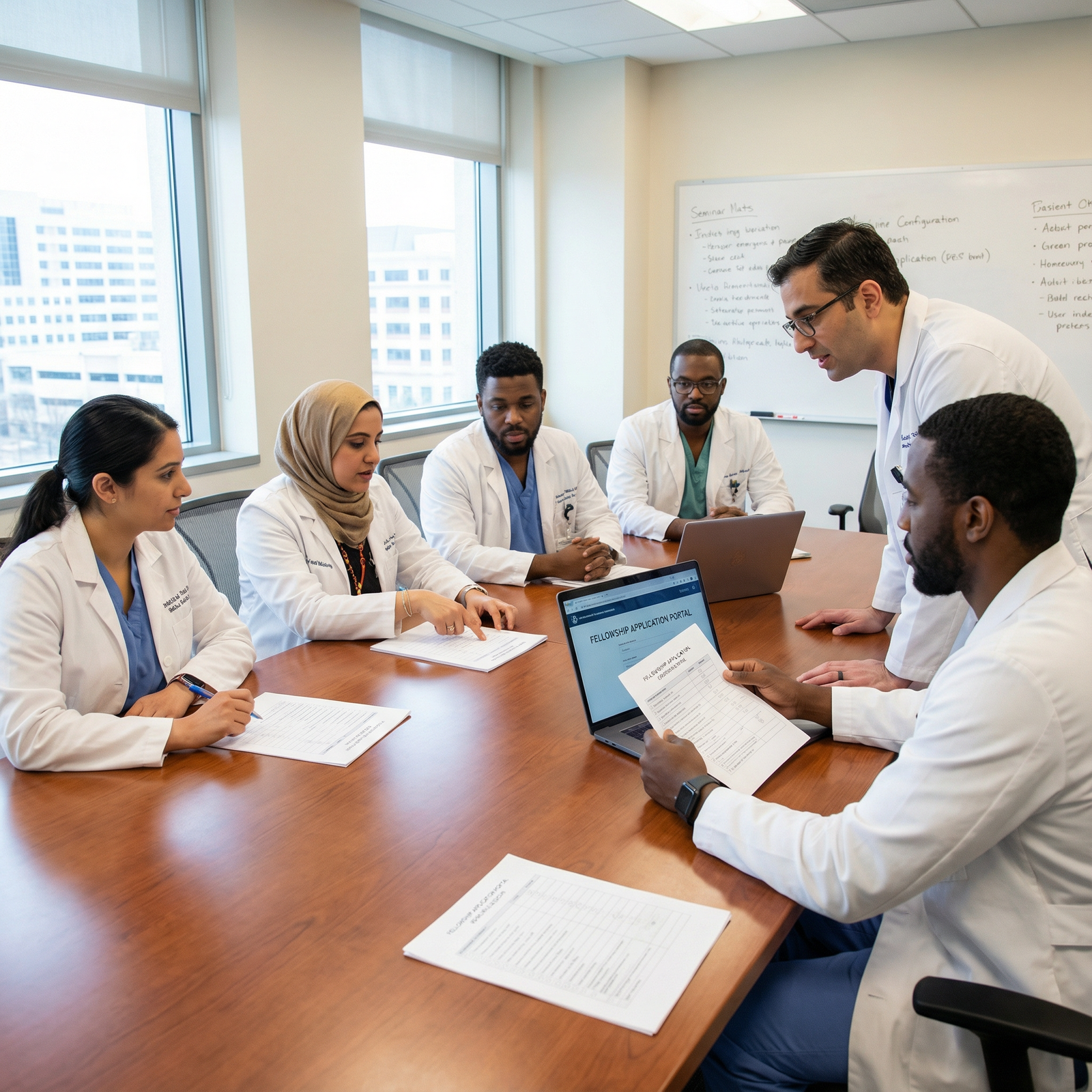
Understanding the Fellowship Landscape in PM&R as a Non-US Citizen IMG
The path from PM&R residency to fellowship is challenging for any resident, but as a non-US citizen IMG (international medical graduate/foreign national medical graduate), your strategy must be more deliberate and time-sensitive. Visa restrictions, program eligibility rules, and competition for a limited number of positions all make early, informed planning essential.
In Physical Medicine & Rehabilitation, common fellowships include:
- Pain Medicine
- Sports Medicine
- Brain Injury Medicine
- Spinal Cord Injury Medicine
- Pediatric Rehabilitation
- Neuromuscular Medicine
- Hospice & Palliative Medicine
- Clinical Neurophysiology / EMG
- Interventional Spine & MSK
- Cancer Rehabilitation
- Research-focused or non-ACGME fellowships
For a non-US citizen IMG, understanding which of these fellowships sponsor visas and what credentials are prioritized is just as important as your clinical interests.
Key Challenges for Non-US Citizen IMGs
You will face several predictable challenges that should shape your preparation plan:
Visa sponsorship variability:
- Many ACGME-accredited fellowships sponsor J‑1 only.
- Some sponsor H‑1B, but often with stricter USMLE and licensing requirements.
- A minority do not sponsor any visas and require permanent residency or citizenship.
Perceived risk by programs:
Programs may worry about:- Delays in visa processing
- Long-term retention (especially for J‑1 with two-year home-country requirement)
- Funding and HR restrictions
Shorter timeline for decisions:
If you are on a J‑1 visa, your grace period and the “clock” to complete fellowship and manage waiver obligations can be tight.
Because of these factors, you must treat fellowship preparation as a multi-year project starting early in residency—ideally in PGY‑2.
Year-by-Year Roadmap: From PGY‑1 to Fellowship Start
This timeline assumes a 4-year PM&R pathway (PGY‑1 prelim + PGY‑2–4, or categorical PGY‑1–4). Adjust it based on your specific program structure.
PGY‑1: Foundation and Orientation
If you are in a transitional or preliminary year:
Clarify Visa Status and Long-Term Options
- Know your exact visa type (J‑1 vs H‑1B), sponsor (ECFMG vs institution), and expiry dates.
- Understand the two-year home-country requirement for J‑1 and options for waiver later.
- Begin tracking which specialties and fellowships are more J‑1- or H‑1B-friendly.
Confirm PM&R Commitment
- Solidify that Physical Medicine & Rehabilitation is truly your long-term choice.
- Seek PM&R mentors even if your internship hospital does not have a rehab department:
- Connect via your future residency program.
- Use national organizations (AAPM&R, AAP, AAPMR’s mentor portal).
Lay Academic and Professional Groundwork
- Update your CV to US academic style.
- Start a case log or document complex patient encounters that might become future case reports.
- Complete BLS/ACLS and keep certifications current (often required for fellowships).
PGY‑1 Fellowship Preparation Task List:
- Clarify visa details and future constraints.
- Identify at least one PM&R mentor (email, virtual, or institutional).
- Start a CV and track clinical/academic activities.
- Attend at least one PM&R-related webinar or virtual conference.
PGY‑2: Exploration and Early Positioning
PGY‑2 (your first full year of PM&R) is crucial for exploration and early branding.
Explore Subspecialties Systematically Rotate through and intentionally evaluate:
- Inpatient rehab (SCI, TBI, stroke)
- Outpatient MSK/spine, pain clinics
- EMG/neuromuscular
- Pediatric rehab
Keep a simple journal after each rotation:
- What did I like? (patient population, procedures, continuity)
- Which attendings’ careers seem appealing?
- How competitive is this field for non-US citizen IMG?
Research Fellowship Options and Visa Sponsorship Begin building a spreadsheet:
- Fellowship name, institution, city/state
- Specialty (e.g., Pain, Sports, SCI)
- Visa policy (J‑1 only, J‑1/H‑1B, permanent resident/citizen only)
- Past history of interviewing or matching IMGs / foreign national medical graduates
- Application platform (ERAS, SF Match, direct) and fellowship application timeline
This is how you’ll answer for yourself, “how to get fellowship in my subspecialty as a non-US citizen IMG?”
Engage in Research Early
- Identify an attending with ongoing research in your area of interest.
- Start with:
- Case reports
- Retrospective chart reviews
- Quality-improvement (QI) projects
- Aim for at least one abstract submission by the end of PGY‑2.
- This is critical for a strong physiatry match into competitive fellowships such as Pain or Sports.
Begin National Networking
- Join AAPM&R and/or AAP as a resident member.
- Attend the national meeting if financially possible (use IMG/resident discounts, travel grants).
- Introduce yourself to fellowship program directors after relevant sessions:
- Short, professional introduction.
- Express early interest, ask about what they seek in applicants.
- Make notes right after each conversation.
PGY‑2 Fellowship Preparation Task List:
- Decide top 1–2 fellowship interests (e.g., Pain vs Sports, SCI vs TBI).
- Build and maintain a visa-eligibility fellowship spreadsheet.
- Join national specialty organizations and attend at least one meeting (in-person or virtual).
- Start or join at least one research or QI project aligned with future fellowship.
PGY‑3: Targeted Preparation and Application Launch
PGY‑3 is usually when you actively apply for fellowship, depending on specialty. For most PM&R fellowships, applications open 12–18 months before start date.
Know Your Fellowship Application Timeline While exact dates vary by cycle and specialty, a generalized timeline is:
July–September (PGY‑3 start):
- Finalize subspecialty decision.
- Request letters of recommendation.
- Polish personal statement and CV.
October–January (PGY‑3 mid-year):
- Submit applications (ERAS, SF Match, or direct).
- Complete supplementary institutional forms if needed.
January–April:
- Interview season (variable, some fellowships may interview even earlier).
March–June:
- Rank lists or rolling offers, depending on specialty and matching system.
Always verify specific dates with each fellowship and match system.
Optimize Your Application Package
a. CV and Experiences
- Emphasize:
- US clinical experience in PM&R.
- Leadership (chief resident roles, committee work).
- Teaching experience (medical students, junior residents).
- Research and publications, especially subspecialty-related.
b. Personal Statement
For a non-US citizen IMG in PM&R, your personal statement should:- Clearly articulate why you chose physiatry and the specific fellowship area.
- Highlight how your background as a foreign national medical graduate adds value:
- Multilingual abilities
- Cross-cultural care experience
- Resourcefulness working in low-resource settings
- Address visa briefly if relevant (e.g., “I am currently on a J‑1 visa sponsored by ECFMG and fully prepared to comply with all regulatory requirements”).
c. Letters of Recommendation (LORs)
- Aim for 3–4 strong letters, with:
- At least two from subspecialty attendings in your chosen field.
- One from your program director or chair.
- Request letters by early PGY‑3:
- Provide CV, personal statement draft, and bullet points of what you’d like highlighted (procedural skills, professionalism, work ethic).
- Emphasize:
Interview Preparation You’ll be asked standard and non-standard questions:
Common Academic Questions:
- “Why this fellowship and this program?”
- “Tell me about a complex patient you managed.”
- “What are your research interests?”
Questions Often Directed to Non-US Citizen IMGs:
- “What are your visa requirements?”
- “Do you plan to stay in the US long-term?”
- “How has your international background shaped your approach to patient care?”
Prepare concise, honest responses:
- Be clear about your visa needs but don’t make visa the centerpiece.
- Emphasize commitment, flexibility, and long-term professional plans in PM&R.
Strategic Program Selection
Given your non-US citizenship, expand your application list beyond what a US graduate might consider:
- Apply broadly (often 15–30 programs, depending on competitiveness of the subspecialty).
- Prioritize programs that:
- Explicitly state they sponsor J‑1 or H‑1B visas.
- Have a history of matching IMGs/foreign-trained physiatrists.
- Balance:
- “Dream” programs (large academic centers).
- “Realistic” programs (mid-sized or community-affiliated).
- “Safety” options (non-ACGME or research-heavy fellowships).
PGY‑3 Fellowship Preparation Task List:
- Confirm your subspecialty and finalize target program list.
- Draft and refine personal statement; secure LORs early.
- Submit applications according to each fellowship’s timeline.
- Conduct mock interviews with mentors or advisors.
PGY‑4: Securing the Match and Transitioning to Fellowship
By PGY‑4, you are usually either matched or in later-stage negotiations for positions that use a rolling application process.
Confirm Match / Offer and Visa Details
- Once you match or receive an offer, immediately:
- Ask the program’s GME office about visa sponsorship procedures and timelines.
- Prepare necessary documentation (ECFMG certificate, USMLE scores, license, passport, prior DS‑2019s if J‑1).
- Clarify:
- Whether the program sponsors J‑1, H‑1B, or both.
- Deadlines for submitting visa-related forms.
- Once you match or receive an offer, immediately:
Prepare Clinically for Fellowship
- If you’re entering Pain or Sports Medicine:
- Maximize exposure to procedures PGY‑4 year (injections, ultrasound, EMG if relevant).
- Review key guidelines (e.g., pain management, opioid prescribing).
- If entering Brain Injury Medicine, SCI, Pediatric Rehab, or Neuromuscular:
- Focus on complex inpatient management, spasticity, assistive technology, ventilator and bowel/bladder management, etc.
- If you’re entering Pain or Sports Medicine:
Maintain Academic Productivity
- Convert ongoing projects into:
- Manuscripts
- Poster/podium presentations
- Present at local or national meetings; this strengthens your credentials and visibility for future academic or subspecialty roles after fellowship.
- Convert ongoing projects into:
Plan Long-Term Beyond Fellowship Especially important for non-US citizen IMGs:
- For J‑1 holders:
- Investigate waiver job options (e.g., underserved areas, academic centers that sponsor waivers).
- Pay attention to state J‑1 waiver requirements and application windows.
- For H‑1B holders:
- Discuss pathways to permanent residency if you plan to stay in the US long-term.
- Consider how your fellowship will position you for your ultimate career goals:
- Academic physiatry vs. private practice
- Research-intensive vs. clinical-heavy positions
- For J‑1 holders:
PGY‑4 Fellowship Preparation Task List:
- Finalize fellowship contract and visa paperwork.
- Complete specialty-aligned rotations to strengthen practical skills.
- Publish or present remaining research/QI projects.
- Begin exploring post-fellowship job options and visa/waiver pathways.
Visa, Licensing, and Legal Considerations for PM&R Fellows

Understanding the intersection of immigration, licensing, and training is essential for fellowship preparation as a non-US citizen IMG.
J‑1 vs H‑1B: Practical Implications
J‑1 (ECFMG-sponsored):
- Most common for residency and many fellowships.
- Pros:
- Widely accepted in academic programs.
- Unified process via ECFMG.
- Cons:
- Typically requires two-year home-country physical presence after completion, unless you secure a waiver.
- Can limit some job options after fellowship until waiver obtained.
H‑1B (Employer-sponsored):
- Less common for fellowship; more often used for residency or attending jobs.
- Pros:
- No mandatory home-country requirement.
- Can lead more directly to permanent residency.
- Cons:
- Some fellowships will not sponsor H‑1B due to cost/complexity.
- Stricter requirements:
- All USMLE Steps passed (including Step 3) before petition.
- State full medical license often required (not just training license).
Fellowship Eligibility and State Licensing
State Training License vs Full License
- Some states allow fellows to work on a training license.
- Other states require a full, unrestricted license, even for fellows.
- Full license often has additional requirements:
- Specific number of US training years
- Primary source verification of medical school
- Additional documentation or exams
Timing of Step 3
- For H‑1B eligibility, Step 3 must be completed before the visa petition.
- Many non-US citizen IMGs take USMLE Step 3 during PGY‑1 or early PGY‑2 for flexibility.
- Even for J‑1 holders, Step 3 completion strengthens career options post-fellowship.
Working With Your GME Office and Immigration Counsel
- Early in PGY‑3, when planning fellowship applications:
- Ask your current GME office if they can provide generic letters or documentation helpful for prospective fellowships.
- If your case is complex (multiple prior visas, dependents, previous J‑1 waiver issues), consider consulting an immigration attorney familiar with graduate medical education.
- Early in PGY‑3, when planning fellowship applications:
Building a Competitive Profile: Beyond the Minimum
To maximize your chances in the physiatry match for fellowship, think about your profile in four domains: clinical, procedural, academic, and professionalism/leadership.
1. Clinical Excellence in PM&R
Programs want fellows who can function as semi-independent junior attendings:
- Strive for strong rotation evaluations, especially in:
- Your target subspecialty rotations.
- Night float/call (demonstrates reliability under pressure).
- Ask attendings for mid-rotation feedback and act on it.
- Show that you can:
- Manage complex cases.
- Communicate clearly with patients, families, and interdisciplinary teams.
- Handle consults and triage appropriately.
2. Procedural Skills and Technical Competence
Highly procedural fellowships (Pain, Sports, Interventional Spine, EMG) will look closely at your hands-on skills:
- Track procedure numbers (e.g., injections, EMG/NCS studies, ultrasound-guided procedures).
- Whenever possible:
- Ask to assist with procedures.
- Read relevant imaging beforehand and discuss with supervising faculty.
- Include these skills and volumes on your CV and discuss them in your personal statement and interviews.
3. Academic Productivity and Scholarship
Particularly valuable if you are preparing for fellowship in an academic field (e.g., Brain Injury, SCI, Pediatric Rehab, Neuromuscular, or Cancer Rehab):
- Aim for by the end of residency:
- 1–2 peer-reviewed publications (case reports acceptable early on).
- Several poster presentations at national or regional meetings.
- Involvement in at least one multicenter or prospective study, if available.
For non-US citizen IMGs, academic achievement also counters any perceived disadvantage and signals long-term commitment to the specialty.
4. Professionalism, Leadership, and Teamwork
Fellowship directors will ask whether you’re someone they can trust with:
- Leading teams (residents, students, therapists)
- Handling conflict or difficult situations
- Representing the program at conferences and in the community
Ways to demonstrate this:
- Serve on residency or hospital committees (wellness, quality improvement, diversity & inclusion).
- Mentor junior residents or medical students, especially other IMGs.
- Take on roles such as chief resident, if available.
Practical Tips and Common Pitfalls for Non-US Citizen IMGs
Practical Tips
Start Earlier Than You Think
- As soon as you start PGY‑2, behave as though fellowship applications are only a year away—because they are.
Use Your IMG Background Strategically
- Instead of viewing “non-US citizen IMG” as a weakness, present it as:
- Evidence of resilience and adaptability.
- Experience with different health systems and resource environments.
- Ability to connect with diverse patient populations.
- Instead of viewing “non-US citizen IMG” as a weakness, present it as:
Be Transparent but Confident About Visa
- Mention it clearly in applications where requested.
- In interviews, be factual and solution-focused; avoid sounding worried or apologetic.
Network Intentionally
- When attending conferences:
- Identify ahead of time which program directors will be present.
- Attend their talks, ask thoughtful questions.
- Introduce yourself briefly, then follow up by email:
- Attach your CV.
- Reiterate your interest.
- Ask one or two specific questions about their fellowship.
- When attending conferences:
Apply Broadly but Thoughtfully
- Don’t apply everywhere randomly; target programs that fit:
- Your clinical and academic interests.
- Your visa and long-term career needs.
- Don’t apply everywhere randomly; target programs that fit:
Common Pitfalls to Avoid
Waiting Too Long to Decide on a Subspecialty
- Late decisions limit your ability to build a tailored CV and research portfolio.
Ignoring Visa Realities Until After the Match
- Matching into a program that cannot sponsor your visa can result in lost positions or substantial delays.
Underestimating the Importance of Communication Skills
- Fellowship interviews heavily evaluate how well you interact with patients and teams; accent is fine, but clarity and empathy are essential.
Not Using Mentors Effectively
- Ask mentors explicitly:
- “Would you feel comfortable writing me a strong letter?”
- “What weaknesses should I work on before fellowship applications?”
- Ask mentors explicitly:
FAQs: Fellowship Preparation for Non-US Citizen IMG in PM&R
1. As a non-US citizen IMG, is it realistic to match into a competitive PM&R fellowship like Pain or Sports Medicine?
Yes, it is realistic, but you’ll need a particularly strong and strategic profile. Key elements include:
- High-quality letters from recognized subspecialty faculty
- Documented procedural experience
- Research or academic output in Pain or Sports Medicine
- Early completion of USMLE Step 3 and clear visa plan
- Applying broadly, including programs with a track record of sponsoring visas and training IMGs
2. When should I start preparing for fellowship during PM&R residency?
Effective fellowship preparation should begin no later than early PGY‑2:
- PGY‑1: clarify visa status and explore PM&R as a long-term path.
- PGY‑2: define subspecialty interest and begin research and networking.
- PGY‑3: submit fellowship applications and interview.
- PGY‑4: finalize visa and contract; prepare clinically for the transition to fellowship.
3. How can I find out which PM&R fellowships sponsor visas for foreign national medical graduates?
Use a multi-step approach:
- Check official fellowship websites (often mention J‑1/H‑1B policies).
- Review program entries in ERAS, SF Match, or FREIDA for visa information.
- Email program coordinators directly with a concise question about visa sponsorship.
- Ask current or former fellows, especially other IMGs, through networking or professional societies such as AAPM&R.
Track this in a spreadsheet as you build your application list.
4. What if I don’t match into fellowship on my first attempt as a non-US citizen IMG?
This is not the end of the road. Options include:
- Completing an additional year as a hospitalist or rehab attending (if visa and license allow) while strengthening your CV.
- Pursuing a research or non-ACGME fellowship year in your desired field.
- Enhancing your profile (publications, procedures, new LORs) and reapplying the following cycle.
If you are on a J‑1 visa, consult early with your GME office and an immigration attorney to ensure any gap year or alternative path doesn’t jeopardize your status or home-country requirement timeline.
By understanding the landscape, starting early, and making strategic choices tailored to your visa status and career goals, you can successfully navigate fellowship preparation as a non-US citizen IMG in Physical Medicine & Rehabilitation and position yourself for a fulfilling career in physiatry.