Preparing for a psychiatry fellowship as a non-US citizen IMG is absolutely achievable—but it requires early planning, strategic choices, and visa-aware decision-making from your very first day in residency. Your status as a foreign national medical graduate shapes not only where you can apply, but also how you need to build your CV, network, and timeline.
This guide walks you through a step-by-step roadmap for fellowship preparation in psychiatry—from PGY-1 to application season—framed specifically for non-US citizen IMGs.
Understanding the Landscape: Fellowships, Visas, and Realistic Options
Before you decide how to get fellowship, you need to understand what you’re aiming for and what constraints you face.
Common Psychiatry Fellowships
Most psychiatry residents apply to one of the following ACGME-accredited fellowships:
- Child and Adolescent Psychiatry (CAP)
- Addiction Psychiatry
- Geriatric Psychiatry
- Consultation-Liaison (CL) Psychiatry
- Forensic Psychiatry
- Sleep Medicine (multidisciplinary)
- Pain Medicine (less common for psychiatry graduates)
Non-ACGME options include:
- Women’s Mental Health
- Neuropsychiatry
- Reproductive Psychiatry
- LGBTQ+ Mental Health
- Research fellowships (T32, institutional research tracks)
How Non-US Citizen Status Affects Fellowship Options
As a non-US citizen IMG, key factors include:
Visa Sponsorship
- Most psychiatry fellowships sponsor J-1 visas through ECFMG
- Some, but not all, can sponsor H-1B; this is program- and institution-specific
- Very few are open to other visa types (e.g., O-1), usually for unique, research-heavy profiles
Institutional Policies
- Some university programs explicitly welcome foreign national medical graduates
- Others have hidden or informal preferences for:
- Internal candidates (their own residents)
- US citizens/permanent residents due to funding rules or perceived visa complexity
Program Competitiveness
- CAP and CL Psychiatry are relatively broad in opportunities
- Forensic, Addiction, and Geriatric can be more niche and sometimes more accessible
- Highly research-oriented or prestigious programs may be more selective but can be IMG-friendly if you bring strong research credentials
Psych Match vs. Fellowship Match: Key Differences
You likely remember the psych match (residency match) as a centralized, NRMP-coordinated process. Fellowship application systems are more fragmented:
- Many psychiatry fellowships use ERAS + NRMP (especially CAP, CL, Addiction)
- Some still use direct applications or institutional portals
- Deadlines can be earlier than you expect (often in PGY-3 for a PGY-5 CAP track, or PGY-2/PGY-3 for a 4-year fast-track)
As a non-US citizen IMG, you must track:
- Whether programs accept your visa type
- Whether they sponsor new visas vs. only continue existing ones
- Whether they impose extra requirements or timing constraints
Building a Fellowship-Ready CV from PGY-1 Onward
Your residency years are your primary runway for fellowship preparation. A well-designed plan from PGY-1 dramatically improves your options.

PGY-1: Laying the Foundations
PGY-1 is about orientation and exposure, but you can still make smart moves:
Clarify your goals early
- Ask yourself:
- Am I leaning toward CAP, CL, Addiction, Forensic, Geriatric, or general adult practice?
- Do I enjoy research, teaching, policy, or clinical work most?
- You don’t need a final answer, but you should identify two or three likely directions.
- Ask yourself:
Identify potential mentors
- Look for faculty who:
- Are fellowship directors or leaders in subspecialties that interest you
- Have experience mentoring IMGs
- Have active research or QI projects
- Request a brief meeting and say explicitly:
- You are a non-US citizen IMG
- You are interested in fellowship
- You want advice on what to focus on
- Look for faculty who:
Join at least one project
- Options:
- Case reports or series
- Quality improvement (QI) projects on your inpatient unit
- Small chart review under a faculty mentor
- Even small contributions, if started early, can lead to:
- A poster at APA or another meeting
- A line on your CV before PGY-3
- Options:
Get strong clinical evaluations
- Fellowship programs care about:
- Reliability, professionalism, documentation, teamwork
- As an IMG, communication skills are often closely scrutinized:
- Ask for feedback on your notes and patient interviews
- Document improvements in your Milestones
- Fellowship programs care about:
PGY-2: Clarifying Subspecialty Direction and Deepening Experience
PGY-2 is the time to solidify your subspecialty interest and start building a profile that clearly aligns with it.
Select rotations intentionally
- If considering Child and Adolescent Psychiatry:
- Electives in child clinics, school consultation, autism programs
- For Consultation-Liaison:
- Extra time on C-L teams, ICU consults, psycho-oncology
- For Addiction:
- Inpatient detox, methadone clinics, dual diagnosis units
- For Forensic:
- Court clinics, jail psychiatry, competency evaluation services
- For Geriatric:
- Memory clinics, nursing home consults, ECT services
- If considering Child and Adolescent Psychiatry:
Strengthen research or scholarly output
- Aim for at least one substantial scholarly activity by the end of PGY-2:
- Poster or oral presentation
- Manuscript submission (case report, brief review, or original research)
- QI project with measurable outcomes
- This is particularly important when:
- You are interested in competitive academic fellowships
- You want to counteract biases sometimes faced by non-US citizen IMGs
- Aim for at least one substantial scholarly activity by the end of PGY-2:
Involve yourself in professional organizations
- Join:
- APA (American Psychiatric Association)
- AACAP (for child), AAPL (for forensic), APM (for CL), AAAP (for addiction), AAGP (for geriatrics)
- Apply for:
- IMG-focused committees
- Resident fellow member positions
- Travel awards or mentorship programs
- These can:
- Provide mentorship
- Help you understand the fellowship application timeline
- Create networking opportunities with national leaders
- Join:
Begin exploring visa implications
- Confirm your current visa type (J-1, H-1B, others) and its duration
- Talk to:
- Your GME office about fellowship after residency
- Current fellows who are non-US citizen IMGs—ask:
- Which programs were visa-friendly?
- Did they face any hidden restrictions?
PGY-3: Positioning Yourself as a Strong Fellowship Candidate
PGY-3 is critical for application preparation. For many psychiatry fellows, this is the year when applications are submitted.
Finalize your target subspecialty
- By early PGY-3, you should know:
- Which fellowship type you are applying to
- Whether you prefer academic vs. community settings
- Geographic or visa-related constraints
- By early PGY-3, you should know:
Plan letters of recommendation strategically
- You typically need 3–4 strong letters, including:
- At least one from a faculty in your target subspecialty
- Preferably one from a program director or associate program director
- A letter that speaks to your professionalism, teamwork, and communication
- Ask early:
- Ideal: 3–6 months before you need them submitted
- Provide:
- Your CV
- Personal statement draft
- Bullet points on your specific contributions and goals
- You typically need 3–4 strong letters, including:
Increase your visibility in your subspecialty
- Present at:
- Grand rounds or case conferences
- Departmental journal clubs in your chosen field
- Volunteer for:
- Teaching medical students on relevant rotations
- Leading small group seminars or resident teaching sessions
- Present at:
Refine your scholarly niche
- You don’t need a lifetime niche, but it helps to have a coherent story, for example:
- CAP: "I’m focused on early identification and intervention in adolescent mood disorders."
- CL: "I’m interested in psych–oncology and the interface of mood and cancer."
- Addiction: "I want to focus on integrating addiction treatment into primary care."
- Frame your projects, presentations, and essays around this narrative.
- You don’t need a lifetime niche, but it helps to have a coherent story, for example:
Visa, Sponsorship, and Practical Realities for Non-US Citizen IMGs
Your immigration status must be part of your strategic fellowship planning, not an afterthought.

J-1 vs. H-1B in Psychiatry Fellowship
Most non-US citizen IMGs in psychiatry are on J-1 or H-1B visas during residency.
J-1 Visa Considerations
- Pros
- Common and widely understood by academic psychiatry departments
- Many fellowships are comfortable sponsoring J-1 through ECFMG
- Cons
- 2-year home residency requirement after training, unless waived
- May limit certain post-fellowship job options unless:
- You pursue a J-1 waiver job (often in underserved areas)
- You return to home country for 2 years
- You obtain a statutory waiver exception (rare)
For fellowship preparation:
- Verify with each program:
- "Do you sponsor J-1 visas for fellows?"
- "Have you had J-1 fellows in your program recently?"
- Consider your post-fellowship plans:
- If you plan to stay in the US long-term, think ahead to the J-1 waiver process.
H-1B Visa Considerations
- Pros
- No 2-year home residency requirement
- Easier transition to permanent jobs and green card pathways
- Cons
- More complicated and expensive for programs to sponsor
- Fewer psychiatry fellowships accept or initiate H-1B sponsorship
- Cap and timing issues can arise (unless institution is cap-exempt, e.g., universities)
For fellowship preparation:
- Ask programs very specifically:
- "Do you sponsor new H-1B visas for fellowship, or only continue existing H-1Bs?"
- "Have you recently matched fellows on H-1B status?"
- Maintain detailed documents of:
- Previous H-1B approvals
- Educational credentials
- Clinical experience
Practical Steps to Manage Visa Issues
Talk to your GME office in PGY-2
- Ask for:
- A meeting with the visa coordinator
- A written statement of your visa type and expiration
- Confirm:
- Whether your current visa will extend through fellowship if you stay in the same institution
- Ask for:
Create a “visa-friendly” fellowship list
- Use:
- Program websites (though often incomplete)
- Email queries to coordinators
- Conversations with recent fellows (especially non-US citizen IMG fellows)
- Note:
- Programs that explicitly state J-1 friendly or H-1B friendly
- Programs that say "cannot sponsor visas"
- Use:
Align your priorities with visa reality
- You may have to balance:
- Optimal subspecialty or program prestige
- Realistic visa sponsorship
- Geographic flexibility (some states/institutions are more IMG-friendly)
- You may have to balance:
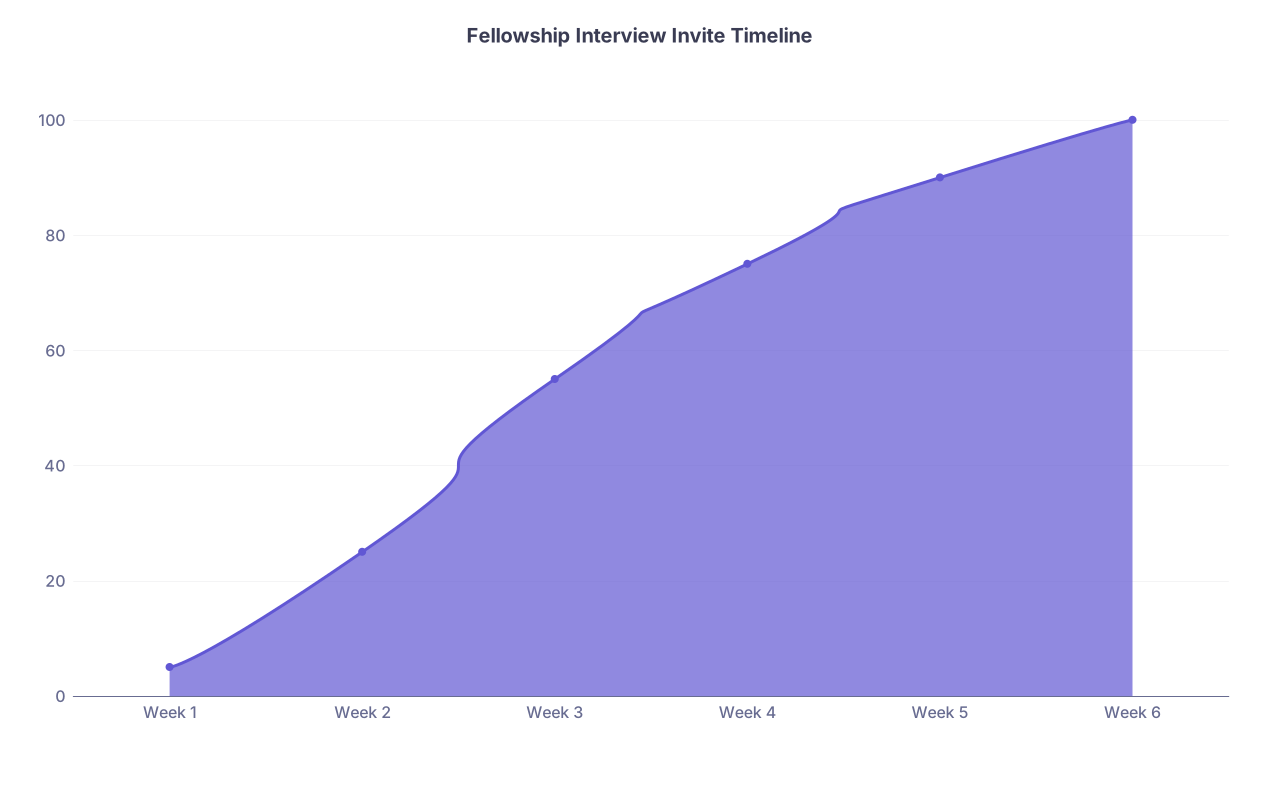
Fellowship Application Timeline and Strategy
Understanding the fellowship application timeline and working backward is crucial for non-US citizen IMG psychiatry residents.
General Timeline (Typical, but Verify by Subspecialty)
This can vary slightly by specialty and year, but a rough framework:
PGY-2 late / PGY-3 early (about 18–24 months before fellowship start)
- Decide on subspecialty
- Begin drafting personal statement
- Identify letter writers
- Build target program list with visa considerations
PGY-3 spring–summer (about 12–18 months before start)
- ERAS opens for some fellowships
- Submit fellowship applications
- Programs begin reviewing and offering interviews
PGY-3 summer–fall (about 10–14 months before start)
- Interview season for many psychiatry fellowships
- Rank lists (if NRMP match is used) or direct offers
PGY-3 fall–winter
- Match results (if NRMP-based)
- Contract signing and visa paperwork initiation
Because processes evolve, you should:
- Check:
- NRMP fellowship schedule
- ERAS fellowship timeline
- Each subspecialty society’s website (e.g., AACAP, APM)
Crafting a Compelling Application as a Non-US Citizen IMG
CV: Highlight strengths and clarity
- Emphasize:
- US clinical experiences
- Leadership roles
- Academic output
- For a foreign national medical graduate, your CV should clearly show:
- Adaptation to US training systems
- Progression and increasing responsibility
- Emphasize:
Personal Statement: Build a coherent narrative Focus on:
- Why this subspecialty?
- Why you, given your background as a non-US citizen IMG?
- How your international perspective enhances your future practice?
Structure suggestion:
- Opening clinical story that illustrates your subspecialty interest
- Bridge to your background as a non-US citizen IMG and how it shapes your empathy and cultural competence
- Summary of your training and scholarly work supporting your fellowship goal
- Future vision—what kind of psychiatrist you aim to be and how this fellowship is essential to that
Letters of Recommendation: Anticipate IMG-specific concerns
- Ask your letter writers to address:
- Your communication with patients and teams
- Your reliability and independence
- How you compare to US graduates they have worked with
- As a foreign national medical graduate, strong, explicit endorsements can counter any biases.
- Ask your letter writers to address:
Program Selection Strategy Consider:
- A mix of:
- Your home institution fellowship (often higher acceptance probability)
- Regional programs where your residency program has relationships
- A few ambitious or top-tier programs that are known to support IMGs
- If visa-limited:
- Build a list where all programs definitively sponsor your visa type
- A mix of:
Interviewing as a Non-US Citizen IMG
Prepare for common questions
- "Tell me about your journey from medical school to here."
- "How does your international background influence your approach to psychiatry?"
- "What are your long-term goals after fellowship?"
- "Do you anticipate staying in the US long-term?"
Address visa questions professionally
- Be honest but concise:
- "I am currently on a [J-1/H-1B]. I understand your program supports [J-1/H-1B]. My long-term goal is to continue practicing in the US, and I’m aware of the necessary steps, including waiver jobs if applicable."
- Avoid:
- Overly detailed, anxious discussions
- Debating immigration policy in the interview
- Be honest but concise:
Show adaptability and insight
- Highlight:
- Times you adapted quickly to US healthcare systems
- Experiences working with diverse populations
- Fellowship directors often want assurance that:
- You will integrate smoothly into their team
- You can handle complex cases with cultural sensitivity
- Highlight:
Planning Beyond Fellowship: Career Strategy and Long-Term Goals
Preparing for fellowship also means preparing for what comes after—especially important for non-US citizen IMGs.
Connecting Fellowship Choice to Future Options
When deciding how to get fellowship, also consider:
Job Market
- CAP and Addiction Psychiatry often have strong demand
- CL and Forensic may have niche but stable opportunities, especially in academic centers
- Geriatric psychiatry is in high demand with aging populations
Visa Waiver Opportunities (for J-1)
- Some subspecialties may have more openings in:
- Underserved communities
- State hospitals
- Rural or semi-rural areas
- Some subspecialties may have more openings in:
Academic vs. Community Career
- If you enjoy:
- Research and teaching → Academic fellowship with robust scholarly resources
- Clinical practice and leadership → Fellowships with strong clinical but less research intensity
- If you enjoy:
Preparing for Fellowship to Optimize Future Visas and Jobs
Build a niche and reputation
- During fellowship:
- Present at national meetings
- Publish at least 1–2 pieces
- This can later support:
- Academic appointments
- O-1 visa applications (for individuals with extraordinary ability), in rare cases
- During fellowship:
Network intentionally
- Stay connected with:
- Faculty mentors
- Co-fellows and residents
- National society leaders
- These contacts can:
- Refer you to J-1 waiver positions
- Help you navigate institutional visa policies in jobs
- Stay connected with:
Understand the fellowship-to-job timeline
- Start your job search during fellowship year 1, especially if:
- You are J-1 and need a waiver
- You require H-1B sponsorship in your first attending job
- Use mentors to:
- Identify IMG-friendly employers
- Review contracts, especially any immigration-related clauses
- Start your job search during fellowship year 1, especially if:
FAQs: Fellowship Preparation for Non-US Citizen IMGs in Psychiatry
1. When should I start preparing for psychiatry fellowship as a non-US citizen IMG?
You should start exploring fellowship paths in PGY-1 and actively preparing by early PGY-2. As a non-US citizen IMG, you need extra time to:
- Clarify which subspecialties are more visa-friendly
- Build a competitive CV that addresses any perceived disadvantages
- Identify mentors who understand both psychiatry and immigration-related challenges
By early PGY-3, you should have:
- A defined subspecialty goal
- At least 2–3 strong potential letter writers
- Some scholarly activity (poster, presentation, or paper)
- A draft of your personal statement and a preliminary list of programs
2. Is it harder for a non-US citizen IMG to match into psychiatry fellowship?
It can be more complex, but not impossible. Main challenges include:
- Programs that do not sponsor visas at all
- Programs that limit H-1B sponsorship or unfamiliarity with visa issues
- Occasional bias or concern about communication or integration
You can compensate by:
- Targeting programs known to be foreign national-friendly
- Demonstrating strong clinical performance and excellent communication
- Securing powerful letters and a focused subspecialty profile
Many non-US citizen IMGs successfully match into CAP, CL, Addiction, Forensic, and other psychiatry fellowships each year.
3. How important is research for psychiatry fellowship as a foreign national medical graduate?
Research is not mandatory for all psychiatry fellowships, but it is often very helpful, especially when:
- You are applying to competitive academic programs
- You want to stand out among US graduates
- You are considering an academic or research career after fellowship
At minimum, aim for:
- One or two posters or presentations
- A case report or small publication if possible
- Involvement in QI projects
For applicants more focused on community practice, strong clinical evaluations, leadership, and teaching activities can carry more weight than formal research.
4. Should I prioritize fellowship programs that are more likely to offer future employment or visa sponsorship?
For non-US citizen IMGs, this is a very practical and often wise strategy. Consider giving extra weight to:
- Institutions that:
- Have a history of hiring and sponsoring visas for former fellows
- Are part of large health systems where internal job opportunities are common
- Locations with:
- Known J-1 waiver opportunities
- High need for psychiatrists in your subspecialty
However, balance this with:
- The quality of training
- Alignment with your long-term career goals
- Your personal and family considerations
By approaching fellowship preparation systematically—from PGY-1 through the application season—and keeping visa realities in clear view, you can create a meaningful and sustainable career path in psychiatry as a non-US citizen IMG. Thoughtful planning, strategic mentorship, and a proactive approach to both training and immigration issues will put you in a strong position not only to match into fellowship, but to thrive long after it ends.