
Understanding the Fellowship Landscape as a Non‑US Citizen IMG in Emergency Medicine
For a non-US citizen IMG in emergency medicine, planning ahead for fellowship is not optional—it’s essential. Visa rules, credentialing requirements, and EM‑specific training expectations all shape your options much more than they do for US graduates. The earlier you understand the landscape, the more control you’ll have over your career.
Why Fellowship Matters for EM Physicians
Emergency medicine is increasingly subspecialized. Many leadership, academic, and high‑acuity roles now informally expect fellowship training, particularly in:
- Critical Care Medicine
- Medical Toxicology
- Emergency Ultrasound (Clinical Ultrasound/POCUS)
- Pediatric Emergency Medicine
- EMS/Prehospital Medicine
- Global Emergency Medicine
- Clinical Research
- Administration/Operations/Quality & Safety
- Sports Medicine
- Wilderness/Disaster Medicine
For a foreign national medical graduate, fellowships can:
- Increase competitiveness for academic or tertiary‑care hospital positions
- Provide visa stability and additional years to solidify your US career
- Offer niche expertise that may be valued if you later work abroad
- Strengthen your profile if you plan to return for a second EM residency or faculty role in another country
But not all fellowships are equally accessible to non‑US citizens or to EM graduates, so careful planning around the EM match, visa pathway, and fellowship application timeline is critical.
Fellowship Types Relevant to EM and Visa Considerations
Broadly, you’ll encounter three categories:
ACGME-accredited clinical fellowships
- Examples: Critical Care, Ultrasound, EMS, Pediatric EM, Sports Medicine
- Pros: Structured training, often qualifies for board subspecialty exams, more standardized GME visa handling
- Cons: Some explicitly require US citizenship or permanent residency; J‑1 sponsorship generally available, but transfer rules matter
Non-ACGME academic/clinical fellowships
- Examples: Global EM, Research, Administration/Operations, Education, Disaster Medicine at some institutions
- Pros: Flexible; often friendly to motivated EM residents; may be easier to negotiate around visa if institution is experienced
- Cons: Less standardized; may not qualify for board certification; sometimes limited funding or “fellow” vs “instructor” titles with different HR implications
International or hybrid programs
- EM fellowships involving time abroad, global health, or binational affiliation
- Pros: Attractive for non-US citizen IMG interested in global emergency medicine or eventual work outside the US
- Cons: Complex visa and credentialing; sometimes require US citizenship for security or funding reasons
Before you commit to a single path, you must understand your visa category and how it interacts with training.
Navigating Visas, Sponsorship, and Legal Realities
For a non-US citizen IMG, fellowship preparation is as much about immigration strategy as academic planning. The same fellowship may be easy to obtain on a J‑1 but nearly impossible on an H‑1B—or vice versa.
Common Visa Paths in EM Residency and Fellowship
J‑1 (ECFMG-Sponsored)
- Most common visa for foreign national medical graduates in US GME
- Allows residency and fellowship training in accredited positions
- Key limitation: The two-year home-country physical presence requirement after completing training, unless you obtain a waiver
H‑1B (Employer-Sponsored)
- Less common in EM, but some programs offer it
- Often preferred if you want to transition directly to a long-term US career
- Subject to cap issues in some settings and may have restrictions on moonlighting
Other pathways (O‑1, Green Card, etc.)
- Less frequent during initial training, sometimes relevant if you have exceptional research credentials or special circumstances
Fellowship Planning by Visa Category
If You Are on a J‑1 Visa
Key constraints:
- J‑1 generally supports residency plus fellowship in sequence, as long as overall training time remains within ECFMG rules
- After all training ends, you must either:
- Return to your home country for two years, or
- Obtain a J‑1 waiver (e.g., Conrad 30, hardship, persecution-based), then change status to H‑1B or another category
Implications for fellowship:
- You can usually do residency + 1–3 years of fellowship on J‑1 without interruption
- But after fellowship, finding a waiver‑sponsoring job (especially if you have a niche fellowship) may require geographic flexibility
- Some J‑1 waiver jobs may not fully utilize your fellowship skills (e.g., rural EM jobs that don’t need a toxicologist or ultrasound director right away)
Strategic advice:
- During residency, research post-fellowship J‑1 waiver job markets, especially in states with active Conrad 30 programs
- When targeting a subspecialty (e.g., Critical Care), ask current fellows how many graduates obtained J‑1 waivers and where
- Confirm with each fellowship program whether they routinely sponsor J‑1s and have experience with non-US citizen IMG issues
If You Are on an H‑1B Visa
Key constraints:
- You are sponsored by the residency institution; a new fellowship means a new H‑1B petition and sometimes a cap issue if moving from a cap-exempt institution to a non-exempt one
- Total H‑1B time (including residency, fellowship, and later work) is usually limited to six years, though some exceptions exist
Implications for fellowship:
- Each fellowship must be willing and able to sponsor an H‑1B
- H‑1B costs and institutional policy mean some EM fellowships won’t sponsor H‑1B even if they take J‑1 residents
- If your overall H‑1B time is almost exhausted, a long fellowship may be hard without starting a green card process
Strategic advice:
- Early in residency, talk with GME and immigration counsel about how much H‑1B time you’ll have left at graduation
- Ask potential fellowships specifically:
- “Do you sponsor H‑1B visas for fellows?”
- “Have you previously sponsored non-US citizen IMG on H‑1B in this program?”
- Consider starting a permanent residency (green card) process if available through a spouse or employer to expand options

Building a Fellowship-Ready Profile During EM Residency
Once you understand your visa framework, you can focus on becoming a standout candidate. Competitive EM fellowships—especially in Critical Care, Ultrasound, and Pediatric EM—evaluate applicants on more than clinical performance alone.
Core Components of a Strong Fellowship Application
Most programs will evaluate:
- Clinical excellence: Strong in-training exam scores, positive evaluations, evidence of steady progression
- Letters of recommendation: Especially from fellowship-trained EM faculty in your intended field
- Scholarly work: Abstracts, posters, publications, QI projects, or education projects relevant to the subspecialty
- Leadership and initiative: Committee work, resident organizations, teaching roles
- Fit with program mission: Alignment with the fellowship’s focus (e.g., global health, administration, research)
As a non-US citizen IMG, you may feel you start at a disadvantage. You can offset that by being deliberate and early in how you position yourself.
PGY-1: Laying the Foundation
Clarify your long-term vision
- Ask yourself: “Where do I see myself 5–10 years after residency—US academic center, community EM, global EM, back home?”
- This will help you decide if fellowship is necessary and which fellowship to pursue
Sample widely within EM
- Use elective blocks to explore: Ultrasound, ICU rotations, EMS ride-alongs, pediatric ED, toxicology consults
- Note which environments energize you; this will inform fellowship choice
Initiate mentorship early
- Identify at least two mentors:
- One for career and wellness (e.g., your APD or trusted faculty)
- One in your potential subspecialty area
- Be explicit that you are a non-US citizen IMG interested in fellowship and need guidance on both academic and visa issues
- Identify at least two mentors:
Start light scholarly involvement
- Join an ongoing project instead of trying to invent one from scratch
- For example, help collect data for a QI initiative in the ED or assist with an ultrasound image database study
PGY-2: Deliberate Positioning Toward a Subspecialty
PGY-2 is typically when you must begin serious fellowship preparation.
Narrow your fellowship interest
- By the middle of PGY-2, aim to have 1–2 realistic targets (e.g., Ultrasound vs. Critical Care)
- Discuss with your mentor how each option aligns with your visa situation and desired geography
Take strategic electives
- Critical Care: Extra MICU, SICU, or Neuro-ICU time, plus a research elective if possible
- Ultrasound: Dedicated ultrasound rotation, teaching junior residents, possibly ultrasound leadership roles
- EMS: Ride-alongs, EMS didactics, prehospital research, involvement with the medical director
- Pediatric EM: Additional pediatric ED time, pediatric-specific QI projects or teaching
Develop 1–2 substantial projects
- Move from “helper” to “owner” on a project:
- Example: Lead a QI project reducing time-to-antibiotics in septic patients
- Or coordinate an EMS protocol evaluation with outcome tracking
- The project should ideally yield presentations or manuscripts within your timeline for applying
- Move from “helper” to “owner” on a project:
Network actively
- Attend national meetings (ACEP, SAEM, SCCM, AAEM, PEM conferences, etc.)
- Introduce yourself at subspecialty interest group sessions (Ultrasound, Global EM, Critical Care)
- Ask your mentors to introduce you to colleagues at institutions where you might later apply for fellowship
Understand program-specific non-US citizen IMG policies
- As you build a preliminary list of fellowships, track:
- Visa types accepted
- Past non-US citizen IMG fellows
- Any preference for US graduates or internal candidates
- As you build a preliminary list of fellowships, track:
PGY-3 and PGY-4: Executing on the Fellowship Application Timeline
The fellowship application timeline in EM is fragmented—different subspecialties use different cycles (e.g., NRMP match vs. ERAS vs. direct applications). You must map your specific subspecialty timeline to your residency year.
Typical patterns:
- Critical Care (for EM)
- Uses ERAS/NRMP in many tracks
- Applications often open ~12–15 months before fellowship start
- Ultrasound, EMS, Toxicology, Global EM, Administration
- Many use non-standardized timelines—some interview 1–1.5 years before start date
- Pediatric EM (via EM route)
- Often uses formal match; check the latest PEM Fellowship program requirements
- Non-ACGME fellowships
- Frequently accept applications on a rolling basis but fill early at prestigious sites
Action steps in your final 1–2 years of residency:
Create a personalized fellowship application timeline
- Start from your expected residency graduation date and work backward:
- Fellowship start date (July year X)
- Application deadline (often July–October year X−1)
- LOR requests (2–3 months before submissions)
- Project completion and abstract deadlines
- Build this into a spreadsheet or calendar
- Start from your expected residency graduation date and work backward:
Strengthen and finalize your scholarly profile
- Aim for at least:
- 1–2 poster or oral presentations at reputable meetings
- 1 manuscript submitted (even if not yet accepted) or a significant QI/education project
- Highlight any unique international perspective, such as EM practice in your home country or global health contributions
- Aim for at least:
Secure strong letters of recommendation
- Target:
- 1 letter from your Residency Program Director
- 1–2 letters from fellowship-trained faculty in your chosen subspecialty
- Optionally, 1 additional letter from a key research or clinical mentor
- As an IMG, your letters help counteract any assumptions about training background—choose letter writers who know you well and will be explicit about your level of performance compared to US grads
- Target:
Prepare for interviews with IMG‑specific questions in mind
- Beyond standard interview questions, you should ask:
- “What has been your experience training non-US citizen IMG fellows?”
- “Do you foresee any visa-related limitations on moonlighting or post-fellowship employment?”
- “How many recent graduates have obtained US faculty or attending positions, and where?”
- Beyond standard interview questions, you should ask:
Choosing the Right Fellowship for Your Career Goals (and Visa Reality)
Fellowship selection for a non-US citizen IMG in emergency medicine should balance professional interest, job market reality, and immigration strategy. Below are key considerations by common EM subspecialties.
Critical Care Medicine (CCM) for EM Graduates
Pros:
- High demand for dual‑trained EM/CCM specialists
- Many academic centers value EM intensivists for ED–ICU integration, sepsis pathways, and consults
- Potential to practice in both ED and ICU, increasing job opportunities
Challenges for non-US citizen IMG:
- Some CCM tracks are historically more familiar with IM/Anesthesia backgrounds and may have fewer EM applicants
- Certain institutions may restrict some CCM tracks to US citizens/permanent residents due to funding or credentialing concerns
- Post-fellowship, some ICU jobs may not sponsor visas, narrowing options if you remain on J‑1 or H‑1B
Best used if:
- You are passionate about critical care and envision a long-term academic or tertiary-care role
- You are comfortable with heavy inpatient ICU work beyond ED shifts
- You have mapped potential ICU or combined ED–ICU jobs that are IMG- and visa-friendly
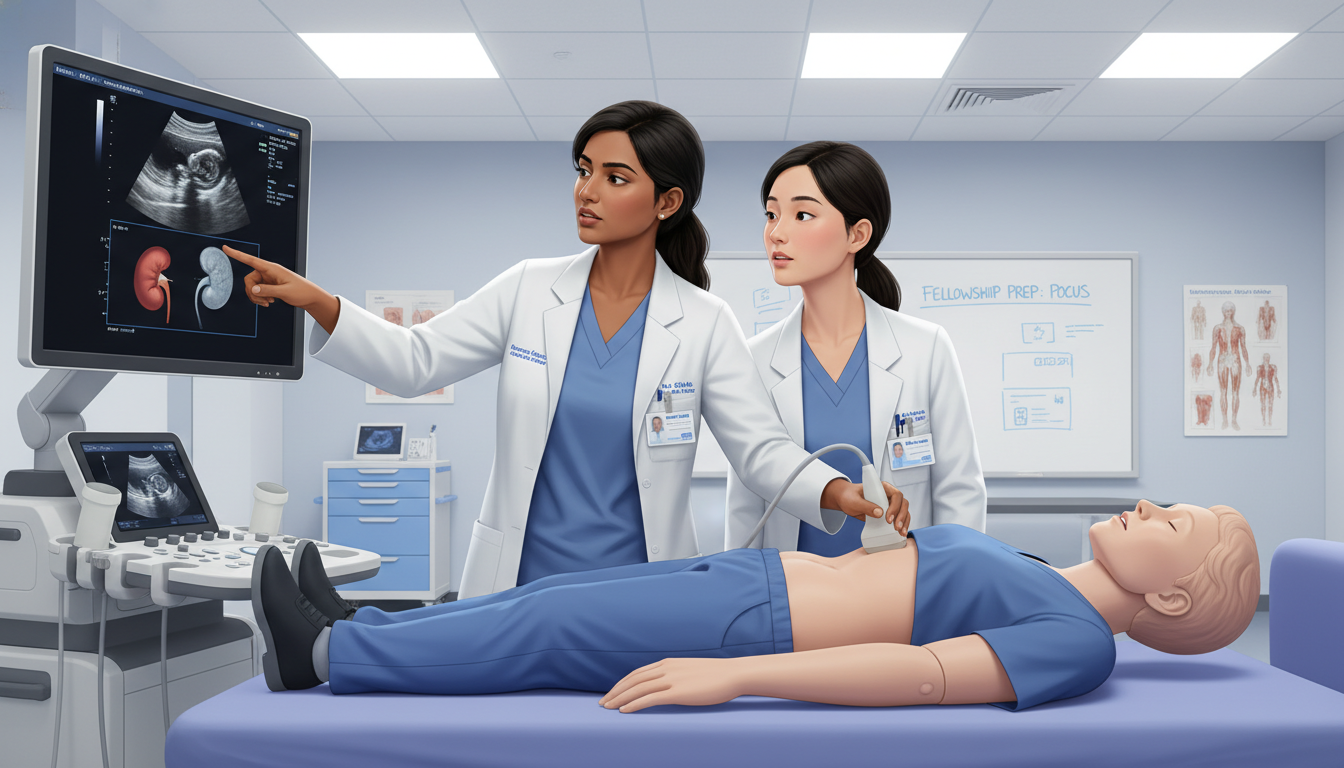
Emergency Ultrasound (Clinical Ultrasound/POCUS)
Pros:
- Clear role within ED departments: ultrasound director, education leader, QI lead
- Skills are highly transferable internationally
- Many EM-focused ultrasound fellowships are accustomed to EM residents and may be more open to IMGs
Challenges:
- Some small community hospitals may not have formal ultrasound director positions or might undervalue the role early on
- Visa issues are generally more program-specific than subspecialty-specific; you must confirm at each site
Best used if:
- You enjoy hands-on teaching, image interpretation, and procedural guidance
- You see yourself in a leadership or education-heavy EM role
- You are interested in a flexible skill set that will remain valuable if you later leave the US
Pediatric Emergency Medicine (PEM) via EM Route
Pros:
- High demand in children’s hospitals and academic centers
- Excellent fit if you enjoy pediatric resuscitation, child advocacy, and multidisciplinary care
Challenges:
- Credentialing and board eligibility pathways can be complex for EM grads versus pediatric grads; you must ensure your track is recognized
- Pediatric institutions sometimes have more restrictive hiring or visa policies, particularly for subspecialty pediatric ICUs or faculty roles
Best used if:
- You are committed to a primarily pediatric practice environment
- You plan to work in larger centers that regularly hire non-US citizens
- You’ve verified that your training sequence (EM residency → PEM fellowship) is acceptable for board certification and future credentialing in your intended country of practice
EMS, Toxicology, Global EM, Administration & Education, and Others
These fellowships can be extremely rewarding but vary widely in structure, visa handling, and job-market impact.
- EMS: Opens paths to medical directorships, system-level roles; often strong fit if you like systems design and prehospital operations
- Toxicology: Niche but highly respected; offers consult roles, poison control center leadership, and complex case management
- Global EM: Natural fit for non-US citizen IMG with cross-cultural experience; be cautious with visa logistics if significant time is spent abroad
- Administration/Operations/Quality & Safety: Valuable if you want leadership or chair-level roles later; many hospital systems appreciate this expertise
- Education Fellowships: Best suited to those with passion for teaching, curriculum design, and academic careers
When choosing among these:
- Evaluate how you want to spend most of your week: clinical shifts vs. operations meetings vs. research vs. teaching
- Ask about alumni outcomes specifically for IMGs: where did they get jobs and on what visas?
- Consider whether the skillset is transferable to positions that can sponsor visas or J‑1 waivers if needed
Practical Steps: How to Get Fellowship and Thrive as a Non-US Citizen IMG
Bringing it all together, here is a consolidated, action-oriented roadmap for fellowship preparation and success.
1. Start Early and Be Honest About Your Constraints
- By early PGY-2, you should know:
- Your likely visa status at graduation
- Your top 1–2 fellowship interests
- Whether you are willing to accept geographically limited paths (e.g., rural J‑1 waiver sites after fellowship)
2. Build a Focused, Not Scattered, Profile
Programs prefer depth over random activities. For example:
If targeting Ultrasound:
- Complete elective rotations
- Present at an ultrasound conference
- Teach medical students and interns during shifts
- Participate in a POCUS QI or education project
If targeting Critical Care:
- Do extra ICU rotations
- Join an ICU-related research or sepsis QI initiative
- Seek feedback from intensivists on your resuscitation skills and incorporate their comments into your personal statement
3. Use Your IMG Background as a Strength
Your experience as a non-US citizen IMG can be an asset:
- Highlight adaptability to different health systems and resource settings
- Emphasize language skills and cultural competency
- For global or administration-focused fellowships, your international insight can differentiate you from US-only trainees
In your personal statement, explain:
- Why you selected emergency medicine specifically as a foreign national medical graduate
- How your background shaped your interest in this fellowship
- Your specific, realistic career goals post-fellowship (e.g., “I aim to work as an EM/CCM attending in an academic safety-net hospital, involved in sepsis QI and resident education.”)
4. Be Systematic With Program Research
Create a spreadsheet with columns such as:
- Program name
- Subspecialty
- Location
- Visa types accepted (J‑1, H‑1B)
- Prior non-US citizen IMG fellows (Yes/No/Unknown)
- Application method (ERAS, NRMP, direct)
- Deadlines and interview season
- Notable features (research focus, global track, pediatric emphasis, etc.)
This will guide both your application list and your strategy for interviews and ranking.
5. Prepare for Fellowship Interviews With Clear, Targeted Messaging
Expect to be asked:
- Why this subspecialty and why now?
- How will you use this training in 5–10 years?
- What unique strengths do you bring to the fellowship?
- How have you overcome challenges, including those specific to being an IMG?
You should also proactively raise:
- Clarifying questions about visa sponsorship and HR processes
- Whether fellows may moonlight (important for finances if you have higher immigration or family costs)
- How the program supports fellows interested in jobs beyond the training institution, including for non-US citizens
6. Think Beyond Fellowship: Preparing for the Job Market
“Preparing for fellowship” for a non-US citizen IMG should also mean “preparing for life after fellowship”:
- Talk to current fellows and recent alumni about:
- Their job search experience as non-US citizens
- Which employers were open to visas (H‑1B, O‑1, or J‑1 waiver positions)
- If on J‑1, track states with strong Conrad 30 programs and consider whether you are open to working there
- If on H‑1B, keep an eye on:
- H‑1B time limits
- Whether your future employers are cap-exempt (academic centers, some hospitals) or subject to the cap
FAQs: Fellowship Preparation for Non‑US Citizen IMG in Emergency Medicine
1. When should I start planning for fellowship if I’m a non-US citizen IMG in EM?
You should begin serious planning by early PGY-2, and ideally start informal exploration and mentorship in PGY‑1. Because your visa status interacts with the fellowship application timeline and post-fellowship employment, you need extra lead time to research programs, refine your interests, and ensure your scholarly output lines up with application cycles.
2. Are there certain EM fellowships that are more IMG- or visa-friendly?
It varies by institution, but in practice, Ultrasound, EMS, and some non-ACGME academic fellowships (administration, education, global EM) tend to be relatively open to non-US citizen IMG compared with some Critical Care or Pediatric-specific fellowships at certain centers. However, many Critical Care and Pediatric EM programs do accept J‑1 and sometimes H‑1B holders. Always confirm program-by-program, because policies change and often depend more on GME and HR rules than on the specialty itself.
3. Can I complete more than one fellowship in emergency medicine as a foreign national medical graduate?
It is technically possible but more complex for non-US citizen IMG due to visa and time constraints. For example, someone might do Emergency Ultrasound followed by Administration, or EM/CCM followed by another niche program. However, the more years you spend in training, the more complicated J‑1 waiver or H‑1B time limits can become. If you are considering multiple fellowships, you must coordinate carefully with immigration counsel and evaluate whether the additional specialization will realistically improve your job prospects.
4. How important is research for getting an EM fellowship as a non-US citizen IMG?
Research is helpful but not always mandatory, depending on the subspecialty. For research-heavy fellowships (e.g., Critical Care at academic centers, clinical research fellowships, some global EM tracks), at least one meaningful project with presentations or publications significantly strengthens your application. For clinical or education-focused fellowships, strong QI, education projects, or curriculum development can substitute for formal bench or clinical research. As an IMG, concrete scholarly output helps counterbalance any concerns about unfamiliar training backgrounds and demonstrates your ability to contribute academically.
By understanding the interplay between your visa status, the EM fellowship landscape, and long-term career goals, you can transform “fellowship preparation” into a strategic roadmap toward the career—and country—where you hope to practice.