Understanding Your Starting Point as a Non-US Citizen IMG
Fellowship preparation for a non-US citizen IMG in general surgery looks different from that of a US graduate. Visa status, institutional sponsorship policies, and perceived risk by program directors all shape your opportunities. The earlier you understand this landscape, the more strategically you can navigate it.
Key Definitions and Terms
- Non-US citizen IMG (International Medical Graduate): You attended medical school outside the US and do not hold US citizenship or permanent residency. You may be on a J-1, H-1B, or other visa.
- Foreign national medical graduate: Often used interchangeably with non-US citizen IMG; emphasizes immigration status.
- General surgery residency: Typically a 5-year ACGME-accredited program (sometimes 7 years with research) that qualifies you to sit for ABS (American Board of Surgery) exams.
- Fellowship: Subspecialty training after residency (e.g., surgical oncology, MIS, colorectal, vascular, transplant, trauma/critical care).
Why Planning Early Matters
As a foreign national medical graduate in general surgery, you face additional barriers:
- Visa restrictions and waiver obligations
- Limited number of programs willing/able to sponsor H-1B
- Fewer positions at highly competitive academic centers
- Extra scrutiny of training background and research experience
Early, deliberate planning allows you to:
- Build a fellowship-competitive CV aligned with your target subspecialty
- Select residency programs and rotations that open fellowship doors
- Time exams, research, and contacts to fit the fellowship application timeline
- Anticipate and mitigate visa challenges well before applications go out
Action step in PGY-1–2: Decide on 2–3 subspecialty interests (even if tentative) and begin tailoring your experiences toward them. You can refine later, but you need a direction now.
Mapping the Fellowship Landscape in General Surgery
Understanding the structure of surgery fellowships and their different competitiveness levels will shape your long-term strategy.
Major Fellowship Pathways After General Surgery
Common fellowships after a general surgery residency include:
- Surgical Oncology
- Vascular Surgery (2-year fellowship path)
- Colorectal Surgery
- Minimally Invasive Surgery (MIS)/Bariatrics
- Hepatopancreatobiliary (HPB) Surgery
- Transplant Surgery
- Trauma and Surgical Critical Care
- Breast Surgical Oncology
- Pediatric Surgery
- Thoracic Surgery (traditional track)
- Complex General Surgical Oncology (CGSO)
Each has specific expectations for research, case volume, and letters, and they vary in how IMG-friendly they are.
IMG-Friendliness and Competitiveness (General Trends)
While exact numbers change year to year, certain patterns are consistent:
Most competitive, academic-heavy
- Pediatric Surgery, Surgical Oncology (CGSO), HPB, Transplant, Thoracic
- Strong emphasis on research, publications, and letters from leaders in the field
- Programs may have fewer positions and strong preference for US grads from top residencies
Moderately competitive, mixed practice settings
- Colorectal, Vascular (fellowship path), MIS/Bariatrics, Breast
- Still value research, but high-quality clinical performance can compensate
- More variation in IMG acceptance by program
Relatively more open to IMG candidates (though still competitive)
- Trauma/Acute Care Surgery, Surgical Critical Care
- Often emphasize operative maturity, ICU competence, and reliability
- Many programs have experience with visa issues and non-US grad trainees
As a non-US citizen IMG, you are not excluded from any fellowship, but you will need stronger objective evidence of excellence—especially academic output and strong US-based endorsements—to be competitive in the most sought-after fellowships.
Linking Your Residency Program to Fellowship Opportunities
Your general surgery residency is the primary platform for your fellowship trajectory. Program factors that strongly influence your fellowship prospects:
- Presence of in-house fellowships (e.g., at your institution)
- Research infrastructure and track record of residents publishing
- Historical match list for surgery residency match into fellowships—where do residents go?
- Faculty who are nationally recognized in your area of interest
- Program’s history of supporting non-US citizen IMGs for advanced training
Action step for early residents: Study your program’s last 5–10 years of fellowship outcomes. Identify graduates who matched into your target field; connect and ask what helped them succeed—and what they would do differently.

Building a Fellowship-Ready Profile During Residency
Knowing how to get fellowship is largely about shaping your daily decisions in residency—rotations, projects, and relationships.
PGY-1 to PGY-2: Laying the Foundation
Clinical Excellence Is Non-Negotiable
Program directors often say: “We can teach you research; we can’t teach you work ethic.” For a foreign national medical graduate, strong clinical evaluations reassure fellowship programs that you can function at a high level in the US system.
Focus on:
- Being reliable: show up early, know your patients intimately
- Mastering documentation, communication, and safe handoffs
- Owning your consults and ward patients
- Developing OR basics: knot tying, suturing, basic laparoscopic skills
Actionable habits:
- Ask senior residents what “top 10” behaviors distinguish the best interns on their service.
- Review cases and indications the night before; pre-read operative steps.
- Keep a case log meticulously updated; this will matter later.
Early Research and Academic Productivity
As soon as you settle in PGY-1, seek low-barrier academic projects:
- Case reports and case series
- Retrospective chart reviews
- Quality improvement (QI) projects
- Book chapters or review articles
Target projects connected to your tentative fellowship interests, e.g.:
- If you’re considering vascular surgery: QI projects on peripheral arterial disease protocols
- For MIS: outcomes of laparoscopic vs. open procedures at your institution
- For trauma/SCC: ICU protocols, sepsis bundles, or transfusion practices
You don’t need a massive randomized trial; you need evidence of curiosity, initiative, and persistence.
PGY-3 to PGY-4: Differentiating Yourself
Around mid-residency, fellowship programs expect a clearer demonstration of your trajectory.
Sharpen Your Subspecialty Identity
- Attend subspecialty conferences (SAGES, ASTS, EAST, SSO, SVS, etc.)
- Join relevant national societies as a resident member
- Seek electives or outside rotations if your home institution is weak in your target area
- Ask to be assigned preferentially to services aligned with your future plans
Deepen Your Research Portfolio
By PGY-3–4, a competitive fellowship candidate should ideally have:
- Several peer-reviewed publications (first- or co-author)
- At least one national or regional oral/poster presentation
- Ongoing projects that will yield additional output
If your residency has a dedicated research year, this is a major asset—especially for Surgical Oncology, HPB, Transplant, Thoracic, and Pediatric Surgery. Use research time strategically:
- Work under a well-funded, well-connected mentor
- Aim for original research in high-impact journals
- Get involved in multi-institutional or clinical trials if possible
Operational Skills and Leadership
Fellowship programs care whether you’ll function effectively as a junior attending:
- Take on chief-of-service–style responsibilities where appropriate
- Mentor junior residents and medical students
- Lead QI initiatives; serve on hospital committees (M&M planning, safety committees)
Action step: Ask your program director or chairman explicitly: “If I told you I want to match into [X] fellowship, what gaps do you see in my CV, and how can I fix them this year?” Then act on that feedback aggressively.
PGY-5 (and PGY-6-7 if Research): Consolidation and Presentation
As you approach applications, your profile should show a coherent story:
- Subspecialty focus with targeted clinical rotations and electives
- Track record of scholarship directly related to that field
- Strong letters of recommendation from recognized leaders
- Evidence of professionalism and teamwork
Remember: your goal is to present yourself not just as a “good resident,” but as a future colleague in that subspecialty.
Understanding the Fellowship Application Timeline and Process
The fellowship application timeline differs by specialty and match system. Knowing when to act—and backward planning from those dates—is crucial.
Key Match Systems for Surgical Fellowships
- ERAS/NRMP: Used for some surgical subspecialties (e.g., Surgical Critical Care, Surgical Oncology, Breast).
- SF Match: Common for Vascular, MIS, HPB, Pediatric Surgery (depending on year/updates).
- Program-direct offers / institutional matches: Some Trauma/ACS, non-ACGME fellowships, and international fellowships.
Timelines evolve, so always check official society and match websites for the current year’s deadlines.
General Fellowship Application Timeline (By PGY Year)
This can vary slightly by specialty, but as a framework:
PGY-2 (early)
- Narrow your focus to 1–2 target fellowships.
- Start networking at conferences.
PGY-2–3
- Intensify research; aim for abstracts at national meetings.
- Identify potential letter writers and work closely with them.
PGY-3–4 (crucial planning stage)
Most surgical fellowships expect applications approximately 1.5–2 years before fellowship start:
- If you finish residency in June 2028, you likely apply mid-2026 to early 2027.
- This means your academic profile must be mature by the middle of your PGY-3–4 year.
Key tasks:
- Clarify your visa status and discuss sponsorship options with your GME office early.
- Draft your personal statement months in advance and revise with mentors.
- Request letters from those who can speak to your surgical judgment, work ethic, and professionalism.
Interview Season and Ranking
- Interviews often run late summer through winter of the year you apply.
- Rank lists are usually submitted a few weeks after the last interviews.
- Keep your PD updated on your progress; programs often communicate behind the scenes.
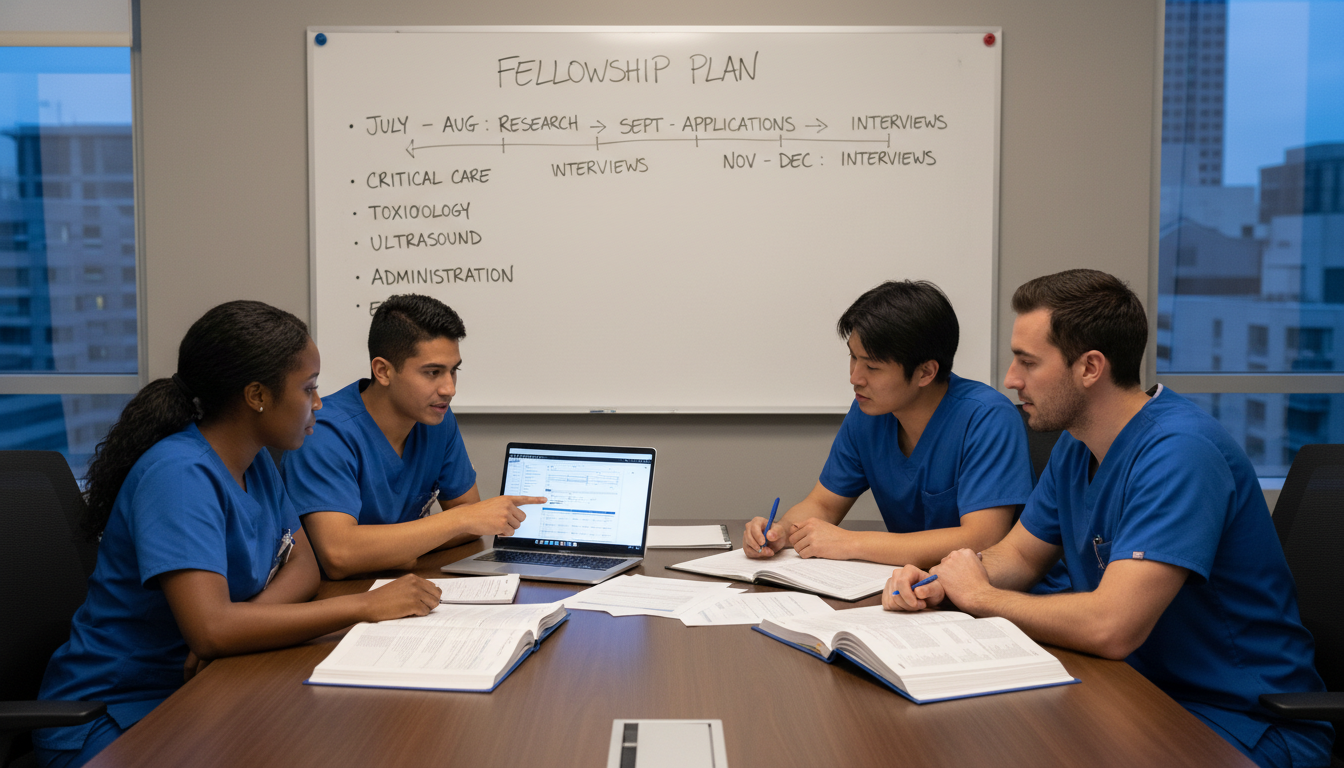
Action step: Create a personalized fellowship application calendar 2 years before graduation, listing for each target specialty:
- Application open date
- Submission deadlines
- Interview windows
- Rank list deadlines
And then integrate your research, away rotations, and exam timing into that calendar.
Navigating Visa and Immigration Challenges Strategically
For a non-US citizen IMG, immigration strategy is not separate from fellowship planning—it is central to it.
Common Visa Scenarios in General Surgery Residency
J-1 visa (ECFMG-sponsored)
- Most common for IMGs in residency.
- Requires a 2-year home country physical presence after training, unless you obtain a J-1 waiver (e.g., Conrad 30, hardship, or persecution waiver).
H-1B visa (institution-sponsored)
- Some residencies and fellowships are willing to sponsor.
- Typically requires all USMLE Steps passed (including Step 3) and institutional capacity.
- Considered more “flexible” for remaining in the US, but not universally available.
Other statuses (e.g., O-1, pending permanent residency)
- Less common during residency but may be relevant for established researchers.
Visa Considerations for Fellowship
Fellowship programs vary widely:
- Some only sponsor J-1.
- Some can sponsor H-1B.
- A minority can handle more complex situations (e.g., O-1).
Your visa status can directly impact which programs will even consider your application.
Action steps:
- Clarify your current visa path with your residency’s GME office and legal counsel by PGY-2.
- Search fellowship program websites specifically for visa policies:
- “We accept J-1 only”
- “Can sponsor H-1B for eligible candidates”
- Email program coordinators for clarification if the website is vague.
The J-1 Waiver and Its Impact on Fellowship Timing
If you finish residency on a J-1:
- You may owe a 2-year home-country return or must secure a J-1 waiver job in a medically underserved area for 3 years (Conrad 30 or similar).
- Completing fellowship on J-1 first may extend your total training period before the 2-year requirement kicks in.
Typical paths:
- Residency → Fellowship (both J-1) → Return home or secure waiver job
- Residency (J-1) → J-1 Waiver job as general surgeon → Fellowship later (trickier but possible in some cases)
- Residency (H-1B) → Fellowship (H-1B or J-1) with different constraints
Because immigration rules change and are complex, always seek professional legal advice; don’t rely solely on hearsay from residents.
Planning tip: When deciding how to get fellowship, assess whether your long-term goal is:
- Staying in US academic practice
- US community practice
- Returning to home country or another region
Then design your visa path and fellowship applications to support that long-term plan.
Using International Opportunities Strategically
If US-based fellowships seem severely constrained by visa issues, consider:
- High-quality Canadian, UK, Australian, or European fellowships that recognize your US residency training.
- Short-term observerships or visiting fellowships at major US centers (to build credentials and return later).
- Building a niche expertise in your home country with plans to collaborate internationally.
These pathways may not be your initial ideal, but they can be stepping stones to an academic career and later re-entry into the US or other systems.

Crafting a Competitive Fellowship Application as a Non-US Citizen IMG
Once your experiences are in place, you must present them convincingly.
Personal Statement: Tell a Coherent, Focused Story
Your personal statement should:
- Clearly explain why this subspecialty and why now
- Connect your background as a foreign national medical graduate to your motivation and strengths (e.g., resilience, cross-cultural communication, resourcefulness)
- Highlight a cohesive narrative: clinical experiences, research focus, and long-term goals
- Address any unusual features proactively (e.g., visa constraints, research gap, transfers) without making excuses
Avoid generic statements about “always loving surgery.” Instead:
- Describe a specific clinical experience that crystallized your interest.
- Show how your research and leadership roles are logical steps toward that fellowship.
- Articulate a realistic career vision: academic surgeon, community leader, global surgery advocate, etc.
Letters of Recommendation: Quality Over Quantity
For competitive fellowships, letters carry significant weight—especially for a non-US citizen IMG.
Aim for:
- 3–4 strong letters, including:
- Your Program Director (often mandatory)
- A subspecialty mentor in your target field
- Another faculty member who has supervised you in the OR and clinically
- Optional: a research mentor if distinct from the above
Ideal letters should:
- Come from people who know you well and can describe specific behaviors (ownership, technical progress, crisis management, teaching).
- Comment on your potential as a future leader in the field, not just a solid resident.
- Whenever possible, come from nationally recognized faculty whose names carry weight.
Practical tip: Schedule a 30-minute meeting with each letter writer:
- Bring an updated CV, personal statement draft, and list of programs.
- Brief them on your career goals and key accomplishments they might not know about.
- Politely ask: “Do you feel you can write a strong letter in support of my application?” This gives them an opportunity to decline if they do not feel comfortable—better a smaller number of strong letters than a lukewarm one.
CV and Experiences: Tailored and Organized
Your CV should present:
- Education and training: Medical school, residency, any prior degrees
- Licensure and certifications: USMLE, ABSITE scores (if you choose to include; some programs ask specifically)
- Research and publications: Organized by peer-reviewed articles, abstracts, presentations, chapters
- Leadership and teaching: Chief resident roles, resident committees, teaching awards
- Honors and awards: From both your home country and US
- International experiences: Particularly valuable if your long-term plan includes global or academic surgery
Customize the emphasis depending on your target fellowship:
- For Surgical Oncology/HPB/Transplant: highlight research, trial involvement, translational work.
- For MIS/Colorectal/Trauma-SCC: highlight case volume, QI projects, and clinical impact.
- For Vascular/Thoracic: highlight imaging, hemodynamic understanding, complex case management.
Interview Strategy: Addressing IMG and Visa Issues Confidently
During interviews, you will likely face:
- Questions about your path as a non-US citizen IMG: training differences, adaptation to US system
- Inquiries into your long-term immigration and career plans
- Probing of your clinical judgment, ethics, and resilience
Approach:
- Be transparent but solution-oriented about visa issues:
- “I am currently on a J-1 visa and plan to continue training in the US through a J-1–sponsoring program. My long-term goal is to…”
- Show you have researched options; avoid sounding confused or passive.
- Emphasize how your international background adds value:
- Experience in resource-limited settings
- Ability to relate to diverse patient populations
- Broader perspective on surgical systems and innovation
Prepare 3–4 concrete examples of:
- Managing complications
- Handling conflict in the team
- Demonstrating leadership under pressure
- Owning a patient’s care across services
Balancing Fellowship Ambition with Well-Being and Realistic Options
Fellowship preparation is demanding, and as a non-US citizen IMG you may feel constant pressure to “overperform.” Sustaining this pace requires thoughtful self-management.
Avoiding Burnout While Remaining Competitive
- Prioritize sleep, exercise, and mental health as performance enhancers, not luxuries.
- Be selective: it’s better to do fewer projects extremely well than many poorly.
- Learn to say “no” strategically to opportunities that don’t converge with your fellowship goals.
Developing a Plan B (and C) Without Losing Focus
Your Plan A might be: “Top-tier HPB or Surgical Oncology fellowship at a major US academic center.”
Plan B could be:
- A less competitive but still reputable program in the same subspecialty
- A related fellowship (e.g., Trauma/SCC with strong oncologic exposure, or MIS with HPB focus)
- A high-quality international fellowship with a track record of strong outcomes
Plan C may involve:
- Practicing as a general surgeon (e.g., in a waiver job or academic community setting) for several years while building more academic capital, then reapplying.
- Pursuing a hybrid career in your home country with visiting scholar or observer positions abroad.
A realistic, multi-tiered plan is not a lack of ambition; it is a sign of strategic maturity.
Frequently Asked Questions (FAQ)
1. As a non-US citizen IMG, which general surgery fellowships are most IMG-friendly?
While this evolves, historically Surgical Critical Care, Trauma/ACS, MIS, and some Colorectal programs have been relatively more open to IMGs, including foreign national medical graduates on visas. Extremely competitive fields like Pediatric Surgery, CGSO, and some Transplant or HPB programs often favor residents from well-known academic institutions with strong research portfolios. However, individual programs in every subspecialty have accepted non-US citizen IMGs with outstanding profiles—your goal is to build a record that stands out and then target programs with a documented history of taking IMG candidates.
2. Should I take a dedicated research year to improve my chances for fellowship?
If you aim for a highly academic, competitive fellowship (e.g., Surgical Oncology, HPB, Pediatric Surgery, Thoracic, Transplant), a dedicated research year can significantly strengthen your CV, especially if you are a foreign national medical graduate starting with limited US research. It is most valuable when:
- Conducted at a reputable US institution
- Supervised by a well-connected mentor
- Results in peer-reviewed publications and national presentations
For some fellowships (e.g., Trauma/SCC, MIS, some Colorectal), a research year is helpful but not always essential if your clinical performance is stellar and you still produce some research during clinical years.
3. How do fellowship programs view my status as a non-US citizen on a J-1 visa?
Programs vary. Some see J-1 sponsorship as routine and are comfortable training non-US citizens, while others avoid visa complexities. From their perspective, concerns include:
- Administrative and legal workload
- Uncertainty about your ability to remain in the US long-term
- Timing of J-1 waiver obligations
Mitigation strategies:
- Show that you understand your own visa pathway and have consulted with GME/immigration experts.
- Target programs that explicitly accept J-1 and have current or past J-1 fellows.
- Emphasize your long-term career vision, whether in US academia, US community practice, or international/global surgery.
4. If I don’t match into my desired fellowship the first time, what should I do?
Options include:
- Completing a different but related fellowship that keeps you close to your interest (e.g., SCC/Trauma before Surgical Oncology, MIS before Bariatric/Advanced MIS).
- Working as a general surgeon (often in a J-1 waiver position if applicable) while continuing research and building subspecialty ties.
- Pursuing a research fellowship or postdoc to boost academic output, then reapplying.
- Exploring international fellowship options to build niche expertise.
In all cases, seek honest feedback from program directors and mentors about specific weaknesses in your application (e.g., limited research, weak letters, low ABSITE scores) and create a 1–3 year plan to correct them.
By understanding the specific constraints and opportunities that come with being a non-US citizen IMG in general surgery, and by aligning your clinical excellence, research, visa strategy, and networking with the fellowship application timeline, you can transform structural disadvantages into a focused, compelling trajectory toward the subspecialty career you want.