Understanding Fellowship Preparation in General Surgery
Fellowship preparation in general surgery starts much earlier than most residents realize. The choices you make from intern year onward shape your competitiveness for the surgery residency match’s next big step: securing a high-quality fellowship in your area of interest.
Whether you are aiming for surgical oncology, trauma/critical care, MIS/bariatrics, colorectal, HPB, transplant, vascular, or breast surgery, the core principles of how to get fellowship successfully are similar:
- Clarify your long-term goals early
- Align your clinical, research, and leadership experiences with those goals
- Build strong, credible mentorship and sponsorship relationships
- Understand the fellowship application timeline and required materials
- Execute a strategy that matches your strengths and mitigates your weaknesses
This guide walks through fellowship preparation step-by-step, focused on general surgery residency trainees from PGY-1 to PGY-5 (or PGY-7 if doing research), with detailed, practical strategies and examples.
1. Clarifying Your Fellowship Goals Early
1.1 Do You Need a Fellowship?
Not every graduating general surgery resident must pursue fellowship, but most do. In many markets:
- Fellowship is increasingly expected in academic and tertiary referral centers
- Subspecialty training may be critical for:
- Complex oncologic surgery
- High-acuity trauma/critical care
- HPB, transplant, cardiothoracic, vascular
- MIS/foregut/bariatrics
- Colorectal, breast, endocrine
Ask yourself:
What operations and pathologies excite you?
Example: You feel most engaged on pancreas, liver, and bile duct cases → consider HPB or surgical oncology.What patient population do you want to serve long term?
Example: You value continuity of care, long-term survivorship, and multidisciplinary care → breast or colorectal might fit.What practice setting are you targeting?
- Community general surgery with broad scope → fellowship may or may not be needed, or a focused MIS/ACS fellowship can be useful.
- Academic referral center → fellowship is almost always expected.
What kind of lifestyle and call schedule do you envision?
- Trauma/critical care: high-intensity periods, potential for defined ICU service weeks
- Breast: more clinic and elective OR, less emergency call
- Transplant: high acuity, irregular hours
The more specific your answers, the easier it becomes to orient your fellowship preparation and portfolio.
1.2 Timeline: When to Decide on a Fellowship Direction
Your interest may evolve, but aim for this general framework:
- PGY-1: Explore broadly. Rotate through trauma, oncology, endocrine, colorectal, etc. Notice what engages you.
- PGY-2: Narrow interests. Start informal conversations with faculty in areas that excite you.
- PGY-3: By the end of this year, aim to have 1–2 fellowship areas of interest identified. Start building targeted research and mentorship relationships.
- PGY-4: Commit to a primary fellowship target and a realistic backup. Align rotations, research, and leadership roles with your chosen path.
- PGY-5 (and PGY-6/7 if applicable): Refine your application, finalize letters, interview, and rank programs.
You do not need absolute certainty in PGY-1, but waiting until PGY-4 to even consider options severely compresses your preparation.
2. Building a Competitive Profile During General Surgery Residency
2.1 Clinical Performance: Your Foundation
Across all subspecialties, fellowship directors care first about whether you are a safe, competent, reliable general surgeon.
Key clinical components:
In-service exam performance (ABSITE):
- Competitive fellowships often look for above-average or upward-trending ABSITE scores.
- Use these scores as feedback: low PGY-1/2 but improved PGY-3/4 reflects positively.
Operative performance:
- Be proactive in the OR, know the patient and anatomy, anticipate steps.
- Seek graduated responsibility: complex laparoscopic cases, major cancer resections, emergency laparotomies.
- Log cases accurately; your case log will be examined for volume and variety.
Evaluations:
- Aim for consistent, positive evaluations reflecting:
- Work ethic and reliability
- Technical growth
- Teamwork and communication
- Ownership of patients
- Aim for consistent, positive evaluations reflecting:
A resident with solid ABSITE scores, growing technical ability, and strong evaluations is a credible candidate for almost any fellowship, assuming the other components align.
2.2 Research and Scholarly Output
For many fellowships—especially oncologic, HPB, transplant, CT, and academic tracks—research is a distinguishing factor in how to get fellowship offers at top programs.
Consider:
Types of scholarly activity:
- Peer-reviewed publications
- Abstracts and presentations (local, regional, national)
- Book chapters
- Quality improvement or educational projects
- Clinical trials participation
When to start:
- PGY-1/2: Join ongoing projects. Learn IRB basics, data collection, literature review.
- PGY-3/4: Lead projects. Aim for submit-ready manuscripts, present at meetings, target specialty-specific journals.
- Dedicated research years: If your program offers 1–2 research years (often between PGY-2 and PGY-3), use them strategically if you’re aiming for highly competitive, research-heavy fellowships.
Aligning research with fellowship interests:
- Trauma/critical care → trauma systems, resuscitation strategies, ICU outcomes.
- HPB or surgical oncology → pancreatic/hepatic malignancy outcomes, neoadjuvant protocols.
- MIS/bariatrics → enhanced recovery, minimally invasive techniques, bariatric outcomes.
- Vascular or transplant → graft patency, rejection, organ allocation.
You do not need 20 papers, but a coherent, focused research narrative in your area of interest is powerful.
2.3 Mentorship and Sponsorship
Mentorship is one of the most critical elements of fellowship preparation.
Types of mentors:
- Clinical mentors: Teach you in the OR and clinic, help you understand the day-to-day of their subspecialty.
- Research mentors: Guide scholarly projects, connect you with collaborators, and help you publish.
- Career mentors/sponsors: Advocate for you with fellowship directors, make phone calls, and write influential letters.
How to cultivate these relationships:
- Show reliability and initiative on rotations: read ahead, present thoughtfully, follow through on tasks.
- Ask for guidance explicitly:
- “I’m strongly considering colorectal fellowship. Could I meet with you to discuss career paths and how to prepare?”
- Ask for feedback and act on it:
- Demonstrating growth in response to feedback builds trust and strengthens mentor investment.
- Maintain contact: especially with mentors who move institutions or work with you during away rotations or research years.
Mentors become your references, letter writers, and direct advocates during the fellowship application and interview process.
3. Understanding the Fellowship Application Timeline
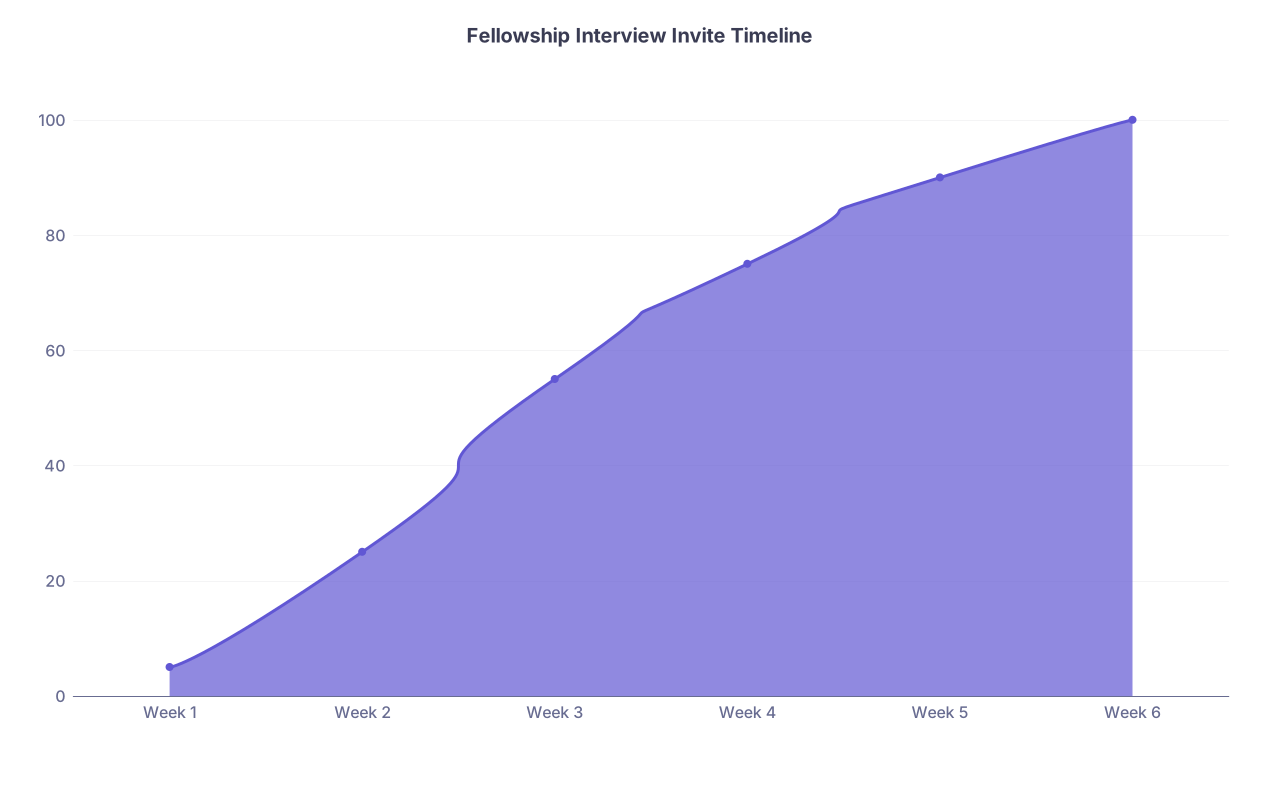
The fellowship application timeline varies by subspecialty (e.g., SSO, AAST, ERAS-based fellowships, SF Match), but many general surgery fellowships now use standardized cycles. Always verify with the relevant matching organization, but the following is a common pattern.
3.1 General Timeline by Residency Year
PGY-2 to early PGY-3
- Explore subspecialty interest seriously.
- Join or initiate relevant research projects.
- Seek early mentorship with key faculty in your area of interest.
- Attend at least one national or regional meeting if possible.
Late PGY-3 to early PGY-4
- Refine your fellowship target (primary and backup).
- Begin drafting your CV and initial ideas for your personal statement.
- Request feedback from mentors about competitiveness and realistic program tiers.
- Identify potential letter writers and give them advance notice.
PGY-4 (primary application year for most traditional pathways)
- Winter–Early Spring:
- Finalize fellowship interest (e.g., MIS vs. colorectal vs. HPB).
- Clarify which match system your target programs use (ERAS, SF Match, independent match, society-based).
- Spring–Early Summer:
- Prepare and upload:
- Updated CV
- Personal statement
- USMLE/COMLEX scores
- ABSITE performance data if requested
- Research and publications list
- Confirm letters of recommendation (LoRs); provide CV and bullets of achievements.
- Prepare and upload:
- Summer–Fall:
- Submit applications as early as the system allows.
- Respond promptly to interview invitations.
- Schedule interviews strategically around rotations, vacation, and call schedules.
PGY-5 (or PGY-6/7)
- Interview (if timing fits your subspecialty cycle) or prepare to start fellowship.
- Finalize rank lists as required by your match system.
- Once matched: coordinate credentialing, licensure, housing, and national meetings to meet future colleagues.
3.2 Variations by Subspecialty
While specific dates change yearly, here are general patterns (always verify current-year details):
Surgical Oncology / HPB (often via SSO or institutional pathways):
- Applications commonly submitted during PGY-3–4.
- Interviews typically in late PGY-4.
- Research-heavy and academic focus.
MIS / Foregut / Bariatric (often via ERAS or fellowship council):
- Applications around mid-PGY-4.
- Emphasis on case volume, laparoscopy/robotics, and technical skill.
Colorectal (often via ERAS):
- Application in PGY-3–4, depending on program structure.
- Heavily evaluate operative log and colorectal exposure.
Trauma / Surgical Critical Care (AAST, NRMP, or institutional):
- Some programs offer combined acute care surgery fellowships; others are SCC-only.
- Application timelines may be slightly earlier than other fields.
Transplant / Vascular / Pediatric / Breast:
- Multiple matching systems; some use SF Match, others ERAS or institutional processes.
- Academic pedigree and research often emphasized.
3.3 Key Documents and Components
Regardless of specialty, most applications include:
- Curriculum Vitae (CV): Up-to-date, structured, error-free.
- Personal Statement: Clearly articulates:
- Why this subspecialty
- Your career vision (5–10 years out)
- Relevant experiences and strengths
- Letters of Recommendation (3–4):
- At least 1–2 from subspecialty faculty in your chosen field
- 1 from your Program Director or Chair
- Possibly 1 from a research mentor if highly relevant
- ABSITE Scores / USMLE/COMLEX: Some fellowships require or request disclosure.
- Case Log: Often provided later, but your operative experience will be discussed.
- ERAS/SF Match/Other Application Platform: Completed fully and accurately.
4. Crafting a Strong Fellowship Application
4.1 Building a Focused, Cohesive Narrative
Your application should tell a coherent story: “This is who I am, this is the surgeon I’m becoming, and this is why this fellowship is the right bridge to my career goals.”
Elements of a cohesive narrative:
- Consistency between CV, personal statement, and letters
- If your CV shows heavy involvement in HPB research and elective rotations, your personal statement should align with that interest.
- Clear long-term goals
- Example: “I aim to build a career as an academic HPB surgeon focusing on pancreatic adenocarcinoma outcomes and resident education.”
- Specific reasons for needing fellowship
- “To gain high-volume experience in complex oncologic liver resections and advanced minimally invasive techniques not commonly performed in my current training environment.”
4.2 Personal Statement: Practical Tips
Avoid generic or overly dramatic statements. Focus on:
- Defining moment(s) that sparked or solidified your interest in the field.
- Concrete experiences:
- Specific rotations, cases, research projects, mentors.
- Your strengths:
- Technical aptitude, work ethic, communication, teaching, research productivity.
- Future direction:
- Desired practice setting (academic vs community, tertiary center vs regional).
- Goals in research, leadership, and education.
Keep it:
- 1 to 1.5 pages maximum
- Clear, well-structured, and error-free
- Reviewed by at least one mentor and someone outside your specialty for clarity
4.3 Letters of Recommendation: Choosing Strategically
Strong letters can significantly influence your surgery residency match for fellowship positions.
Aim for:
- Writers who know you well, not just “big names” with limited experience working with you.
- A mix of:
- Subspecialty faculty (ideally at least one recognized in the fellowship community)
- Program Director/Chair
- Research mentor if your projects are central to your narrative
Help your letter writers help you:
- Provide an updated CV
- Provide your personal statement draft or summary of goals
- Remind them of specific cases, projects, or evaluations where you excelled
- Give them ample lead time and clear deadlines
4.4 Program Selection Strategy
Create tiers:
- Reach Programs: Very competitive, high-profile academic centers.
- Balanced Programs: Good fit, realistic chance based on your profile.
- Safety Programs: Solid training, slightly less competitive or less research-heavy.
Consider:
- Case volume and case mix
- Fellowship class size and culture
- Operative autonomy vs. supervision
- Research infrastructure (if relevant to your goals)
- Geographic/location preferences
- Graduates’ career outcomes (academic vs private, job placement quality)
Applying too narrowly (only to “dream programs”) creates unnecessary risk. A balanced list increases your odds of matching into a fellowship that genuinely advances your career.

5. Succeeding in Fellowship Interviews and Beyond
5.1 Preparing for Fellowship Interviews
Fellowship interviews are generally more conversational and focused than residency interviews, but they still assess core domains:
- Technical and clinical maturity
- Fit with the program’s culture and mission
- Career trajectory and academic potential
- Professionalism and interpersonal skills
Preparation steps:
- Review your CV and publications: be ready to discuss any project in detail.
- Revisit major cases: particularly complex or unusual ones relevant to the subspecialty.
- Prepare thoughtful answers for:
- “Why this fellowship and this institution?”
- “What are your 5–10 year career goals?”
- “What are your strengths and areas for growth?”
- Prepare questions that show insight:
- “How do you balance fellow and resident operative experience?”
- “What percent of graduates go into academic vs community practice?”
- “How does your program support fellows preparing for faculty positions or additional advanced training?”
5.2 Common Interview Pitfalls to Avoid
- Being vague about your career goals (“I’m not really sure, I just like the field”)
- Overemphasizing prestige instead of fit and training quality
- Speaking negatively about your residency program or colleagues
- Not knowing the program’s key faculty, case mix, or structure
- Overstating your role in research projects (faculty can and do verify)
5.3 Rank List Strategy and Decision-Making
When finalizing your rank list, weigh:
- Training quality: case volume, acuity, subspecialty diversity
- Mentorship and environment: collegiality, support, faculty accessibility
- Location and personal factors: family, partner’s career, cost of living
- Career outcomes: job placement, academic vs community positions, alumni network
Aim to rank based on where you will become the best version of the surgeon you want to be, not merely name recognition.
5.4 Preparing for Fellowship During Senior Residency
Once you match:
- Solidify general surgery skills: abdominal exploration, bowel resection, perforated viscus, hernia repairs, emergency cases.
- Seek targeted rotations in your subspecialty if possible.
- Complete any pending research projects and manuscripts; they can influence early impressions in fellowship.
- Address logistical items:
- Licensure in the fellowship state
- Credentialing, hospital paperwork
- Housing and moving arrangements
- Board exam scheduling and study planning
This period is also where preparing for fellowship overlaps with preparing for early attending life, especially if your fellowship is relatively short (1–2 years).
6. Balancing Fellowship Preparation with Residency Life and Well-Being
6.1 Managing Time and Priorities
The residency life and challenges phase is intense. You are juggling:
- OR time and call
- Clinic
- Academic conferences and didactics
- Research projects
- Fellowship preparation (applications, interviews, networking)
- Personal responsibilities and family
Strategies:
- Plan backward from deadlines: For example, if applications open in May, set internal deadlines for CV and personal statement drafts in March/April.
- Use small time blocks for incremental progress:
- 20 minutes of editing your CV
- 30 minutes of data collection or reading for a pending manuscript
- Protect at least one weekly block (even a half-day) for focused scholarship or application work, particularly in PGY-3–4.
6.2 Maintaining Professional Reputation
Fellowship directors often informally call your Program Director or mentors. Your reputation in the hospital matters:
- Be reliable with notes, orders, and follow-up.
- Avoid chronic lateness or incomplete work.
- Treat staff, residents, and students respectfully—word travels quickly.
- Manage conflict professionally; programs are wary of candidates who may be disruptive or difficult to work with.
6.3 Preventing Burnout During the Process
Fellowship preparation can feel like a second full-time job layered on top of general surgery residency. Guard against burnout by:
- Setting realistic goals: you do not need to be perfect in every domain.
- Finding peers also applying—mutual support, mock interviews, shared resources.
- Protecting time for sleep, exercise, and non-medical relationships as much as possible.
- Seeking help early if stress becomes overwhelming—program leadership, wellness resources, and trusted mentors can assist with workload and expectations.
Remember: a rested, engaged resident will interview and perform far better than someone chronically exhausted and cynical.
FAQ: Fellowship Preparation in General Surgery
1. When should I start preparing for fellowship during general surgery residency?
You should start exploring fellowship options in PGY-1–2, but serious, targeted preparation typically ramps up in PGY-3–4. By the end of PGY-3, aim to know your leading fellowship interests and have at least some aligned research or mentorship. Formal application work (CV, personal statement, letters) usually starts in early PGY-4, depending on your subspecialty’s fellowship application timeline.
2. Do I need research to match into a general surgery fellowship?
Research is not absolutely required for every fellowship, but it is strongly advantageous, especially for academic and competitive fields (HPB, surgical oncology, transplant, CT, MIS at high-profile centers). Quality and relevance matter more than raw quantity. A handful of well-executed projects with presentations or publications in your subspecialty can significantly strengthen your profile and demonstrate your commitment to that field.
3. How important are ABSITE scores and board exams for fellowship selection?
ABSITE scores are commonly considered a marker of your fund of knowledge and study habits. Many programs prefer at least average or above-average scores, especially if they are consistent or show improvement over time. Extremely low scores may raise concerns but can be mitigated by a clear upward trend, strong clinical evaluations, and robust letters. Passing USMLE/COMLEX and eventually the ABS qualifying exam is essential, particularly for programs expecting fellows to function at a high independent level and move quickly toward board certification.
4. How many programs should I apply to for fellowship, and how do I choose them?
The number varies by subspecialty and your competitiveness, but many applicants apply to 10–25 programs. Choose programs by:
- Training quality and case volume in your desired area
- Program culture and mentorship quality
- Alignment with your long-term goals (academic vs community practice)
- Geographic preferences and personal considerations
Most applicants build a balanced list including reach, balanced, and safety programs. Discuss your specific situation and strategy with trusted mentors who know both you and the fellowship landscape in your field.
By deliberately aligning your experiences, mentorship, research, and application strategy throughout your general surgery residency, you position yourself strongly for the next step. Thoughtful fellowship preparation is not just about matching—it is about shaping the surgeon and leader you will become for decades to come.