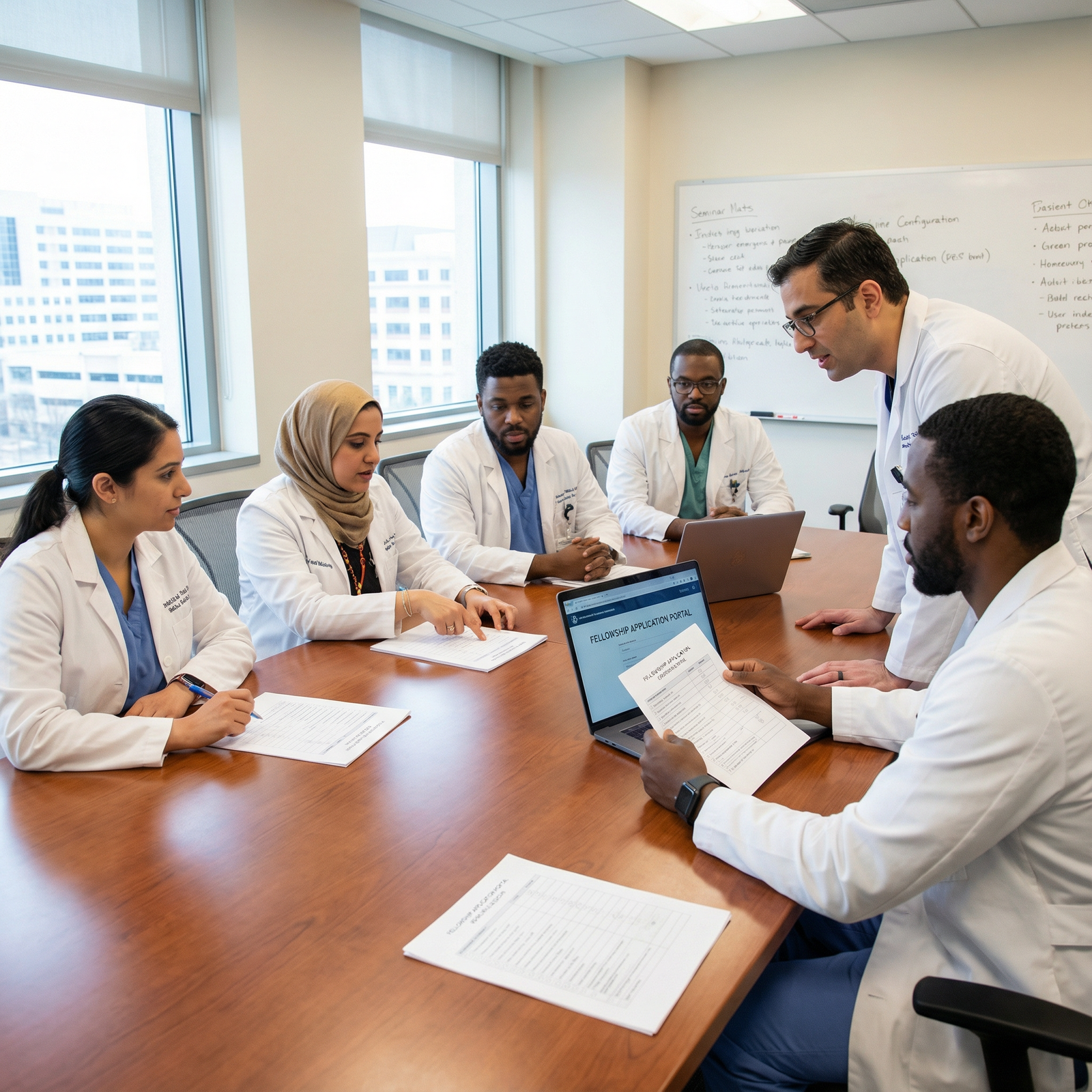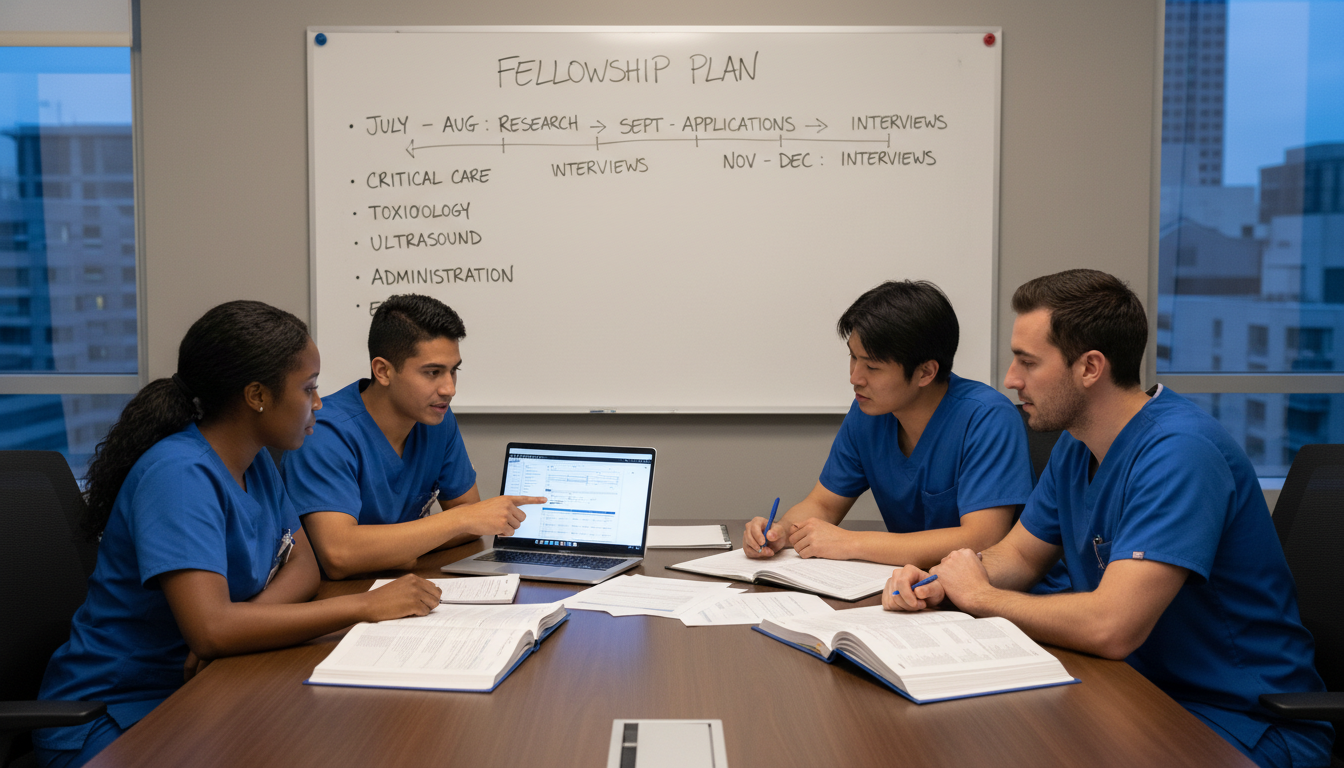
Fellowship preparation as an international medical graduate (IMG) in internal medicine starts much earlier than most residents think. For many IMGs, the real work begins before residency, continues strategically through all three years, and extends into a carefully timed fellowship application timeline. This IMG residency guide will walk you step by step through how to get fellowship in a competitive U.S. environment—focusing on internal medicine residency and the most common subspecialties (cardiology, GI, pulm/crit, heme/onc, nephrology, ID, and others).
Understanding the Fellowship Landscape for IMGs
Before planning, you need an accurate picture of the current environment for an international medical graduate aiming for subspecialty training.
1. Fellowship Competitiveness by Subspecialty
In internal medicine, fellowships vary significantly in competitiveness. Very roughly, from most to least competitive (nationally):
- Highly competitive
- Cardiology
- Gastroenterology
- Hematology/Oncology
- Pulmonary/Critical Care (increasingly competitive)
- Moderately competitive
- Endocrinology
- Rheumatology
- Nephrology (varies by region)
- Infectious Diseases (recently more accessible)
- Less competitive (currently)
- Geriatrics
- Palliative Care
- Sleep Medicine
- Hospital Medicine fellowships (where they exist)
For IMGs, competitiveness is often higher because some programs are limited by institutional or visa constraints. That makes early and intentional preparation non-negotiable.
2. Common Barriers for International Medical Graduates
Typical challenges IMGs face when aiming for fellowship:
- Visa issues
- Some programs do not sponsor visas or only sponsor J-1, not H-1B.
- Government funding rules may limit the number of visa trainees.
- Perceived training differences
- Program directors may prefer applicants from U.S. MD/DO schools or “known” IM residency programs.
- Research access
- Fewer research opportunities in smaller or community-based programs.
- Networking disadvantage
- Lack of U.S. mentorship or alumni networks at the start of residency.
- US clinical experience
- Limited track record in U.S. healthcare before residency.
These barriers are real—but they can be significantly mitigated with deliberate planning, especially if you start during PGY‑1.
Laying the Foundation: Pre‑Residency and PGY‑1 Strategy
Pre‑Residency: Setting Yourself Up Before Day 1
If you are still in medical school or have just matched:
Clarify your fellowship interests early
- You don’t need certainty, but you should know:
- Which subspecialties you might enjoy
- Rough competitiveness level
- Required research intensity
- Example: If you are considering cardiology or GI, plan from day one as if you are competing in the top tier.
- You don’t need certainty, but you should know:
Understand your residency program’s strengths
- Before residency starts, research:
- Which fellowships your program has in-house (e.g., cardiology, GI, pulm/crit, heme/onc).
- Where recent graduates matched (ask the coordinator or look on the website).
- Which attendings are strongly involved in research.
- Choose rotations and mentors accordingly once you start.
- Before residency starts, research:
Visa strategy
- Discuss J-1 vs H-1B with advisors early.
- Recognize:
- J-1 may require a waiver job after fellowship.
- Some competitive fellowships are more comfortable with J-1 than H-1B.
- Keep all visa/immigration documentation organized and accessible.
PGY‑1: Build Credibility and Define Direction
PGY‑1 is about proving reliability and starting to differentiate yourself.
A. Clinical Performance: Your Foundation
Program directors for fellowship will look at:
- In‑training evaluations
- Rotation comments
- Professionalism reports
- USMLE/COMLEX and ITE scores
- Chief recommendations (if any)
Priorities for PGY‑1:
- Be reliable and easy to work with
- Show up early, finish notes, call back promptly.
- Volunteer (within reason) for procedures, admissions, and teaching.
- Document strong performance
- Ask faculty directly: “What can I improve to become a top resident in this program?”
- Request specific feedback mid-rotation; then show improvement.
These evaluations become the narrative that your PD and faculty will later use in letters for your IM match into fellowship.
B. Early Exposure to Your Target Subspecialty
During PGY‑1:
- Do at least one rotation or consult month in your area of interest (if scheduling allows).
- Use that time to:
- Observe the fellowship culture and workload.
- Introduce yourself to fellows and faculty as an IMG interested in that field.
- Ask: “What do you wish you had done earlier in residency to prepare for fellowship?”
Take notes: mentors, research leads, typical fellowship destinations of former residents.
C. Start Research Small but Early
You don’t need an RCT during PGY‑1. Focus on:
- Case reports/series
- Chart reviews
- Quality improvement (QI) projects
Actionable steps:
- Ask subspecialty attendings:
- “Do you have any small projects or case reports I can help with?”
- Offer to do:
- Data collection
- Chart review
- Reference formatting
- Abstract drafting
- Aim to submit:
- 1–2 abstracts to local/state conferences by the end of PGY‑1.
- At least one case report or short communication for publication.
This is especially important for an international medical graduate, since early publications can compensate for lack of a U.S. school pedigree.

PGY‑2: Consolidating Your Profile and Scaling Up
PGY‑2 is the critical year in fellowship preparation. Much of your application—letters, research, leadership—must be ready or nearly ready by the end of PGY‑2.
1. Deepen Your Subspecialty Commitment
By early PGY‑2, you should have:
- Chosen your primary target fellowship (e.g., Cardiology).
- Identified a backup plan (e.g., Hospitalist + later cardiology, or pulmonary/critical care instead).
Then:
- Schedule more subspecialty rotations (consults, electives, clinics) in your area of interest.
- Ask to follow up on complex cases longitudinally (great for case reports and continuity).
2. Secure Strong Mentorship
You should have three types of mentors:
Primary subspecialty mentor
- Ideally a senior faculty member in your target field, active in research and fellowship selection.
- Role: scientific/research guidance, networking, strong letter of recommendation.
Program-based mentor
- Chief resident, APD, or PD who knows your overall performance.
- Role: advocacy within the program; honest feedback on competitiveness.
Peer/near-peer mentor
- Current or recent fellow who matched into your desired field.
- Role: specific application and interview advice; model for your CV.
How to engage with mentors:
- Schedule formal meetings every 3–6 months.
- Send a 1–2 page updated CV and one-page career goals statement before each meeting.
- Ask targeted questions:
- “Which programs are realistic for me based on my profile?”
- “How many publications should I aim for before the fellowship application deadline?”
- “Where do my current weaknesses lie—research, scores, letters, or something else?”
3. Build a Fellowship-Relevant Research Portfolio
For competitive subspecialties, you will need visible scholarly output. For an international medical graduate, this often carries more weight than for U.S. grads.
Aim (depending on time and field):
- Highly competitive fields (cards, GI, heme/onc):
- 2–5 abstracts/posters
- 1–3 peer‑reviewed publications (case reports, original research, reviews)
- Moderately competitive fields:
- 1–3 abstracts
- At least 1 publication or strong QI project with presentation
Practical tips to increase productivity:
- Join existing projects with clear timelines rather than starting everything from scratch.
- Offer to do the “time‑consuming but essential” work (data entry, chart review)—this makes you valuable.
- Use tools like:
- Excel/REDCap for data
- Citation managers (Zotero, Mendeley)
- Weekly research meetings with your team
Present your work whenever possible:
- Departmental research days
- State ACP meetings
- National subspecialty conferences (e.g., ACC, ACG, ATS, ASCO, etc.)
4. Leadership, Teaching, and Distinguishing Features
Subspecialty PDs increasingly want well‑rounded fellows. Consider:
- Teaching roles:
- Morning report leader
- Med student teaching
- Simulation instructor
- Leadership:
- Resident council
- QI committee
- Diversity & inclusion projects
- Distinguishing experiences:
- Global health work
- Prior specialty training outside the U.S.
- Advanced degrees (MPH, MSc) – if already in progress or completed
Document these clearly in your CV and eventually in your personal statement as part of “how to get fellowship” by telling a compelling story.
PGY‑3 and the Fellowship Application Timeline
By PGY‑3, you should be executing a clear, planned fellowship application timeline rather than improvising. Most internal medicine fellowships use ERAS and NRMP with applications opening around July and interviews from August to November (this can change slightly by year and specialty, so always check current dates).
1. Timeline Overview (Typical)
PGY‑2: January–March
- Decide definitively whether you will apply this cycle.
- Finalize your list of target fellowships.
- Identify your three (or more) main letter writers.
PGY‑2: April–June
- Draft your personal statement.
- Update your CV thoroughly.
- Confirm research submissions and expected publications.
- Meet with PD/APD to discuss your competitiveness and program list.
- Request letters of recommendation early (April–May).
PGY‑3: July
- Finalize ERAS application (CV, personal statement, experiences).
- Confirm that all letters are uploaded.
- Submit your fellowship application as early as allowed.
PGY‑3: August–November
- Attend interviews.
- Send thoughtful, professional thank‑you messages.
- Update programs with significant new achievements (publications, awards).
PGY‑3: November–December
- Rank list meetings with mentors.
- Submit rank list (if NRMP match is used).
- Prepare for potential SOAP or off‑cycle opportunities if needed.
2. Letters of Recommendation: Quality Over Quantity
You typically need 3–4 letters, including:
- Program Director letter (usually mandatory).
- At least two subspecialty letters from your chosen field.
- Optional: additional letter from a hospitalist or other general IM faculty who knows you well.
Strong letters for an IMG residency graduate should specifically highlight:
- Comparison to U.S. graduates and peers:
- “One of the top residents in our program over the last 5 years.”
- Concrete examples:
- Difficult cases handled well
- Initiative in research
- Teaching contributions
- Reliability and professionalism:
- No concerns regarding communication or teamwork.
How to help your letter writers:
- Provide:
- Updated CV
- Personal statement draft
- List of programs you’re targeting
- Bullet points of work done with them (projects, cases, rotations)
- Politely ask:
- “Would you feel comfortable writing a strong letter of recommendation for my fellowship applications?”
3. Personal Statement: Your Story as an International Medical Graduate
Your personal statement should:
- Explain:
- Why this subspecialty?
- Why now?
- Why you—specifically, as an IMG in internal medicine?
- Show:
- A coherent narrative from your medical school days to residency and future goals.
- Avoid:
- Generic “I love cardiology because the heart is fascinating” statements.
- Overly dramatic or unrelated life stories.
A powerful IMG‑focused structure:
- Origin – briefly: where you trained and how you developed initial interest in the subspecialty.
- Transition to U.S. system – challenges and growth as you adapted to U.S. internal medicine residency.
- Evidence of commitment – research, elective choices, specific patient cases that shaped you.
- Future plans – how you see yourself contributing (e.g., academic medicine, global health, community care, research).

Strategic Program Selection and Interview Performance
1. Choosing Where to Apply
For an international medical graduate, smart targeting is crucial.
Factors to consider:
- IMG friendliness
- Check program websites and FREIDA for current or former IMGs.
- Look at recent fellows’ profiles (LinkedIn, program web pages).
- Visa sponsorship
- Confirm J‑1 and/or H‑1B policies before applying widely.
- Fit with your goals
- Academic research vs community clinical focus.
- Patient population and procedural volume.
- Geographic flexibility
- Being open to multiple regions increases your odds.
Application strategy by competitiveness:
- Highly competitive fellowship + IMG + non‑top‑tier residency:
- Apply broadly (40–60+ programs).
- Include mix of university, university-affiliated community, and strong community programs.
- Moderate fellowship + decent research + good letters:
- 20–40 programs may be sufficient.
2. Preparing for Interviews
Common fellowship interview themes:
- Tell me about yourself.
- Why this subspecialty?
- Why our program?
- Describe a challenging clinical situation.
- Your most meaningful research project.
- Your future career goals (academic vs community).
Specific advice for IMGs:
Communication clarity
- Practice concise answers with fluent, confident English.
- Consider mock interviews with faculty, mentors, or co‑residents.
Addressing your IMG background positively
- Emphasize:
- Broader clinical exposure from your home country.
- Adaptability and resilience in a new system.
- Cultural and linguistic skills that benefit diverse patients.
- Avoid:
- Sounding defensive or apologetic about your background.
- Emphasize:
Know your CV in detail
- Be ready to discuss:
- Every research project (methods, limitations, your role).
- Any gap years or transitions.
- Be ready to discuss:
3. After Interviews: Communication and Ranking
Professional post‑interview behavior:
- Send short, specific thank‑you emails within 24–48 hours.
- Reference something concrete you discussed.
- If the program is a top choice, you may say:
- “Your program remains one of my top choices” (avoid definitive “number one” unless absolutely certain and consistent).
When making your rank list:
- Weigh:
- Training quality and subspecialty breadth.
- Visa security and institutional stability.
- Geographic/family considerations.
- Your long‑term goal (e.g., preparing for fellowship in an even more sub‑specialized area later, such as interventional cardiology).
Remember: In NRMP, always rank programs in true order of preference, not based on where you “think” you will match.
Life After Matching (or Not Matching): Long-Term Fellowship Preparation
If You Match
Use fellowship to:
- Strengthen your academic credentials:
- Multi‑year research projects
- Grant exposure
- First‑author manuscripts
- Build subspecialty‑specific skills:
- Procedures
- Complex case management
- Start preparing for fellowship after fellowship if relevant (e.g., interventional, EP, advanced endoscopy, transplant hepatology).
If You Don’t Match
Not matching is painful but not the end—especially for an international medical graduate who already overcame multiple hurdles.
Realistic paths:
Hospitalist or chief year
- Gain strong U.S. experience.
- Continue/expand research with subspecialty groups.
- Reapply with a stronger profile.
Research fellowship or post‑doc
- Join a research team in your target subspecialty.
- Build robust publications and network.
- Reapply after 1–2 years.
Alternative but related fellowship
- Consider a less competitive field but maintain involvement in your original subspecialty interest when possible.
Key is to stay in the system, stay productive, and maintain clinical or research relevance.
FAQs: Fellowship Preparation for IMGs in Internal Medicine
1. As an IMG, how many publications do I need to be competitive for subspecialty fellowship?
There is no fixed number, but for highly competitive fields (cardiology, GI, heme/onc), many successful IMGs have at least 2–5 abstracts and 1–3 peer‑reviewed publications by the time they apply. For moderately competitive fields, 1–2 solid scholarly products (publication or major QI project with presentations) may be enough if combined with strong letters, solid clinical performance, and good interview skills.
2. Does my internal medicine residency program reputation matter for fellowship?
It matters, but it is not everything. Coming from a top academic IM residency can open doors more easily, but IMGs from smaller or community programs successfully match into good fellowships every year. If your program is not widely known, you can compensate by:
- Building a strong research record.
- Obtaining powerful letters from recognized faculty (including external mentors if possible).
- Performing exceptionally in your rotations and on in‑training exams.
3. How important is visa status for fellowship applications?
Visa status does influence opportunities, but it does not make fellowship impossible. Some programs:
- Sponsor only J‑1 visas.
- Rarely or never sponsor H‑1B. Others are more flexible. As an international medical graduate, you must:
- Check visa sponsorship policies early.
- Discuss with your PD and GME office.
- Possibly apply to a broader range of programs.
- Be open to locations where visa sponsorship is more common.
4. When should I start preparing for fellowship if I’m an IMG in internal medicine?
Ideally, before residency and definitely by early PGY‑1. Use PGY‑1 to:
- Establish yourself as a reliable, high‑performing resident.
- Explore subspecialties through rotations and informal mentorship.
- Start small research or QI projects.
By PGY‑2, you should be fully committed to a field, with active research, identified mentors, and a clear application plan. Waiting until late PGY‑3 severely limits your ability to build a competitive profile, especially for more competitive fellowships.
With early planning, strategic mentorship, and consistent scholarly work, an international medical graduate in internal medicine can absolutely succeed in the IM match for fellowship. Treat each year of residency as a deliberate step toward that goal—and align your rotations, research, relationships, and timing with the fellowship path you envision.