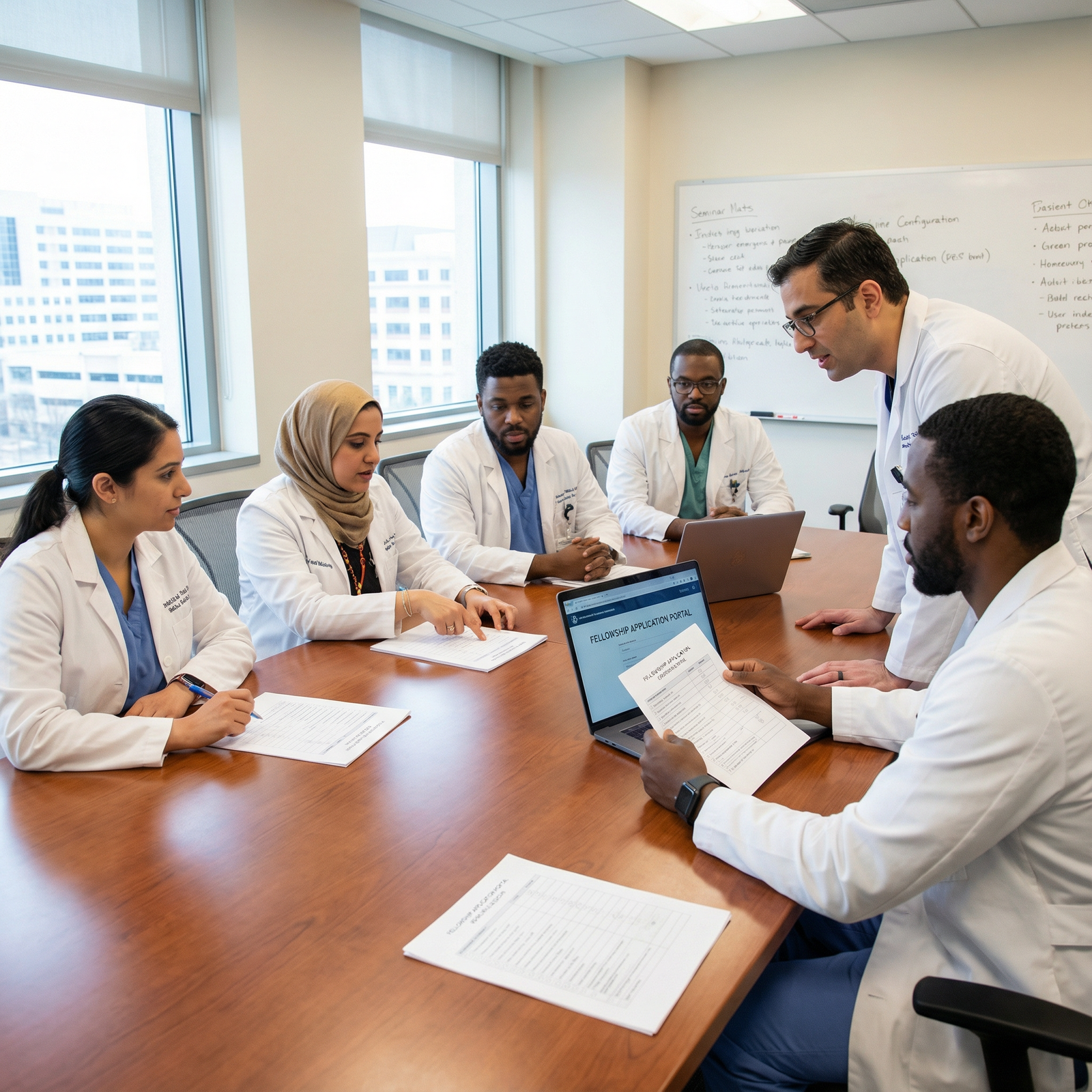
Understanding the Fellowship Landscape for IMGs in General Surgery
For an international medical graduate (IMG) in general surgery, fellowship preparation should start well before your PGY‑3 or PGY‑4 year. The path is absolutely achievable, but it requires strategy, clarity, and early planning.
As an IMG, you’re often balancing extra hurdles: visa issues, perception bias, fewer “built‑in” networks, and the need to repeatedly prove your capabilities. This IMG residency guide focuses on how to convert a general surgery residency—especially as an IMG—into a competitive platform for fellowship training.
We’ll cover how to map the fellowship application timeline, how to strengthen your profile during residency, and how to answer the big question: not just how to get fellowship, but how to get the right fellowship for your long‑term career.
1. Clarifying Your Fellowship Goals Early
1.1 Know Why You Want a Fellowship
Before building your CV, be honest about your goals:
- Career direction
- Academic surgeon (research, teaching, subspecialty expertise)
- High‑volume clinical surgeon (private practice or community hospital with subspecialty focus)
- Hybrid academic–clinical role
- Practice environment
- Large academic center
- Community or rural setting
- International practice with U.S. training as a credential
- Lifestyle and values
- Call intensity, OR time vs. clinic, procedural variety
- Geographic preferences and family considerations
Write out your priorities. For example:
“I want to be an academic colorectal surgeon in a major U.S. center, with 50% OR time, 25% clinic, 25% research/teaching, and strong mentorship opportunities.”
This level of clarity helps you reverse‑engineer your fellowship plan.
1.2 Explore Fellowship Options in General Surgery
Common fellowships after a general surgery residency include:
- Surgical Critical Care / Trauma
- Acute Care Surgery
- Minimally Invasive / Bariatric Surgery
- Colorectal Surgery
- Surgical Oncology
- Hepatopancreatobiliary (HPB) Surgery
- Transplant Surgery
- Breast Surgical Oncology
- Vascular Surgery (independent)
- Thoracic Surgery (independent)
- Pediatric Surgery (highly competitive)
- Endocrine Surgery
Each field has different competitiveness, research expectations, and typical fellowship application timelines. For example:
- Pediatric surgery, HPB, transplant, surgical oncology
Often expect strong research productivity, letters from national leaders, and sometimes advanced degrees. - MIS, bariatric, colorectal, acute care surgery
Still competitive, but often slightly more accessible for IMGs if you build a focused clinical and research portfolio.
1.3 Understand IMG‑Specific Considerations
As an international medical graduate, you should explicitly consider:
- Visa status
- J‑1 vs. H‑1B during residency
- Fellowship program willingness to sponsor visas
- Potential J‑1 waiver obligations and how they affect timing of fellowship
- Perception and bias
- Some programs default to U.S. grads unless an IMG’s file is truly exceptional.
- You must often show clear, documented excellence—clinical performance, research, and strong letters.
- Networking gap
- You may not have a built‑in U.S. network from medical school.
- You’ll need to be deliberate about connecting with mentors, national societies, and conferences.
Your “why” plus your specific IMG constraints should guide how early and how intensely you prepare.
2. Building a Fellowship‑Ready Profile During Residency
2.1 Academic Productivity: Research and Scholarly Work
For many competitive fellowships, your research profile is the major differentiator—especially for IMGs.
Start early: PGY‑1 to early PGY‑2
- Ask your program director or research director:
“Which attending surgeons are most active in research and have fellows who match well?” - Join ongoing projects where data are already collected; these can produce faster publications.
- Start with realistic roles:
- Data collection and chart review
- Literature reviews and meta‑analyses
- Quality improvement (QI) studies with potential for publication
Aim for a balanced portfolio:
- First‑author papers in reputable journals (not just predatory or low‑impact)
- Co‑author contributions to demonstrate collaboration
- Conference presentations (local → regional → national)
- Book chapters or review articles, particularly with senior attendings in your desired field
As a general benchmark for competitive surgical fellowships, many successful applicants have:
- 5–15 peer‑reviewed publications (not all first‑author)
- Several podium or poster presentations at national meetings (e.g., ACS, SAGES, AAST, SSAT, SSO, ASCRS)
If you are starting late (say, mid‑PGY‑3), be strategic:
- Prioritize projects that can yield at least an abstract before interview season.
- Seek multi‑institutional or database studies that can move faster with well‑organized teams.
2.2 Clinical Excellence and Rotation Strategy
Your primary currency in any training environment is still your clinical performance.
Focus on:
- Consistent, top‑tier evaluations from attendings
- Strong operative logs that show progressive responsibility
- Demonstrated ownership of patient care:
- Anticipating complications
- Communicating clearly with ICU teams, consultants, and families
- Presenting concisely on rounds
If your program allows, try to align elective rotations with your intended subspecialty:
- Interested in colorectal?
Request additional colorectal service time, including clinic and endoscopy. - Interested in MIS/bariatric?
Seek exposure to advanced laparoscopy and robotic surgery. - Interested in trauma/acute care surgery?
Increase ICU, trauma bay, and night‑float rotations; log complex critical care cases.
For IMGs, you’ll often need visible champions at your institution. Stellar performance on key services can convert attendings into advocates and letter writers.
2.3 Securing Strong Mentors and Sponsors
You need both:
- Mentors – Guide your development, help choose projects, review your CV, provide honest feedback.
- Sponsors – Use their reputation to promote you to fellowship programs, make calls, and advocate for interviews and rankings.
Identify:
- 1–2 faculty in your target subspecialty
- 1–2 program or department leaders (Program Director, Chair, Vice‑Chair for Education/Research)
How to cultivate these relationships:
- Be reliable on their service.
Show up early, know your patients in detail, follow through on tasks, and communicate proactively. - Schedule career meetings.
Ask: “I’m an international medical graduate in general surgery and I’m very interested in [subspecialty]. Could we discuss how to build a competitive fellowship application over the next 2–3 years?” - Ask for specific advice and follow through.
Nothing impresses mentors more than a resident who actually implements suggestions.

3. Mastering the Fellowship Application Timeline
Understanding when things need to happen is central to fellowship preparation for IMGs. The fellowship application timeline varies by specialty and match system.
3.1 Common Match Systems and Schedules
Most general surgery fellowships are coordinated via one of these:
- NRMP (National Resident Matching Program)
- Used by many specialties: surgical oncology, vascular (independent), transplant, thoracic (independent), etc.
- Application typically opens ~18 months before fellowship start.
- ERAS (Electronic Residency Application Service)
- Platform used for many NRMP fellowships (similar to residency).
- SF Match
- Used for some fields (e.g., pediatric surgery, colorectal in some years/locations).
- Institution‑specific or non‑standardized processes
- Some acute care surgery, MIS, and niche fellowships may have their own systems.
Always confirm each year’s details on:
- NRMP website
- SF Match website
- Specialty society pages (e.g., SSO, ASCRS, AAST, SAGES)
3.2 General Timeline Example (for a PGY‑3/PGY‑4 Resident)
Let’s assume a common scenario: you’re applying for a fellowship that begins immediately after your PGY‑5 year.
PGY‑2 (early)
- Decide on likely subspecialty interests.
- Start or intensify research in that field.
- Attend at least one national conference; join relevant societies as a resident member.
PGY‑2 (late) – PGY‑3 (early)
- Deepen involvement in specific projects that you can carry to completion.
- Seek opportunities to present at regional/national meetings.
- Identify potential letter writers and strengthen those relationships.
PGY‑3 (mid to late)
- Confirm your fellowship field.
- Draft and refine your CV and personal statement (first draft).
- Request feedback from mentors and peers.
- Check visa and credentialing requirements for target programs (critical for IMGs).
PGY‑4 (early) – Main application period
- ERAS/SF Match opens: fill out detailed application.
- Upload personal statement, updated CV, and select programs.
- Request letters of recommendation early (4–6 weeks before they’re due).
- Submit your application as early as possible within the window.
PGY‑4 (mid to late) – Interview season
- Attend interviews, ideally scheduling high‑priority programs early (if possible).
- Continue presenting at meetings and finalizing new manuscripts—this shows ongoing productivity and can be mentioned at interviews.
- Keep mentors updated so they can call or email on your behalf.
PGY‑4 (late) – Ranking and match
- Submit rank list.
- Prepare for potential post‑match scramble if needed.
- If unmatched, debrief with mentors immediately and formulate Plan B (more research, different specialty, or application cycle).
3.3 IMG‑Specific Timeline Issues
As an international medical graduate:
- Visa discussions should start during PGY‑2–3.
- Clarify whether you’re on J‑1 or H‑1B and how that limits fellowship options.
- Some programs will not sponsor H‑1B for fellowship; some cannot accept J‑1 due to institutional policies.
- Credentialing and licensing can be slower.
- Make sure you keep USMLE/COMLEX scores, ECFMG certification, and prior training documents easily available.
- Plan contingencies.
- If you might need a J‑1 waiver position after residency, consider how this interacts with your fellowship timing; some IMGs complete a waiver job first, then return for fellowship.
Treat the fellowship application timeline as a project plan, with deadlines and milestones. Put these into a calendar you review monthly.
4. Optimizing Your Application: CV, Personal Statement, and Letters
4.1 Crafting a Fellowship‑Focused CV
Your CV should tell a coherent story: “This is a general surgery resident with focused interest and growing expertise in [subspecialty],” and “this person will be an asset to our program.”
Key sections:
- Education and Training
- Include medical school (with city/country for IMGs), residency program, and any prior residency or internships abroad.
- Certifications and Exams
- USMLE/COMLEX scores (if requested), ECFMG status, ACLS/ATLS/BLS, FLS/FES where relevant.
- Clinical Experience
- Highlight rotations relevant to the fellowship, including elective or away rotations.
- If you served as Chief Resident on a key service, note it.
- Research and Publications
- Separate “Peer‑Reviewed Articles,” “Conference Presentations,” “Book Chapters,” “Quality Improvement Projects.”
- Use a standard citation format.
- Emphasize work in your target subspecialty.
- Teaching and Leadership
- Resident teaching roles, medical student supervision, simulation labs.
- Committee work, resident council, diversity and inclusion efforts.
- Honors and Awards
- Scholarships, research awards, “Resident of the Month/Year,” etc.
- Professional Memberships
- ACS, SAGES, AAST, ASCRS, SSO, depending on your field.
As an IMG, you may have a rich pre‑US background. Include key achievements from your home country, but emphasize recent, U.S.-based achievements most heavily.
4.2 Writing a Compelling Personal Statement
Your personal statement is not a second CV. It should:
- Explain why this subspecialty matters to you.
- Show how your background as an IMG has shaped your perspective and resilience.
- Demonstrate that you understand what the field involves—lifestyle, case mix, research expectations.
- Outline your career vision and how their fellowship will help you get there.
A simple structure:
- Opening narrative
- A concise, clinical story or experience that sparked or solidified your interest.
- Development of interest
- Exposure during residency; specific mentors; what you enjoyed about the work.
- What you bring
- Clinical traits, work ethic, research record, teaching roles.
- Unique IMG perspective: adaptability, cross‑cultural communication, resourcefulness.
- Career goals
- Academic vs. community; leadership or research ambitions.
- Closing
- Reiterate enthusiasm and fit.
Avoid:
- Overly dramatic or generic statements (“I always wanted to be a surgeon since childhood.”)
- Negativity about home country training or prior institutions.
- Overemphasis on financial motivation or immigration hardship without tying it to professional growth.
4.3 Letters of Recommendation: Strategy for IMGs
Aim for 3–4 strong letters:
- At least two from faculty in your target subspecialty.
- One from your Program Director (often mandatory).
- Optional: Department Chair or a well‑known surgeon in another closely related field.
For IMGs, the strength of these letters can be decisive, especially when there is implicit bias to overcome.
Tips:
- Choose writers who:
- Know you well clinically and/or academically.
- Can comment on your growth over time.
- Are respected in the specialty (national involvement is ideal).
- Provide them with:
- Your updated CV.
- A draft of your personal statement.
- A bullet list of 5–7 specific points you’d be grateful if they mention (e.g., “ownership of patient care,” “independence in the OR,” “leading QI projects,” “effective teacher”).
Ask early:
“Would you feel comfortable writing a strong, detailed letter of recommendation for my fellowship applications in [subspecialty]?”
If they hesitate, it’s better to seek someone else.

5. Performing Well on Interviews and Navigating the Match
5.1 Preparing for Fellowship Interviews
For IMGs, interviews are often where you dispel any residual doubts.
Expect common domains:
- Clinical competence
- “Tell me about a complex case you managed recently.”
- “How do you handle complications and communicate them to patients?”
- Research and academic interest
- “What was your role in this study?”
- “If you had unlimited resources, what research question would you pursue in this field?”
- Understanding of the specialty
- “Why [subspecialty] and not another path?”
- “What aspects of this fellowship’s curriculum attracted you?”
- Career goals
- “Where do you see yourself in 5–10 years?”
- “How do you envision your ideal practice?”
Practice concise, structured answers. Use frameworks such as:
- STAR (Situation, Task, Action, Result) for behavioral questions.
- SPIKES for describing how you deliver bad news or manage complications.
Be prepared to discuss:
- Your immigration/visa status clearly and honestly.
- Any interruptions or anomalies in your training history.
- How you adapted to the U.S. healthcare system as an international medical graduate.
5.2 Common Mistakes for IMGs in Interviews
Avoid:
- Over‑apologizing for being an IMG or for your accent; focus on your strengths and contributions.
- Underselling your experience from your home country; translate it into relevant skills.
- Appearing program‑agnostic; show that you know specifics about each program’s strengths (case mix, faculty, research opportunities).
Have thoughtful questions ready:
- “How do prior fellows from IMG backgrounds typically integrate into your academic group?”
- “What support is available for fellows interested in clinical research or QI projects?”
- “How do you see the subspecialty evolving over the next decade?”
5.3 Ranking Strategy and Post‑Match Planning
When finalizing your rank list:
- Rank programs in true order of preference, not based on where you think you have the best chance, assuming they’re all realistic options.
- Weigh:
- Case volume and diversity.
- Operative independence.
- Faculty mentoring culture.
- Research infrastructure.
- Visa support and institutional experience with IMGs.
- Geographic/personal factors (family, schools, spouse employment).
If you do not match:
- Debrief with at least two honest mentors.
- Identify gaps: research, letters, interview skills, or visa limitations.
- Consider:
- A dedicated research year or two (ideally funded, in your subspecialty).
- Another fellowship with overlapping skill sets (e.g., critical care → trauma/ACS; MIS → bariatric).
- Strengthening your profile and reapplying in the next cycle.
Unmatched cycles are stressful, but many IMGs succeed on a second attempt with targeted improvements.
6. Long‑Term Vision: Preparing for Fellowship and Beyond
6.1 Thinking Ahead to Post‑Fellowship Jobs
When you ask yourself how to get fellowship, you should also think: “What comes after?”
While preparing for fellowship, start building a profile that will be attractive to future employers:
- Maintain a case log that demonstrates breadth and depth.
- Keep track of outcome data when possible (e.g., leak rates, complication audits).
- Build a niche skill set (e.g., advanced laparoscopy, complex endoscopy, robotic surgery, ECMO, transplant immunology).
- Develop a reputation as:
- The resident who gets things done.
- The one who can be trusted with sick patients and complex cases.
- A team‑oriented leader.
6.2 Academic vs. Non‑Academic Paths
If you envision an academic career:
- Prioritize:
- Peer‑reviewed publications and ongoing research projects.
- Grand rounds presentations, teaching awards, education leadership roles.
- Early collaboration with basic or translational scientists, if relevant.
If you aim for community or private practice:
- Focus on:
- High operative volume and proficiency.
- Efficiency, throughput, and professionalism.
- Some involvement in QI and hospital committees, which are highly valued in community settings.
Many IMGs ultimately choose hybrid roles, doing complex surgery in a community or regional academic center with some teaching and QI responsibilities.
6.3 Maintaining Wellness and Resilience
Preparing for fellowship as an IMG can feel like a never‑ending competition: from the surgery residency match to every evaluation and application thereafter. Protect your long‑term performance by:
- Establishing sustainable routines for sleep, exercise, and nutrition.
- Seeking support (formal or informal) when overwhelmed—co‑residents, faculty, counseling services.
- Setting realistic expectations; you don’t need to be perfect, but you do need to be consistent.
A healthy, resilient surgeon is more likely to thrive in both fellowship and future practice.
FAQs: Fellowship Preparation for IMG General Surgery Residents
1. As an IMG, which surgical fellowships are most realistic for me?
It depends heavily on your profile, but IMGs commonly match into:
- Surgical critical care / trauma
- Acute care surgery
- Minimally invasive / bariatric surgery
- Colorectal surgery
- Some HPB, transplant, and surgical oncology programs
Highly competitive fields like pediatric surgery or top‑tier transplant/HPB remain possible but usually require exceptional research portfolios, strong letters from recognized leaders, and often a longer preparation period (sometimes including a dedicated research fellowship).
2. How many publications do I need to be competitive for a surgical fellowship?
There is no absolute number, but for many academic fellowships, successful applicants often have:
- Around 5–15 peer‑reviewed articles (combined first‑author and co‑author)
- Several national conference presentations
Quality matters more than quantity. Focus on reputable journals, meaningful contributions, and clear alignment of your work with your target subspecialty. If you start late, prioritize projects likely to yield at least abstracts or manuscripts before interviews.
3. Can I still match into a good fellowship if my USMLE scores are not strong?
Yes. Once you are in a U.S. general surgery residency, fellowship selection committees weigh:
- Clinical performance and evaluations
- Letters of recommendation
- Research productivity
- Interview performance
- Fit with the program
USMLE scores become less decisive. As an international medical graduate, you can compensate for modest scores with an outstanding in‑residency record, strong mentorship, and a focused, coherent application.
4. When should I start preparing for fellowship during residency?
Ideally, start actively preparing by early PGY‑2:
- Explore potential subspecialties.
- Begin research projects.
- Identify key mentors.
- Attend at least one relevant national meeting.
By PGY‑3, you should have a good idea of your subspecialty interests and be building a targeted portfolio. The formal fellowship application typically occurs in PGY‑4, so waiting until then to start is usually too late—especially for IMGs pursuing competitive fields.
By approaching your training strategically—understanding the fellowship application timeline, cultivating mentors, building a focused academic and clinical profile, and anticipating IMG‑specific challenges—you can transform your general surgery residency into a launchpad for the fellowship and career you envision.