Understanding the Fellowship Landscape in OB GYN as an IMG
For an international medical graduate in obstetrics & gynecology, fellowship preparation starts long before you fill out an application. To build a strong strategy, you need a clear picture of the subspecialty landscape, how the U.S. system views IMGs, and where you fit.
Major OB GYN Fellowships in the U.S.
Common ACGME-accredited OB GYN subspecialties include:
- Maternal-Fetal Medicine (MFM)
- Gynecologic Oncology
- Reproductive Endocrinology and Infertility (REI)
- Female Pelvic Medicine and Reconstructive Surgery (FPMRS / Urogynecology)
- Minimally Invasive Gynecologic Surgery (MIGS) – some are AAGL or non-ACGME
- Complex Family Planning
- Pediatric & Adolescent Gynecology – often non-ACGME
- Global Women’s Health / Academic Generalist tracks – variable structures
Each has a different competitiveness profile and emphasis:
- Highly research-heavy: Gynecologic Oncology, REI, MFM
- Procedurally focused: MIGS, FPMRS, Gynecologic Oncology
- Policy / advocacy / public health-oriented: Complex Family Planning, Global Women’s Health
As an IMG residency applicant or early resident, use this IMG residency guide approach:
- Map your interests early.
By PGY-1, start exploring which subspecialties resonate with you. - Study program patterns.
Look up fellowship rosters and note which programs have previously matched international medical graduates. - Align your residency.
When possible, choose an OB GYN residency with active fellowships in your area of interest and a history of placing graduates into fellowships.
How Being an IMG Affects Your Fellowship Path
Being an international medical graduate does not exclude you from competitive OB GYN fellowship slots, but it changes the playing field:
- Visa issues matter. Some programs do not sponsor visas or only accept J-1.
- Perception of training. Program directors rely heavily on:
- Your U.S. residency pedigree
- Research productivity and quality
- Strong, specific letters from U.S. mentors
- Need for a clear narrative. You must articulate:
- Why OB GYN in the U.S.
- Why this specific subspecialty
- How your international background adds value
Your goal: make program directors think, “This candidate is already functioning like a junior faculty member in our subspecialty, and their IMG background is an asset, not a risk.”
Building a Fellowship-Ready Profile During OB GYN Residency
For IMGs, fellowship preparation starts as soon as you match into OB GYN residency. Think of each residency year as a stage in a multi-year project.

PGY-1: Exploration and Foundations
Goals:
- Establish mentors
- Learn the system
- Build a reputation for reliability
Actions:
Request an early mentorship meeting.
- Meet your program director and ask:
- “Which of our residents have successfully matched into MFM/Onc/REI/etc. in recent years?”
- “Which faculty are best for mentorship in that area?”
- Ask to be introduced to those faculty.
- Meet your program director and ask:
Sample subspecialties.
- During required rotations, consciously assess:
- Which patient populations energize you (high-risk pregnancy, oncology, infertility, surgery-intensive, etc.)
- What balance of clinic vs OR vs L&D you enjoy
- Keep notes; these will later fuel your personal statement and interviews.
- During required rotations, consciously assess:
Start simple research or QI.
- Volunteer for data collection or a retrospective chart review.
- Even one poster by the end of PGY-1 shows initiative.
Build your professional identity.
- Attend departmental conferences consistently.
- Introduce yourself to fellowship faculty during conferences.
- Stay late to help with complex cases; reliability is remembered.
PGY-2: Commit, Produce, and Be Visible
Goals:
- Narrow to 1–2 fellowship interests
- Launch at least one substantial project
- Start speaking and presenting
Actions:
Choose a primary subspecialty focus.
- By mid-PGY-2, decide your likely path (e.g., MFM vs MIGS).
- You don’t need 100% certainty, but you should invest strategically.
Deepen subspecialty exposure.
- Request extra elective time on that service if allowed.
- Attend that division’s journal clubs and subsection meetings.
- Volunteer for consults or complex cases when on call.
Elevate your research.
Instead of many tiny projects, aim for 1–2 high-yield projects:- A retrospective study with enough sample size to publish
- A quality improvement initiative with measurable outcomes
- A multi-center project if your program is part of a consortium
Target:
- By end of PGY-2: at least one abstract accepted (local, regional, or national).
Develop teaching skills.
- Offer to teach medical student small groups on OB topics.
- Volunteer for simulation sessions.
- Ask a faculty member for feedback on your teaching style.
Program directors value future fellows who can teach and supervise.
PGY-3: Peak Production and Networking
This is the critical year for your obstetrics match-equivalent into fellowship.
Goals:
- Turn projects into abstracts and manuscripts
- Secure strong letters of recommendation
- Start planning your fellowship application timeline
Actions:
Finalize research outputs.
- Submit abstracts to key meetings: SMFM (MFM), SGO (Oncology), ASRM (REI), AUGS (FPMRS), AAGL (MIGS), etc.
- Convert accepted abstracts into manuscript drafts.
- Aim to have at least one publication submitted, ideally accepted, before applications.
Strengthen clinical reputation.
- Ask for feedback from fellowship faculty on your performance on subspecialty rotations.
- Request to scrub in for advanced cases and actively demonstrate:
- Sound intraoperative judgment
- Attention to detail
- Ability to handle complex discussions with patients and families
Secure mentors and letter writers. Strong letters for IMGs often make a decisive difference. Aim for:
- One letter from your program director
- One from a leader in your chosen subspecialty (fellowship director if possible)
- One additional letter from a research or clinical mentor
Approach them early (6–9 months before applications) and share:
- Updated CV
- Draft personal statement (even rough)
- List of programs you’re considering
- Summary of projects you’ve done with them
Start your fellowship application strategy.
Build a list of programs that:
- Sponsor your visa type (if needed)
- Have IMGs among current or past fellows
- Match your research and clinical interests
Reach out politely to current fellows (especially IMGs) to ask:
- “What does this program value most in applicants?”
- “Are there any unspoken expectations or priorities?”
PGY-4: Executing the Fellowship Application and Backup Plans
Goals:
- Submit strong applications
- Interview convincingly
- Plan contingencies (in case you don’t match)
Actions:
Final polishing of your CV and application.
- Update with all new abstracts, publications, leadership roles.
- Re-frame non-U.S. experiences to highlight transferable skills:
- Leading a clinic abroad
- Managing limited-resource scenarios
- Bilingual or multicultural care
Interview preparation. Specifically for IMGs, practice answering:
- “Why did you choose to train in the U.S.?”
- “How has your experience as an international medical graduate shaped your perspective in OB GYN?”
- “What unique value do you bring to our fellowship team?”
Develop a backup plan.
- Strengthen generalist OB GYN skills.
- Consider 1–2 year academic generalist positions with strong research support and a track record of feeding into fellowship.
- If you are preparing for fellowship re-application, focus that gap year on:
- Additional research
- Subspecialty-heavy clinical practice
- Additional degrees (MPH, clinical research certificate) if feasible
Fellowship Application Mechanics for OB GYN IMGs
Understanding the logistics of how to get fellowship is as important as your substantive preparation.

Application Platforms and Timelines
Most OB GYN fellowships use one of the following:
- ERAS (Electronic Residency Application Service) – for many ACGME-accredited fellowships
- SOAP-like or institution-specific applications – for some non-ACGME or MIGS programs
- NRMP Fellowship Match – governs the actual matching process for many subspecialties
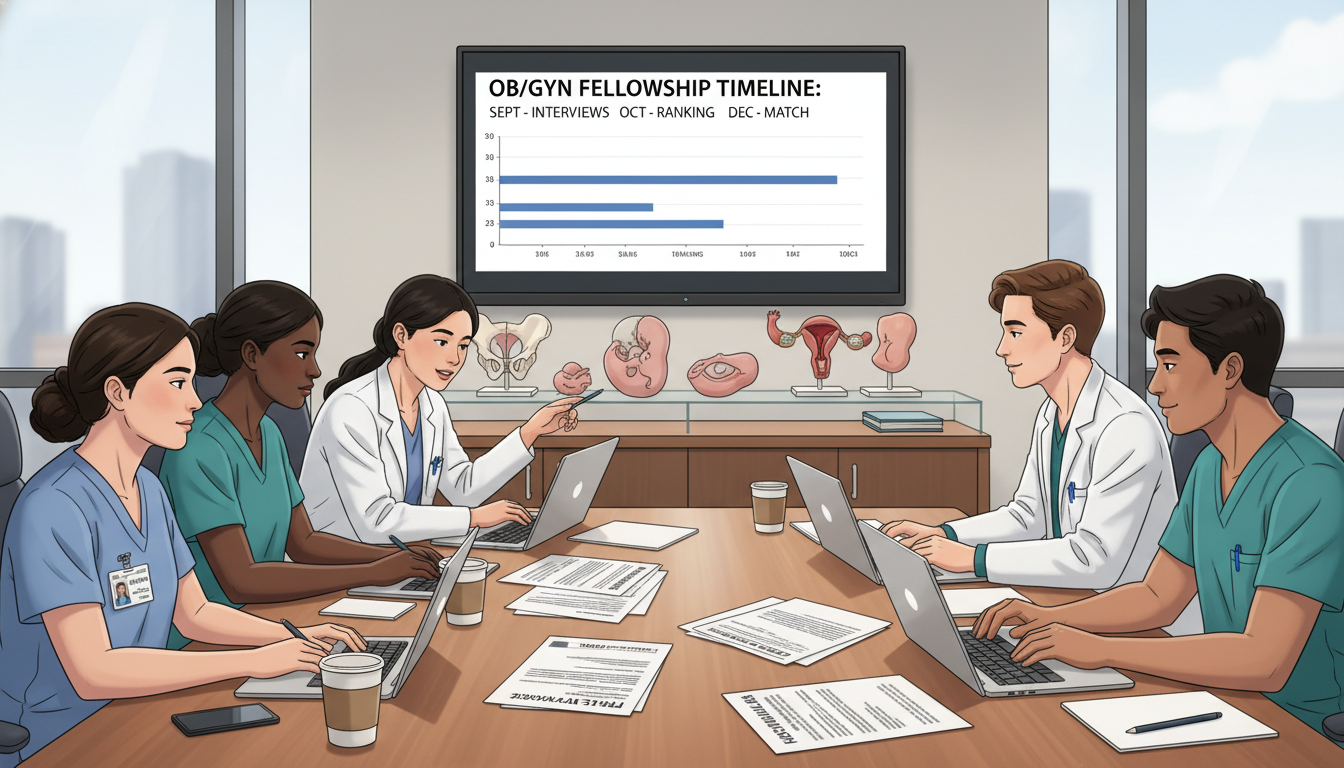
A generalized fellowship application timeline (adjust based on your specific subspecialty):
18–24 months before matriculation (early PGY-3):
- Start targeted research projects
- Clarify sub-specialty choice
- Build program list
12–15 months before matriculation (mid PGY-3):
- Finalize CV structure
- Draft personal statement
- Approach letter writers
9–12 months before matriculation (late PGY-3):
- ERAS or other application platforms open
- Submit applications early in the season
- Begin scheduling interviews
6–9 months before matriculation (early PGY-4):
- Interviews and second looks (if applicable)
- Refine rank list
- NRMP match submission
Match day:
- Celebrate results or execute backup plan
Always verify exact dates on the NRMP and specialty society websites each year, as they can shift.
Visa and Sponsorship Considerations
As an IMG, visa status is central to your planning:
J-1 visa holders:
- Most common among IMGs in residency.
- Many fellowships accept J-1 visa holders via ECFMG sponsorship.
- Remember the two-year home-country requirement after training unless you secure a waiver (which may influence your post-fellowship job choices).
H-1B visa holders:
- Some fellowships will sponsor H-1B, but fewer than for J-1.
- Confirm directly with each program; websites are sometimes outdated.
- H-1B may offer more flexibility for later employment.
Practical tips:
Keep a spreadsheet of programs with columns for:
- J-1 accepted?
- H-1B accepted?
- Previously matched IMGs?
- Any notes from residents/fellows?
If a program is unclear, send a brief, professional email to the fellowship coordinator asking specifically about visa policy.
Tailoring Your Application as an IMG
Beyond standard elements, consider how to present your IMG-specific background:
International experience as an asset.
- Emphasize:
- Exposure to diverse pathology and resource-limited settings
- Cultural competency and language skills
- Adaptability to different health systems
- Emphasize:
Address potential concerns indirectly.
- Demonstrate clear evidence of:
- Strong communication skills (presentations, teaching, patient satisfaction)
- Familiarity with U.S. practice patterns (guidelines, documentation, systems-based practice)
- Long-term commitment to U.S. academic or clinical practice (if applicable)
- Demonstrate clear evidence of:
Personal statement strategy.
- Connect your choice of fellowship to:
- A clear clinical or research question you want to pursue
- Experiences from your home country and U.S. training
- A specific type of patient impact or system change you aspire to make
- Connect your choice of fellowship to:
Research, Scholarship, and Academic Branding for OB GYN IMGs
For many competitive OB GYN fellowships, especially those with strong academic reputations, research productivity can offset perceived disadvantages of being an IMG.
Choosing the Right Research Projects
Aim for strategic depth, not just quantity.
Align with your desired subspecialty.
MFM: perinatal outcomes, ultrasound, hypertension in pregnancy
Onc: surgical outcomes, chemo/radiation patterns, tumor markers
REI: IVF outcomes, PCOS, diminished ovarian reserve
FPMRS: pelvic floor disorders, incontinence, prolapseContribute to ongoing faculty projects.
- Join established data sets or trials rather than starting every project from scratch.
- This shortens your time to publication and embeds you in a team.
Target multi-modal output:
- Abstracts → posters → oral presentations → manuscripts
- Case reports only as supplements, not your main scholarly activity.
Useful Metrics and Realistic Targets
For a competitive fellowship application, a realistic but strong research profile for an IMG in OB GYN might look like:
- 2–4 peer-reviewed publications (mix of first-author and co-author)
- 3–6 national or regional presentations (posters or oral)
- Evidence of ongoing, active projects at the time of application
Programs will also look for:
- Your role in the project (did you design it, analyze data, write, or simply collect data?)
- Increasing complexity or responsibility over time
- Themes consistent with your fellowship goals
Building an Academic “Brand”
Your “brand” is the story your CV tells at a glance.
For example, a strong brand for a future MFM fellow might show:
- Repeated MFM-focused projects (e.g., hypertensive disorders in pregnancy, preterm birth, fetal anomalies)
- Active involvement in SMFM activities or local high-risk OB interest groups
- Clinical excellence feedback from MFM faculty
- Teaching sessions on obstetric topics to junior residents or students
As an IMG, this coherence helps programs quickly understand who you are and what you bring.
Professional Development, Mentorship, and Long-Term Planning
Fellowship is not the endpoint; it’s a bridge to your longer-term career. Thinking ahead strengthens your application and your ultimate satisfaction.
Building Your Career Vision Early
To stand out, articulate a 5–10-year vision:
- Do you see yourself:
- In academic medicine or community practice?
- Doing 50% clinical / 50% research, or mostly clinical with specific scholarly interests?
- Leading a service line, a safety initiative, or global health projects?
Use this vision to:
- Choose research topics aligned with your future niche
- Identify mentors who are living versions of your ideal future self
- Evaluate whether a given fellowship program can realistically support your goals
Mentorship vs Sponsorship
You need both, and they are different:
- Mentors advise you and help you grow.
- Sponsors use their reputation and network to open doors for you (introductions, recommendation calls, invitations to collaborate).
Practical steps:
- Ask one or two senior faculty to serve as primary mentors; schedule check-ins 2–3 times per year.
- Identify at least one potential sponsor in your subspecialty:
- Someone who is respected nationally or regionally
- Someone who has shown interest in your success (e.g., invited you to co-author, present, or join a committee)
As an international medical graduate, having a U.S.-based sponsor can be especially powerful in counteracting unfamiliarity with your background.
Preparing for Fellowship and Beyond
While you’re preparing for fellowship, also think about what comes next:
Job market realities:
- Some subspecialties (e.g., MFM, FPMRS) might have robust job availability across different settings.
- Others may be more tied to large academic centers or urban areas.
Geographic and visa considerations:
- If you’re on a J-1, explore states and institutions with a history of J-1 waiver positions in your field.
- If you’re on H-1B, learn how fellowship training time will interact with later H-1B or green card applications.
Additional training or degrees:
- MPH, MEd, or clinical research training programs may enhance your competitiveness for certain academic roles.
- Consider whether you might pursue these in parallel with fellowship or in a research year.
In your interviews and personal statement, clarity about your long-term plan reassures fellowship programs that you will capitalize on the training they provide.
FAQs: Fellowship Preparation for OB GYN IMGs
1. When should an IMG in OB GYN residency start preparing for fellowship?
Ideally, begin orientation-level preparation in PGY-1: exploring subspecialties, seeking mentors, and joining at least one simple research or QI project. By PGY-2, you should have narrowed your subspecialty interest and committed to 1–2 substantial projects. By early PGY-3, you should be heavily producing abstracts/manuscripts and assembling your fellowship application strategy.
2. How important is research for an IMG applying to OB GYN fellowship?
Research is often critically important, especially for competitive fellowships or academically oriented programs. For IMGs, research demonstrates your ability to operate in the U.S. academic environment and can mitigate unfamiliarity with your medical school or prior training. Aim for several well-executed, subspecialty-aligned projects that lead to abstracts and peer-reviewed publications rather than many small, disconnected efforts.
3. Can I match into a competitive OB GYN fellowship as an IMG on a J-1 visa?
Yes, many J-1 visa holders successfully match into OB GYN fellowships every year. However, you must be strategic:
- Focus applications on programs that clearly accept J-1 fellows.
- Highlight strengths that offset visa-related administrative concerns (strong performance, clear long-term commitment, research productivity).
- Understand post-fellowship options, including J-1 waivers or returning to your home country, and be prepared to discuss your plan.
4. What if I don’t match into fellowship on my first attempt?
A non-match is not the end of your fellowship journey. Many successful fellows matched on a second attempt after:
- Spending 1–2 years as a generalist OB GYN (often in an academic or subspecialty-heavy setting)
- Intensifying their research output and subspecialty-specific clinical exposure
- Strengthening their letters of recommendation and refining their personal statement
If you do not match, schedule a debrief with your program director and mentors, obtain honest feedback, and design a deliberate gap-year or bridge-year plan that makes you a stronger candidate the next cycle.
By understanding the fellowship landscape, building a deliberate multi-year plan during your OB GYN residency, and leveraging your international background as a strength rather than a liability, you can construct a compelling and competitive pathway to subspecialty training in the United States.