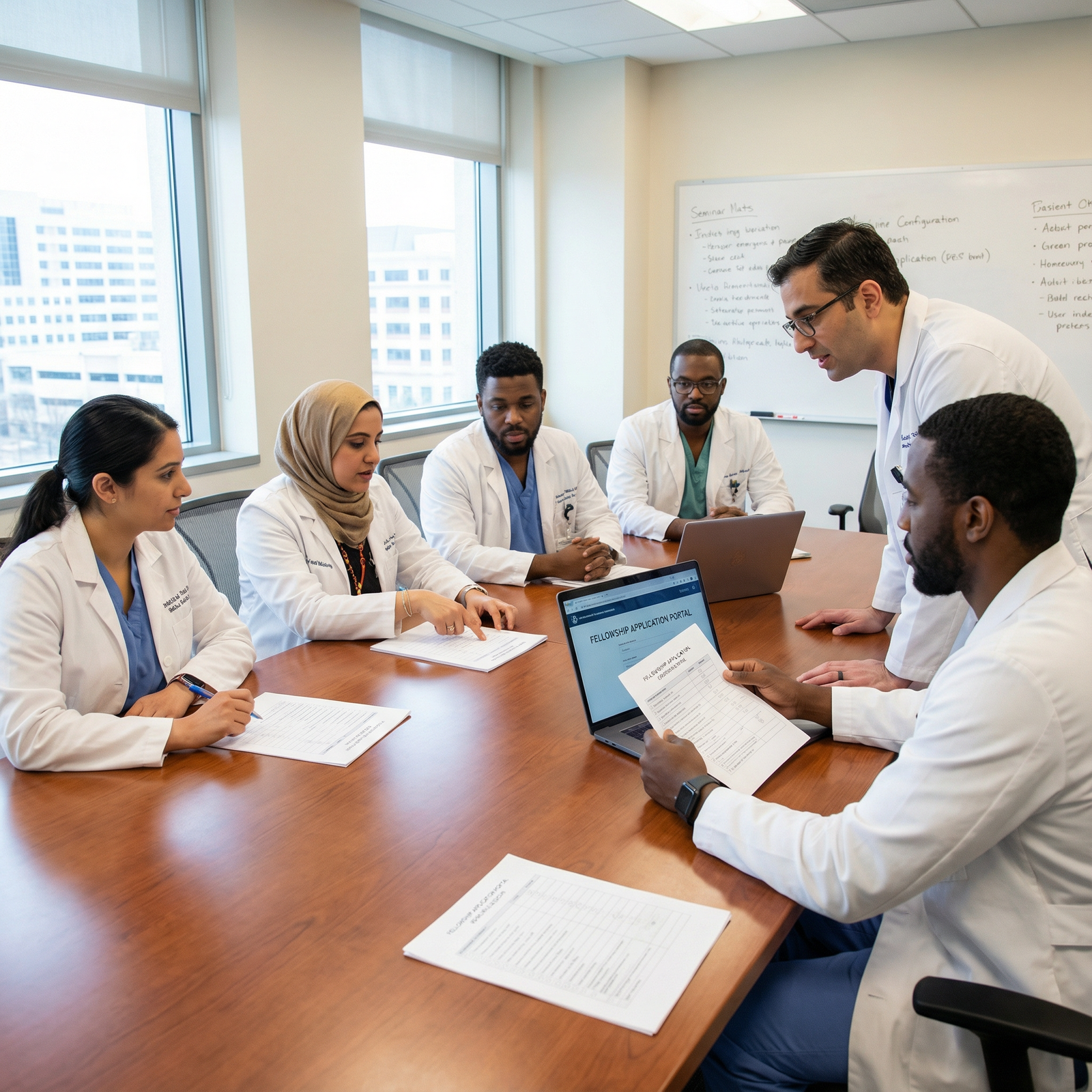
Understanding the Fellowship Landscape After an Internal Medicine Residency
Finishing an internal medicine residency opens a wide range of subspecialty options, but it also brings a new set of strategic questions: When should you start preparing for fellowship? How do you build a competitive profile while surviving residency? What does the fellowship application timeline actually look like?
As an MD graduate from an allopathic medical school, you already know how competitive the allopathic medical school match and internal medicine residency process can be. Fellowship is similar—just with a different set of metrics, timelines, and expectations.
This guide is written specifically for internal medicine residents and recent MD graduate residency alumni who are considering subspecialty training. It focuses on:
- Mapping the IM match to fellowship pipeline
- Building a strong fellowship CV starting in PGY‑1
- Understanding the fellowship application timeline
- Strategically positioning yourself for competitive programs
- Practical tips on how to get fellowship while protecting your well‑being
Whether you’re set on cardiology, GI, heme/onc, pulmonary/critical care, or still undecided, early planning will make a real difference.
Choosing a Fellowship Path: Clarifying Your Goals and Options
Before you can prepare effectively, you need a realistic sense of what you want and why.
Common Internal Medicine Fellowships
Most MD graduate residency physicians in internal medicine who subspecialize go into one of these ACGME-accredited fellowships:
- Cardiology (Cardiovascular Disease)
- Gastroenterology (GI)
- Hematology/Oncology
- Pulmonary/Critical Care Medicine (PCCM)
- Endocrinology
- Infectious Diseases
- Nephrology
- Rheumatology
- Geriatrics
- Hospital Medicine fellowships (various tracks)
- Allergy & Immunology (via IM or Pediatrics pathway)
- Palliative Care / Hospice Medicine
- Sleep Medicine (after IM or other pathways)
Each field differs in competitiveness, lifestyle, and job market. For example, cardiology and GI are among the most competitive; nephrology and ID have seen fluctuating interest but remain clinically and academically rich.
Questions to Clarify Your Direction
Start asking yourself these questions as early as PGY‑1:
What type of day do I enjoy most?
- High‑acuity, procedure-heavy (e.g., PCCM, cardiology, GI)?
- Cognitive, longitudinal (e.g., rheumatology, endocrinology)?
- Systems-oriented and hospital-focused (e.g., hospital medicine fellowship)?
What patient populations do I gravitate toward?
- Cancer and complex chronic disease (heme/onc)
- Critically ill and ventilated patients (PCCM)
- Autoimmune disease (rheumatology)
- Chronic kidney disease, dialysis (nephrology)
Do I want a career in academic medicine?
If yes, prioritize programs strong in research and teaching. If no, community-based fellowships with strong clinical volume may be better.What procedures or skills excite me?
- Echo and caths (cardiology)
- Endoscopy/colonoscopy (GI)
- Bronchoscopies, ventilator management (PCCM)
Lifestyle and geography considerations
- Call frequency, nights, ICU time
- Family or partner needs
- Long‑term geographic preferences
Use Rotations Strategically
During PGY‑1 and early PGY‑2:
- Volunteer for elective time in subspecialties of interest
- Ask chief residents and attendings which rotations are “high-yield” for exposure
- Ask to follow complex patients across services (e.g., from wards to ICU to clinic)
Example:
If you’re leaning toward cardiology, try to schedule:
- CCU rotation
- Echocardiography lab exposure
- Outpatient cardiology clinic
- Cardiology consult service
This will clarify your interest and connect you to future letter writers.

Building a Competitive Fellowship Portfolio During Residency
Once you have a sense of direction, you need to intentionally shape your fellowship application profile.
Key Components of a Strong Fellowship Application
Most internal medicine fellowship programs holistically assess:
Clinical performance
- Rotation evaluations (especially subspecialty rotations)
- Autonomy, reliability, and teamwork
- Procedural competence (where relevant)
Letters of recommendation
- At least 2–3 strong letters, usually including your PD
- Ideally 1–2 from subspecialty faculty in your desired field
- Content that highlights specific strengths, not generic praise
Scholarly activity and research
- Abstracts, posters, publications
- QI projects, case reports, guideline involvement
- Degree of your actual contribution matters
Standardized tests and exams
- USMLE/COMLEX scores (particularly Step 2, and Step 3 if taken)
- ITE (In-Training Exam) performance in residency may be noted
- ABIM certification (for post-match credentialing)
Personal statement and narrative
- Clear subspecialty interest and career goals
- Evidence of reflection and insight
- Explanation of any red flags or non‑linear paths
Program reputation and fit
- Your residency program’s track record of sending graduates to subspecialties
- Alignment of your goals with the fellowship’s strengths
Clinical Excellence: The Foundation
Your performance during the internal medicine residency years is the cornerstone of your fellowship preparation:
- Be reliable and prepared: Pre‑round thoroughly, know your patients, anticipate questions.
- Seek feedback: Ask attendings “What is one thing I could do better this rotation?” and act on it.
- Demonstrate initiative: Volunteer for challenging cases, follow up on complex workups, present mini‑talks.
- Maintain professionalism under stress: Word about how you perform—positive or negative—spreads quickly.
Programs want fellows who are trusted clinicians first, then researchers.
Research and Scholarly Activity: Start Early and Be Strategic
For many IM fellowships—especially cardiology, GI, and heme/onc—research matters.
PGY‑1 to early PGY‑2:
- Meet with potential research mentors in your field of interest
- Ask chiefs or upper-level residents which attendings consistently publish and support residents
- Start with feasible projects:
- Retrospective chart reviews
- Case reports or series
- QI projects aligned with hospital initiatives
PGY‑2 to early PGY‑3:
- Aim to have at least:
- 1–2 poster presentations at regional or national meetings
- 1–2 manuscripts under review or in preparation (even if not yet accepted)
- Leverage:
- Data registries at your institution
- Existing ongoing projects where you can join as a co‑investigator
- QI projects that can be written up as scholarly work
Practical tips:
- Be clear about timelines: “If we start now, do you think we can submit an abstract by [conference deadline]?”
- Protect time: Use elective or research blocks for data collection and writing, not clinical catch‑up.
- Keep a simple document tracking:
- Title, authors, your contribution
- Status (idea/data/abstract/manuscript/accepted)
- Conferences and journals submitted to
Leadership, Teaching, and Professional Involvement
Fellowship programs like to see evidence that you’re invested in the broader profession:
Teaching:
- Give noon conferences or morning reports
- Teach medical students on wards
- Develop a mini‑curriculum (e.g., for EKG interpretation)
Leadership roles:
- Chief resident (if applicable and interested)
- Committee membership (e.g., sepsis, code blue, QI committees)
- Resident council or wellness committee
Professional societies:
- Join specialty societies early (e.g., ACC for cardiology, ACG/AASLD for GI, ASCO/ASH for heme/onc)
- Apply for trainee memberships, travel grants, or mentorship programs
Even if you’re just starting your allopathic medical school match journey in IM or are early PGY‑1, thinking ahead about these elements will make your eventual fellowship preparation smoother.
Fellowship Application Timeline: Month‑by‑Month Guide
Understanding the fellowship application timeline is critical. Dates may shift slightly each year, but the general pattern through ERAS and NRMP remains.
Below is a typical 3‑year categorical internal medicine residency leading into a 3‑year fellowship (e.g., cardiology, GI, heme/onc, PCCM).
PGY‑1: Exploration and Foundations
July–December (PGY‑1 start):
- Focus: Becoming a safe, reliable intern
- Actions:
- Get oriented, learn workflows, study core IM topics
- Informally explore subspecialties by asking seniors and attendings
- Track interesting cases (potential case reports)
January–June (late PGY‑1):
- Begin targeted exploration:
- Request subspecialty electives (if allowed) in areas you might be interested in
- Attend subspecialty conferences and journal clubs
- Meet at least one faculty member in a potential field to discuss:
- Their career path
- Competitiveness and expectations in their subspecialty
- Possible beginner research opportunities
PGY‑2: Decision and Portfolio Building
PGY‑2 is the critical year for fellowship preparation.
July–December (early PGY‑2):
- Clarify target field by mid‑PGY‑2 if possible
- Secure one or more research/academic projects
- Seek rotations that highlight your interest (e.g., heme/onc consults, GI inpatient, CCU)
- Start keeping an updated CV
January–March (mid PGY‑2):
- Confirm your decision to apply that cycle (or wait a year, if needed).
- Identify letter writers:
- Program Director (PD)
- At least 1–2 subspecialty faculty who know you well
- Request a “career development meeting” with your PD:
- Discuss competitiveness and realistic range of programs
- Ask about your program’s historical match outcomes for that field
April–June (late PGY‑2):
- Fellowship applications through ERAS:
- ERAS usually opens to applicants in late winter/early spring
- Programs can start receiving applications around July
- During this period:
- Write and refine your personal statement
- Finalize your CV
- Confirm publications and abstracts
- Provide letter writers with:
- Your updated CV
- Personal statement draft
- A short bullet list of projects and clinical strengths to highlight
- Take USMLE Step 3 (if you haven’t yet) – this may help your profile and future licensure
PGY‑3: Application Submission, Interviews, and Match
July–August (start of PGY‑3 during application year):
- Submit ERAS application early (as close to opening as reasonably possible).
- Complete any supplemental applications (if used by your specialty).
- Monitor ERAS for:
- Application verification
- LoR arrival and completeness
September–November: Interview Season
- Fellowship interviews mostly occur during this window.
- Plan for:
- Time off or lighter rotations (coordinate with chiefs and PD early)
- Preparing your “story”:
- Why this subspecialty
- Why this program and location
- 2–3 patient cases that shaped your interest
- Reviewing each program before the interview:
- Key faculty
- Clinical and research strengths
- Unique features (tracks, niches, or collaborations)
December–January: Ranking and Match
- NRMP rank lists typically:
- Open in late fall
- Close in early winter
- Discuss your rank list with:
- Your PD or a trusted mentor
- Consider:
- Program culture and fit
- Geography and family needs
- Procedural volume and academic resources
End of PGY‑3 and Beyond:
- Transition planning:
- Licensing and credentialing
- Moving logistics
- ABIM boards (often taken after residency, before or early in fellowship)

Positioning Yourself Competitively by Subspecialty
The basics of how to get fellowship are similar across subspecialties, but each field has its own nuances. Here are targeted considerations for some of the most common internal medicine fellowships.
Cardiology
- Competitiveness: High
- What helps:
- Strong IM residency performance, especially in ICU and CCU
- Echo and EKG interpretation skills
- Cardiology research (outcomes, imaging, heart failure, interventional)
- Participation in ACC or local cardiology meetings
- Practical tips:
- Seek cardiology‑focused electives, including imaging and consults
- Ask to present at cardiology journal club or case conferences
- Build at least one tangible cardiology project (poster or manuscript)
Gastroenterology (GI)
- Competitiveness: Very high
- What helps:
- GI‑related research: liver disease, IBD, GI bleeding, endoscopy outcomes
- Strong letters from well‑known GI faculty (if possible)
- Demonstrated interest via electives and conferences
- Practical tips:
- Work with hepatology clinics, IBD clinics, or GI motility if available
- Attend major GI meetings (ACG, AASLD, DDW) if feasible
- Highlight continuity of care and procedural interest in your personal statement
Hematology/Oncology
- Competitiveness: High
- What helps:
- Oncology or hematology research
- Case management of complex inpatient and outpatient oncology patients
- Participation in tumor boards, heme/onc journal clubs
- Practical tips:
- Get involved with clinical trials groups or outcomes research
- Connect with heme/onc mentors early for multi‑year projects
- Be ready to articulate your interest in either heme, onc, or both
Pulmonary/Critical Care Medicine (PCCM)
- Competitiveness: Moderate to high, varies by region and program
- What helps:
- Strong ICU performance and excellent evaluations in high‑acuity settings
- Research in sepsis, ARDS, ventilator management, or pulmonary disease
- Comfort with procedures: intubations, central lines, chest tubes (as appropriate)
- Practical tips:
- Maximize ICU rotations (medical and potentially surgical)
- Keep a procedure log that you can reference during interviews
- Practice talking through complex ICU cases clearly and concisely
Other Subspecialties (Endo, Rheum, ID, Nephrology, etc.)
These fields may be slightly less numerically competitive but still require a solid, thoughtful application:
- Endocrinology: Emphasize chronic disease management, diabetes research, and endocrine pathophysiology.
- Rheumatology: Highlight autoimmune diseases, musculoskeletal exams, and longitudinal care.
- Infectious Diseases: Show global health, antimicrobial stewardship, or epidemiology interest.
- Nephrology: Emphasize CKD management, dialysis experience, and fluid/electrolyte expertise.
For each, the recipe is similar: consistent clinical excellence + at least some scholarly or focused interest + clear narrative of why the field fits you.
Practical Strategies, Pitfalls, and Long‑Term Planning
Crafting a Compelling Personal Statement
Your personal statement should:
Tell a coherent story:
- A few defining experiences that led to your subspecialty choice
- How your internal medicine residency shaped your perspective
- What you envision in your career (clinical, academic, or blended)
Avoid overused clichés:
- “I have always wanted to be a cardiologist since childhood”
- Generic statements about “lifelong learning” without specific examples
Address gaps, if needed:
- Briefly explain leaves of absence, exam delays, or significant career shifts
- Emphasize what you learned and how you’ve grown
Letters of Recommendation: How to Secure Strong Ones
When requesting letters:
Ask the right people:
- Faculty who have seen you in demanding settings (ICU, consults, clinics)
- Mentors who can comment on both clinical and academic strengths
Ask the right way:
- In person or via a well‑constructed email
- Explicitly ask: “Do you feel you can write a strong letter of recommendation for my [subspecialty] fellowship applications?”
Provide materials:
- CV and personal statement
- A bullet list of 3–5 specific things you’d be grateful if they highlighted (e.g., initiative on a particular rotation, leadership on a QI project).
Balancing Burnout and Ambition
Preparing for fellowship while in an internal medicine residency is demanding. Some practical advice to protect yourself:
- Set realistic goals:
- It is better to complete 1–2 meaningful scholarly projects than start 10 and finish none.
- Use your support system:
- Co‑residents, chiefs, program leadership, and even mental health services.
- Schedule breaks:
- Small, deliberate moments away from medicine—exercise, hobbies, family time—help you perform better in the long run.
Remember, being functional and healthy is part of being a good future fellow.
Thinking Beyond Fellowship: Preparing for Fellowship and Beyond
As you’re preparing for fellowship, also keep a long view:
Where do you see yourself 5–10 years after fellowship?
- Academic vs community vs hybrid practice
- Interest in clinician‑educator tracks, research, administration, or leadership roles
Align your fellowship applications with those goals:
- Programs with strong research infrastructure if you want an academic career
- High‑volume clinical programs if you want primarily clinical practice
Understanding how to get fellowship also means understanding how each fellowship shapes your later job opportunities.
FAQs: Fellowship Preparation for MD Graduates in Internal Medicine
1. When should I start preparing for fellowship during my internal medicine residency?
You should start informal preparation in PGY‑1, mainly by exploring subspecialties and building strong clinical habits. Formal fellowship preparation—research projects, mentor meetings, targeted electives—typically ramps up in PGY‑2, with applications submitted near the end of PGY‑2 or start of PGY‑3, depending on the cycle.
If you are undecided by mid‑PGY‑2, you can:
- Apply later in residency (some residents apply in PGY‑3)
- Take a chief year or a hospitalist year before applying, while strengthening your CV
2. Do I need research to match into a fellowship?
For highly competitive fellowships (cardiology, GI, heme/onc), research is strongly recommended and often expected, especially for academic programs. For less competitive fields or community‑focused fellowships, research may be less critical but still beneficial.
If you trained as an MD graduate in a residency with limited research infrastructure, focus on:
- Case reports and case series
- QI projects you can present at regional conferences
- Joining multi‑center or outcomes projects when available
3. How many programs should I apply to for fellowship?
The answer depends on:
- Your subspecialty
- Your competitiveness (scores, research, letters, residency program reputation)
- Geographic flexibility
General (very rough) guidance:
- Highly competitive subspecialties: often 25–40+ programs
- Moderately competitive: 15–30 programs
- Less competitive subspecialties: 10–20 programs
Your PD and mentors can help tailor this number based on your profile and your desired regions.
4. I’m not sure which subspecialty I want. Will that hurt my chances?
Being undecided early in residency is normal. What matters is that by the time you apply, you can articulate a clear, thoughtful rationale for your chosen field.
To explore effectively:
- Use PGY‑1 and early PGY‑2 to sample key subspecialties
- Attend subspecialty conferences, ask questions, and compare how you feel on different rotations
- Keep notes on which patient populations and clinical problems you find most engaging
If needed, you can delay your application by a year—work as a hospitalist or chief resident while you clarify your goals and strengthen your portfolio. Fellowship program directors generally respect a deliberate, well‑explained path.
Preparing for fellowship as an MD graduate in internal medicine is a multi‑year process that builds on your success in the allopathic medical school match and IM match. By planning early, maintaining clinical excellence, and aligning your activities with your long‑term goals, you’ll not only improve your chances of matching into a strong internal medicine residency fellowship—you’ll also position yourself for a sustainable, rewarding career in your chosen subspecialty.