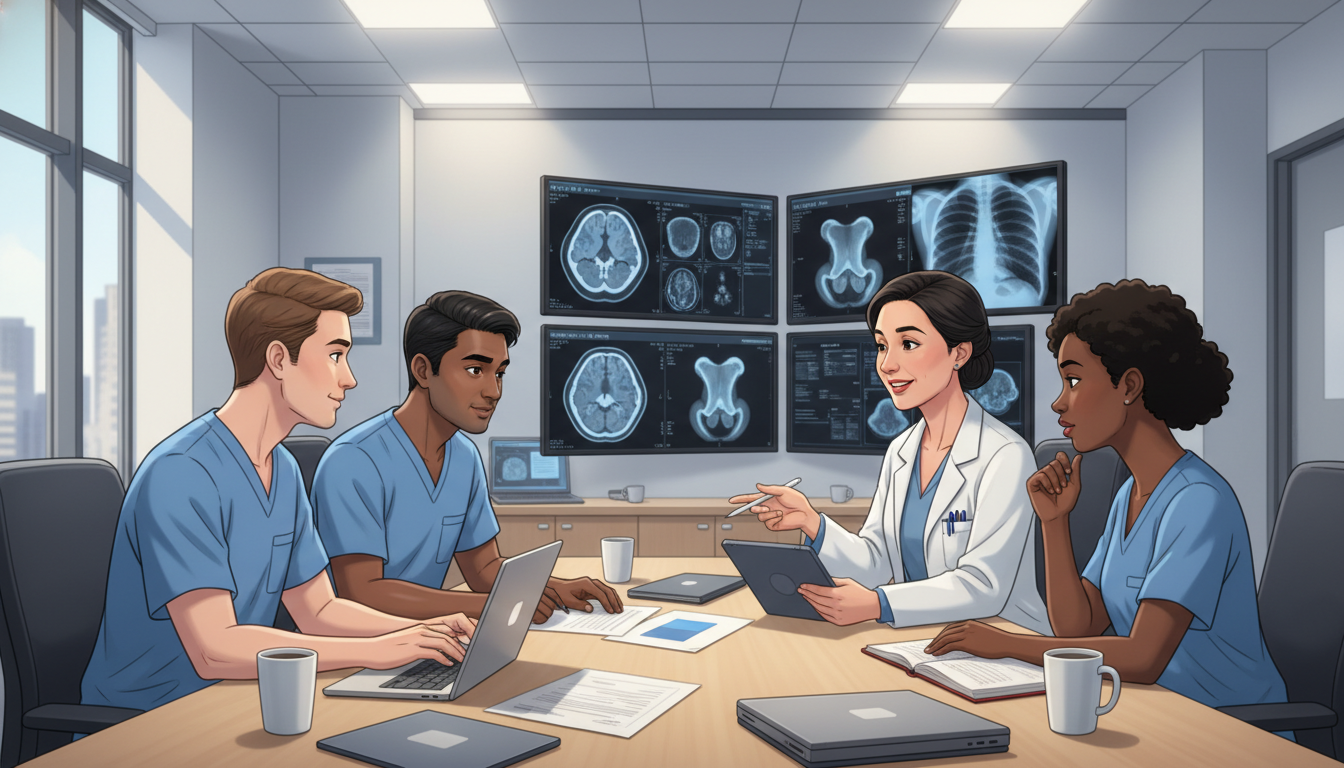
Understanding the Fellowship Landscape for Non-US Citizen IMGs
For a non-US citizen IMG in diagnostic radiology, fellowship preparation starts much earlier than most people think. You are not only planning what subspecialty to pursue, but also where you can train, how you will secure a visa, and when to apply relative to the diagnostic radiology match and your residency training.
In the US system, almost all radiology graduates complete at least one fellowship. For an international or foreign national medical graduate, fellowship training is often essential for:
- Strengthening your CV to be competitive for academic or high-level private practice jobs
- Meeting employment expectations in many markets where subspecialization is the norm
- Enhancing your chances of remaining in the US for work opportunities, if that is your goal
- Developing a niche that distinguishes you from other applicants (e.g., body MRI, MSK, IR, neuroradiology, breast, pediatric imaging, emergency radiology, etc.)
Key challenges unique to non-US citizen IMGs
Compared to US graduates, a non-US citizen IMG often faces:
- Visa limitations (J-1 vs H-1B vs other statuses)
- Program hesitation about sponsorship costs or administrative complexity
- Less access to “informal” networks and mentors in US radiology
- Potential gaps in research opportunities before residency
- Less familiarity with the fellowship application timeline and unspoken expectations
The good news: many programs actively value international diversity and are accustomed to training foreign national medical graduates. With early planning and strategic preparation, you can absolutely secure excellent fellowship positions.
Choosing Your Subspecialty and Fellowship Strategy
Before focusing on how to get fellowship, you must clarify what fellowship(s) make sense for your career and visa situation.
Step 1: Understand the major diagnostic radiology fellowships
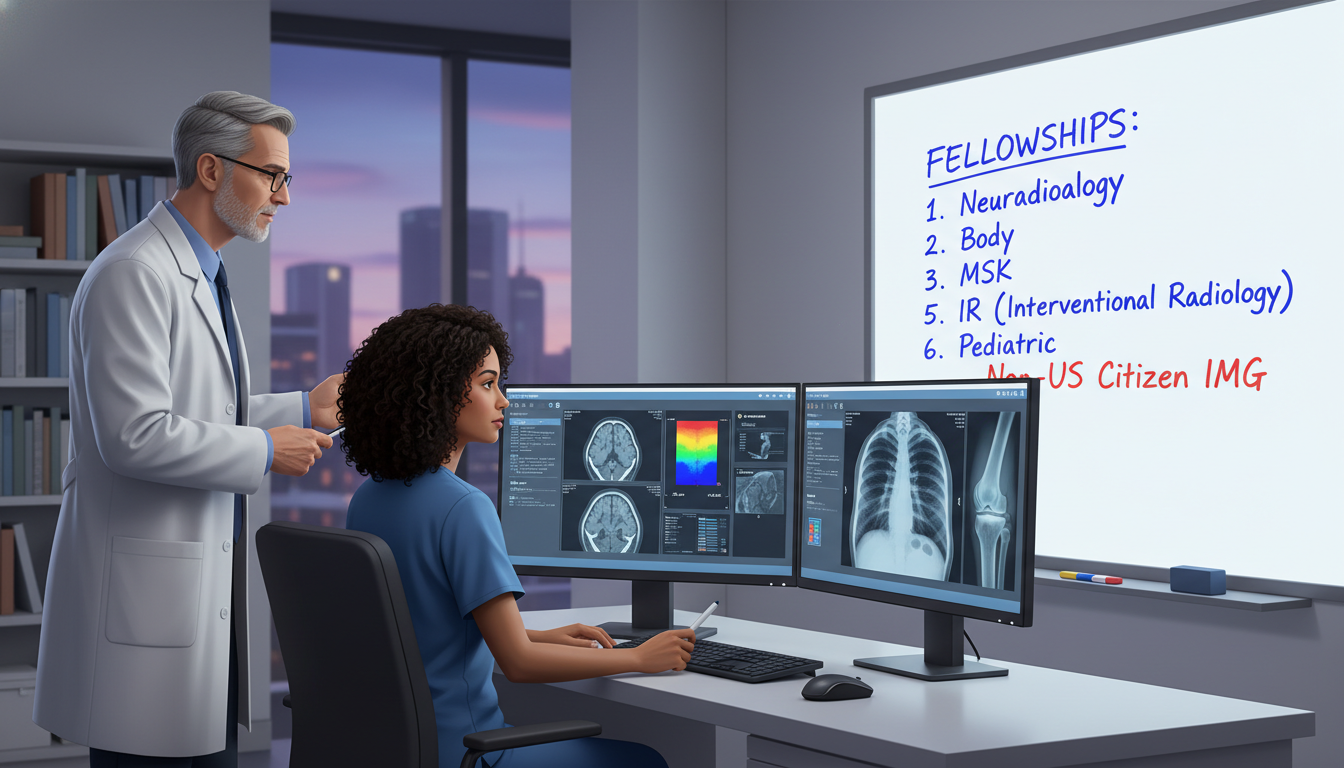
Common ACGME-accredited radiology fellowships include:
- Neuroradiology
- Musculoskeletal (MSK) Radiology
- Abdominal/Body Imaging
- Breast Imaging
- Pediatric Radiology
- Interventional Radiology (Integrated IR fellowship or ESIR pathways)
- Nuclear Radiology / Nuclear Medicine
- Emergency Radiology (some are ACGME, many are non-ACGME)
- Cardiothoracic/Cardiac Imaging (often non-ACGME)
Each subspecialty has different competitiveness, case mix, and job market dynamics. For a non-US citizen IMG, pay attention to:
- Visa-friendliness: Some subspecialties (e.g., IR, neuroradiology, MSK) may have more positions at institutions accustomed to sponsoring visas.
- Job market alignment: In many regions, subspecialty training is expected. For academic careers, neuroradiology, body, or IR can be particularly advantageous.
- Board eligibility requirements in your target country: If you may eventually practice outside the US, ensure the fellowship is recognized or provides adequate training in that system.
Step 2: Align fellowship and long-term goals
Ask yourself:
Where do I ultimately want to practice?
- Long-term in the US?
- Return to home country?
- Open to Canada, UK, or Gulf countries?
What practice setting do I prefer?
- Academic center with research and teaching
- High-volume private practice
- Mixed community–academic or teleradiology
Which imaging modalities and organ systems do I enjoy most?
- Do you like procedures and patient contact (IR, some MSK, breast)?
- Do you prefer complex cross-sectional interpretation (neuro, body, chest)?
For example:
- If you want an academic career in the US, neuroradiology or body imaging with significant research output may be ideal.
- If you plan to return home but want a competitive profile, a high-volume MSK or body fellowship at a well-known US center can be powerful.
- If you enjoy procedures and want versatility, an ESIR pathway plus IR fellowship may suit you, but visa planning is crucial.
Step 3: Consider single vs multiple fellowships
Some non-US citizen IMGs pursue two fellowships (e.g., neuroradiology + MSK, body + emergency, IR + body) to increase job flexibility or align with home-country requirements.
Pros:
- More diverse skills
- Broader job options in different systems
- Extra time in the US for research, networking, and visa transitions
Cons:
- Delays starting full attending salary
- More visa renewals to manage
- Risk of burnout or prolonging training without clear career benefit
Discuss with mentors and recent graduates from similar backgrounds to see if dual fellowship truly advances your specific goals.
Timeline: When to Start Preparing and Applying
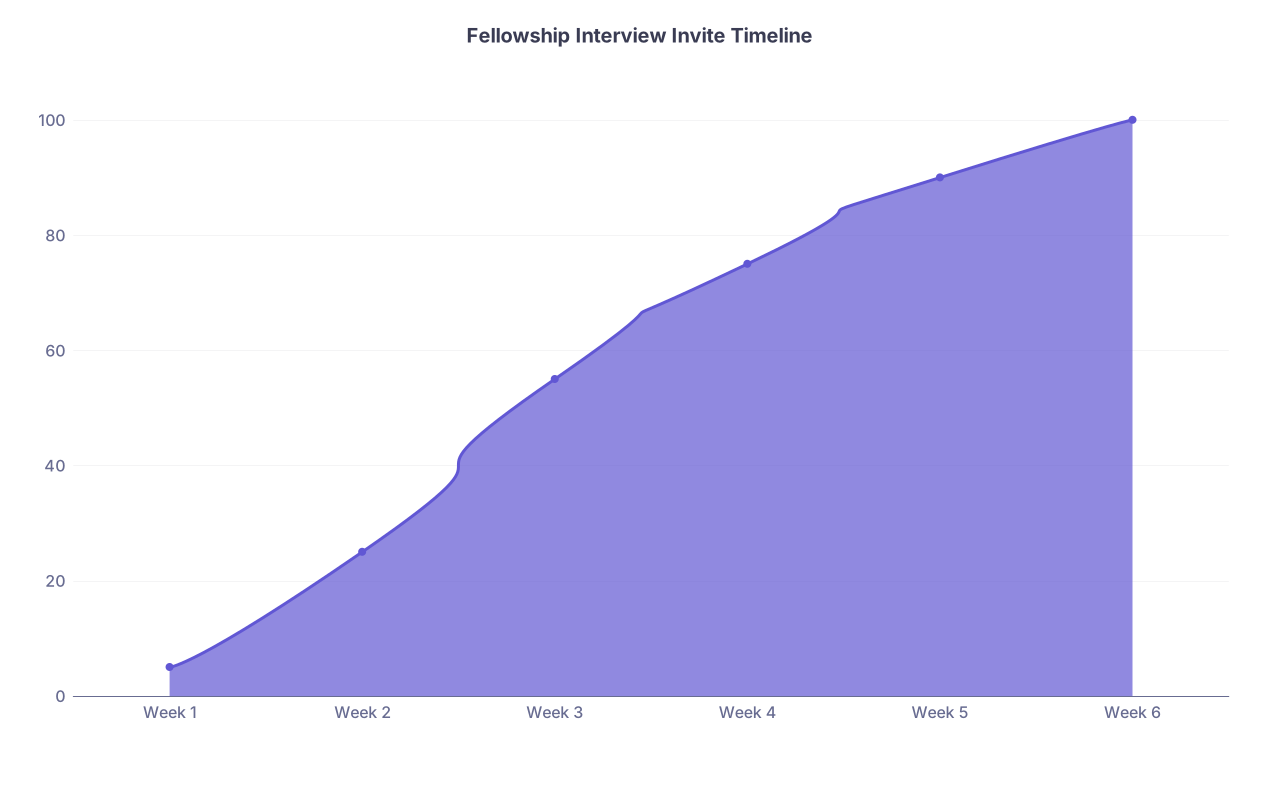
The fellowship application timeline in radiology is famously confusing, with some subspecialties moving to centralized processes and others still relying on early, individual offers.
General timeline for a non-US citizen IMG in DR
Assuming a standard 4-year US diagnostic radiology residency (PGY-2 to PGY-5):
Intern year (PGY-1):
- Learn about US radiology training structure
- Begin exploring subspecialty interests via reading, webinars, and talking to senior residents
- Attend local or virtual radiology conferences if possible
Early PGY-2 (R1):
- Clarify top 2–3 fellowship interests
- Start minor research projects or case reports in those areas
- Seek mentors in your home department (including any faculty who were non-US citizen IMGs)
Late PGY-2 to early PGY-3 (R2):
- For some subspecialties (especially historically competitive ones), applications may open as early as 20–24 months before fellowship start.
- Update your CV, draft a personal statement, and request letters of recommendation.
- Begin monitoring ERAS, NRMP, and individual program websites for their specific fellowship application timelines.
PGY-3 to early PGY-4 (R3):
- Peak period for interviews and offers for many fellowships.
- Continue research and elective rotations aligned with your target field.
- Confirm visa strategy (J-1 vs H-1B) with your program’s GME office and potential fellowship programs.
PGY-4 to PGY-5 (R4):
- Finalizing fellowship contracts and, if necessary, backup plans (e.g., non-ACGME fellowships, home-country opportunities).
- If preparing for fellowship after a gap year or transitioning to research, align your timeline carefully.
Subspecialty differences in timing
Timelines change periodically, so always check current policies, but:
- Neuroradiology, MSK, body, pediatric radiology: Many have been moving toward more standardized dates (often using ERAS/NRMP), but some programs still accept early applications.
- Breast imaging, emergency radiology, non-ACGME fellowships: Timelines can be variable and sometimes later than neuro/MSK.
- IR fellowships: Transitioned largely into integrated residencies and ESIR pathways, but some traditional fellowship-style training still exists.
As a non-US citizen IMG, you should start preparing earlier than your US peers because you must add:
- Time to clarify visa sponsorship options
- Time to gather documentation from overseas (medical school records, prior training letters, sometimes licensing documents)
- Time to secure strong letters from US attendings who know your work
Building a Competitive Profile as a Non-US Citizen IMG
Your fellowship application must demonstrate excellence in core radiology skills and clear subspecialty interest, while also reassuring programs that any visa issues are manageable.
Academic and clinical performance
Program directors consistently value:
- Strong in-training exam performance and ABR Core Exam preparation
- Consistent, positive clinical evaluations in your radiology residency
- Evidence of growth in speed, accuracy, and reporting quality
- Professionalism and communication skills, including with technologists, referring clinicians, and patients
Actionable steps:
- Request mid-year feedback from attendings on subspecialty rotations
- Track and reflect on your diagnostic accuracy and turnaround times
- Keep a record of notable cases to discuss in personal statements and interviews
Research and scholarly activity
You do not need a PhD or 10 publications, but you should have:
- At least a few meaningful scholarly outputs (abstracts, posters, case reports, quality improvement projects, or papers)
- Clear connection between your research and the fellowship you are pursuing (e.g., MSK projects for an MSK fellowship)
Concrete strategies:
- Join projects that are already underway rather than trying to start everything from zero.
- Work with faculty who regularly publish and mentor residents.
- Target at least one national/international conference presentation (RSNA, ARRS, ASNR, SIR, etc.).
- For those preparing for fellowship with limited time, a strong case series or well-prepared poster can still be impactful.
Letters of recommendation
For a foreign national medical graduate, letters are particularly important because they:
- Validate that you can perform at the level of US-trained peers
- Provide reassurance about communication skills, professionalism, and cultural acclimatization
- Help bridge any perceived gaps from being a non-US citizen IMG
Guidance:
- Aim for 2–3 strong letters from US radiology faculty in the subspecialty you are applying to, plus one from your program director or chair.
- Choose recommenders who know you well clinically, have seen you on call or in challenging situations, and can comment specifically on your strengths.
- Provide them with your updated CV, personal statement draft, and a bullet list of projects/cases you worked on with them.
Showcasing your strengths as an IMG
Your background as a non-US citizen IMG can be a major asset if you present it thoughtfully:
- Highlight multilingual skills and experience working in diverse health systems.
- Emphasize adaptability, resilience, and cross-cultural communication.
- Frame any extra hurdles you overcame (USMLE, relocation, adjusting to a new health system) as evidence of perseverance and commitment.
In your personal statement and interviews, connect your international background to how you will enrich the fellowship program and care for diverse patient populations.

Navigating Visas, Sponsorship, and Institutional Policies
Visa planning is one of the most critical parts of fellowship preparation for a non-US citizen IMG. It can shape where you apply, what kind of positions you accept, and your long-term options for working in the US.
Common visa pathways for fellowships
J-1 (ECFMG-sponsored)
- Most common visa type for foreign national medical graduates in residency and fellowship.
- Relatively straightforward for institutions to implement.
- Typically requires a two-year home-country physical presence after completion, unless you obtain a waiver (e.g., Conrad 30 for physicians working in underserved areas, or academic/research waivers).
- Often preferred by academic radiology fellowship programs due to familiarity.
H-1B (employer-sponsored work visa)
- Some fellowship programs sponsor H-1B, but many do not, given time and cost.
- Allows dual intent (you can pursue a green card while on H-1B).
- Requires passing all USMLE Steps and sometimes additional institutional criteria.
- Cap-exempt if sponsored by non-profit academic institutions or universities, which many radiology fellowships are.
Other statuses (O-1, permanent resident, etc.)
- O-1 can apply in exceptional cases (extraordinary ability in sciences), but is rare specifically for fellowship trainees.
- If you become a permanent resident (green card holder), you effectively remove many training-related visa restrictions.
How visas affect your fellowship application strategy
Some programs explicitly state on their websites:
- “We sponsor J-1 only”
- “We sponsor J-1 and H-1B”
- “We do not sponsor visas”
Before applying, create a spreadsheet with each target program’s:
- Visa policy (J-1, H-1B, both, or none)
- Recent history of accepting non-US citizen IMGs
- GME office contact for visa questions
If you are on a J-1 for residency, you may continue on J-1 for fellowship with ECFMG as your sponsor; this is a relatively smooth process but may increase the importance of planning for a home-country return or waiver later.
Practical steps for managing the process
- Talk to your residency program’s GME office and international office early (PGY-2) to understand visa implications for your fellowship plans.
- During interviews, ask programs (politely and succinctly) about their experience sponsoring visas and hiring prior international fellows.
- Keep all immigration documents, I-94 records, DS-2019/approval notices, and passports organized and scanned.
- If planning to remain in the US long-term, discuss with mentors how fellowship choice and location may impact your chances for J-1 waiver or H-1B conversion later.
Application Execution, Interviews, and Backup Plans
Once you understand your subspecialty choice, timeline, and visa strategy, you can focus on the practical mechanics of how to get fellowship as a non-US citizen IMG.
Application materials
Most radiology fellowships require:
- ERAS application or institutional application form
- Curriculum vitae (CV) tailored to highlight radiology and subspecialty experience
- Personal statement (1 page, clear and specific)
- 3–4 letters of recommendation
- USMLE scores, medical school transcript, and sometimes MSPE
- Proof of current visa or immigration status (for non-US citizens)
Tips for a strong personal statement:
- State clearly why you are choosing this subspecialty and how it fits your long-term career goals.
- Include 1–2 brief patient or case examples that illustrate your development in this field.
- Mention your research or quality projects and what you learned from them.
- Address your non-US citizen IMG status briefly and positively (showing what your global perspective adds), without making it the entire focus.
Interview preparation
Fellowship interviews are often conversational, but expectations are high. Prepare for:
Clinical questions:
- Discuss complex cases you have read in the subspecialty.
- Explain how you handle diagnostic uncertainty and communicate with referring clinicians.
Behavioral questions:
- Tell me about a challenge you faced as an IMG and how you adapted.
- Describe a conflict with a consultant or colleague and how you resolved it.
Goals and fit:
- Why our program?
- How does this fellowship prepare you for your post-training plans (in the US or abroad)?
As a non-US citizen IMG, also be ready to discuss:
- Visa status in simple terms (e.g., “I am currently on a J-1 sponsored by ECFMG, and I understand that for fellowship your institution sponsors J-1 as well.”).
- Your flexibility about geographic location or future practice settings.
Common pitfalls to avoid
- Applying too narrowly: Only to a handful of top-tier programs when visa and competitiveness may require a broader net.
- Ignoring visa policies: Applying widely without checking visa sponsorship, leading to wasted applications.
- Weak subspecialty alignment: CV and personal statement that do not clearly match the fellowship type (e.g., no neuro exposure but applying only to neuroradiology).
- Late start: Waiting until mid PGY-3 to organize research, letters, and statements when your subspecialty sends out offers earlier.
Building a backup plan
Given the extra uncertainties for non-US citizens, always have at least one backup strategy:
- Alternative fellowships (e.g., if neuro is overfilled, consider body or emergency radiology at strong institutions).
- Non-ACGME fellowships in your target area, which sometimes have more flexible timelines and visa options.
- Fellowship or consultant posts in your home country or other countries where your US radiology residency is valued.
- Additional research year or chief resident role if you need more time to strengthen your application, provided your visa allows this.
A thoughtful backup plan reduces anxiety and gives you more negotiating power, because you are not dependent on a single outcome.
Preparing for Life During and After Fellowship
Fellowship is not just another year of training; it is the bridge between residency and independent practice. For a non-US citizen IMG, it is also often the staging ground for your next immigration and career steps.
Maximizing your fellowship experience
During fellowship:
- Seek high case volume and broad exposure; avoid being overly selective early on.
- Maintain and expand your research, especially if preparing for academic careers.
- Network with faculty, visiting professors, and alumni who practice in your target countries or institutions.
- Document key cases and create a teaching file or portfolio you can reference in future interviews.
Preparing for fellowship-to-job transition
Start preparing for fellowship exit and job applications early in your fellowship year:
- Understand local job market demands in your subspecialty (academic vs private).
- For those wanting to remain in the US, explore J-1 waiver jobs or H-1B-eligible positions before late fellowship.
- Attend job fairs and networking events at major conferences during your fellowship.
- Fine-tune your CV to emphasize subspecialty expertise, procedural numbers, and any leadership roles during fellowship.
If you plan to return to your home country
Leverage your US fellowship by:
- Keeping systematic logs of procedures and case volumes that may be required for local credentialing.
- Requesting detailed letters verifying your training, case mix, and performance.
- Maintaining connections with US mentors who can support future collaborations, visiting professorships, or research.
By planning your fellowship application timeline and training decisions with both short-term and long-term goals in mind, you can transform fellowship from an isolated year into a strategic launchpad for your entire career.
FAQs: Fellowship Preparation for Non-US Citizen IMGs in Diagnostic Radiology
1. When should I start planning for fellowship if I am a non-US citizen IMG in radiology residency?
You should begin serious planning in early PGY-2 (R1). This includes exploring subspecialties, starting basic research, identifying mentors, and understanding visa implications. Because many fellowships open applications 18–24 months before start date and visas add extra complexity, non-US citizen IMGs benefit from starting at least 6–12 months earlier than they think is necessary.
2. Is it harder for a foreign national medical graduate to match into a competitive radiology fellowship?
Competitiveness varies by subspecialty and program, but being a non-US citizen IMG does not automatically preclude you. Programs that have historically trained international fellows are often very welcoming. You must, however, be strategic: target programs that sponsor your visa type, build a strong record of clinical performance and subspecialty interest, and apply broadly. Many non-US citizen IMGs successfully match into neuroradiology, MSK, body, and other top-tier fellowships every year.
3. Should I choose J-1 or H-1B for fellowship if I have a choice?
There is no one-size-fits-all answer. J-1 is often simpler for training institutions and widely used for residency and fellowship, but it usually carries a two-year home-country return requirement unless you get a waiver. H-1B offers dual intent and can be advantageous if you plan to pursue a green card in the US, but fewer fellowship programs sponsor it, and requirements are stricter. Discuss your situation with your GME office, an immigration attorney, and mentors familiar with IMG pathways before deciding.
4. How important is research for radiology fellowship applications as an IMG?
Research is important but does not have to be overwhelming. Having some focused scholarly work in your target subspecialty—such as case reports, abstracts, posters, or a couple of papers—can significantly strengthen your application and signal commitment. For highly academic fellowships, more substantial research is helpful, but high-quality clinical performance, strong letters, and clear subspecialty interest remain the core elements of a successful application.
By approaching fellowship preparation deliberately—clarifying your goals, understanding the diagnostic radiology match environment, planning your fellowship application timeline, and addressing visa realities head-on—you can navigate the system effectively as a non-US citizen IMG and secure fellowship training that sets you up for a successful, fulfilling radiology career.