

The worst Step 2 CK mistake during a gap year is thinking, “I have tons of time.” You do not. The interview calendar does not care about your flexible schedule, and programs will screen you out if your score isn’t in by the time they build their first rank lists.
Let’s build a real timeline: month-by-month and then week-by-week, so you do not end up panic-scheduling Step 2 in October with three unfinished Qbanks and a half-written personal statement.
This guide assumes:
- You are taking a gap year before applying for residency (or during a research year)
- You will apply in September of your application year
- You want your Step 2 CK score available to programs by then
Adjust months by +/− 1–2 as needed, but keep the order and logic.
Big-Picture Timeline: When You Should Take Step 2 CK
At this point you should understand the anchor dates.
Most people in a gap year aiming for a smooth, non-crunch application cycle should:
- Finish core clinical rotations: before or at the very start of gap year
- Start serious Step 2 CK prep: ~6 months before exam
- Take Step 2 CK: mid-May to mid-July of the application year
- Have score back: by early–mid August at the latest
Here’s the compact map:
| Period | Focus |
|---|---|
| Aug–Oct (Year -1) | Light review + clinical strength |
| Nov–Jan (Year -1) | Dedicated prep build + Qbank |
| Feb–Mar (Year 0) | Heavy questions + NBMEs |
| Apr–Jun (Year 0) | Dedicated block + exam |
| Jul–Aug (Year 0) | Applications + interviews prep |
Where Year 0 = application year (ERAS submission that September).
To visualize the slope of work:
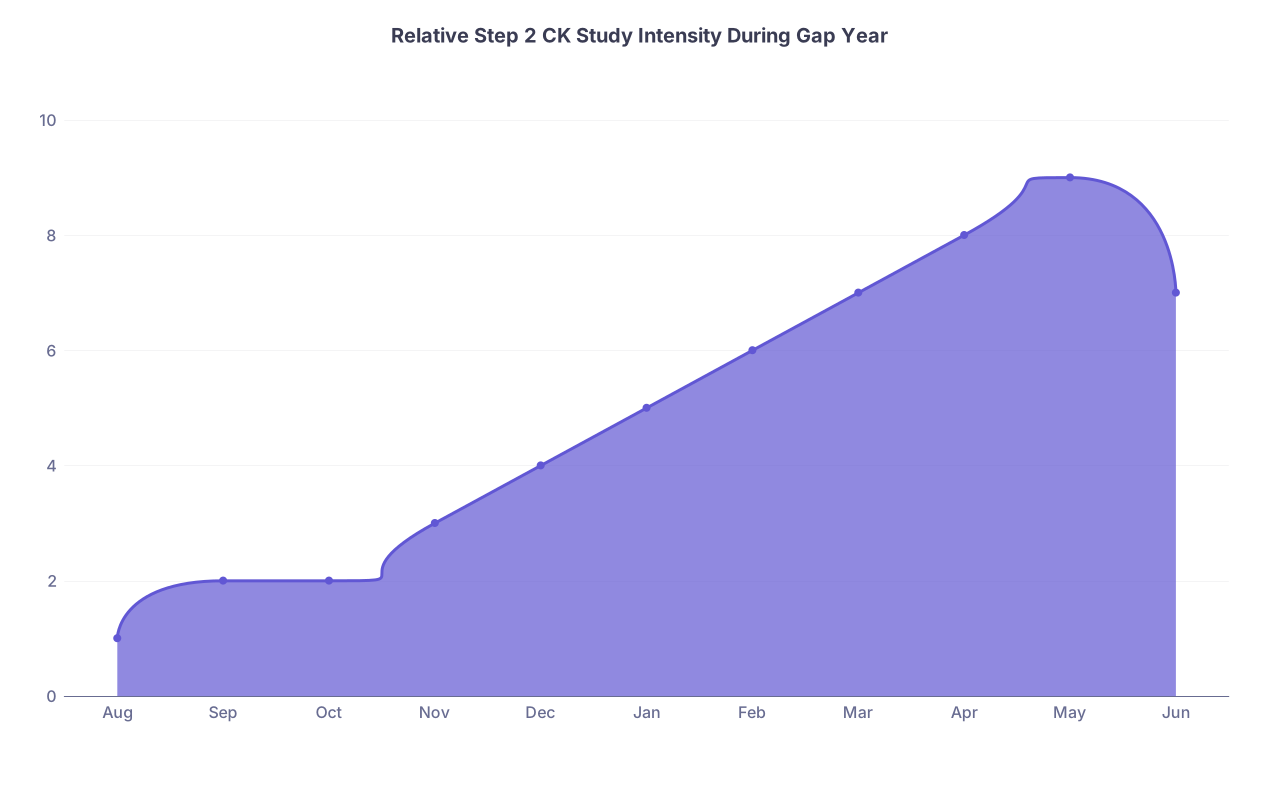
| Category | Value |
|---|---|
| Aug | 1 |
| Sep | 2 |
| Oct | 2 |
| Nov | 3 |
| Dec | 4 |
| Jan | 5 |
| Feb | 6 |
| Mar | 7 |
| Apr | 8 |
| May | 9 |
| Jun | 7 |
1 = almost nothing, 10 = full dedicated.
Phase 1 (Aug–Oct): Set the Floor, Not the Ceiling
If you start your gap year thinking “I’ll get serious later,” you’re already behind. At this point you should be protecting your baseline knowledge and setting your schedule constraints.
August: Reality Check + Structure
At this point you should:
- Clarify your gap year obligations:
- Research? Job? Scribe? Fellowships?
- Typical weekly hours (be honest, not fantasy)
- Decide your target exam month:
- Competitive specialties (Derm, Ortho, ENT, Plastics): May–early June
- Moderately competitive (EM, Anes, Rads, OB/GYN): June
- Less competitive (FM, Psych, Peds): June–early July
- Map backward 4–6 months for real prep time
Concrete tasks (1–2 weeks):
- Sign up for:
- One main Qbank: UWorld (non-negotiable)
- Optional second: AMBOSS or Kaplan if you know your foundations are weak
- Make a weekly skeleton schedule:
- 3–4 sessions per week of 1–2 hours for Qbank
- 1 session per week for light reading/Anki/video
September: Low-Level Activation
At this point you should be building habits, not burning out.
Weekly goal:
- 40–60 timed Qbank questions/week (not blocking your whole day)
- Review all explanations for missed questions
- Start Anki (or similar spaced repetition) for:
- Weak subjects from questions
- Core high-yield Step 2: management algorithms, antibiotics, emergency conditions
Example week:
- Mon: 20 timed questions + 1 hour review
- Wed: 20 timed questions + 1 hour cards
- Sat: 1–2 hours content review (videos/notes)
You are not trying to be “dedicated.” You are trying to avoid getting cold.
October: Soft Diagnostic + Tighten Schedule
By now, at this point you should:
- Have 200–300 Qbank questions completed
- Feel where you’re rusty (OB? Peds? Psych? ICU-level IM?)
Concrete tasks:
- Take a baseline NBME or UWorld Self-Assessment:
- Goal: not the score but pattern of misses
- Roughly categorize:
- Green (solid): >70% on question blocks, minimal review needed
- Yellow (okay but shaky)
- Red (truly bad / forgotten)
Use that to assign future study weight.
Phase 2 (Nov–Jan): Build the Engine Quietly
This is where disciplined students quietly separate themselves. At this point you should be doing consistent, modest work that compounds.
November: Lock in Weekly Volume
Now you increase volume without pretending you are on dedicated.
Target:
- 100–120 Qbank questions/week
- All timed, random, mixed (no cherry-picking easy sections)
- Start rotating short subject refreshers:
- One half-day per week: “focus block” (e.g., OB hemorrhage, CHF, pneumonia, neonatal issues)
If you struggle with structure, use a simple rotation:
- Week 1 focus: IM + Peds
- Week 2 focus: OB/GYN + Surgery
- Week 3 focus: Psych + Neuro
- Week 4: Mix of everything + review weak topics
December: First Mini-Dedication
Most people are a bit freer around the holidays. At this point you should take advantage of that.
Plan a 10–14 day mini-dedicated block if you can:
- 40–60 questions/day for 5–6 days/week
- 3–4 hours of deep review/day
Concrete goals for December:
- Hit ~800 total Qbank questions done by the end of the month
- Identify your bottom 3 subjects and start a running “fix this” document:
- Short bullet list of:
- Frequently missed diagnoses
- “Always forget” management steps
- Tricky guideline thresholds (BP, glucose, lab cutoffs)
- Short bullet list of:
January: Checkpoint NBME + Calendar Lock
This is a pivot month. At this point you should:
- Decide your exact test week (even if not scheduled yet)
- Look at:
- Work/research deadlines
- Conference presentations
- Personal events (weddings, travel, etc.)
Then:
- Take a NBME or UWSA in late January:
- If you’re >235–240 and rising:
- You’re on a good track for many specialties
- If you’re <220:
- You need more structured content review in Feb–Mar
- If you’re >235–240 and rising:
Also:
- Aim to be 50–60% through your primary Qbank by end of January.
Here’s where people usually stand if they’re doing it right:
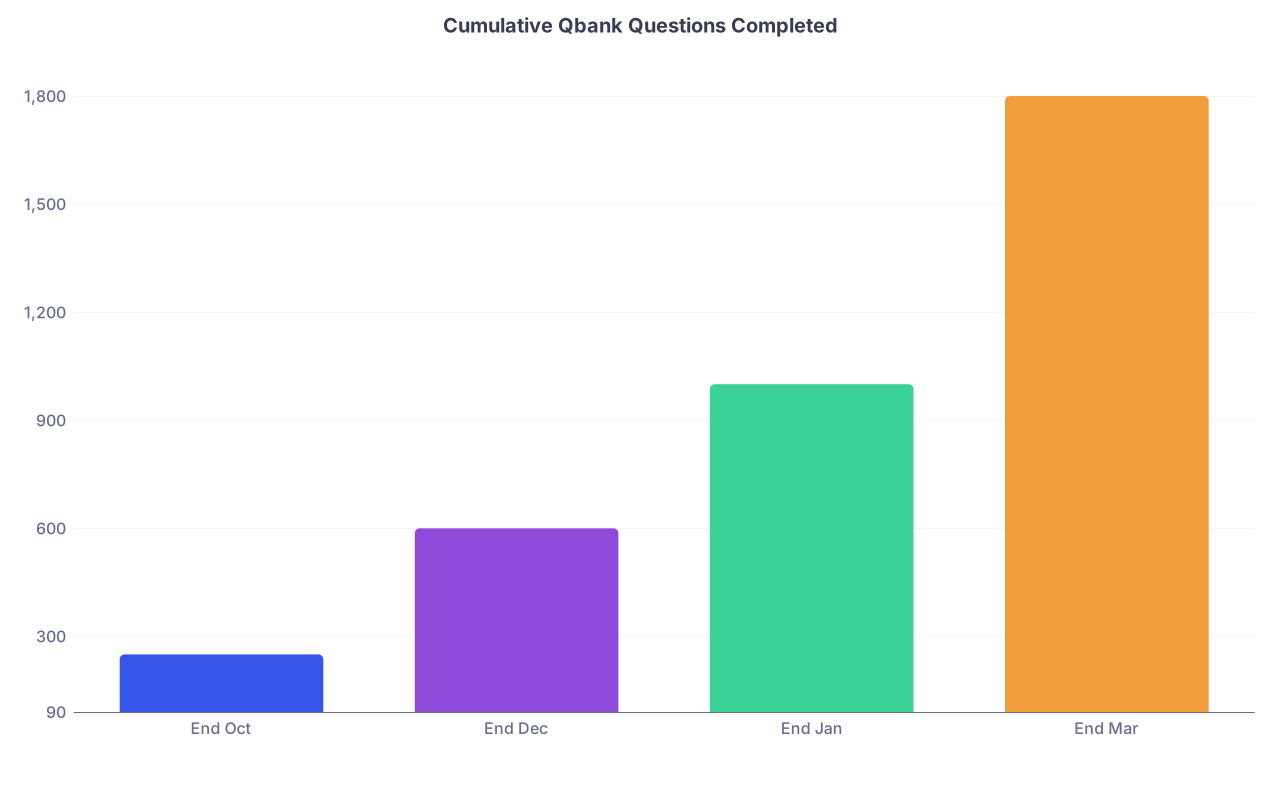
| Category | Value |
|---|---|
| End Oct | 250 |
| End Dec | 600 |
| End Jan | 1000 |
| End Mar | 1800 |
You want to be at or near that trajectory.
Phase 3 (Feb–Mar): Heavy Build Before Official Dedicated
This is where the gap year advantage really kicks in. You have time. Use it before the chaos of applications.
February: Structured Content Repair
At this point you should be:
- Finishing the first pass of your main Qbank or close to it
- Devoting 1–2 hours/day, 5–6 days/week to Step 2
Weekly plan:
- 40–80 timed questions/day, 3–4 days/week
- 1 day: system-focused review (e.g., OB + Peds)
- 1 day: weakness repair (working through your “fix this” document, targeted reading, videos)
If your last NBME was weak:
- Prioritize broad content review resources:
- OnlineMedEd, Boards & Beyond, or similar
- Focus on medicine, OB, peds, emergency/ICU care
March: Simulate Dedicated While You Still Have Flexibility
By late March, at this point you should be behaving like you’re 70–80% into dedicated, even if life isn’t cleared yet.
Goal by end of March:
- Core Qbank pass essentially done (>85–90% complete)
- 2–3 self-assessments total taken so far
- Have a list of:
- Target test date (e.g., June 10)
- Start of “true dedicated” (e.g., May 10)
Consider:
- Starting a second Qbank (AMBOSS or UW incorrects-only)
- Starting more exam-specific practice:
- 40-question blocks back-to-back
- Rare/edge-case topics: vasculitides, rheum, oncology, derm, heme
Phase 4 (Apr–Early Jun): True Dedicated, Without the Panic
Now we build the actual day-by-day pattern. At this point you should be clearing your plate.
Assume:
- Exam date: mid-June
- Dedicated period: 4–6 weeks (mid-May–exam)
- April = ramp + scheduling + serious calibration
April: Final Calibration + Lock Exam Date
In early April, at this point you should:
- Schedule the exam if you have not already
- Look at test center locations and:
- Choose a center with good reviews
- Avoid dates right after big life events
By mid-April, do:
- NBME or UWSA #2 or #3
- If at/near your target score → full speed ahead
- If still below 220 and aiming for a competitive specialty → consider:
- Pushing exam back a few weeks
- Re-balancing your gap year commitments
Late April: Pre-Dedicated Ramp
Target weekly load:
- 200–300 Qbank questions/week
- 1 full-length self-assessment every 2–3 weeks
Typical day (pre-dedicated):
- 2 blocks of 40 questions timed (80 total)
- 2–3 hours review
- 30–45 minutes of Anki or rapid fire review
Phase 5 (Dedicated Month): Week-by-Week Plan
Here’s the part everyone cares about. The gap year lets you avoid 14-hour grind days. Use that freedom wisely.
At this point you should be roughly:
- 4 weeks from test: starting full dedicated
- Score: ~10–20 points below your realistic target
Week −4 (One Month Before Exam): Systems Sweep
Focus: coverage and rhythm.
Daily pattern:
- 2–3 blocks (40 questions each) per day:
- 1 mixed block
- 1 system-focused block (rotate IM, OB, Peds, Surg, Psych)
- 3–4 hours of review
- 1–2 hours of targeted reading/videos on that day’s weak topic
By the end of this week you should:
- Have no major system completely untouched
- Be able to get through a 40-question block without mental collapse
Week −3: Long-Day Simulation + First Real Test
Focus: building exam stamina.
At this point you should:
- Take a full-length self-assessment (NBME or UWSA) early in the week:
- Replicate test conditions (timed, minimal breaks, quiet room)
- Analyze:
- Recurrent mistakes (fatigue? misreading? knowledge gaps?)
- “Pattern” misses (e.g., always choosing CT when US is correct, overusing broad-spectrum antibiotics, mis-timing steroids)
Day structure (non-NBME days):
- 3 blocks/day (120 questions)
- 3–4 hours review
- 1 short “core must-know list” review (you’re building this as you go)
Week −2: Targeted Precision
Now it’s surgical. At this point you should be done with new content and focused on:
- Wrong-answer patterns
- Ambiguous decision-making (e.g., when to operate vs observe)
- Fast recognition of classic clinical pictures
Plan:
- 2–3 blocks/day (80–120 questions)
- 1 NBME/UWSA mid-week
- End-of-day:
- 30–45 minutes of your personal weak list
- 30 minutes walking while listening to audio review or just decompressing
If your latest self-assessment is:
- Within ~5–10 points of your goal → stay the course
- Dropping significantly from previous scores → you’re either burned out or cramming nonsense. Cut total volume; focus on quality review.
Week −1: Taper, Don’t Crash
Last week is where people destroy good preparation by panicking. Do not.
At this point you should:
- Take your final self-assessment 5–7 days before test day
- Decide: “If I score within X points of this, I’m okay walking into the exam”
Daily plan:
- Early week:
- 1–2 blocks/day (40–80 questions)
- Review only, no new resources
- Last 2–3 days:
- 1 light block/day or none
- Flip through:
- Your weak lists
- Key algorithms (ACS, stroke, sepsis, DKA, OB emergencies)
- “Always forget” facts only
Day before exam:
- Half-day max:
- No new questions
- Light review in the morning
- Walk, relax, early dinner, pack bag
Test-day stamina is built over weeks, not in a 10-hour cram session the night before.
How This Fits With ERAS and Match
Step 2 CK isn’t the only thing happening. At this point you should line up Step 2 with letters, ERAS, and interviews.
Let’s wrap it into a merged timeline.
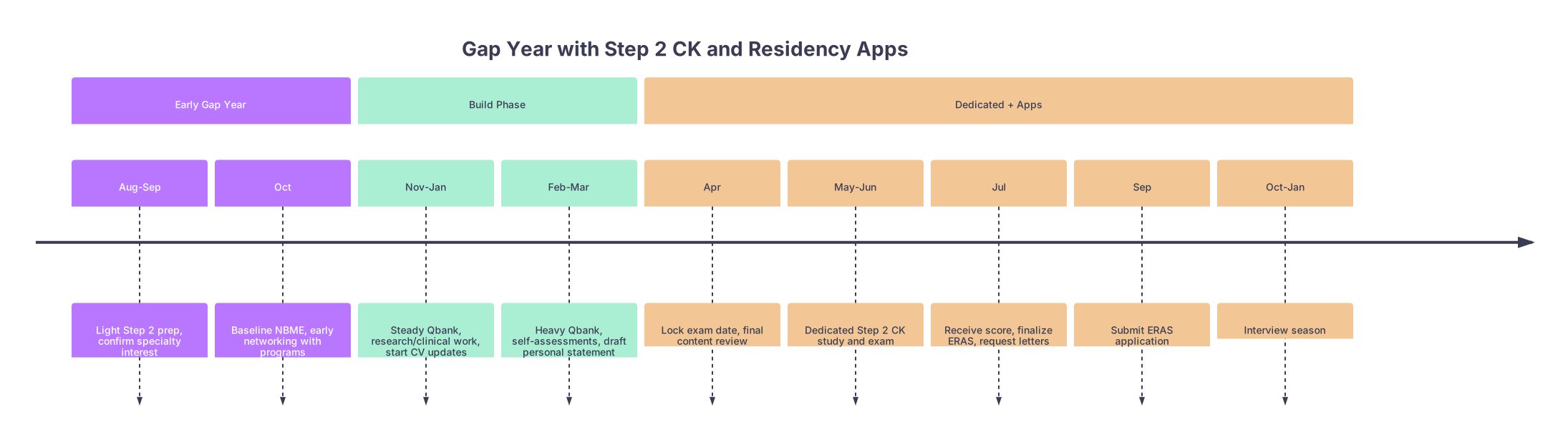
| Period | Event |
|---|---|
| Early Gap Year - Aug-Sep | Light Step 2 prep, confirm specialty interest |
| Early Gap Year - Oct | Baseline NBME, early networking with programs |
| Build Phase - Nov-Jan | Steady Qbank, research/clinical work, start CV updates |
| Build Phase - Feb-Mar | Heavy Qbank, self-assessments, draft personal statement |
| Dedicated + Apps - Apr | Lock exam date, final content review |
| Dedicated + Apps - May-Jun | Dedicated Step 2 CK study and exam |
| Dedicated + Apps - Jul | Receive score, finalize ERAS, request letters |
| Dedicated + Apps - Sep | Submit ERAS application |
| Dedicated + Apps - Oct-Jan | Interview season |
The key interaction points:
- Letters of Recommendation:
- During early gap year (Aug–Jan), at this point you should be:
- Doing something that will generate strong letters (research, clinical work, teaching)
- Asking attendings early once you’ve worked with them enough
- During early gap year (Aug–Jan), at this point you should be:
- Personal Statement & ERAS:
- Draft PS in Feb–Mar
- Refine June–July (post-Step 2)
- Using Step 2 CK strategically:
- If Step 1 is weak (or Pass but low preclinical performance):
- A strong early Step 2 CK score (May–June) can salvage your application
- If Step 1 is solid:
- You still want Step 2 by August to avoid the “awaiting score” question mark in filters
- If Step 1 is weak (or Pass but low preclinical performance):
Sample Weekly Templates (Gap Year Reality)
Here’s how this looks if you’re also working a real job (20–40 hrs).
Example: 30-hour Research Week, Pre-Dedicated (February)
At this point you should adopt something like:
- Mon:
- Research 9–5
- 40-question block + 1.5 hour review in the evening
- Tue:
- Research 9–3
- 40-question block + cards
- Wed:
- Research 9–5
- Off from studying or light Anki
- Thu:
- Research 9–3
- 40-question block + review
- Fri:
- Half day: 2 blocks (80 questions) + review
- Sat:
- 2–3 hours targeted content review
- Sun:
- NBME or off-day depending on your schedule
You’re not trying to be a hero daily. You’re trying to hit consistent weekly volume.
The Three Non-Negotiables
End this with clarity. If you remember nothing else:
Book the exam early in the application year, then work backward.
Mid-May to mid-June is the sweet spot for most gap-year applicants. Lock it, then build your phases around that date.Finish your primary Qbank before dedicated truly starts.
Dedicated is for sharpening and self-assessments, not plowing through 1,500 untouched questions while writing your personal statement.Use the gap year to avoid crunch, not to avoid work.
Light but consistent prep from August–January beats a panicked 4-week cram every single time. Your future self in interview season will thank you.


